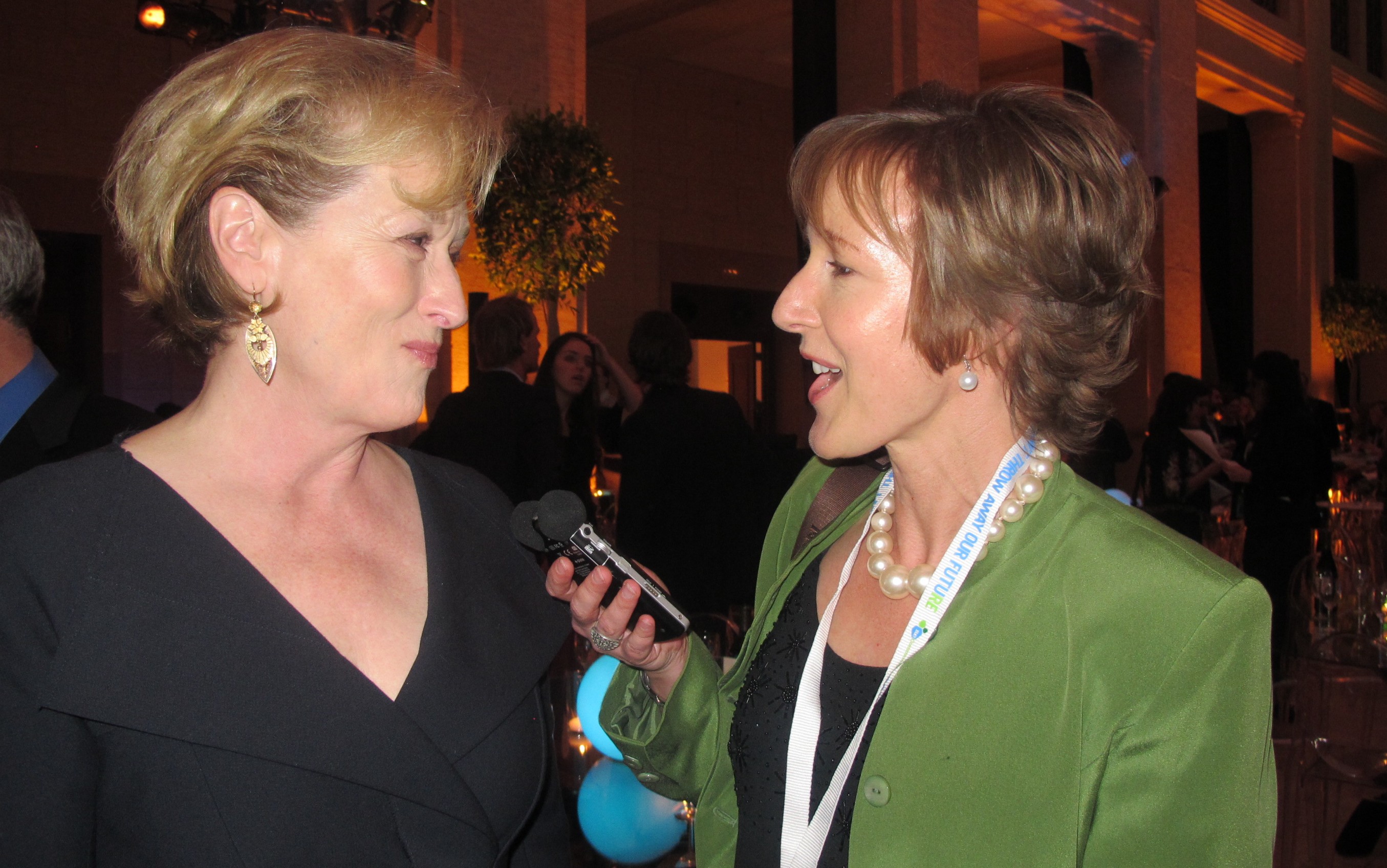
The first thing that strikes you about Meryl Streep is her grace and poise. Like a true royal, she glided into the throng of green designers and architects gathered at the Cradle to Cradle Products Innovation Institute Gala in San Francisco this week, completely unruffled by the crush of fans; the flash of cameras and smart phones; and the fierce security guards. Yet instantly, like a chameleon, Streep can switch from serene queen of the movies to cozy confidante. I found myself standing next to her and shook her hand. As you know, she’s renowned for her authentic accents in every exotic role she’s played, so I asked her, “Can you do a good Scottish accent?” She immediately leaned over and whispered in my ear, “I love the way they say murdererrrr!” Rolling those r’s as only a lass from Scotland – or Meryl Streep – can do. Then she laughed with that infectious burst of effervescence. Now that would make even The Iron Lady melt a wee bit.
But enough trivia. The best part is, I found her later that evening and she agreed to a Fresh Dialogues interview. We had a lively conversation about her green design guru and close friend William McDonough; and why she’s become an activist for the environment. Enjoy her hilarious tribute to McDonough below and check out the highlights of her interview…
Interview highlights
Why should we care for the environment?
We’re all part of the ecosystem. We’re all connected. You can’t go around in a bubble…
On why Bill McDonough inspires her
Unlike so many environmental messages which are negative: “don’t this…don’t that!” Bill approaches things in a positive, restorative, beneficial way…with a focus on abundance. His mantra is a beautiful thing: “Designing a safe, healthy and delightful world for the love of all children, for all species, for all time.”
He’s a fervent optimist. His cup is never half empty or even half full. It’s always full of water and air. We were both profoundly affected by similar things: Silent Spring (the book by Rachel Carson) and concern for the impact of toxins on children. He’s the consummate multi-tasker. He leaves me breathless.
On the roots of her environmental consciousness
It all goes back to being a mother. That’s the most invested relationship. You pay attention, perhaps for the first time. What is going in your child’s mouth? What’s her environment like? What will the future be?
In 1989 Streep cofounded “Mothers and Others” to raise awareness of toxic pesticides used in food production.
On how playing acclaimed chef, Julia Child influenced her green journey
We need to think about the provenance of our food. Where does it come from? Is it produced locally and with concern for the environment?
During her hilarious speech in San Francisco, Streep praised the work being done by Brad Pitt, William McDonough and Tom Darden through the Make it Right Foundationin New Orleans and beyond. The group began building green-designed houses for low income families displaced by Hurricane Katrina in 2008.
Does Streep consider herself a green activist?
In an interview with USA Today, she said, “We are all activists every day that we make a purchase. We vote daily with our credit cards; we demonstrate with our dollars.”
Today Streep helps raise awareness of toxins in food and the environment by supporting the work of the Children’s Health Environmental Coalition and is known to shop at Whole Foods and prefer locally produced goods. Her home in Connecticut is fueled by geothermal power.
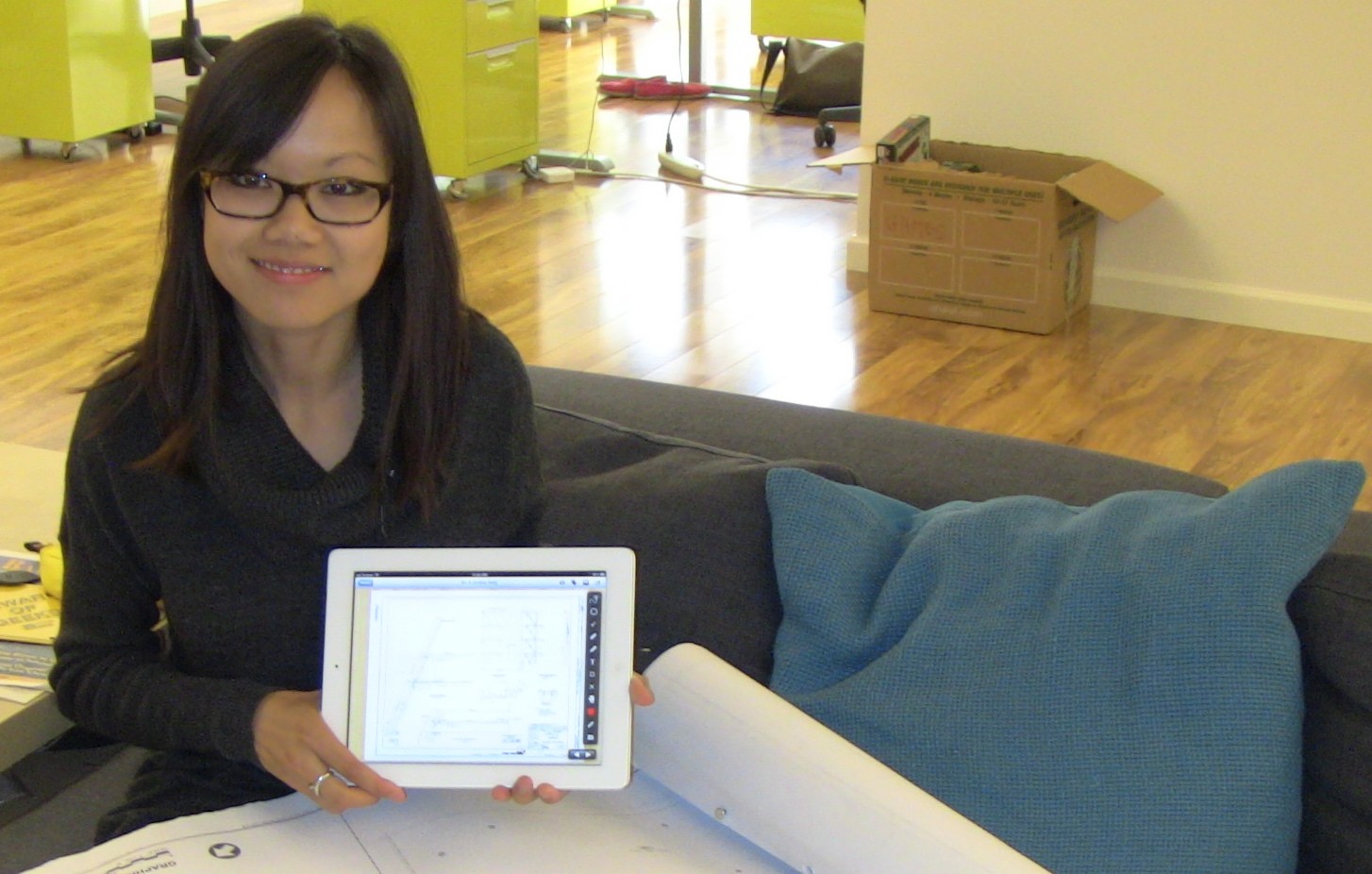
Last week, Fresh Dialogues visited PlanGrid, the recent Y Combinator startup winner that’s tackling what some call the “insane paper” problem that the construction industry produces. Computer-Aided Design (or CAD) works well as a green and efficient solution for the design phase, but once on the field, architects, site managers and construction supervisors still have to lug around giant reams of blueprints. Thirty year old CEO Ryan Sutton-Gee explains how he had a lightbulb moment when the iPad came out and COO Tracy Young demonstrates their solution. Using the cloud, PlanGrid can upload up to 60,000 blueprints to an iPad, and enable construction teams to edit, update, tag photos and instantly share information as construction progresses. Sutton-Gee likens the on-site photo tagging ability to Instagram, with automatic uploads allowing construction teams to verify time, date and location information at each stage in the construction.
Here are some highlights from my conversation with Sutton-Gee and Tracy Young:
On the Paper Problem
“Our estimate is that $4 Billion was spent in 2011 just on paper in construction alone, which is a ridiculous. It’s an insane about of paper. It’s an insane amount of trees.”
On the PlanGrid Solution
“There are the hard cost savings of reducing paper and then there are the soft cost savings of saving time and reducing rework. On several projects, we’ve reduced the paper consumption by 90%.” PlanGrid CEO Ryan Sutton-Gee
“You could fill up all of downtown San Francisco with paper – that’s how many trees we’re saving.” PlanGrid COO Tracy Young
On Silicon Valley
“We are being used by very large Silicon Valley companies – that everyone is familiar with – to build some of their office spaces. (Apple’s new campus perchance?) People in Silicon Valley are always up with tech. They’re the early adopters in everything, including us.”
On Y Combinator and Startup Advice
“It was really great with Y Combinator. The most important thing that took a while to realize is that it’s actually not that risky…Even if everything had gone totally wrong for us, at worse I would have spent six months working on something I was really passionate about…That was the opportunity cost… If you’re in an industry and there’s a huge problem and there’s a technically feasible solution…go for it!”
In June, Fresh Dialogues toured the Tesla Factory and last week we finally got behind the wheel of the finished product: a Model S Performance. It’s an impressive vehicle: sleek, stylish and powerful. Very powerful. The acceleration felt like a rocket. We took it 0-50 in about four seconds and thanks to its low center of gravity, it was easy to handle on the winding hill roads around Palo Alto. Going 60 plus on Highway 280 felt smooth and effortless. You gain speed so fast, it’s quite formidable, especially for this Toyota Prius driver. In the latest test drive, Motor Trends confirmed a 0-60 mph time of 3.9 seconds; faster than Tesla’s own specs of 4.4. That makes it the fastest American sedan.
I’d heard about the ‘sensitive’ accelerator pedal and wondered how it would be in the confined space of the Tesla HQ parking lot? But I found it easy to navigate and control both in forward and reverse gears. Backing into a parking space was a cinch thanks to the rear camera.
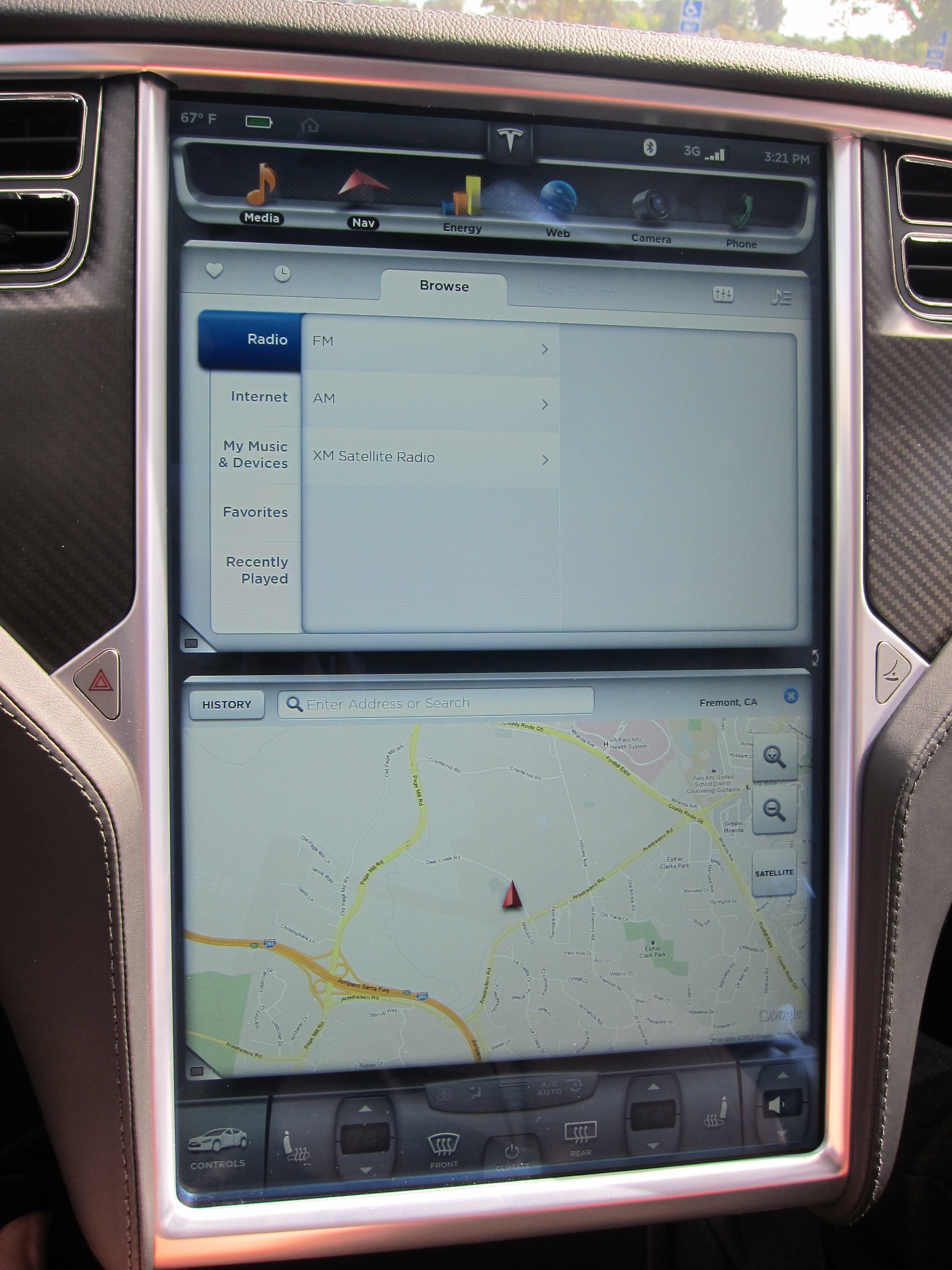
The massive 17-inch touch screen looked like it could be a major driving distraction, but having experienced its utility, I’m more appreciative. Glad to see that most functions can be controlled from the steering wheel, including the impressive sound system. Spinal Tap fans will be delighted to learn that the volume goes to eleven (really!); a spec no doubt dictated by Tesla product architect, Elon Musk with tongue firmly in cheek.
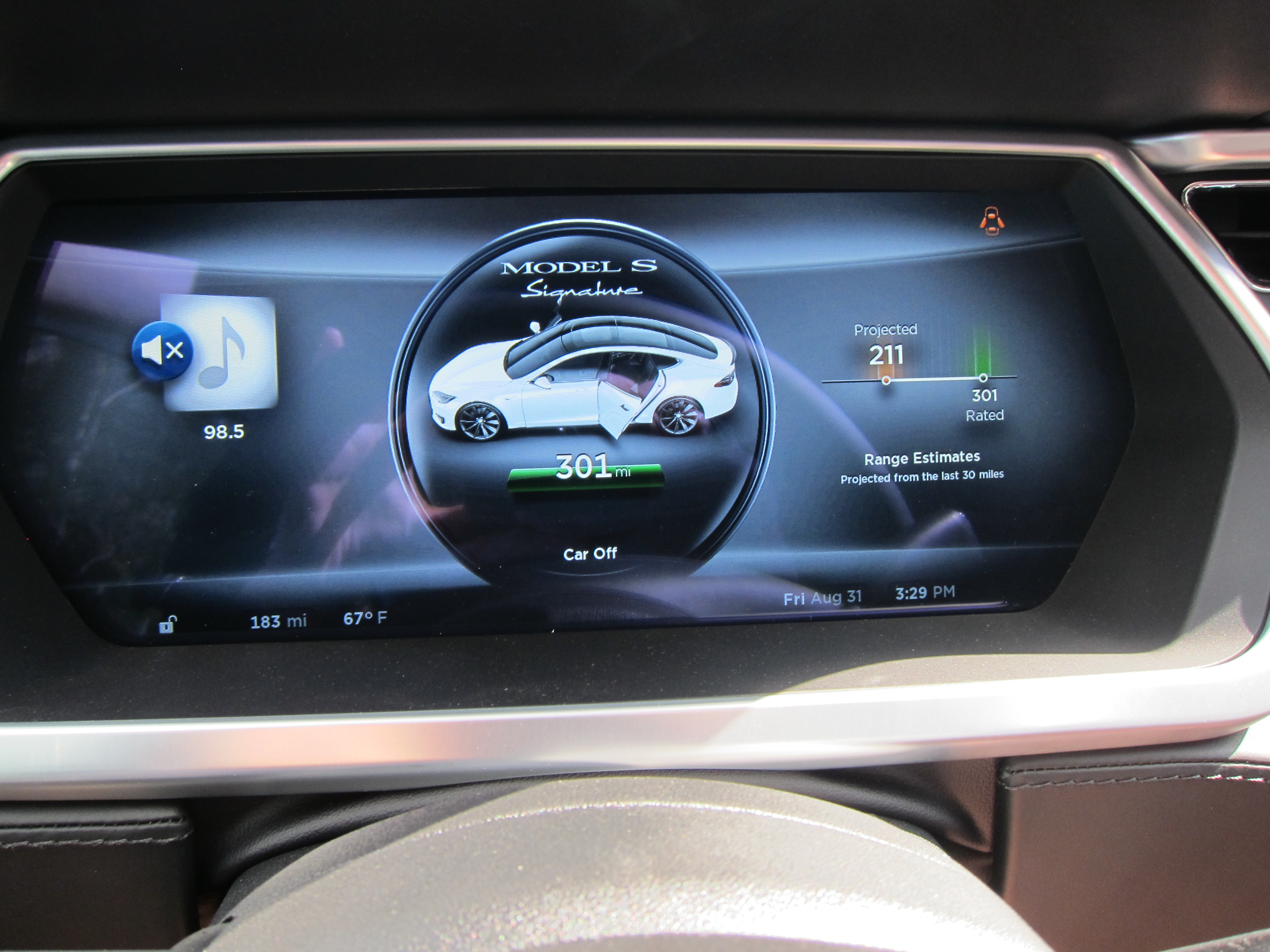
You can choose what appears on your dashboard: energy consumption, range, media, climate control, etc.
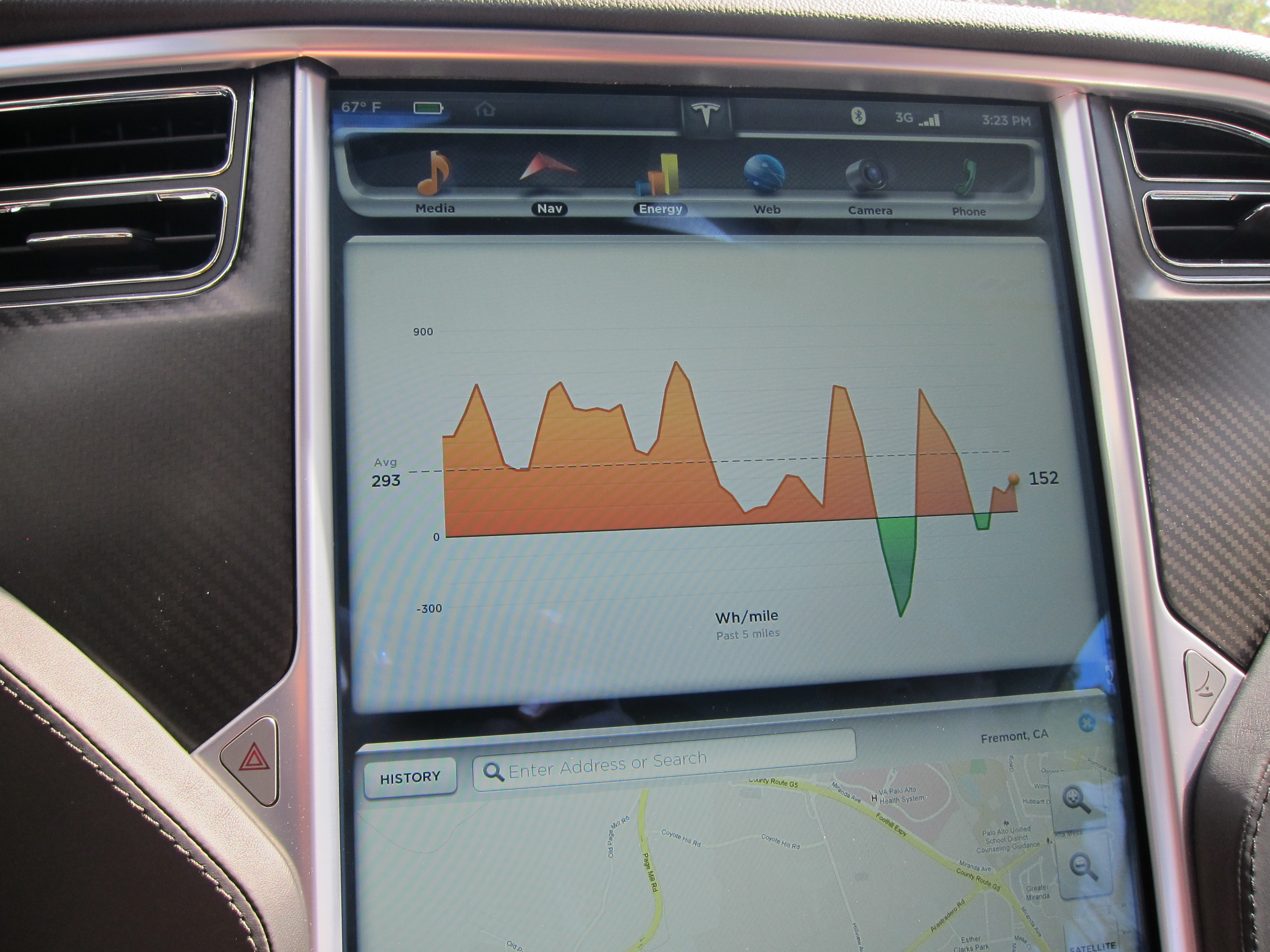
Tesla’s Christina Ra explained the energy charts and how the range is impacted by all that powerful acceleration.
The regenerative breaking was very noticeable (see green shading on graph). The second you take your foot off the accelerator, you feel it kicking in, giving you more control and increasing the range of the car. It’s rated 265 miles by the EPA, but the way we were driving, the projected range fell to 192. To get the maximum range, Tesla recommends an optimum speed of 55 mph, with the windows up and no A/C.
Two criticisms:
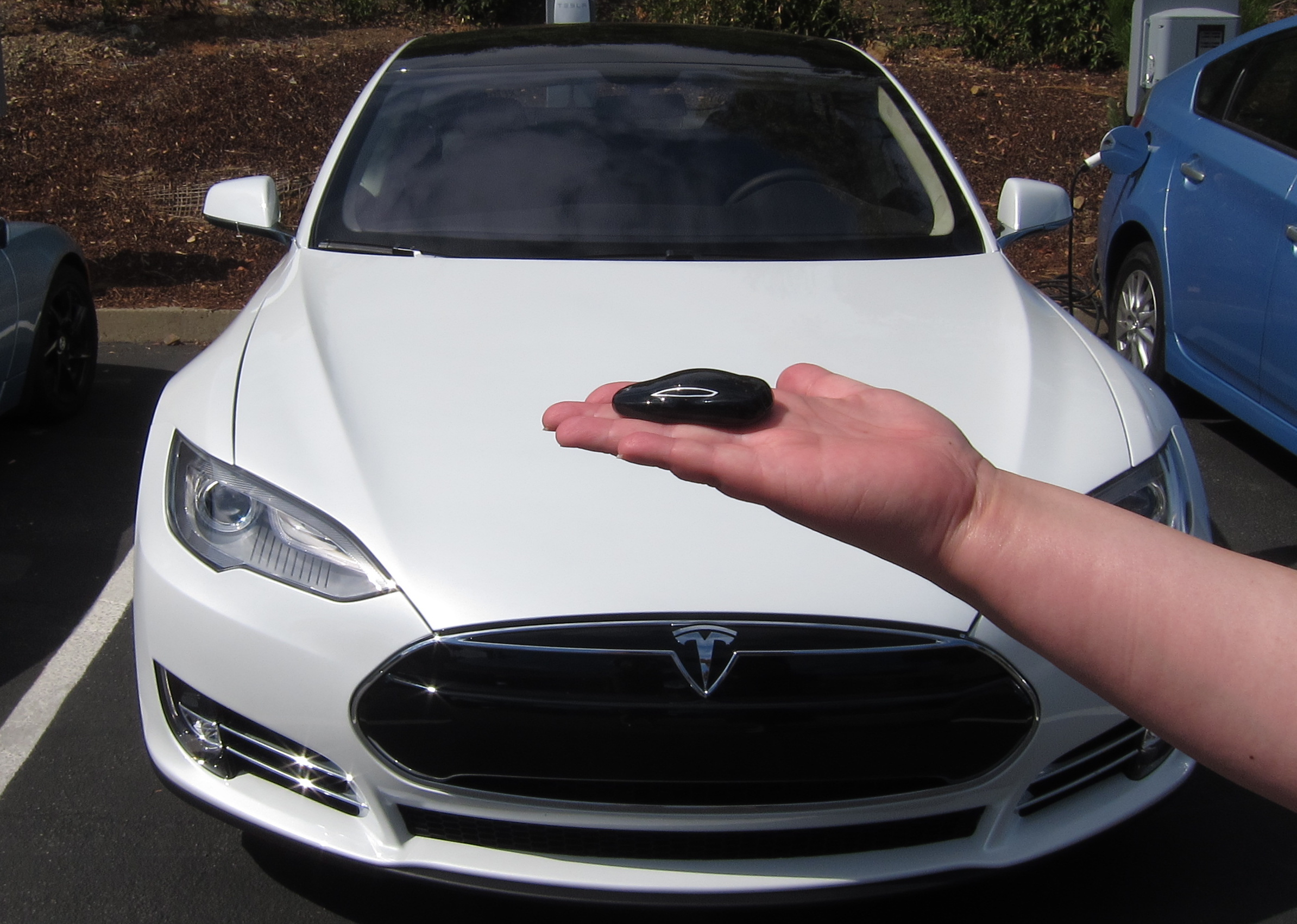
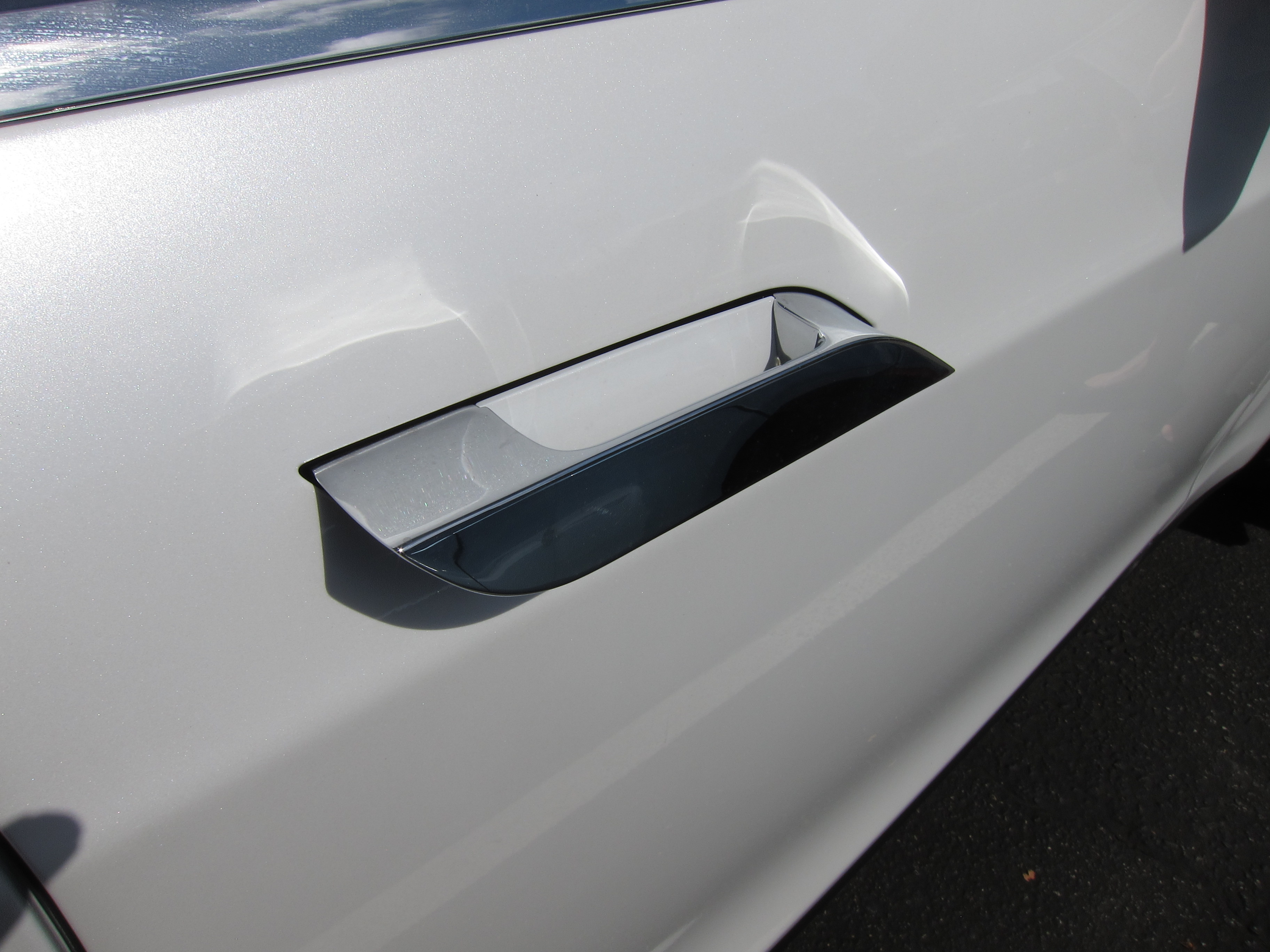
1. These snazzy door handles certainly look and act cool. Tesla Factory worker Charles Lambert said it best, they’re distinctive and sexy. According to reports, they’re not just eye candy, they actually improve the aerodynamics of the car. I understand they’re fitted with an anti-break-your-fingers release mechanism, but when I checked it out, the handle gave me a good finger squeeze – not in a good way. It stung. Maybe I’m extra sensitive, but I think Tesla should consider adjusting the specs, just a tad.
2. When you get in the car and sit down in the driver seat, the car switches on. Touch the foot break and the motor is on and ready to go. But when you stop, it feels disconcerting not to have an “off” button. Say you pull over to make a phone call… or enjoy the sunset? I’d be more comfortable knowing this super powerful motor is definitely off. And isn’t suddenly going to take off….
Overall though, a remarkable driving experience and a giant leap up from my beloved Toyota Prius. Made in Silicon Valley is definitely a plus.
Did you know that buildings account for almost 40 percent of total energy use in the U.S.; almost 40 percent of carbon dioxide emissions; and 12 percent of total water consumption? The climate friendly solution is “green building.”
But what does green building mean? And what is the future of green building? Phil Williams, VP of Webcor Builders sat down with Fresh Dialogues to answer these questions and explain how the venture capital and building sectors work together to deliver innovative green building products – like smart glass – that reduce energy consumption and environmental impact.
Here are some highlights of our conversation (edited for clarity and length):
What is green building?
“The term actually started here in San Francisco in the mid-1990s, and starts with a certification of a building under the LEED standard (Leadership in Energy and Environmental Design), developed by the US Green Building Council. We try to reduce the energy, the water, be responsible in the use of materials and create healthy interior environments.” Phil Williams
Why build green?
“There’s a high probability of climate change due to man’s impact; it’s seen as good business, it’s my energy bill today in terms of what is my overall cost of doing business.” Phil Williams
What should we expect from green building in the future?
It’s like a box of Cheerios…you’ve got some healthy products, you’ve got some less healthy products, some with sugar, some with fat. The consumer can now make a choice. When we didn’t know, the consumers were blind to the health or the energy consumption of a building. The marketplace will determine what happens, but now the information will be available.” Phil Williams
How do new green building products get in the supply chain?
“We work closely with several venture capital firms that are specifically focused in the built environment, and we have a strong engineering background…We can be part of that next breed of product…we have that advantageous viewpoint that we can lend to our clients and we can help those new innovative firms get a foothold in a very competitive industry. Any insight that we can provide benefits everyone.” Phil Williams
Webcor is sponsoring a four part interview series all about Green Building. Check back soon for more details.
Meantime, you can check out other green building interviews and stories by clicking here or on the Green Building Tab above.
Tesla Motors released its first batch of all electric Model S sedans today. The cars are actually built – not just assembled – at the Tesla Factory in high priced Silicon Valley. The company’s CEO, Elon Musk, says he’s creating “the greatest car company of the 21st Century,” yet despite the hoopla, Tesla is one of the most shorted stocks on the Nasdaq. Will this ambitious entrepreneur – who led the successful SpaceX mission to the international space station last month – prove detractors wrong again?
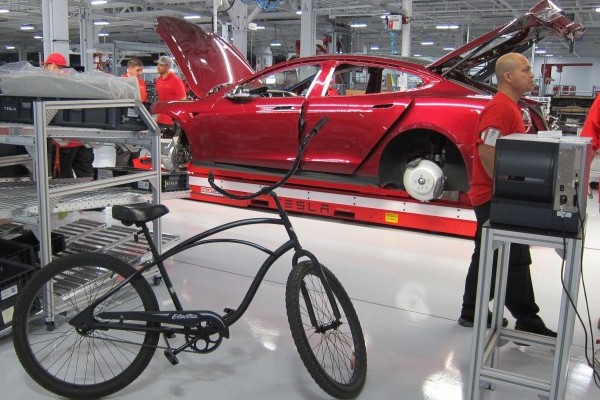
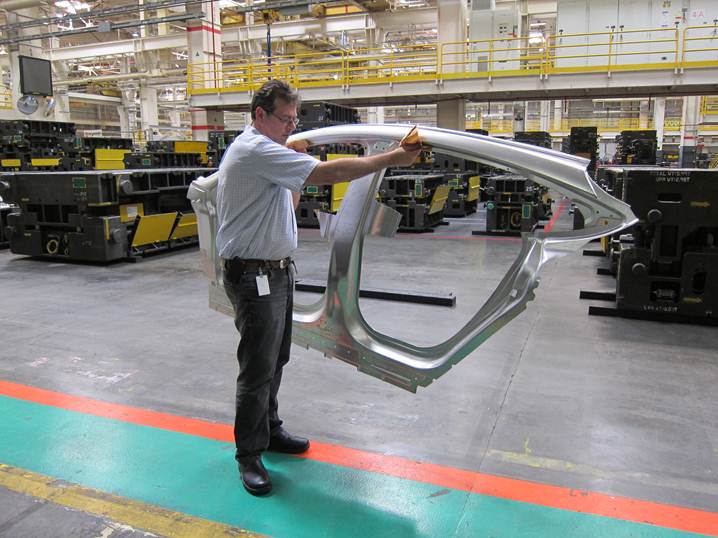
I visited the factory on June 14 and Gilbert Passin, VP of Manufacturing at Tesla gave me a fascinating two hour tour. He explained the process of making a Model S, from the stamping shop, where huge hydraulic press machines stamp sheets of aluminum into 3-dimensional fenders, hood panels, doors, and roofs; to the quality testing where the paint work is meticulously checked and recycled water is used to test each model’s watertightness.
At the stamping shop, Passin says, “These parts are extremely critical because it’s like the foundation of what makes a good car…See the robot is actually picking up the part in slow motion to make sure that everything works well…you don’t want anything to break.”
Shiny red robots and red T-shirt clad employees work hard at the factory: stamping, assembling, welding, painting and testing. The release of the first ten Model S Sedans is a big milestone for this innovative company. We talk to Charles James Lambert, who is a team leader working on the stylish and unique door handles Tesla manufactures at the factory. “I’m building a door handle that’s going on something fabulous to me: the model S…so sexy to me, the car, right?” he says. “That we have a door handle that responds. It’s pure elegance to me.”
Steve Jurvetson, a Tesla board member, snagged the very first prelaunch Model S (Elon Musk had to wait for number 2) and raves about it with the wide-eyed glee of a teenager describing his first set of wheels. “It’s kind of like driving in a hyper space portal to the future…” says Jurvetson.
Yet this futuristic car, that accelerates 0-60 in 4.4 seconds, does so in a whisper, not a roar. Jurvetson argues that silent is better. “It’s like saying I sleep better when there’s industrial noise going on outside my house, really?” he says and suggests that for drivers who miss the roar of an internal combustion engine, downloadable sounds might be the answer… “People can make it sound like whatever you want. You know, Harley Davidson: “huff pwuffpwuff pwuff.” Fine…just dial it up…blast your ears out…who cares?” he says.
Jurvetson, a Silicon Valley venture capitalist, sincerely believes that all vehicles will be electric one day and Tesla will lead the way. “I love what it represents: emblem of the future and a symbolic step towards a oil-free economy.”
The Model S is phase two of Elon Musk’s masterplan to disrupt the car industry and create efficient sustainable transportation. In 2008, Tesla released the Roadster, a high-end electric sports car priced at over$100,000. With the Model S, Tesla has made a more affordable car, and a year or two after its Model X comes out in 2013, aims to produce a 3rd generation model for $30,000. An electric car “for the masses.” Tesla has already catalyzed an industry shift. Today most major car companies are releasing electric or hybrid models. “Even some of the biggest competitors – the gas burning giants of the past – have admitted that they kicked off their electric vehicle program because they saw what Tesla did,” says Jurvetson. “Management said: this little company in CA is doing it, why can’t we?”
Tesla may be a trailblazer, but it faces a bumpy road ahead. Those shorting the stock (betting that the stock will fall in value on the Nasdaq) have a bearish reaction to Tesla’s high debt levels, tough competition and uncertain prospects for mass-market adoption. But it’s more than just the scrappy startup -the Millennium Falcon (Star Wars)- against the Empire (GM, Ford et al). Damon Lavrinc, Transportation Editor for Wired Magazine explains, “The established players don’t like to be challenged on their own home surf.”
He argues that to succeed, Tesla must address both range anxiety and charging time challenges. Price is also an issue. The 150-mile range car may have a base price of $50,000 after federal rebates. But for the fully loaded 300-mile range model, you’ll pay closer to $100,000. California buyers also get a state rebate ($2500) plus those precious carpool stickers. “Once we can get that price of entry lower, once we can get that battery capacity larger, that’s when it’s really going to take off,” says Damon Lavrinc. So far, Tesla has 10,000 reservations for the Model S and will deliver about half this year, ramping up to 20,000 in 2013, if the orders continue to come.
Experts compare it to the BMW 5 Series, but Tesla’s VP of Manufacturing explains its edge. “We’ll change the world by bringing a product that’s extremely efficient, very clean for theplanet, extremely fast, extremely comfortable…extremely beautiful,” says Passin. But Tesla has to get it right the first time, there’s no room for error.
Back in the Tesla Factory, at the end of our tour, Passin explains, “The car has to be finished, has to be perfect, the people working here know this is the end of the line, so it has to be good.” Although these challenges seem formidable, Elon Musk is attacking them like a true tech superhero, channeling the wild ambition of Steve Jobs and his obsessive search for perfection. Musk reportedly works 80-90 hours a week, splitting his time between Tesla and his space exploration company, SpaceX. Elon Musk was reportedly the inspiration for the Iron Man movies. “He may have superpowers, I don’t know,” says Passin, chuckling.
Last month, Musk proved naysayers wrong with his historic SpaceX Mission to the international space station. Can he do the same for the Electric Vehicle market? So much depends upon the successful launch of the Model S sedan. Damon Lavrinc of Wired Magazine sums up what’s at stake: “It’s not just so much a make or break it for Tesla, it is very much a make or break it for the entire electric vehicle industry.”