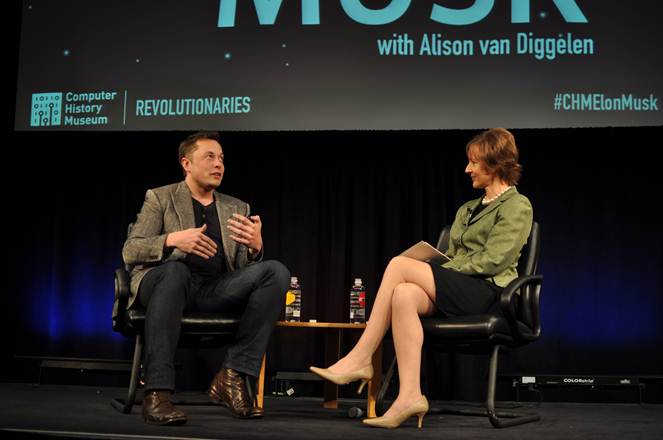
During my January interview with Elon Musk, we got a glimpse inside the mind of this revolutionary entrepreneur. We explored his inspiration for disruptive startups like SpaceX, Tesla Motors and SolarCity; and he gave some advice on how to build, motivate and retain excellent teams; as well as some warnings about the hazards of over-committing and sleep deprivation.
He told me, “I really didn’t want to be CEO of two startups at the same time. It was not appealing. And shouldn’t be appealing by the way, if anyone is thinking that’s a good idea. It’s a terrible idea.”
On how to build, motivate and retain an excellent team (@1.05.00 on video)
“A company is a group of people that are organized to create a product or service. That’s what a company is. So in order to create such a thing, you have to convince others to join you in your effort and so they have to be convinced that it’s a sensible thing, that basically there’s a some reasonable chance of success and if there is success, the reward will be commensurate with the effort involved. And so I think that’s it…getting people to believe in what you’re doing – and in you – is important.”
“In the beginning there will be few people who believe in you or in what you’re doing but then over time, as you make progress, the evidence will build and more and more people will believe in what you’re doing. So, I think it’s a good idea when creating a company to create…to have a demonstration or if it’s a product to have a good mark up or even if it’s software to have good demoware, or to be able to sketch something so people can really envision what’s it’s about. Try to get to that point as soon as possible. And then iterate to make it as real as possible, as fast as possible. I think that makes sense.”
On time management and sleep
“Sleep is really great. I find if I don’t get enough sleep then I’m quite grumpy. Obviously, I think most people are that way. And also I try to figure out what’s the right amount of sleep, because I find I can drop below a certain threshold in sleep and although I’d be awake more hours and I could sustain it, I would get less done…my mental acuity would be affected. So I found generally, the right number for me is around six to six and a half hours on average per night.”
“Having a smart phone is incredibly helpful because that means you can do email during interstitial periods, like if you’re in a car (he has a driver), you’re walking, in the bathroom, everywhere. You can do email practically when you’re awake and so that’s really helpful: to have email for SpaceX, and Tesla integrated on my phone. And then you have to apply a lot of hours to actual working.”
On where his inspiration strikes (hint: not just Burning Man)
“It’s kind of a cliche, but it happens a lot in the shower…I don’t know what it is about showers (laughter)…I kind of stand there in the (long) shower and…not to mention the burning man epiphanies. Those are huge…There are some times. like late at night if I think about something and I can’t sleep and I’ll be up for several hours, sort of pacing around the house, thinking about things and occasionally I’ll sketch something or send myself an email or something like that.”
On keeping it in the family (Musk has five sons, all under 9)
“I do drag them along on a lot of things…they’re remarkably unimpressed. I wish they were more interested…maybe they’ll get more interested later. If they’re really interested in working at Tesla or SpaceX then I’d help them do that. I’m not sure I’d necessarily want to insert them into the CEO role at some point. If the rest of the team and the board felt that they were the right person then that would be fine but I wouldn’t want people to feel that I’d installed my kid there. I don’t think that would be good for the company or the kid really.”
“I was of the school of thought that it’s best to give away 99% or more of one’s assets, the Buffet School of thought. I’m mostly inclined in that direction, but after seeing what happened with Ford, GM and Chrysler, where GM and Chrysler went bankrupt and Ford did not, and Ford seemed to make better long term choices…in part because of the influence of the Ford family, I thought, well OK, there may be some merit in having some longer term family ownership. At least a portion of it. It acts as a positive influence…in the long term interest of the company…so the company does proper long term things. Look at what happened also in Silicon Valley with Hewlett Packard. It’s quite sad. That to some degree is because there was much diminished influence by the Hewlett and Packard families. I think they should have prevailed…when they were opposed to the merger that took place at one point. I think they were right, actually.”
On the likelihood of a SpaceX IPO this year
“No, there’s no IPO planned. I must say, running a public company does have its drawbacks. In the case of Tesla and Solarcity …we had to raise capital and we had a kind of complex equity structure that needed to be resolved by going public. So I thought we kind of needed to do that in those two cases. We don’t have to do that at SpaceX. I think there’s a good chance we will at some point in the future, but SpaceX’s objectives are super longterm and the market is not. So I’m a bit worried that if we did go public, certainly if we went public too soon, that the market pressure would force us to do short term things and abandon longterm projects…(like) going to Mars is very longterm.”
On the Hyperloop
“I did promise that I’d do some paper on the Hyperloop idea and things got a little hectic toward the end of last year because I’d committed to make these milestones at Tesla to the public market and I had to stay true to that obligation, which required an insane level of work and attention.” Check back soon at Fresh Dialogues for updates on the Hyperloop.
On how the SolarCity IPO got done, “by the skin of its teeth”
Elon Musk: “(It) was a very difficult IPO to get done. That IPO occurred just by the skin of its teeth. It was such a tough one…If it wasn’t in December, it would mean pushing it out quite a bit and the problem is, we’d already pushed it out quite a bit. So if we didn’t go public, we’d have to do a private round and then…the whole thing wouldn’t feel right. It’s like you’re sitting at the altar, and you don’t do the wedding. It’s a bit awkward. So we really needed to do it and I think if we hadn’t done it, people would have looked at it as a failure. It wouldn’t have been good. There have just been too many failures…not enough success, let’s say, in the solar arena. We need to chalk up success…”
Alison van Diggelen: “It was a rare piece of sunshine for the solar industry last year…”
Elon Musk: “Right. Exactly. Ironically for the solar industry doesn’t have a lot of that.”
On why Musk wants to go to Mars before he’s ‘too old’
“I guess I’d like to be able to go to Mars while I’m still able to manage the journey reasonably well. I don’t want to be like 75 and go to Mars…It could be mildly arduous…I’d like to get there ideally in my 50’s. That would be kind of cool. I aspire to make that happen, and I can see the potential for that happening. I’m not saying it will happen, but I think it can happen…I’ll try to make it happen.”
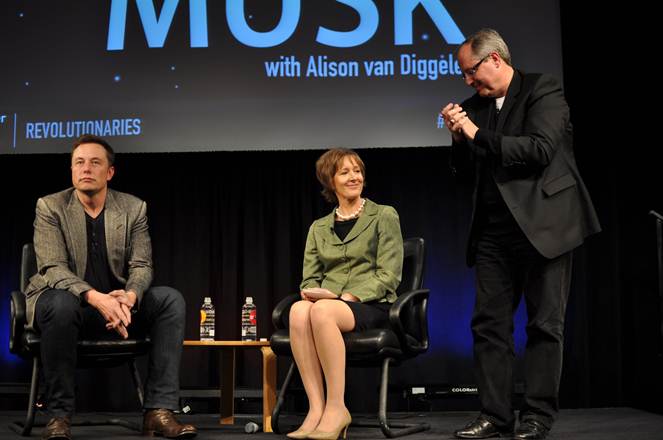
Last night Elon Musk, CEO of SpaceX and Tesla Motors joined me in conversation for the Revolutionaries Series at the Computer History Museum in Silicon Valley. We explored his journey from South Africa to Silicon Valley and beyond and he was exceptionally candid about his entrepreneurial highs and lows. He also shared a fascinating glimpse into the future…flying cars, hyperloops and Mars, oh my! His eyes welled up as he spoke with deep emotion about Neil Armstrong, the need for space exploration and the impassioned vigils after the death of the EV1. But he also displayed a great sense of humor throughout the interview. Did you know he plans to die on Mars? Just not on impact.
.
Here is the transcript of our conversation:
Here’s the podcast from KQED:
On the chances of a SpaceX IPO this year
Not likely. Elon explained that he’s not in a hurry to make SpaceX a public company because the short term desires of shareholders would conflict with the company’s longer term goals (which included manned space flights to Mars).
On flying cars
He anticipates the production of flying cars in the near future (and he wasn’t talking about the acceleration of Tesla’s Model S). In response to my question: will it be an Elon Musk production? he demurred. But when I asked, is someone going to do it? He replied: someone *is* doing it.
On the inspiration for Tesla Motors
Musk had the audience roaring with laughter when we discussed the wailing and gnashing of teeth that occurred after the forced recall of the EV1. He said, “How often do customers have candlelight vigils for the end of life of a product? Especially a GM product?”
On being an entrepreneur @38.0 on video
Remember that failure is the most likely outcome. Only do it, if you’re compelled to do it and are willing to eat glass and stare into the abyss.
“If you don’t eat glass you are not going to be successful,” Elon Musk
On the importance of sleep
Musk recommends getting a good night’s sleep, as you’ll be more productive. Despite running two companies and having five children, he averages 6 hours a night. Less than that and he admits to getting grumpy and achieving much less.
On the environment @55.0-1.00.00 on video
He says putting hydrocarbons into the atmosphere is “the world’s dumbest experiment“…We’re playing a lethal game of Russian roulette with the atmosphere and every year, we’re adding another bullet.
The hour long interview will appear on the Computer History Museum YouTube channel next week and air on KQED TV in April. Check back soon for more photos and more details on inspiration, innovation and SolarCity. Check out #CHMElonMusk on Twitter for more audience reaction.
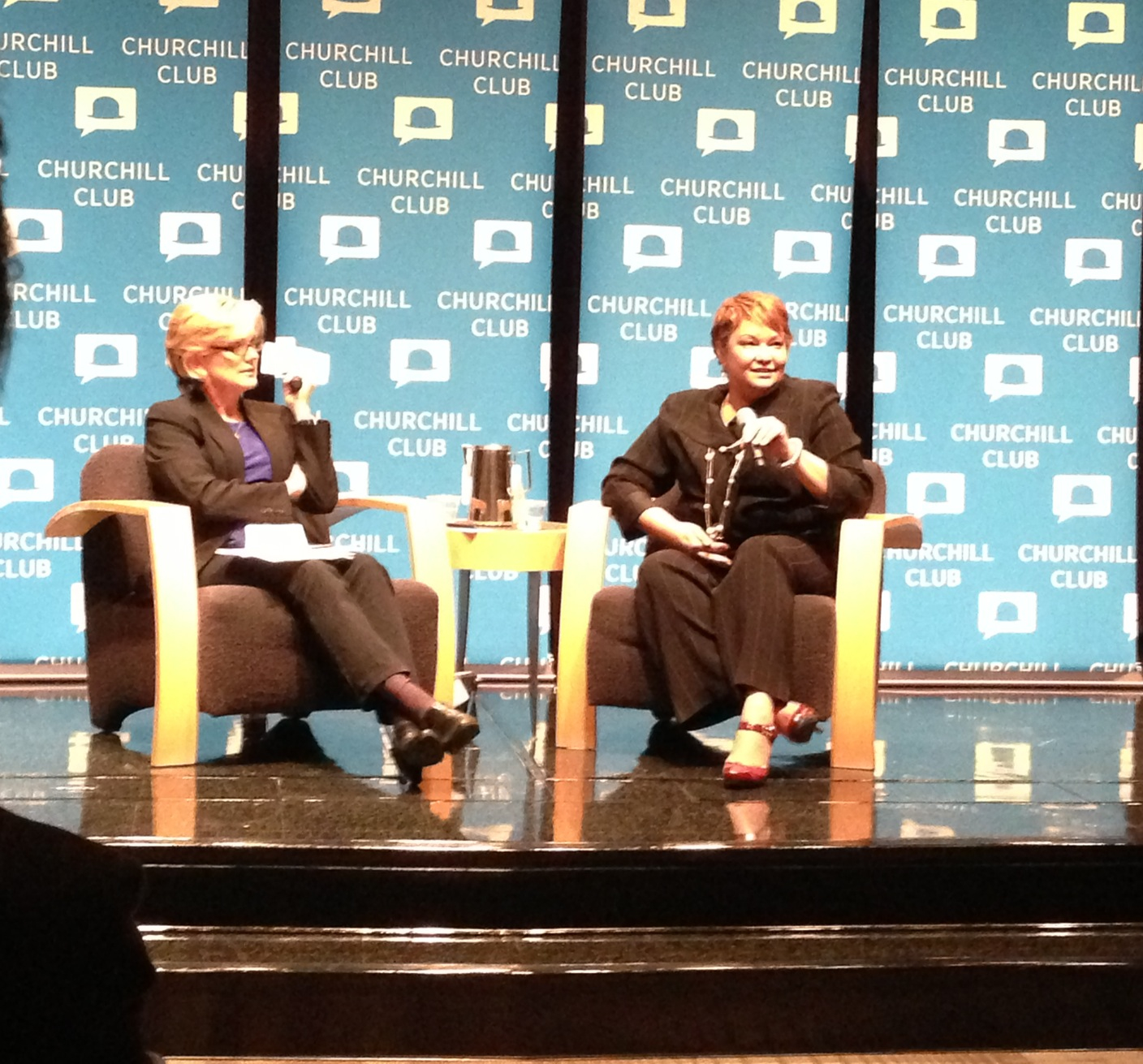
Environmental policy was front and center Tuesday evening at the Churchill Club in Silicon Valley as EPA Administrator, Lisa Jackson took the stage with former Michigan Governor, Jennifer Granholm. Fracking and the proposed Keystone pipeline were hot topics during the lively discussion.
In December, Jackson announced that she will leave her post after four tumultuous years in DC and didn’t rule out running for elected office. Speculation is rife about her running for Governor of New Jersey.
On Fracking
“It can and should be done safely..I’m enough of a scientist to say: the verdict is not in yet. We need more data.”
On the Keystone Pipeline
“I will be gone (from the EPA) before a decision is made. A revised environmental impact study will be done, then public feedback, then President Obama will decide ‘if it’s in the national interest’. This will take into account pollution, groundwater, and the economic perspective. It’s too soon in the process to say (if it will get the green light).
A Price on Carbon?
“The current climate doesn’t lead me to believe there will be a national law soon. But that doesn’t preclude state action (such as California’s), and the private sector, where important progress can be made.”
Jennifer Granholm, who was a strong advocate for cleantech during her eight year tenure as Governor of Michigan added, “The Federal Government could offer a pot of money to incentives states to take action and stimulate progress from the bottom up.” She likened her idea to the “Race to the Top” program for education.
On Green Innovation and the Role of the EPA
“The EPA can level the playing field by setting emissions standards and goals which stimulate the private sector to compete and beat them. It often costs less than EPA estimates, due to private sector innovation. But the private sector needs uniform and not patchwork standards…”
“The EPA works for all the American people, not special interests…it’s not a zero sum game. For it to succeed no one needs to lose. There are win/win strategies. Regulations need to be enforced. The work we do is vital and sacred.”
On Science and Climate Change
“I am a scientist and at the EPA we have more scientists than any other Federal agency except NASA…We face a roll-back in the Clean Air Act. Be aware that consensus is enough – unanimity is not required or you’ll miss the window for action.”
There was a vocal climate change skeptic in the audience whom Jackson addressed directly saying he wasn’t representative of the majority of Americans.
On her Greatest Achievements at the EPA
“The endangerment finding made pollution actionable…and we raised fuel efficiency standards.”
As Dana Hull explains in the Mercury News, during Jackson’s tenure, the EPA finalized its endangerment finding which authorizes it to take reasonable efforts to reduce greenhouse gases.
The event was hosted at the Microsoft Campus in Mountain View by Rob Bernard, the company’s green czar.
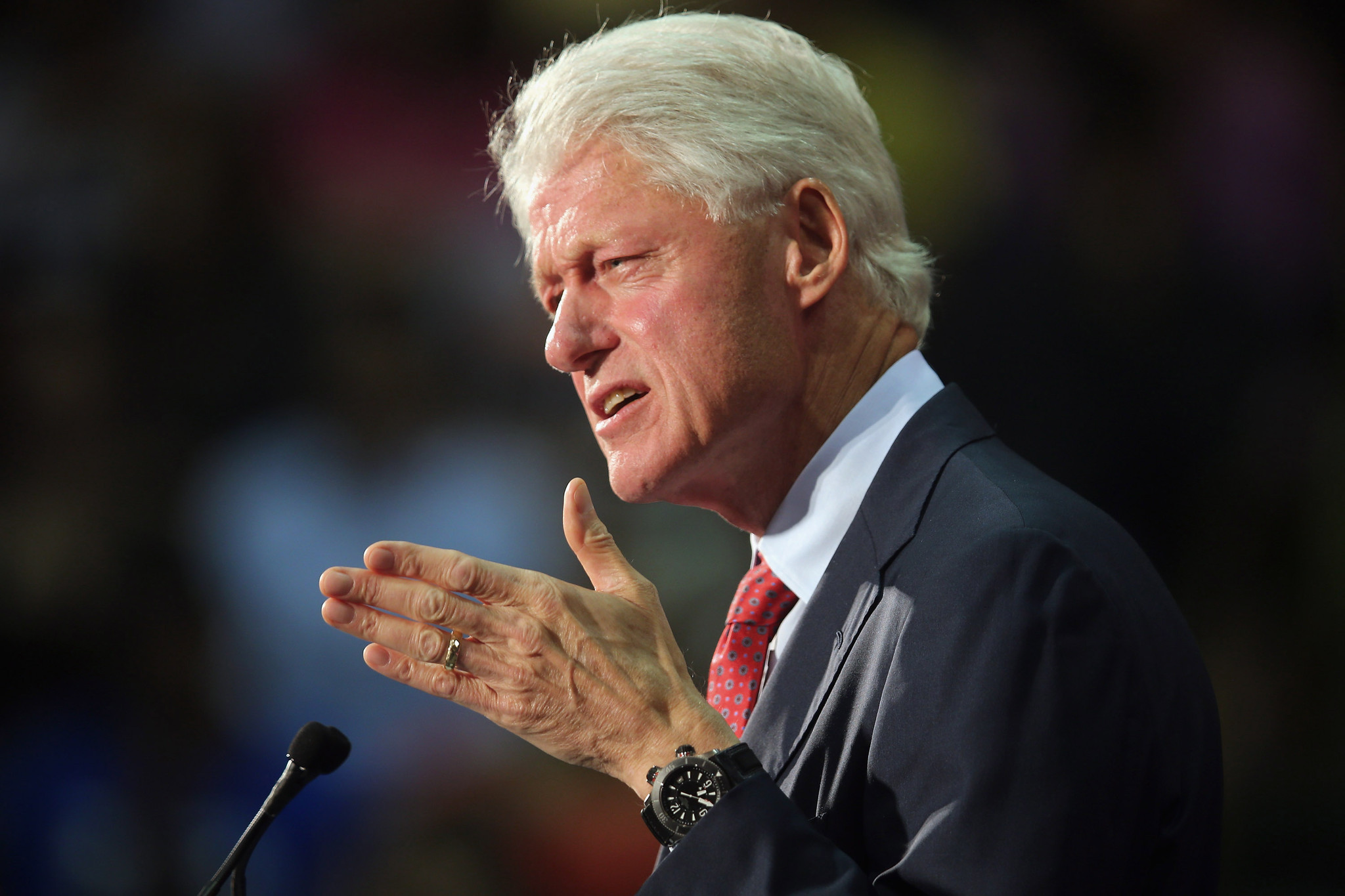
On December 7, President Bill Clinton appeared at Celebrity Forum in Silicon Valley and talked at length about climate change, referring to Berkeley scientist Dr. Richard Muller as “a hero of mine.”
You may recall Dr. Muller, the self described “former skeptic” who frequently emphasized the fallibility of research on global warming and was funded by the Koch Foundation. But last summer, after thorough research with the Berkeley Earth project, he announced his dramatic conversion in an Op-Ed in the New York Times. He now concludes that global warming is happening, and that humans are essentially responsible for all of the warming in the last 250 years.
I happened to be sitting next to Dr. Muller last week, and although he was whisked backstage by some big secret service staffers after Clinton’s speech, he agreed to answer a few Fresh Dialogues questions by email about his research and how he feels about hero worship by number 42.
You might be surprised to learn three things about Dr. Muller:
1. He says Hurricane Sandy cannot be attributed to climate change.
2. He suggests individually reducing our carbon footprint is pointless – we need to “think globally and act globally” and encourage the switch from coal to gas power in China and developing nations. He’s a fan of “clean fracking.”
3. He says climate skeptics deserve our respect, not our ridicule.
Muller hopes that Berkeley Earth will be able to coordinate with the Clinton Foundation on their mutual goal of mitigating global warming.
Here’s our interview: (it also appears at the Huffington Post, together with a lively debate)
.
van Diggelen: You wrote in the New York Times that the Berkeley Earth analysis will help settle the scientific debate regarding global warming and its human causes – how so?
Muller: Science is that small realm of knowledge on which we can expect and obtain agreement. I felt that many of the skeptics had raised legitimate issues. They are deserving of respect, not the kind of ridicule they have been subjected to. We have addressed the scientific issues in the most direct and objective way, and just as I have adjusted my conclusions, I expect that many of them will too.
van Diggelen: Regarding the human cause of global warming, you say that your conclusions are stronger than that of the Intergovernmental Panel. You concluded “essentially all of this increase in temperature results from the human emission of greenhouse gases.” The panel said “most of the warming.” Why is this significant?
Muller: The IPCC said “most of the warming” (meaning 51% or more) for the past 50 years. They could not rule out an important role from solar variability. We say essentially all of the warming of the past 250 years. Our analysis allows us to make a better prediction for the future since it does not have confusion from a solar component.
van Diggelen: What’s your message to climate change skeptics?
Muller: Most of your skepticism is still valid. When something extraordinary happens in weather, such as the accidental occurrence of Hurricane Sandy hitting New Jersey and New York City just at the peak of tides — many people attribute the event to “Climate Change.” That’s not a scientific conclusion, and it is almost certainly wrong. Hurricanes are not increasing due to human causes (actually, they have been decreasing over the past 250 years). Tornadoes are not increasing due to human causes. (They too have been decreasing.) So please continue to be skeptical about most of the exaggerations you will continue to hear! Proper skepticism is at the heart of science, and attempts to suppress such skepticism represent the true anti-science movement.
However, we have closely examined the evidence for temperature rise, and there are several conclusions that are now strongly based on science. The temperature of the Earth has been rising in a way that closely matches the rise in carbon dioxide. The history of solar activity does not match the data at all. Based on this, the human cause for this warming is strongly indicated. Read our Berkeley Earth papers and see if your objections are answered. I believe that the key objections have all been addressed. Based on this, you should consider changing your skepticism on global warming, even if you are properly skeptical about all the claims that are lumped together under the rubric of “climate change.”
van Diggelen: You’ve said that the difficult part is agreeing what can and should be done about climate change…any suggestions?
We need to recognize that the greatest contributors to climate change in the coming decades will be China, India, and the developing world. Thus any solution must be focused on realistic actions that they can take. The Clinton Foundation is doing wonderful work on energy efficiency and energy conservation, and working closely on this with the developing world. The only other action that we can take that could be equally important over the next 20 to 30 years is to help them switch from coal to natural gas. (For the same energy delivered, cleanly-produced gas creates only half to one third of the greenhouse emissions.) This was the subject of my WSJ Op Ed with Mitch Daniels. It is also discussed in detail in my new book “Energy for Future Presidents.”
van Diggelen: What are YOU doing to reduce your carbon footprint?
Muller: I am trying to get people to stop asking that question! It is very misleading. This is a problem in which we need to think global and act global (NOT local!) Reducing our own footprint, if it is done in a way that will not influence China and the developing world, is not a worthwhile action. It may make us feel good, and then in the future after the world has warmed (because our actions were not something that China could afford to copy) we’ll be saying “at least it wasn’t MY fault.” Wrong! We need to be acting to help China and the emerging economies. Focusing on ourselves at home is a way of avoiding coming to terms with the problem.
van Diggelen: What should others be doing? If you could have President Obama’s ear for 5 minutes, what would you say?
Muller: Double (or more) our efforts to help China become more energy efficient. And equally important: develop “clean fracking” standards. Work with China to expedite and accelerate their switch from coal to natural gas. Devise market-based approaches that will guarantee that the developing world will apply clean methods to their natural gas production. Show leadership by approving a US move to nuclear power; reverse your unfortunate canceling of the Yucca Mountain waste storage facility. In the US emphasize technologies that can work in China (e.g. natural gas), not those that are too expensive (e.g. autos with costly lithium-ion batteries).
van Diggelen: Just how urgently is action needed on climate change?
Muller: We need to act, but no need to panic. I see no tipping points that are scientifically valid. Of course, we don’t understand the atmosphere and biosphere well enough to be sure. Rather than speed of action, the key parameter is finding solutions that are profitable — because those are the ones most likely to be applicable to the poorer nations.
van Diggelen: How do you explain Hurricane Sandy? Some scientists say it was exacerbated by climate change? Warmer oceans, more evaporation? Higher sea level swells?
Muller: None of the above. Hurricane Sandy was a freak storm that happened because a relatively small hurricane (it wasn’t even a category 1 storm when it hit New York City) veered towards the coast during a very high tide. None of the causes of the damage can be attributed in a scientific manner to climate change.
The word “scientific” in that last sentence is very important. Many of the critics of the skeptics claimed that the skeptics were not being scientific. Yet that is also true of the alarmists. There is an unfortunate tendency, when the issue is very important (as in climate change) to abandon science and work from gut feelings. No, that is a mistake; when the issue is important, then it is most urgent that we stick to our science! We must be objective!
Hurricane Sandy cannot be attributed to global warming. The rise over the oceans, in the last 50 years, has been about 0.5 degree C. That’s tiny! In those 50 years, sea level rose by 4 inches. So the high tide, if not for global warming, would not have been 14 feet but “only” 13 feet 8 inches. There was a similarly severe storm in 1938 (my parents lived through it out on Long Island). We should stop attributing all freak storms to climate change. This is an important issue, so let’s emphasize the science.
Unfortunately, there will always be scientists with some credentials that will exaggerate, maybe even convincing themselves. I recall back in the 1950s, when I was a kid in New York City, that the freak storms and changes in climate were attributed by some eminent scientists to atmospheric nuclear testing. (Maybe the freak storms and changes in climate should now be attributed to the nuclear test ban.) It is not science to list the bad things that have happened lately and claim that they “may be linked” to climate change. Even scientists, such as those who were passionately afraid of thermonuclear war, tend to see connections in things that aren’t there.
Climate change is real, and we need to do something to stop it. But it is not strong enough (0.6 C in the last 50 years) to be noticeable by individuals. It takes scientists analyzing large amounts of data to see it. (A statistical analysis of hurricanes shows that they have actually been decreasing in number that hit the US coast over the past 150 years.) That gives us a good idea about what has been happening, and allows us to make predictions for the future. Those predictions are worrisome enough that we should act — always remembering to keep our focus on China. But let us not be deluding into thinking that every extreme event is evidence supporting our worry.
van Diggelen: How did it feel to be called a hero by Bill Clinton?
Muller: I didn’t know whether to correct him or just feel awed. President Clinton is the true hero for his fantastic foundation, and for addressing many of the most serious problems in the world, from AIDS to clean water to ending poverty.
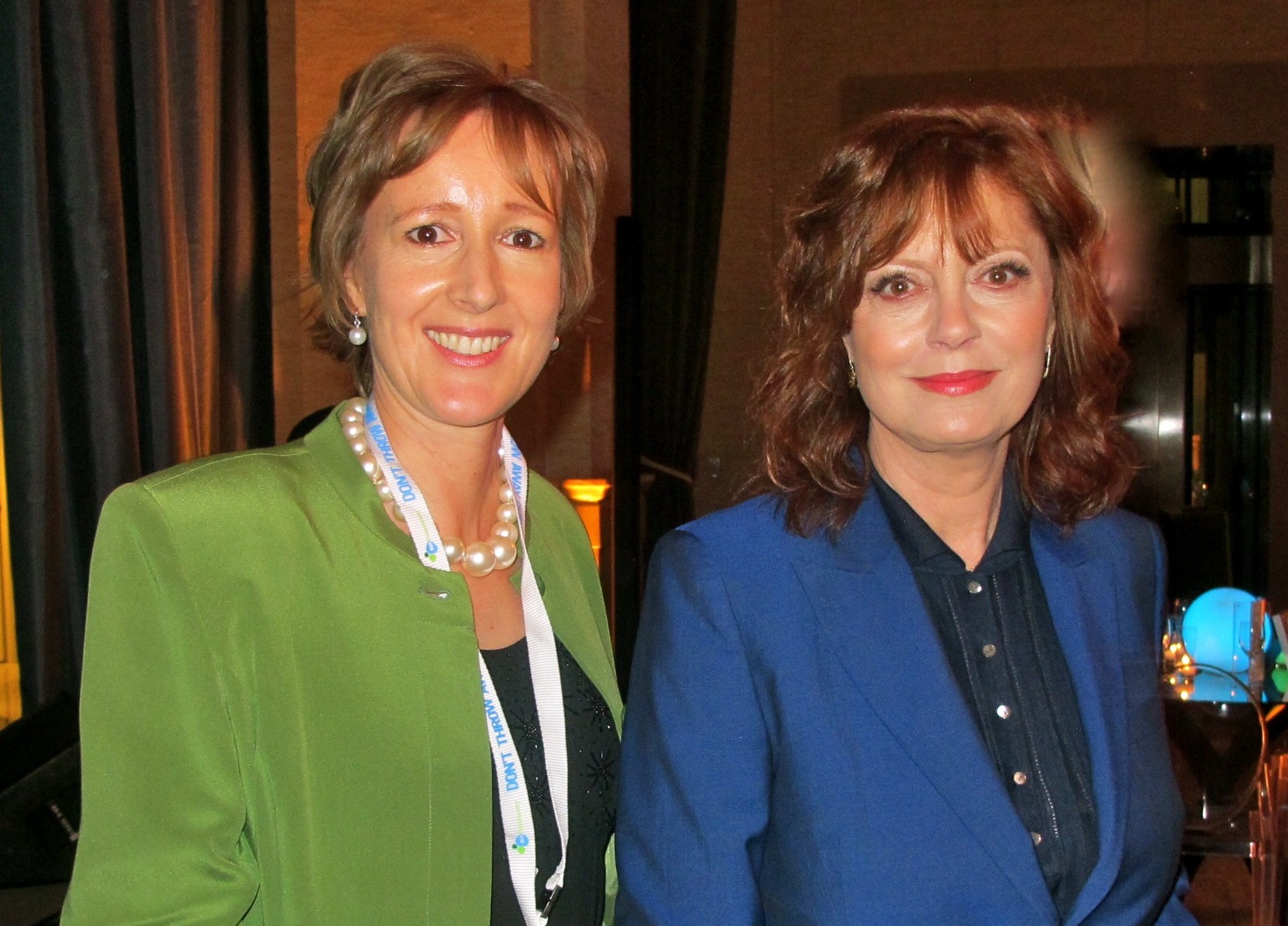
“We are a community of change agents,” said Sarandon. “Bringing about the world we want for our children.”
In a video tribute at the Bently Reserve, Will.i.am enthused about healthy design being a human right, and thanked Bill McDonough for inspiring him. “It’s my mission…to create products that after we use them have a new beginning,” said the popular singer songwriter, and quipped, pointing first at himself then at Bill McDonough: “Will.i.am…Bill.i.am.”
The newly crowned “Bill.i.am” came on stage to great applause and was obviously amused by his tributes. He announced his upcoming book, “The Upcycle” (a tome on upcycling to be released in 2013) and what he called “his baby,” a Bill Clinton inspired solution to homelessness in Haiti and beyond.
“What if we could design a house that could be built by children and their parents in a day without tools?” said McDonough, who is well known for his visionary zeal. He showed the audience a model of a simple one room home, made of ‘upcycled’ plastic no doubt. He dreams that these homes could be shipped in flatpacks to earthquake and storm damaged areas, wherever there is a need around the world.
“What if we could do (for building) what Muhammad Yunus did for banking?” said McDonough, alluding to the microfinance guru who received the Nobel Peace Prize for his work alleviating poverty in Bangladesh.
Perhaps McDonough has a similar award in mind? He’s won many awards in the green design field (including three Presidential Awards for Sustainable Development and Design), and has taken some criticism, but one thing is for certain, he’s never been short on grand vision. Witness the 6-hour long Monticello Dialogues.
He may yet succeed in taking Cradle to Cradle mainstream and making the world a healthier and greener place. With allies like Meryl Streep, Susan Sarandon and Will.i.am who can doubt him?
Click here to see highlights of Fresh Dialogues exclusive interview with Meryl Streep at the event.
The video was recorded at the Cradle to Cradle Products Innovation Institute Gala, the Bently Reserve, San Francisco on Wednesday November 14, 2012.

 van Diggelen: Regarding the human cause of global warming, you say that your conclusions are stronger than that of the