Elon Musk: The Reluctant CEO of Tesla Motors (Interview Transcript)
By Alison van Diggelen, host of Fresh Dialogues
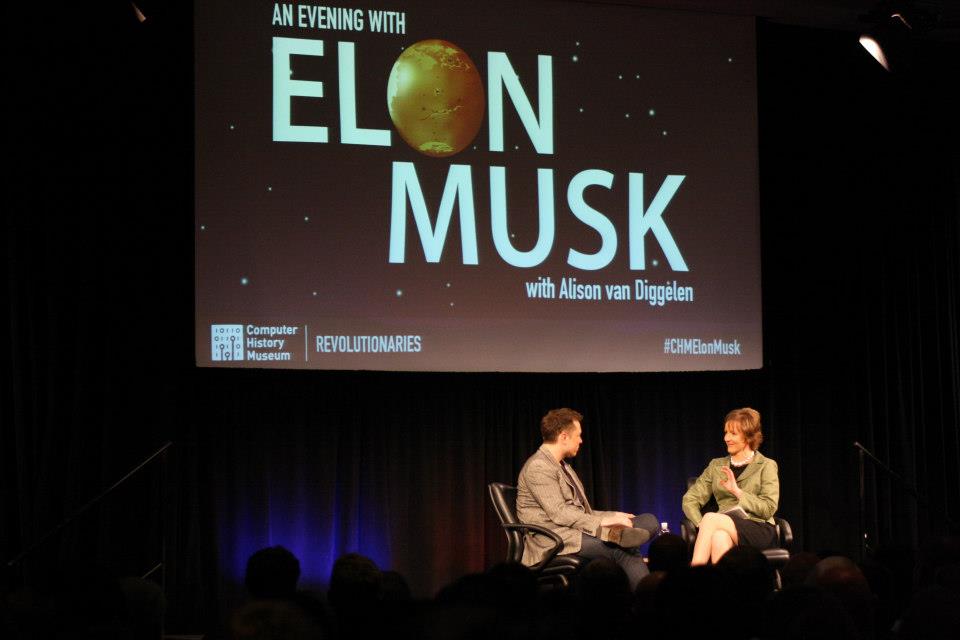
On Tuesday evening, Elon Musk, CEO of Tesla Motors sat down with me at the Computer History Museum in Mountain View to discuss his life’s work. During the hour long interview, he gave a detailed account of Tesla Motors’ early days and how he became the reluctant CEO.
Why reluctant? Well, he was in the throws of getting his other little startup off the ground…the rocket company, SpaceX. If you missed that story, SpaceX has become the de facto replacement for NASA’s space shuttle and serves the International Space Station.
.
But back to electric cars…Here’s what Elon said:
“I really didn’t want to be CEO of two startups at the same time. It was not appealing. And shouldn’t be appealing by the way, if anyone is thinking that’s a good idea. It’s a terrible idea.”
And yet, he’s somehow making it work. Tesla’s Model S was picked as Motor Trend’s Car of the Year 2013 and he doesn’t seem quite so reluctant these days. In this transcript excerpt, he also offers this advice to entrepreneurs:
“In the beginning there will be few people who believe in you or in what you’re doing but then over time, as you make progress, the evidence will build and more and more people will believe in what you’re doing… it’s a good idea when creating a company to have a demonstration… a good mark up or if it’s software to have good demoware, or to be able to sketch something so people can really envision what’s it’s about.”
The interview aired this week on KQED radio and the podcast is now available on this page. Or listen here
Here’s a transcript excerpt.
The Reluctant Tesla CEO: Transcript of January 22, 2013 Interview with Elon Musk
Alison van Diggelen: Shortly after founding SpaceX, you then got interested in electric vehicles and I understand you watched the vigils for the death of the EV1, when they were all smashed. Talk about that and why you felt even after founding SpaceX: ‘I have to get involved with Tesla.’
Elon Musk: Yea, well. My interest in electric vehicles goes back a long time…goes back 20 plus years.
Alison van Diggelen: To the dating scene…(Musk refers earlier in the interview to the fact that in his college days, he used to bore dates with his fascination with electric cars and says, ‘it was not a winning combination…but recently it’s been more effective.’
Elon Musk: Exactly and in fact the original reason I came to Silicon Valley was to work on electric vehicle energy storage technology. I thought that big car companies would develop electric cars. It was obviously the right move and I thought that was vindicated when General Motors and Toyota announced…General Motors was doing the EV1, Toyota did the electric RAV 4, the original one. And they made these announcements and brought those to market and I thought: well this is great, we’re going to have electric cars, GM is obviously going to do the EV2 and 3 and then just keep getting better. Everything would be cool.
And then when California relaxed its regulations on electric cars, GM recalled all of the EV1s and crushed them into little cubes, which seemed kind of nutty. So in fact, the people didn’t want their EV1s recalled…
Alison van Diggelen: Yes…
Elon Musk: In fact they tried court orders to stop the cars from being recalled. They held a candlelit vigil, OK in the yard where the cars were crushed…now…
Alison van Diggelen: Did you attend that vigil?
Elon Musk: No, I did not.
Alison van Diggelen: You’re moved by it.
Elon Musk: Well certainly, I mean, it’s crazy…When was the last time you heard about any company… customers holding a candlelight vigil for the demise of their product? Particularly a GM product? (laughter) I mean what bigger wake up call do you need? Like hello! The customers are really upset about this. They’d really prefer if it didn’t get recalled. So that kind of blew my mind. So it was like ‘wow.’
And then we had the advent of lithium ion batteries which really is one of the key things to make electric cars work, but it’s still nothing. And so in 2003, I actually had lunch with one of the other cofounders of the company JB Straubel (now CTO of Tesla Motors) who was actually working on a hydrogen airplane or something. He mentioned to me the tzero car that was done by AC Propulsion. 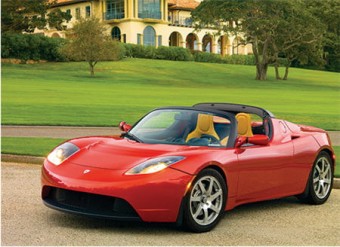
AC Propulsion are the sort of guys who had actually been on the EV1 program and they took a gasoline sports car, a kit car and outfitted it with lithium ion batteries, consumer grade cells, and they created a car which was essentially the precursor of the (Tesla) Roadster, and had very similar specifications: sub 4 seconds zero to 60 mph, 250 mile range and also a two-seater sports car. But it was quite primitive. It didn’t have a roof for one thing. At all. And none of them had doors. But it didn’t have any safety system at all, no air bags, it wasn’t homologated, so you couldn’t sell it. So in order to sell that car, in order to create a commercial version of that car, there was a fair bit of work that was required.
I kept trying to get AC Propulsion to commercialize the tzero, and I said: ‘Look, I’ll fund the whole effort, we really need to do this.’
But they just refused to do it. They wanted to make an electric Scion. Which in principle sounds good, but in fact it would have cost $75,000 and nobody wants to buy a $75,000 Scion.
The technology was just not ready. There was just no way to make a good value proposition.
Alison van Diggelen: What was it that compelled you to say: ‘I have to be CEO here and lead this company.’ Why not just say: ‘I’ll help you JB and get this rolling’?
Elon Musk: Well I really didn’t want to be CEO of two companies. I tried really hard not to be actually. Yes. So AC Propulsion finally said…I told AC Propulsion: ‘If you’re not going to do this, I’m going to create a company to do this.’
And they said well, there’s some other guys who’re also interested in doing that and you guys should combine efforts and create a company. And that’s basically how Tesla came together.
And then we had a lot of drama (laughter). But since I’d provided like 95% of the money, so I could have been the CEO from day one… but I really didn’t want to be CEO of two startups at the same time. It was not appealing. And shouldn’t be appealing by the way, if anyone is thinking that’s a good idea. It’s a terrible idea.
…
Alison van Diggelen: It’s one thing to have all those wonderful ideas in the shower and at Burning Man, but it’s another thing to build, motivate and retain a team of excellent people. Can you talk about some tips and some things you’ve learned that obviously work for you?
Elon Musk: Yeah. Well a company is a group of people that are organized to create a product or service. That’s what a company is. So in order to create such a thing, you have to convince others to join you in your effort and so they have to be convinced that it’s a sensible thing, that basically there’s a some reasonable chance of success and if there is success, the reward will be commensurate with the effort involved. And so I think that’s it…getting people to believe in what you’re doing – and in you – is important.
In the beginning there will be few people who believe in you or in what you’re doing but then over time, as you make progress, the evidence will build and more and more people will believe in what you’re doing. So, I think it’s a good idea when creating a company to create…to have a demonstration or if it’s a product to have a good mark up or even if it’s software to have good demoware, or to be able to sketch something so people can really envision what’s it’s about. Try to get to that point as soon as possible. And then iterate to make it as real as possible, as fast as possible. I think that makes sense.