Innovation and Silicon Valley go together like bits and bites. Another month another innovation competition. But Intel’s Global Challenge caught our attention for the breadth and quality of its innovators from around the world, who competed for $100,000 in prize money and the chance to pitch some of the valley’s top venture capitalists at UC Berkeley’s Haas School of Business.
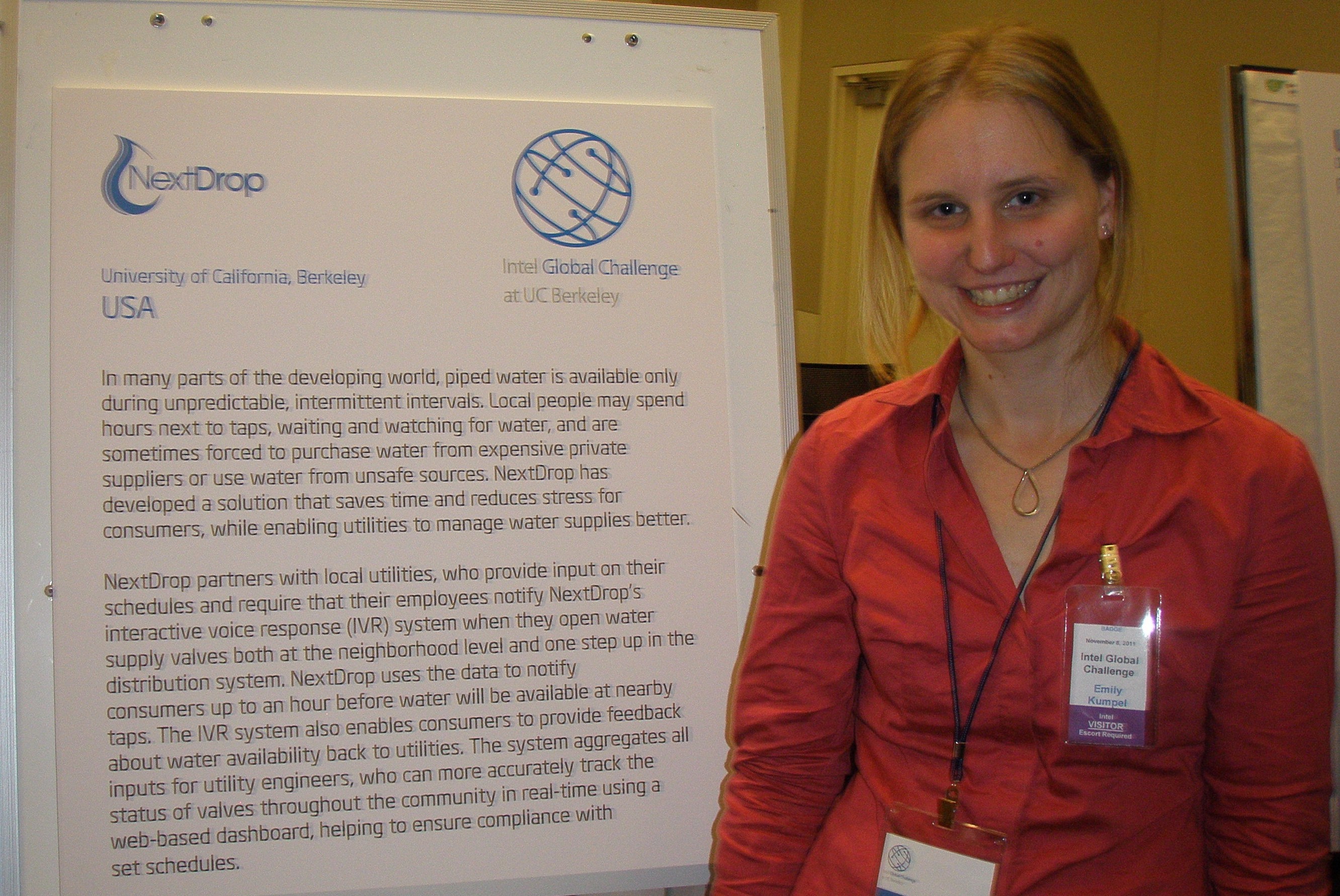
Fresh Dialogues was delighted to see a good number of environmentally conscious innovators made the cut, including PolySol, a recyclable alternative to plastic, made from coconut husks; Nitrate Production System, a low-cost earth-friendly fertilizer and ValleyFeed, a wireless wildfire detection system. These innovative teams came from India, Jordan and Saudi Arabia/Lebanon respectively. Closer to home, NextDrop, a Berkeley based team demonstrated a ground breaking system that uses crowd-sourcing technology to monitor and facilitate efficient water use in India. The venture capital judges agreed and gave NextDrop the Social Innovation Award.
The award winning team includes National Science Foundation Fellow, Emily Kumpel (pictured) who is a PhD candidate in Civil and Environmental Engineering at the University of California at Berkeley. She brings her water management experience in Madagascar and Tanzania to NextDrop’s diverse team who include Ashish Jhina, Thejovardhana Kote, Anu Sridharan, Madhusadhan B, and Ari Almos.
We look forward to following their progress blog as they scale up NextDrop’s project in India.
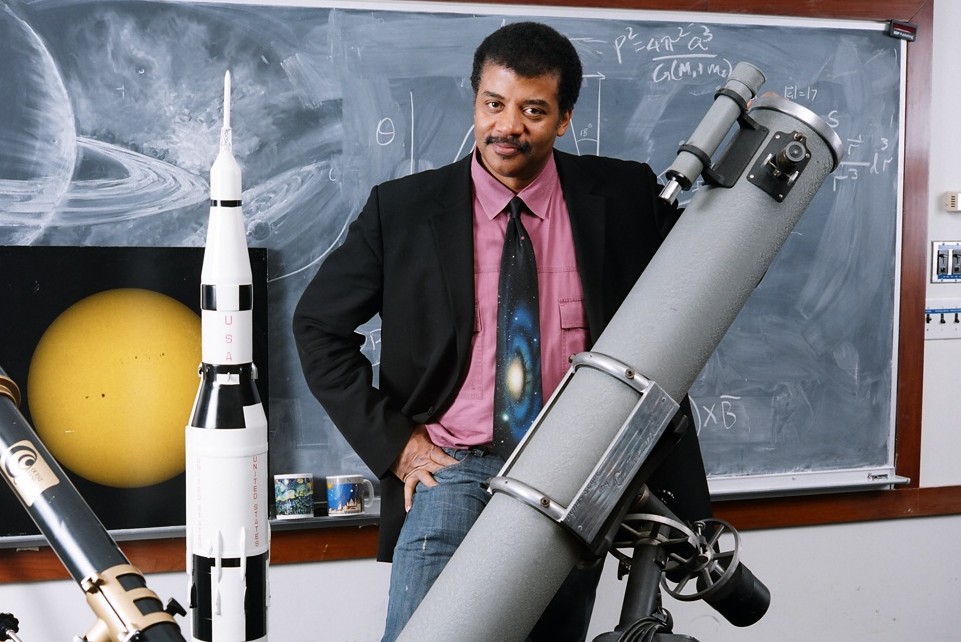
He’s known as the “sexiest” astrophysicist alive, host of Nova ScienceNow on PBS, and Stephen Colbert’s favorite interviewee. Neil deGrasse Tyson may be more comfortable talking black holes and cosmic quandaries, but on Friday evening in Silicon Valley, Fresh Dialogues asked him to weigh in about climate change and he didn’t disappoint. Beginning – like any good scientist – with the facts (evidence from chemistry, biology and geology); he made this challenge to climate deniers:
“You have to be mature enough to recognize something can be true even if you don’t like the consequences of it. That’s what it means to be a mature adult.”
Tyson shared plans for “an experiment” he will describe during his next appearance on Jon Stewart’s Daily Show (slated for next February). Here’s a preview:
“All climate scientists should announce they’re going to take their entire life savings and invest in industries that will thrive under the conditions of global warming. All those in denial of global warming – which tends to be some of the wealthier people of the nation – won’t do that. As global warming unfolds, that will be the greatest inversion of wealth the world has ever seen. That’s all it takes,” said Tyson, adding with a smile and a shrug, “I could get rich off this.”
He then got serious, “I’m a public scientist and it’s not my goal in life to exploit your ignorance ’cause I’ll get your money, because you won’t believe what I’m telling you. I’d rather you recognize the value of scientific research and we all move into the future together.”
Fresh Dialogues wonders if Tyson has shared his plan with green economy investor Al Gore, who’s been criticized for “putting his money where his mouth is.” Some say Gore is poised to become the world’s first “carbon billionaire.”
Days before the Global Climate Conference in Durban South Africa, NBC’s Special Correspondent Tom Brokaw delivered a strong message in Silicon Valley for those who deny climate change. “It’s real, we see it in our weather systems,” he said and made a somber call to action, saying everyone needs to take a part. Brokaw, who has hosted two documentaries about global warming for the Discovery Channel, says he’s planning an expedition to Antarctica with a team of climate scientists to record the glacial melting next January.
Brokaw cited carbon based fuels and energy consumption as major issues, and stopped short of making specific policy recommendations, but said that the Obama administration missed a valuable opportunity to do something substantial about energy and jobs. “People could have got allied with that,” he added.
He acknowledged his part in contributing to the problem (long commutes in polluting LA traffic to visit his beloved mother), but is now doing what he can to be greener. He recently adopted solar in his Montana Ranch, recouping his capital investment in only three years. In this intimate video, he waxes lyrical about the piping hot water and heating system – even during long Montana winters.
.
.
Brokaw ended on an upbeat note, saying that he thinks the younger generation will change things for the better.
The video was recorded on November 21st, 2011 at the Commonwealth Club in Silicon Valley, moderated by KGO TV’s Dan Ashley. Brokaw is promoting his new oeuvre The Time of Our Lives, a conversation about America; Who we are, where we’ve been, and where we need to go now, to recapture the American Dream.
Google is on a green spending spree. By July 2011 it had invested over $700 M in clean energy. Today the figure is over $850 M and set to grow (approaching $1 B as at August 2012). Fresh Dialogues asked Google: How does it choose green startups and projects?
He’s talking about large solar power tower projects, like BrightSource’s Ivanpah project in California’s Mojave Desert to which Google contributed $168 M; and one of the world’s largest wind farms, Alta Wind Energy Center, also in the Mojave Desert where Google invested $55 M.
.
.
In June this year, Google demonstrated its game-changing strategy by investing in SolarCity. This time it was a $280 M investment, to create a fund enabling the solar company to make residential rooftop installations more affordable (often eliminating the upfront cost for homeowners).
“Google is setting an example that other leading American companies can follow,” said Lyndon Rive, CEO of SolarCity. “The largest 200 corporations in the U.S. have more than $1 trillion in cash on their balance sheets. Investments in solar energy generate returns for corporate investors, offer cost savings for homeowners, create new local jobs…and protect the environment.”
Despite the departure of Google’s Green Czar – Bill Weihl – this week, Parag Chokshi confirms that “we have a strong team and our work will continue. ..we actually have several executives that work on our green initiatives … other executives include Rick Needham, who has led and oversees our $850M in clean energy investments; and Urs Hoelzle, who oversees our entire infrastructure and has spearheaded our energy efficiency work.”
This video was recorded at the Google Headquarters in Mountain View CA on July 8, 2011.
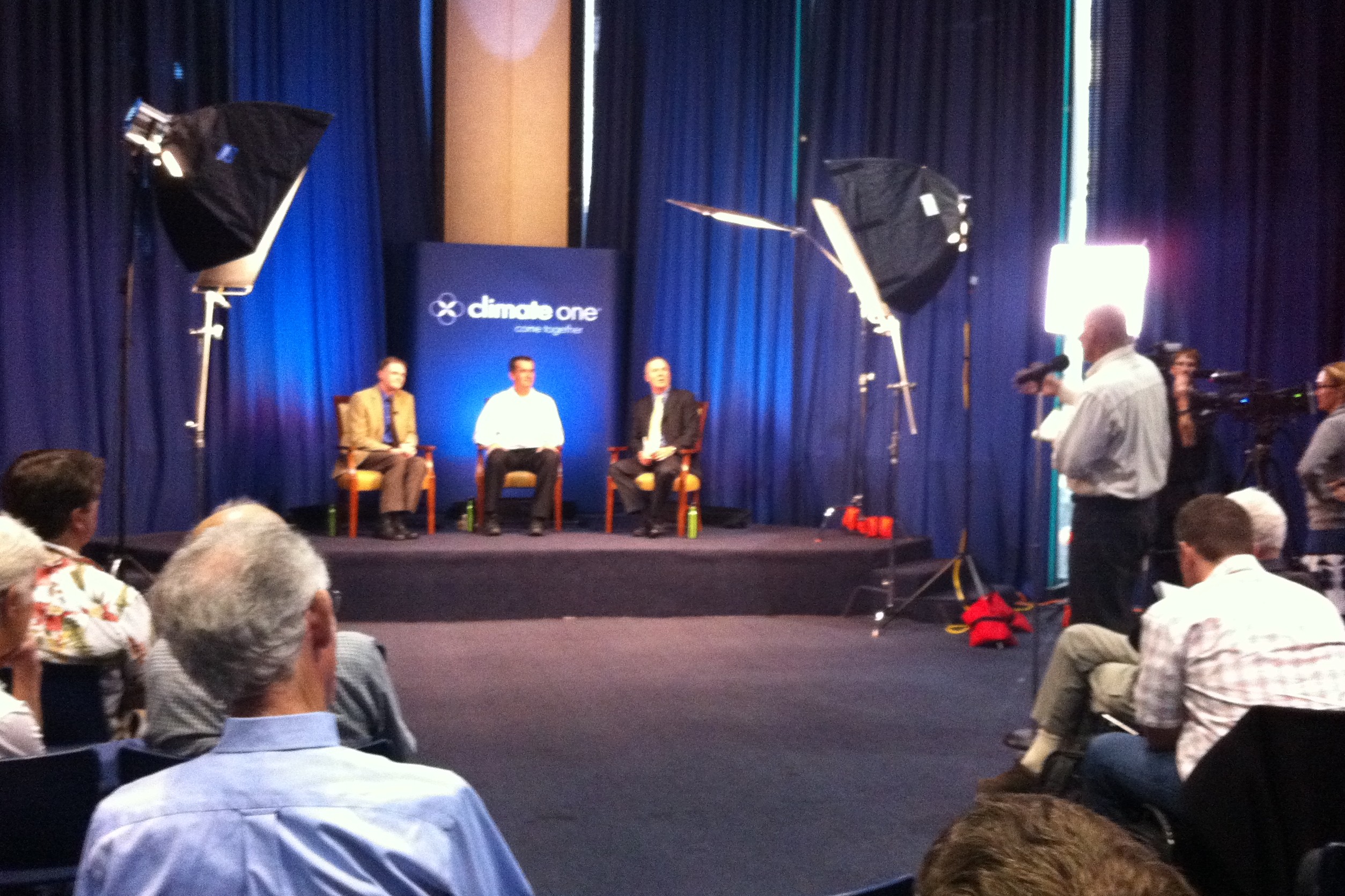
Climate One‘sGreg Dalton brought together a pair of climate experts yesterday at the Commonwealth Club to discuss the “Great Disruption” – Is it the end of the world as we know it? What will happen to the global economy when the world stops denying the realities of climate change?
Australian environmental business expert Paul Gilding, and Senior Fellow at the Post Carbon Institute, Richard Heinberg shared their wisdom in a lively dialogue with Dalton. Gilding’s latest book is The Great Disruption and describes how to fight-and win-what he calls The One Degree War to prevent catastrophic warming of the earth. It has even received a favorable review by Tom Friedman in his New York Times column. Heinberg’s tenth book is The End of Growth and describes exactly why this decade will be worse than the Great Depression; he predicts future global growth will be a zero sum game thanks to resource, climate and financial limits. Despite the rather apocalyptic theme of both authors, the near capacity audience was treated to some upbeat comments from Gilding coupled with some more cautionary responses from Heinberg. Here are some of the highlights:
On Change
“People’s ability to change is quite impressive – witness World War 2- we can end the denial and decide on a different future…the debate is how to act not whether to act.” Paul Gilding.
“During WW2, the enemy was visible. The U.S. has a larger capacity for denial. We will have to hit a wall before seeing change…it”s like a slow motion crash.” Richard Heinberg.
On Carbon Tax
“In Australia, a carbon tax is going through Parliament. The price is low…but every balance sheet will soon show the cost of carbon. (In OZ) The debate is over.” Paul Gilding.
On the Trigger
“The price of energy, food and transport will be the trigger point. Government must put in place the framework for change.” Paul Gilding.
On Clean Tech
“Exciting things are happening in renewables. Solar will be cheaper than coal within a decade. Then the game changes dramatically.” Paul Gilding
What a stimulating way to spend your lunch hour. Thanks to Greg Dalton for orchestrating a memorable – if sobering – event.
Read transcripts, see photos and check out our ARCHIVES featuring exclusive interviews with Tom Friedman, Paul Krugman, Vinod Khosla and many more green experts and visionaries…