In Part Two of my Bloom Energyinterview with CEO KR Sridhar, we discuss the affordability of the Bloom Box and what barriers to entry make the fuel cell sector difficult to penetrate. As CNET’sBrooke Crothers emphasized in his recent article there are many fuel cell manufacturers with expensive products; Bloom has to prove itself special by making its fuel cells SIGNIFICANTLY more affordable. It’s a long road from $800,000 (Google and eBay’s beta Bloom Boxes’ price tag) to $3,000 -which KR says is the backyard-box goal).
The BBC’s correspondent, Maggie Shiel underlines affordability in her post on Bloom’s reach for energy Nirvana; and Grist’s Todd Woodyexpounds further on the challenges Bloom faces and Walmart’s role in driving down costs. New York Times columnist Tom Friedman has a unique take on the Bloom story in a recent column called “Dreaming the Impossible Dream.”
This from Bloom CEO, KR Sridhar:
“Our goal is clearly to make it affordable. It needs mass market adoption… If it’s not affordable, it’ll be the niche market…it’ll be a Tesla. We need it to be a Honda Civic.”
“It’s a very complex interdisciplinary field…it requires knowledge in a significant number of engineering, science, and material science disciplines. And the development of all the process know-how is fairly complex.”
Financial
“There’s a significant amount of capital that need to be invested over a long period of time to get it to where it needs to be.” (Reportedly over $400 Million has been invested in Bloom Energy since 2002, from several venture capital firms, led by Kleiner Perkins’ John Doerr.)
To see Part I of the Bloom Energy interview where KR discusses the company’s technology and efficiency click here
To check out more VIDEO interview segments at the Fresh Dialogues Channel click here
Like most ambitious entrepreneurs in Silicon ValleyBloom EnergyCEO KR Sridharwants to change the world. Now where have we heard that line before? It’s the ubiquitous rally cry for thousands of Google/ Facebook/eBay wannabes around the world. But what makes KR Sridhar different?
How about $400 Million in venture capital from the likes of Kleiner Perkins’ John Doerr; a 100-strong team of PhD. rocket scientists (like himself) and top engineers from multiple disciplines who’ve been working secretly for eight years; and a client list that includes Google, eBay, Staples and FedEx. Add to that, enthusiastic backing from Arnold Schwarzenegger, splashy coverage from CBS’s 60 Minutes, and Time Magazine which last December dubbed him one of eight “Tech pioneers who will change your life.”
Yet, it does sound too good to be true. Not surprisingly, the naysayers are aplenty. A skeptical article in the Economist said there were many reasons for questioning the company’s “hype”, including the difficulty of shrinking the fuel cell components, and competition from the likes of GE. In a typically British fashion, it mocked Bloom Energy’s ambitions, referring to “flower power” and “fuel’s gold” in the article.
But if we look back a few years; before KR Sridhar emerged from stealth to become the Steve Jobs of Green Energy – more substantive information emerges. He was quoted in Tom Friedman’sNew York Times column as saying,“We are thrivers. Thrivers are constantly looking for new opportunities to seize and lead and be number one. That is what America is about.” In an exclusive interview at the Bloom Energy headquarters, I asked him to explain this comment, his motivations and why he believes his company really can change the world.Distributed power that is reliable, and affordable are key parts of his strategy.
“This is a mission about changing the world because energy is a passport to a better living. For the rest of the world that does not have access to power, access to electricity, to give them that is empowering them to a better life. So if the solution works and you make it affordable and you can distribute it all over the world then definitely you have changed the world. So … if that’s your goal and you achieve that goal, clearly given the size of the energy market, it’s in trillions not in billions and given how many people you can impact with this kind of stuff, this has to be a prominent company. So, I would say being the number one corporation is an offshoot of achieving your larger mission.” KR Sridhar, CEO Bloom Energy
To check out more exclusive Fresh Dialogues interviews with Tom Friedman, Vinod Khosla, Paul Krugman, and many other leaders click here or use the Search Box to the right.
A former NASA advisor who developed technologies to sustain life on Mars, this earnest scientist is now harnessing his visionary skills and a large team of engineers to solve the energy crisis. His ambitious goal? To revolutionize the energy industry, just like cell phones revolutionized the communications industry. His team is developing high efficiency fuel cells to provide a globaldistributed system of electricity supply at low cost and a low (and ultimately zero) carbon footprint. Clients include Google, eBay, Fedex and Walmart. Not too shabby.
The company has been in stealth mode for the last eight years andindustry speculationhas been rife about its future plans. Thanks to a CBS 60 Minutes Report by Lesley Stahl on February 21st, and the official Bloom Energy unveiling, many more details are now available of this potentially revolutionary product.
Even before opening his doors to 60 Minutes, KR agreed to discuss Bloom Energy’s progress in this exclusive and detailed Fresh Dialogues interview, recorded in 2009. To read the interview transcript click here
“Energy is a passport to a better living. For the rest of the world that doesn’t have access to power, to electricity; to give them that is empowering them to a better life. If your solution works and you make it affordable and you distribute it all over the world, then you have definitely changed the world….You give power to the people.”
What’s in the Bloom Box?
“It takes the chemical energy from the fuel and converts that to electrons with no in between conversion. So you are changing your currency only once. It’s an electro-chemical reaction..like a battery…but the big difference is it’s a power generator so you keep supplying the fuel in and you’ll keep getting the electrons out – most importantly without combustion. It’s a one step conversion… high efficiency…you burn less fuel – less greenhouse gases -and eliminate all the combustion related polluting gases.”
What’s the link with transportation?
“Transportation can potentially go in two directions in the future. One is a hydrogen infrastructure for the car, the other one is an electrical infrastructure for the car…plug-in hybrids…Our device can either produce the electricity that’ll charge the car or provide you hydrogen if the transportation becomes hydrogen based. So we’ve sort of become the gas station for the transportation industry.”
There are still many unanswered questions about Bloom Energy, but here are some more clues.
To check out more Fresh Dialogues VIDEO interview segments click here and check for other Fresh Dialogues video interview segments with lots more PRODUCT AND BUSINESS PLAN DETAIL about Bloom Energy.
Rolf Papsdorf, President of the Alternative Energy Development Corporation was a recipient of the 2009 Tech Awardsin Silicon Valley, for bringing renewable energy (zinc fuel cells) and empowerment to a small community in South Africa. Check out this exclusive interview with Mr. Papsdorf who discusses how to create a carbon neutral community, the advantages of zinc fuel cells (portability is a big plus) and why he wants to meet Al Gore.
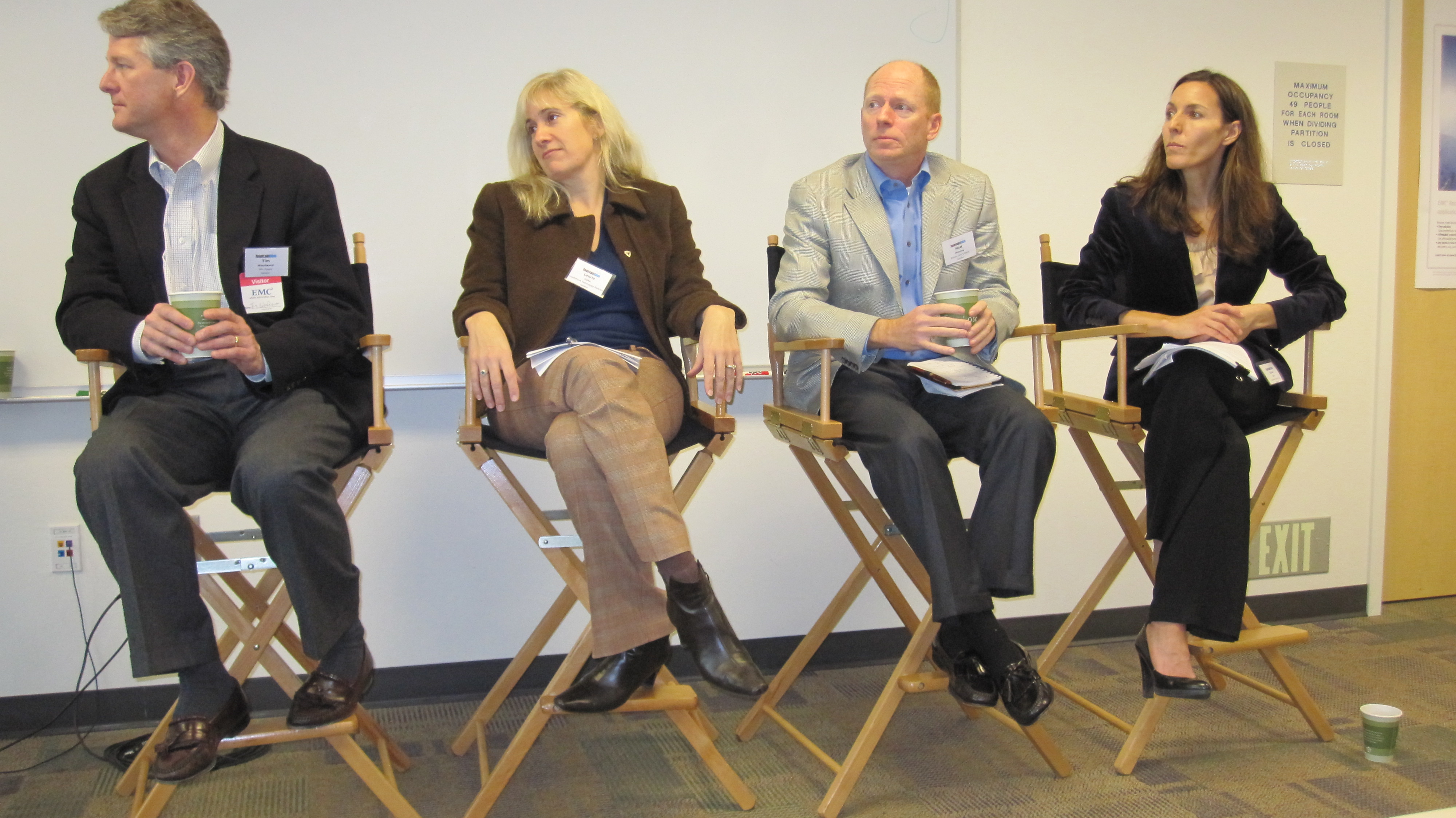
The Obama administration ought to have sent an envoy to the FountainBlueState of Clean Green Conference on January 29, 2010. A panel of Silicon Valley clean tech experts had much to share in response to Moderator Greentech Media’sEric Wesoff’s question…if you had Department of Energy Secretary, Steve Chu’s job, what would you do? In other words, how can Obama better jumpstart the clean tech economy?
Tim Woodward, Managing Director, Nth Power said the government needs to create market demand, and recommends that every government building should have solar power and be retrofitted for energy efficiency; but warned,
“There’s a little too much of a ‘large check mandate’ in the Federal Government that picks technologies and stifles innovation at lower levels: figure out how to get smaller dollars into the innovation engine of smaller companies.”
“I look at the pricing and incentivizing through market pricing. We’re still subsidizing imported oil without putting the investment into alternative energies…I think we should put a tax on imported oil and use it to help pay off some of the defense spending we’re using to protect the transmission of that oil. We need to forge ahead with cap and trade legislation… until we have a price on carbon it’s hard for the markets to plan and have any certainty.”