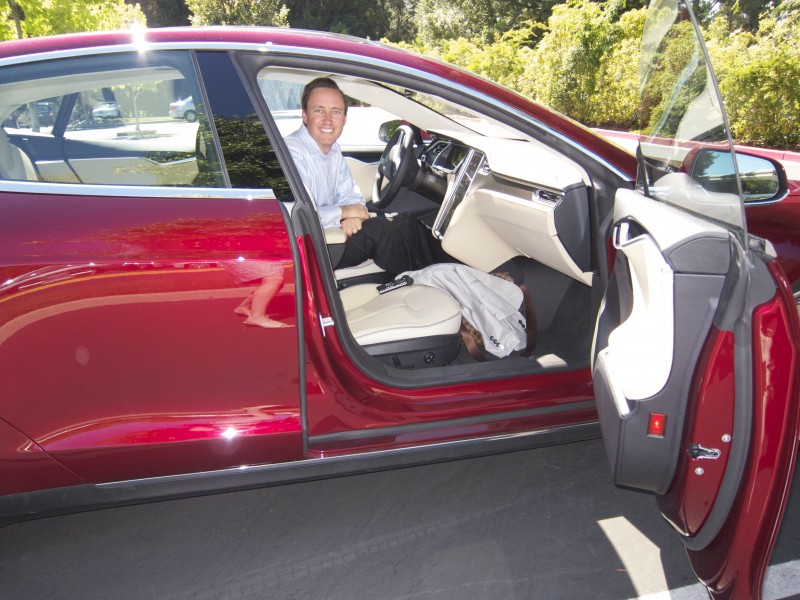
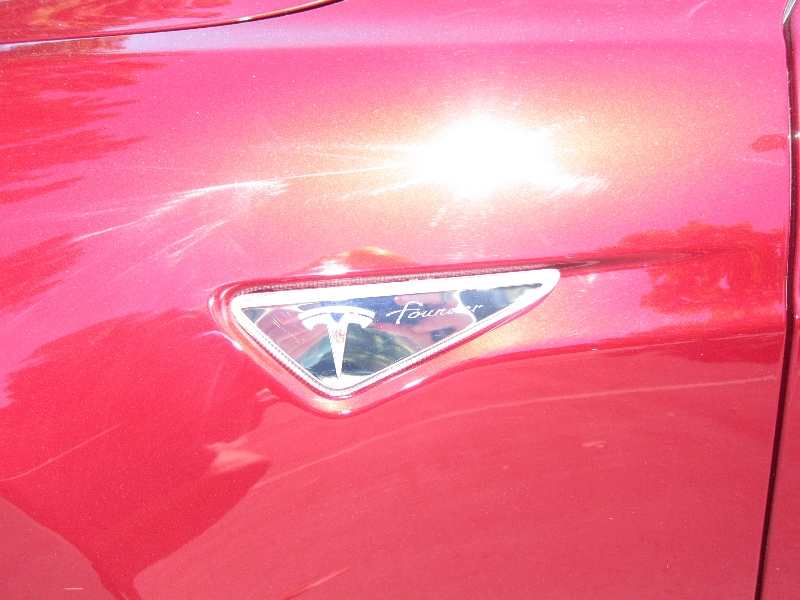
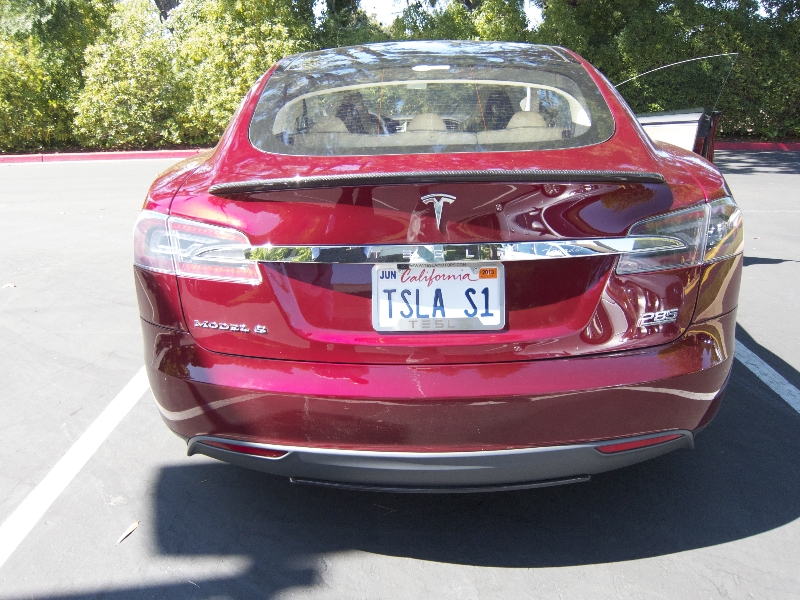
In June, Fresh Dialogues toured the Tesla Factory and last week we finally got behind the wheel of the finished product: a Model S Performance. It’s an impressive vehicle: sleek, stylish and powerful. Very powerful. The acceleration felt like a rocket. We took it 0-50 in about four seconds and thanks to its low center of gravity, it was easy to handle on the winding hill roads around Palo Alto. Going 60 plus on Highway 280 felt smooth and effortless. You gain speed so fast, it’s quite formidable, especially for this Toyota Prius driver. In the latest test drive, Motor Trends confirmed a 0-60 mph time of 3.9 seconds; faster than Tesla’s own specs of 4.4. That makes it the fastest American sedan.
I’d heard about the ‘sensitive’ accelerator pedal and wondered how it would be in the confined space of the Tesla HQ parking lot? But I found it easy to navigate and control both in forward and reverse gears. Backing into a parking space was a cinch thanks to the rear camera.
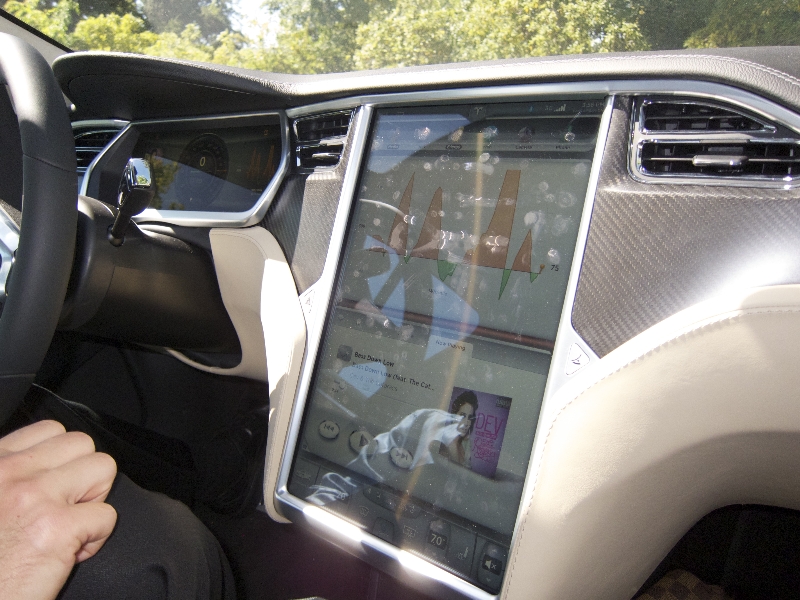
The massive 17-inch touch screen looked like it could be a major driving distraction, but having experienced its utility, I’m more appreciative. Glad to see that most functions can be controlled from the steering wheel, including the impressive sound system. Spinal Tap fans will be delighted to learn that the volume goes to eleven (really!); a spec no doubt dictated by Tesla product architect, Elon Musk with tongue firmly in cheek.
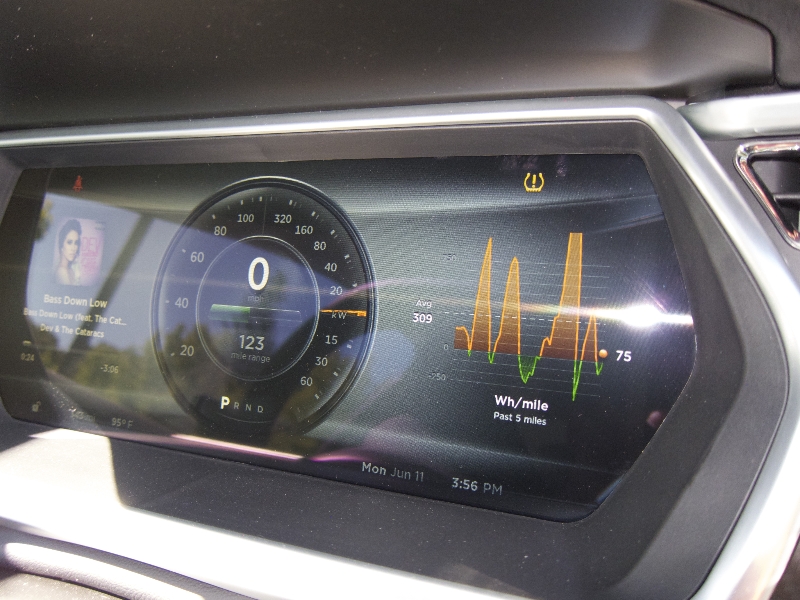
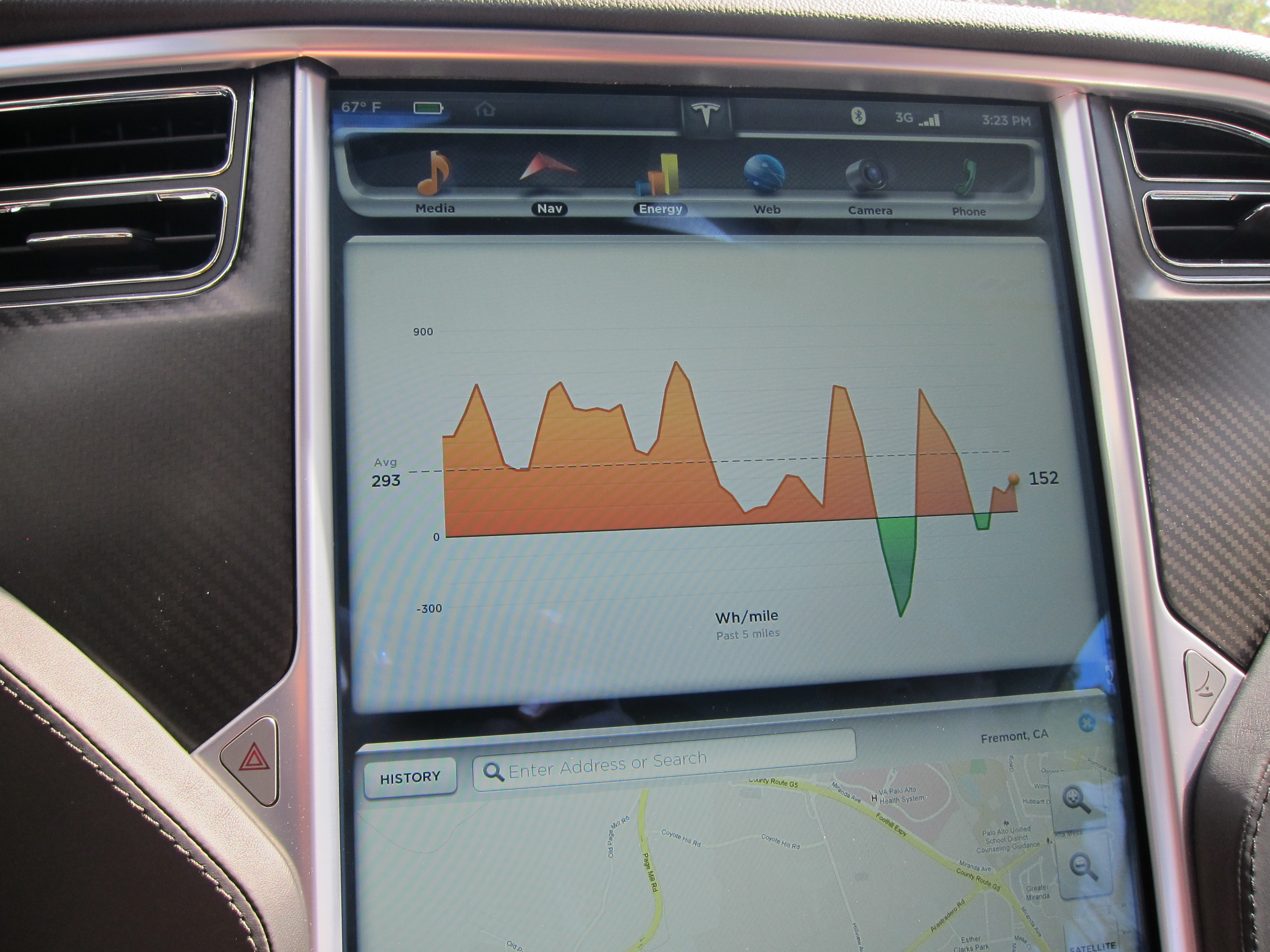
You can choose what appears on your dashboard: energy consumption, range, media, climate control, etc.
Tesla’s Christina Ra explained the energy charts and how the range is impacted by all that powerful acceleration.
The regenerative breaking was very noticeable (see green shading on graph). The second you take your foot off the accelerator, you feel it kicking in, giving you more control and increasing the range of the car. It’s rated 265 miles by the EPA, but the way we were driving, the projected range fell to 192. To get the maximum range, Tesla recommends an optimum speed of 55 mph, with the windows up and no A/C.
Two criticisms:
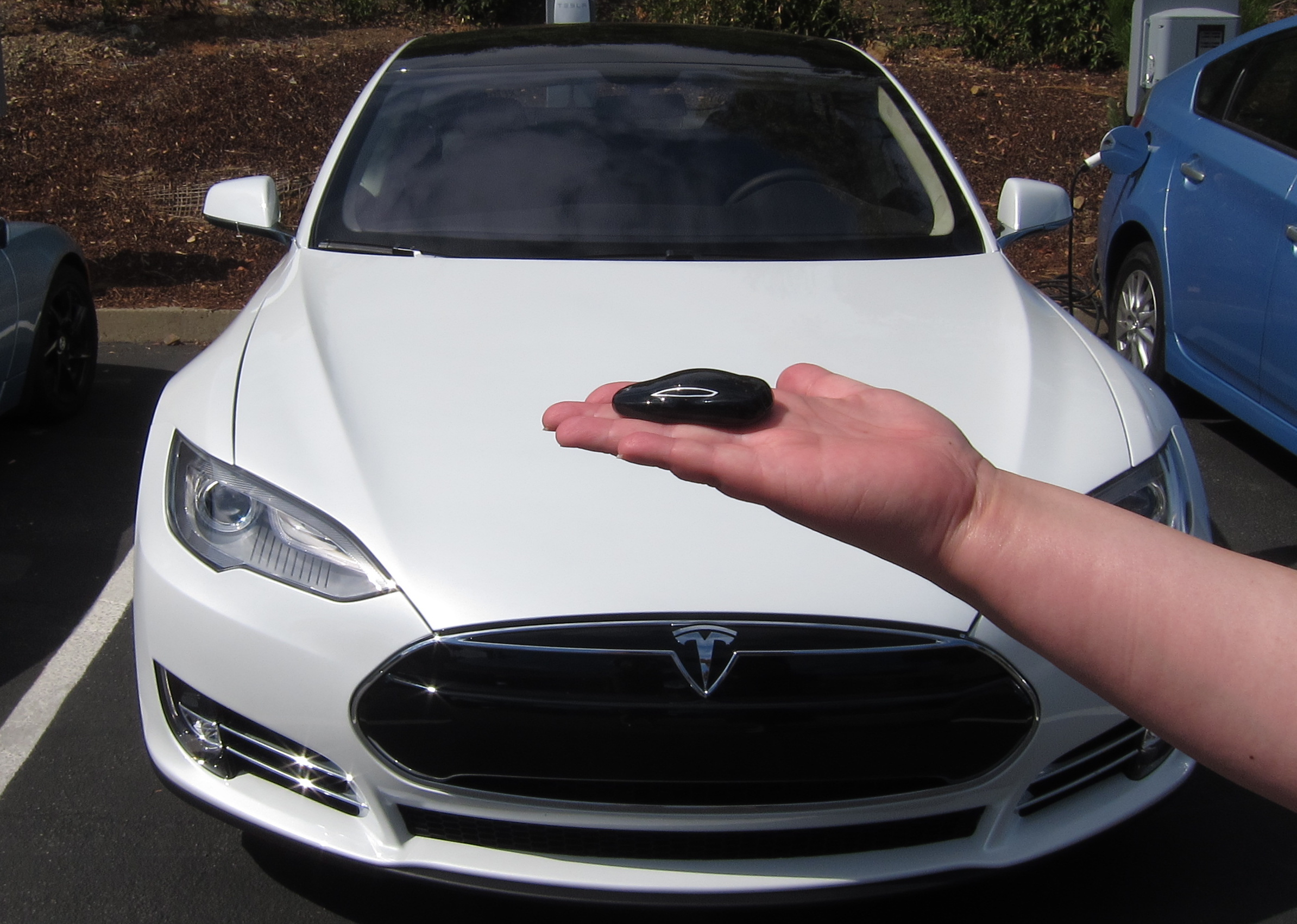
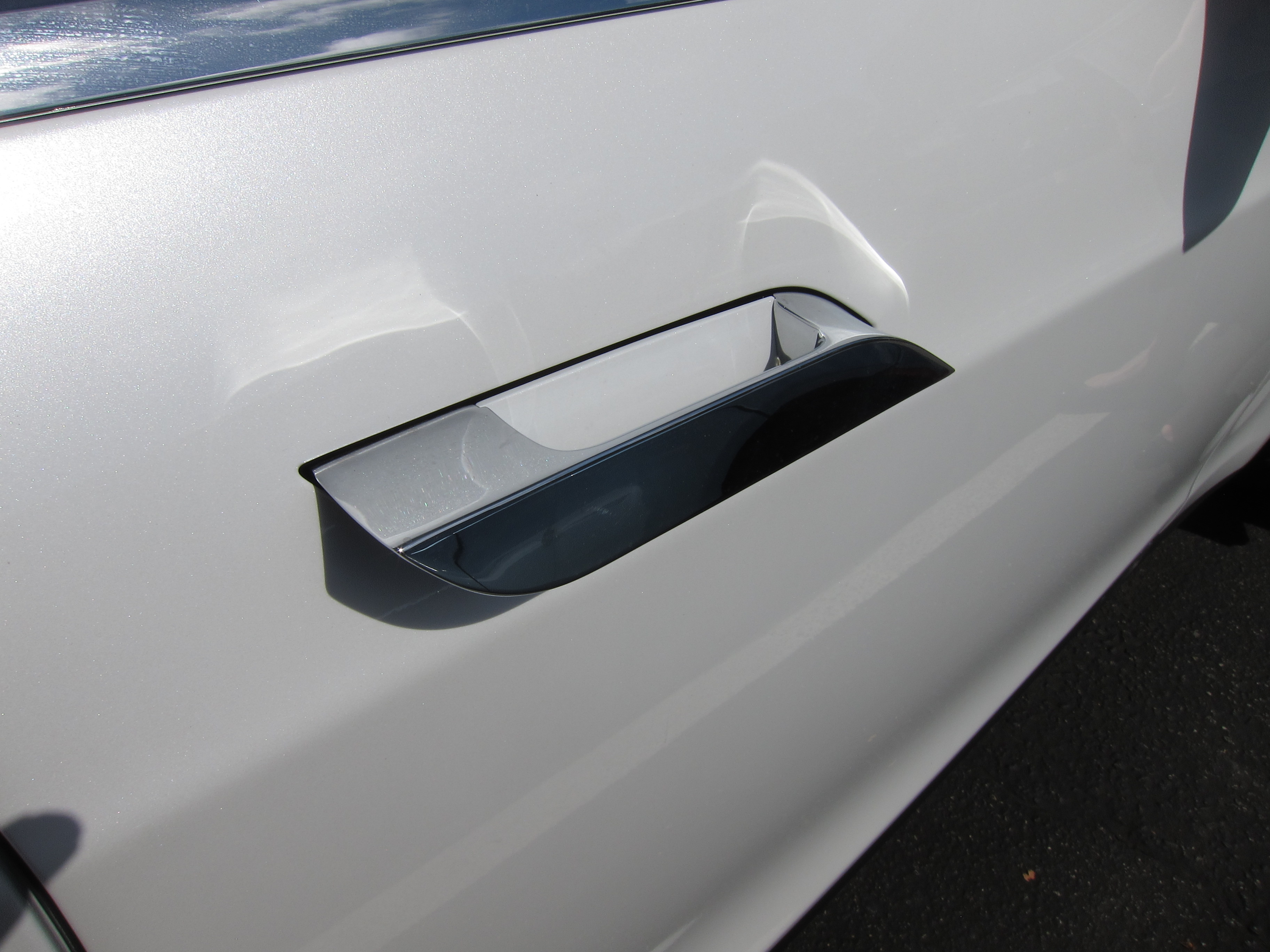
1. These snazzy door handles certainly look and act cool. Tesla Factory worker Charles Lambert said it best, they’re distinctive and sexy. According to reports, they’re not just eye candy, they actually improve the aerodynamics of the car. I understand they’re fitted with an anti-break-your-fingers release mechanism, but when I checked it out, the handle gave me a good finger squeeze – not in a good way. It stung. Maybe I’m extra sensitive, but I think Tesla should consider adjusting the specs, just a tad.
2. When you get in the car and sit down in the driver seat, the car switches on. Touch the foot break and the motor is on and ready to go. But when you stop, it feels disconcerting not to have an “off” button. Say you pull over to make a phone call… or enjoy the sunset? I’d be more comfortable knowing this super powerful motor is definitely off. And isn’t suddenly going to take off….
Overall though, a remarkable driving experience and a giant leap up from my beloved Toyota Prius. Made in Silicon Valley is definitely a plus.
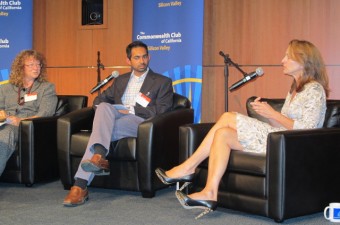
This month, I moderated a panel of green jobs experts for the Commonwealth Club Silicon Valley. Experts included: Parag Chokshi, Clean Energy Public Affairs Manager, Google; Josh Green, General Partner, Mohr Davidow Ventures; Linda Keala, Vice President Human Resources, SolarCity and Nanci Klein, Deputy Director, Office of Economic Development, City of San Jose.
The panel shared insights about the green economy, as well as tips for finding and securing green investments and green jobs. Here are highlights of our conversation (edited for space and clarity).
What are hot sectors in the green economy?
Josh Green, Mohr Davidow Ventures: “In the current environment, we’re looking for less capital intensive deals (energy efficiency, LED lighting and building management systems), so that means we’re on the side of energy demand much more than energy production. People call this cleantech IT – Information Technology. I’m an investor in Xicato, an LED module company. The LED convergence will happen…the payback is less than two years and (it’s) equivalent to halogen light. You don’t have to replace them for ten years or more and especially in a commercial settings, you end up lowering your maintenance costs.”
On cleantech growth sectors in Silicon Valley
Nanci Klein, Office of Economic Development, City of San Jose: “People say manufacturing has left the US…but manufacturing is very exciting here. When you talk about innovation and commercialization, Silicon Valley is a hub around new product introduction. Contract manufacturers will take a low volume, high mix of products. …the ten largest in the world – Tier One contract manufacturers – are all here in Silicon Valley, six of them in San Jose. They’re like a secret weapon resource. We try to link baby investors to these companies. You take someone with a hot idea and you put them with all of the accelerated services…if the product is good you can have a rocket in terms of acceleration.”
Josh Green, Mohr Davidow Ventures: “The loan guarantee program is operating well within the loan loss reserves. Certain loans are going to fail…The Solyndra mess became a big political football…the good news is that we’ve passed the half life…Congress officially stopped all its hearings. There will be continued efforts to end the loan guarantee program…but Solyndra itself: it’s over in terms of an issue. As investors, it never was an issue, it was a company that was not successful…I’ve got a portfolio with lots of companies that are not successful. Out of 100 investments, if you have 10 that meet your investment objectives (10x your money or better) then you’re ‘wildly’ successful, that makes you a top venture capitalists. That means you have a 90% – under your expectations success – rate.”
Tips on getting a green job
Linda Keala, Director of HR, SolarCity:
1. “A background in cleantech is not a prerequisite.”
2. “Differentiate yourself – what about the job (post) got you inspired? What resonated about the company?”
3. “I love getting handwritten letters. A personalized message tells me this is who I am, this is what I can bring to the company. Sometimes I get them in little pink envelopes…”
4. “Touch a spot in our hearts and we’ll take a close look at that resume.”
Josh Green, Mohr Davidow Ventures: “Have passion to change the world.”
How to get a job in Google’s Green Team (there are currently seven openings in the sustainability/green team areas)
Parag Chokshi, Clean Energy Public Affairs Manager at Google:
Here are the qualities Google looks for:
1. “Be a self starter, work independently and drive forward a project.”
2. “Think about creative solutions. We value innovation and creativity.”
3. “Show passion and new ways of thinking about things…that is very valuable.”
How is the City of San Jose helping entrepreneurs in Silicon Valley and beyond?
Nanci Klein, Office of Economic Development, City of San Jose: Here are some of the resources available – The Entrepreneur Center in downtown San Jose; Business Owner Space; Opportunity Fund. Check out SJEconomy.com. She also recommends the Cleantech Open competition and SolarTech an association for those in solar and financing sectors. The City of San Jose is working in partnership with Lawrence Berkeley Lab and others to create Prospect Silicon Valley, a demonstration and commrecialization center for cleantech startups.
On storage and battery technology
Josh Green, Mohr Davidow Ventures: “Storage is the most important development that could happen for our grid at the utility scale storage level as well as the emerging EV market to encourage the widespread adoption of EVs. ON the grid side, there is NO storage…the second you produce an electron it has to be consumed…this results in the creation of “Peaker Plants” used for 5-15 hours a year (especially in August). Storage has the greatest potential to unlock value.
In the transportation sector, lithium ion batteries are the lightest batteries and they still weigh about 1400 lbs in the new Tesla Model S. To the extent that you can get these to be a smaller battery pack you can unlock incredible advantages.
For the next 10 years, lithuim ion technologies are going to be where batteires and storage are focused. There are about 50-60 venture backed companies in the Bay Area, working on advanced battery technology. Mohr Davidow has invested in extracting lithium from geothermal brine at goethermal plants in Southern California. Its the lowest cost producer in the world with the best environmental footprint. We believe that lithium will help fuel the storage revolution.“
Did you know that buildings account for almost 40 percent of total energy use in the U.S.; almost 40 percent of carbon dioxide emissions; and 12 percent of total water consumption? The climate friendly solution is “green building.”
But what does green building mean? And what is the future of green building? Phil Williams, VP of Webcor Builders sat down with Fresh Dialogues to answer these questions and explain how the venture capital and building sectors work together to deliver innovative green building products – like smart glass – that reduce energy consumption and environmental impact.
Here are some highlights of our conversation (edited for clarity and length):
What is green building?
“The term actually started here in San Francisco in the mid-1990s, and starts with a certification of a building under the LEED standard (Leadership in Energy and Environmental Design), developed by the US Green Building Council. We try to reduce the energy, the water, be responsible in the use of materials and create healthy interior environments.” Phil Williams
Why build green?
“There’s a high probability of climate change due to man’s impact; it’s seen as good business, it’s my energy bill today in terms of what is my overall cost of doing business.” Phil Williams
What should we expect from green building in the future?
It’s like a box of Cheerios…you’ve got some healthy products, you’ve got some less healthy products, some with sugar, some with fat. The consumer can now make a choice. When we didn’t know, the consumers were blind to the health or the energy consumption of a building. The marketplace will determine what happens, but now the information will be available.” Phil Williams
How do new green building products get in the supply chain?
“We work closely with several venture capital firms that are specifically focused in the built environment, and we have a strong engineering background…We can be part of that next breed of product…we have that advantageous viewpoint that we can lend to our clients and we can help those new innovative firms get a foothold in a very competitive industry. Any insight that we can provide benefits everyone.” Phil Williams
Webcor is sponsoring a four part interview series all about Green Building. Check back soon for more details.
Meantime, you can check out other green building interviews and stories by clicking here or on the Green Building Tab above.
Tesla Motors released its first batch of all electric Model S sedans today. The cars are actually built – not just assembled – at the Tesla Factory in high priced Silicon Valley. The company’s CEO, Elon Musk, says he’s creating “the greatest car company of the 21st Century,” yet despite the hoopla, Tesla is one of the most shorted stocks on the Nasdaq. Will this ambitious entrepreneur – who led the successful SpaceX mission to the international space station last month – prove detractors wrong again?
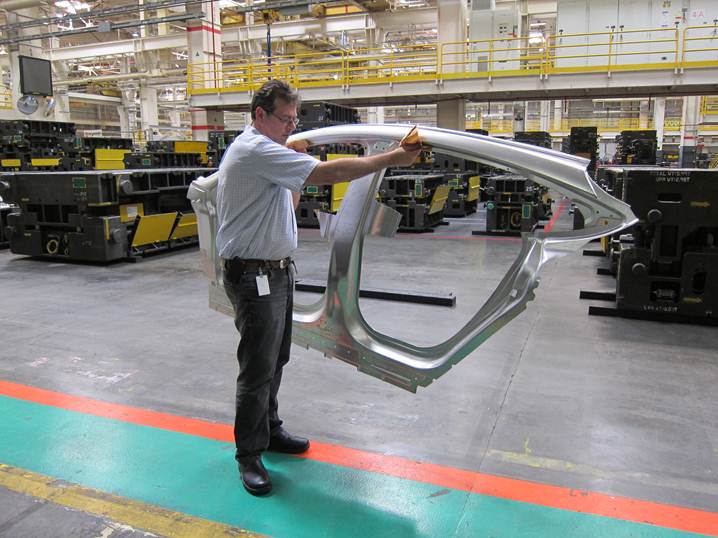
I visited the factory on June 14 and Gilbert Passin, VP of Manufacturing at Tesla gave me a fascinating two hour tour. He explained the process of making a Model S, from the stamping shop, where huge hydraulic press machines stamp sheets of aluminum into 3-dimensional fenders, hood panels, doors, and roofs; to the quality testing where the paint work is meticulously checked and recycled water is used to test each model’s watertightness.
At the stamping shop, Passin says, “These parts are extremely critical because it’s like the foundation of what makes a good car…See the robot is actually picking up the part in slow motion to make sure that everything works well…you don’t want anything to break.”
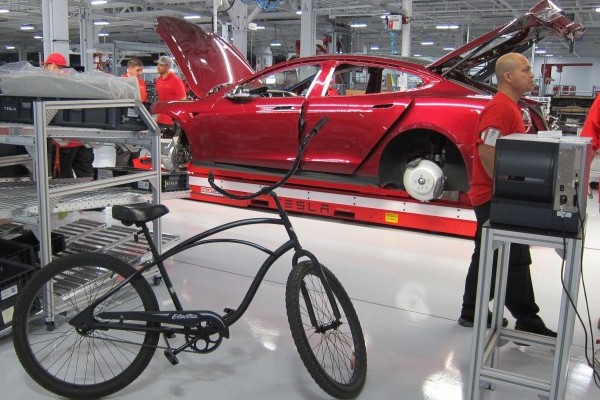
Shiny red robots and red T-shirt clad employees work hard at the factory: stamping, assembling, welding, painting and testing. The release of the first ten Model S Sedans is a big milestone for this innovative company. We talk to Charles James Lambert, who is a team leader working on the stylish and unique door handles Tesla manufactures at the factory. “I’m building a door handle that’s going on something fabulous to me: the model S…so sexy to me, the car, right?” he says. “That we have a door handle that responds. It’s pure elegance to me.”
Steve Jurvetson, a Tesla board member, snagged the very first prelaunch Model S (Elon Musk had to wait for number 2) and raves about it with the wide-eyed glee of a teenager describing his first set of wheels. “It’s kind of like driving in a hyper space portal to the future…” says Jurvetson.
Yet this futuristic car, that accelerates 0-60 in 4.4 seconds, does so in a whisper, not a roar. Jurvetson argues that silent is better. “It’s like saying I sleep better when there’s industrial noise going on outside my house, really?” he says and suggests that for drivers who miss the roar of an internal combustion engine, downloadable sounds might be the answer… “People can make it sound like whatever you want. You know, Harley Davidson: “huff pwuffpwuff pwuff.” Fine…just dial it up…blast your ears out…who cares?” he says.
Jurvetson, a Silicon Valley venture capitalist, sincerely believes that all vehicles will be electric one day and Tesla will lead the way. “I love what it represents: emblem of the future and a symbolic step towards a oil-free economy.”
The Model S is phase two of Elon Musk’s masterplan to disrupt the car industry and create efficient sustainable transportation. In 2008, Tesla released the Roadster, a high-end electric sports car priced at over$100,000. With the Model S, Tesla has made a more affordable car, and a year or two after its Model X comes out in 2013, aims to produce a 3rd generation model for $30,000. An electric car “for the masses.” Tesla has already catalyzed an industry shift. Today most major car companies are releasing electric or hybrid models. “Even some of the biggest competitors – the gas burning giants of the past – have admitted that they kicked off their electric vehicle program because they saw what Tesla did,” says Jurvetson. “Management said: this little company in CA is doing it, why can’t we?”
Tesla may be a trailblazer, but it faces a bumpy road ahead. Those shorting the stock (betting that the stock will fall in value on the Nasdaq) have a bearish reaction to Tesla’s high debt levels, tough competition and uncertain prospects for mass-market adoption. But it’s more than just the scrappy startup -the Millennium Falcon (Star Wars)- against the Empire (GM, Ford et al). Damon Lavrinc, Transportation Editor for Wired Magazine explains, “The established players don’t like to be challenged on their own home surf.”
He argues that to succeed, Tesla must address both range anxiety and charging time challenges. Price is also an issue. The 150-mile range car may have a base price of $50,000 after federal rebates. But for the fully loaded 300-mile range model, you’ll pay closer to $100,000. California buyers also get a state rebate ($2500) plus those precious carpool stickers. “Once we can get that price of entry lower, once we can get that battery capacity larger, that’s when it’s really going to take off,” says Damon Lavrinc. So far, Tesla has 10,000 reservations for the Model S and will deliver about half this year, ramping up to 20,000 in 2013, if the orders continue to come.
Experts compare it to the BMW 5 Series, but Tesla’s VP of Manufacturing explains its edge. “We’ll change the world by bringing a product that’s extremely efficient, very clean for theplanet, extremely fast, extremely comfortable…extremely beautiful,” says Passin. But Tesla has to get it right the first time, there’s no room for error.
Back in the Tesla Factory, at the end of our tour, Passin explains, “The car has to be finished, has to be perfect, the people working here know this is the end of the line, so it has to be good.” Although these challenges seem formidable, Elon Musk is attacking them like a true tech superhero, channeling the wild ambition of Steve Jobs and his obsessive search for perfection. Musk reportedly works 80-90 hours a week, splitting his time between Tesla and his space exploration company, SpaceX. Elon Musk was reportedly the inspiration for the Iron Man movies. “He may have superpowers, I don’t know,” says Passin, chuckling.
Last month, Musk proved naysayers wrong with his historic SpaceX Mission to the international space station. Can he do the same for the Electric Vehicle market? So much depends upon the successful launch of the Model S sedan. Damon Lavrinc of Wired Magazine sums up what’s at stake: “It’s not just so much a make or break it for Tesla, it is very much a make or break it for the entire electric vehicle industry.”
On Monday, I checked out the very first Tesla Model S at Sandhill Road, Silicon Valley. Steve Jurvetson, a Tesla board member is the proud owner.
Hoping for a splendid drive along 280, I was disappointed when Jurvetson said he’d promised the Tesla team that there’d be no test drives until the official release on June 22nd. Not even a wee tour around the parking lot.
But I did get a detailed tour of the car’s interior and will be reporting more details soon about Jurvetson’s car and my fascinating two-hour tour of the Tesla Factory, here and on NPR’s KQED radio.
You’ll notice that there’s no tailpipe on the car. All electric, zero emissions.
Note the acceleration patterns. The Model S generates electricity when you take your foot off the gas pedal.
Read transcripts, see photos and check out our ARCHIVES featuring exclusive interviews with Tom Friedman, Paul Krugman, Vinod Khosla and many more green experts and visionaries…
Join the conversation at our Fresh Dialogues Facebook Page

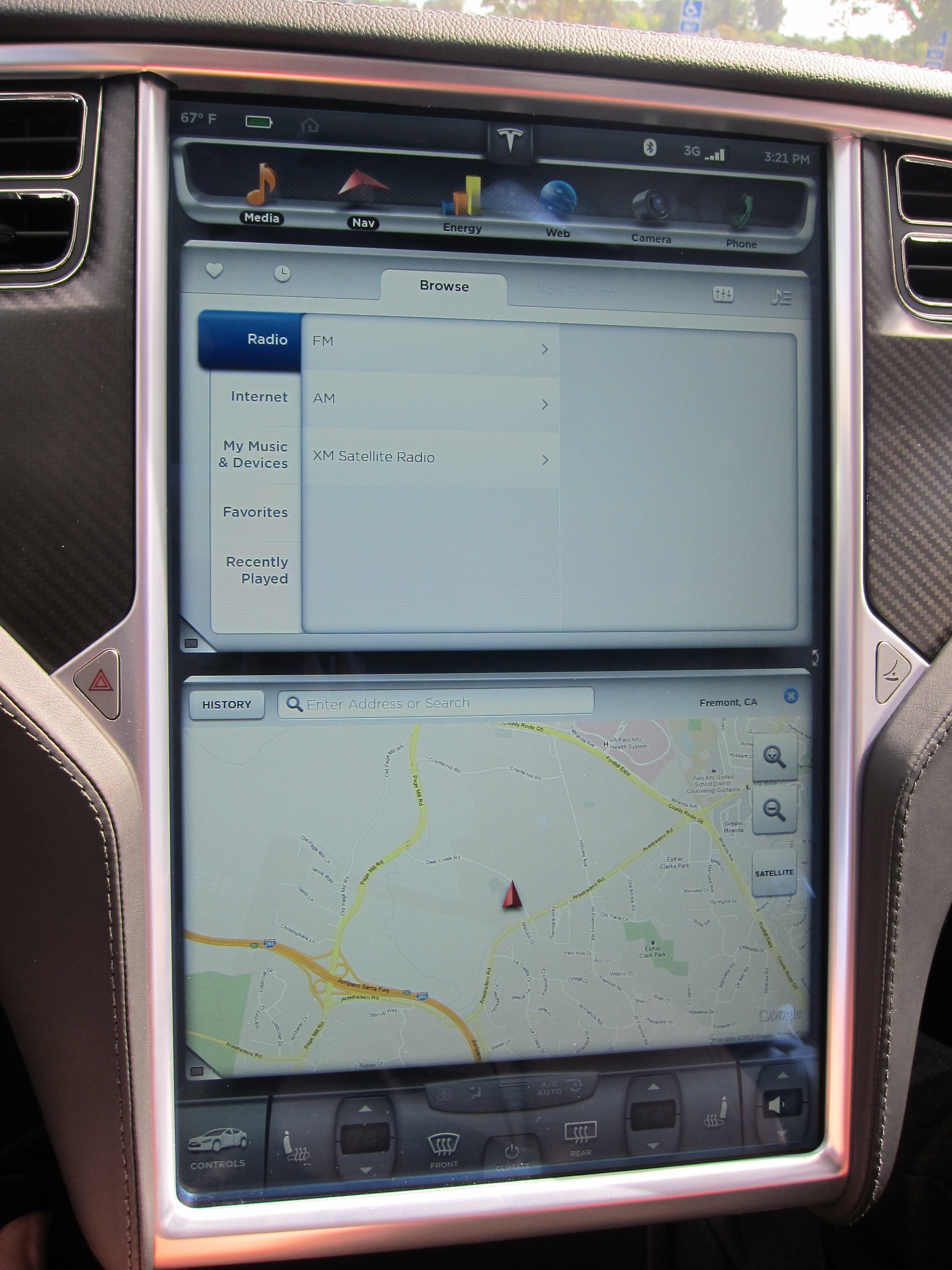 The massive 17-inch touch screen looked like it could be a major driving distraction, but having experienced its utility, I’m more appreciative. Glad to see that most functions can be controlled from the steering wheel, including the impressive sound system. Spinal Tap fans will be delighted to learn that the volume goes to eleven (really!); a spec no doubt dictated by Tesla product architect, Elon Musk with tongue firmly in cheek.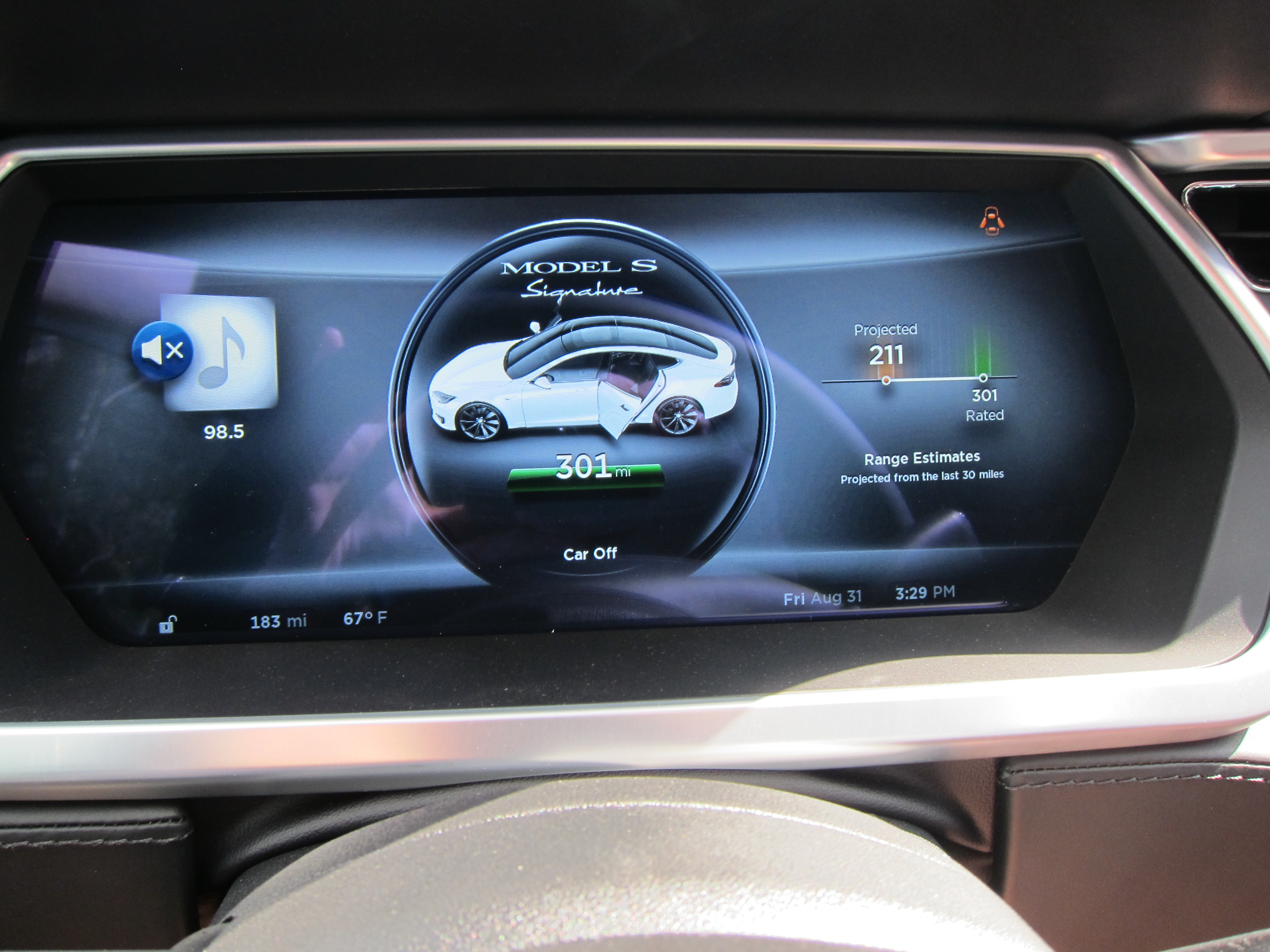
 2. When you get in the car and sit down in the driver seat, the car switches on. Touch the foot break and the motor is on and ready to go. But when you stop, it feels disconcerting not to have an “off” button. Say you pull over to make a phone call… or enjoy the sunset? I’d be more comfortable knowing this super powerful motor is definitely off. And isn’t suddenly going to take off….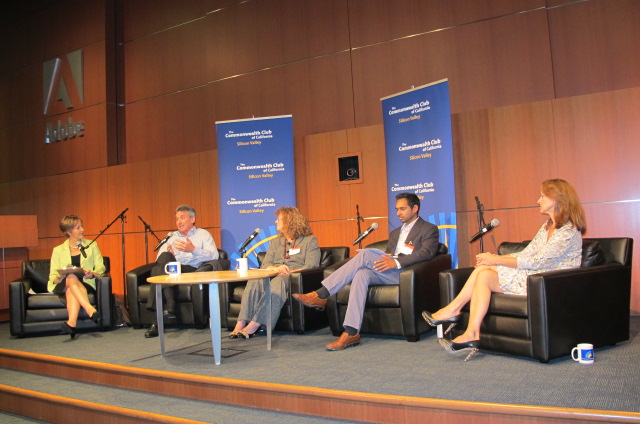
 On Solyndra