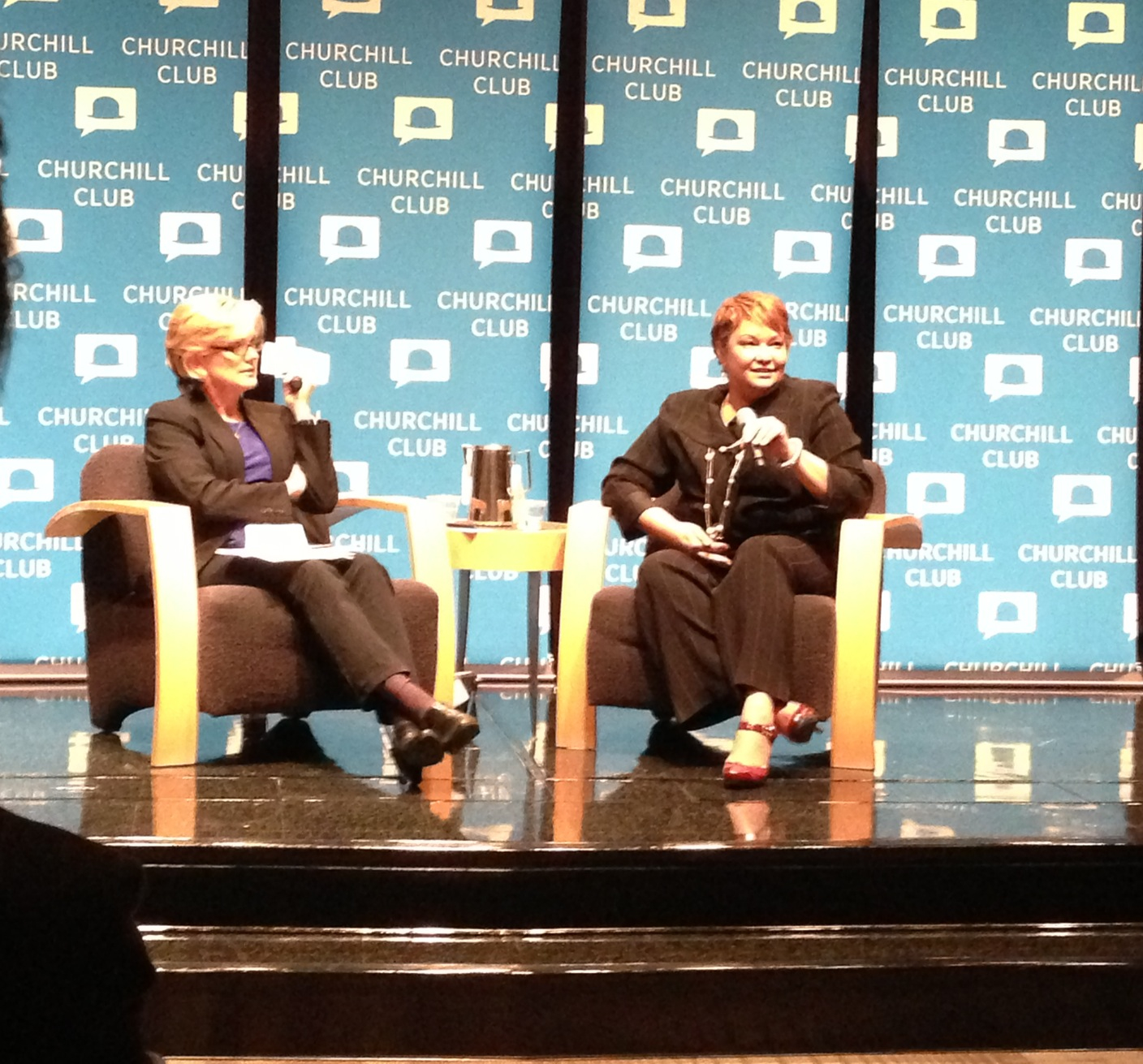
Environmental policy was front and center Tuesday evening at the Churchill Club in Silicon Valley as EPA Administrator, Lisa Jackson took the stage with former Michigan Governor, Jennifer Granholm. Fracking and the proposed Keystone pipeline were hot topics during the lively discussion.
In December, Jackson announced that she will leave her post after four tumultuous years in DC and didn’t rule out running for elected office. Speculation is rife about her running for Governor of New Jersey.
On Fracking
“It can and should be done safely..I’m enough of a scientist to say: the verdict is not in yet. We need more data.”
On the Keystone Pipeline
“I will be gone (from the EPA) before a decision is made. A revised environmental impact study will be done, then public feedback, then President Obama will decide ‘if it’s in the national interest’. This will take into account pollution, groundwater, and the economic perspective. It’s too soon in the process to say (if it will get the green light).
A Price on Carbon?
“The current climate doesn’t lead me to believe there will be a national law soon. But that doesn’t preclude state action (such as California’s), and the private sector, where important progress can be made.”
Jennifer Granholm, who was a strong advocate for cleantech during her eight year tenure as Governor of Michigan added, “The Federal Government could offer a pot of money to incentives states to take action and stimulate progress from the bottom up.” She likened her idea to the “Race to the Top” program for education.
On Green Innovation and the Role of the EPA
“The EPA can level the playing field by setting emissions standards and goals which stimulate the private sector to compete and beat them. It often costs less than EPA estimates, due to private sector innovation. But the private sector needs uniform and not patchwork standards…”
“The EPA works for all the American people, not special interests…it’s not a zero sum game. For it to succeed no one needs to lose. There are win/win strategies. Regulations need to be enforced. The work we do is vital and sacred.”
On Science and Climate Change
“I am a scientist and at the EPA we have more scientists than any other Federal agency except NASA…We face a roll-back in the Clean Air Act. Be aware that consensus is enough – unanimity is not required or you’ll miss the window for action.”
There was a vocal climate change skeptic in the audience whom Jackson addressed directly saying he wasn’t representative of the majority of Americans.
On her Greatest Achievements at the EPA
“The endangerment finding made pollution actionable…and we raised fuel efficiency standards.”
As Dana Hull explains in the Mercury News, during Jackson’s tenure, the EPA finalized its endangerment finding which authorizes it to take reasonable efforts to reduce greenhouse gases.
The event was hosted at the Microsoft Campus in Mountain View by Rob Bernard, the company’s green czar.
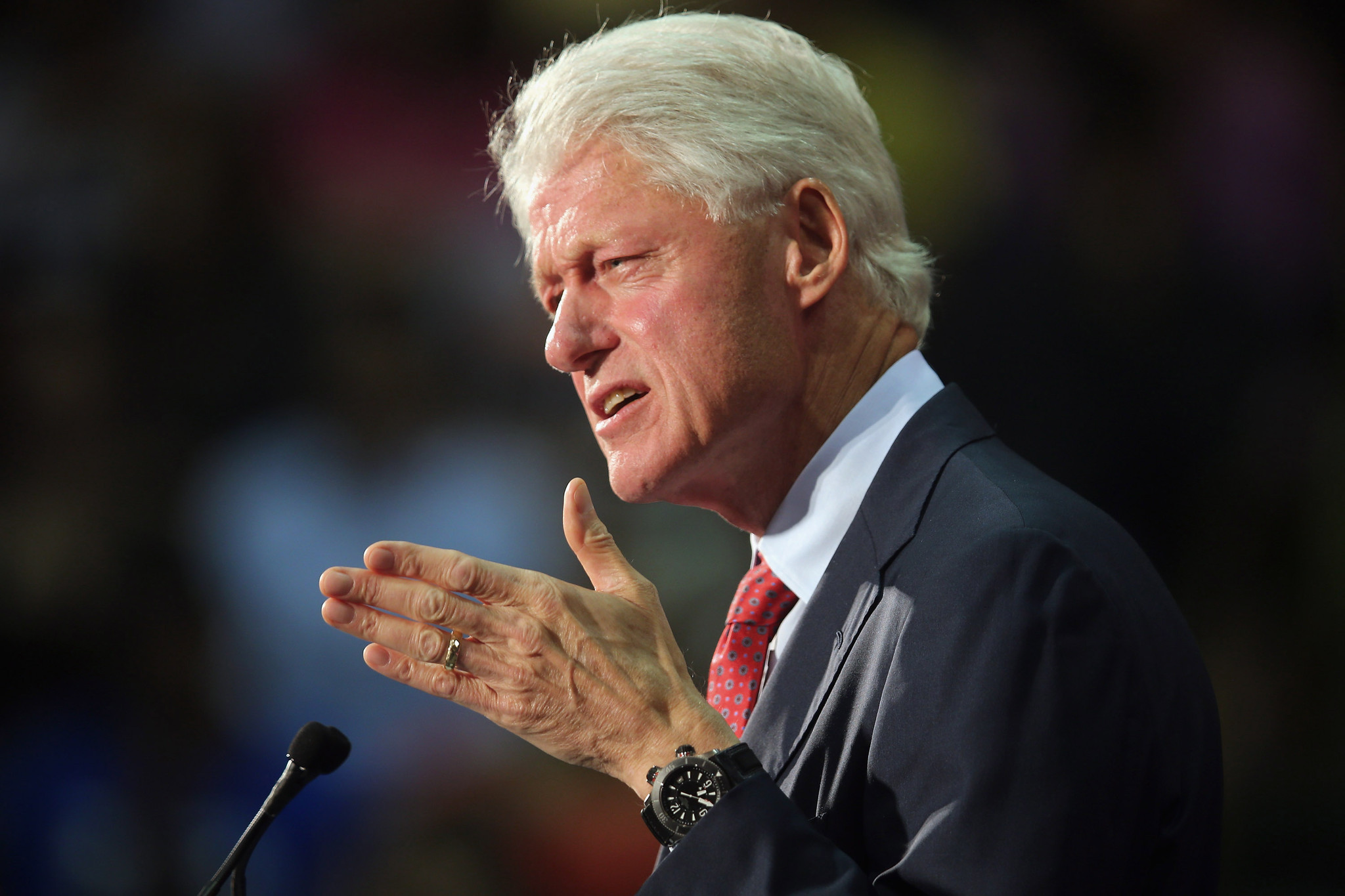
On December 7, President Bill Clinton appeared at Celebrity Forum in Silicon Valley and talked at length about climate change, referring to Berkeley scientist Dr. Richard Muller as “a hero of mine.”
You may recall Dr. Muller, the self described “former skeptic” who frequently emphasized the fallibility of research on global warming and was funded by the Koch Foundation. But last summer, after thorough research with the Berkeley Earth project, he announced his dramatic conversion in an Op-Ed in the New York Times. He now concludes that global warming is happening, and that humans are essentially responsible for all of the warming in the last 250 years.
I happened to be sitting next to Dr. Muller last week, and although he was whisked backstage by some big secret service staffers after Clinton’s speech, he agreed to answer a few Fresh Dialogues questions by email about his research and how he feels about hero worship by number 42.
You might be surprised to learn three things about Dr. Muller:
1. He says Hurricane Sandy cannot be attributed to climate change.
2. He suggests individually reducing our carbon footprint is pointless – we need to “think globally and act globally” and encourage the switch from coal to gas power in China and developing nations. He’s a fan of “clean fracking.”
3. He says climate skeptics deserve our respect, not our ridicule.
Muller hopes that Berkeley Earth will be able to coordinate with the Clinton Foundation on their mutual goal of mitigating global warming.
Here’s our interview: (it also appears at the Huffington Post, together with a lively debate)
.
van Diggelen: You wrote in the New York Times that the Berkeley Earth analysis will help settle the scientific debate regarding global warming and its human causes – how so?
Muller: Science is that small realm of knowledge on which we can expect and obtain agreement. I felt that many of the skeptics had raised legitimate issues. They are deserving of respect, not the kind of ridicule they have been subjected to. We have addressed the scientific issues in the most direct and objective way, and just as I have adjusted my conclusions, I expect that many of them will too.
van Diggelen: Regarding the human cause of global warming, you say that your conclusions are stronger than that of the Intergovernmental Panel. You concluded “essentially all of this increase in temperature results from the human emission of greenhouse gases.” The panel said “most of the warming.” Why is this significant?
Muller: The IPCC said “most of the warming” (meaning 51% or more) for the past 50 years. They could not rule out an important role from solar variability. We say essentially all of the warming of the past 250 years. Our analysis allows us to make a better prediction for the future since it does not have confusion from a solar component.
van Diggelen: What’s your message to climate change skeptics?
Muller: Most of your skepticism is still valid. When something extraordinary happens in weather, such as the accidental occurrence of Hurricane Sandy hitting New Jersey and New York City just at the peak of tides — many people attribute the event to “Climate Change.” That’s not a scientific conclusion, and it is almost certainly wrong. Hurricanes are not increasing due to human causes (actually, they have been decreasing over the past 250 years). Tornadoes are not increasing due to human causes. (They too have been decreasing.) So please continue to be skeptical about most of the exaggerations you will continue to hear! Proper skepticism is at the heart of science, and attempts to suppress such skepticism represent the true anti-science movement.
However, we have closely examined the evidence for temperature rise, and there are several conclusions that are now strongly based on science. The temperature of the Earth has been rising in a way that closely matches the rise in carbon dioxide. The history of solar activity does not match the data at all. Based on this, the human cause for this warming is strongly indicated. Read our Berkeley Earth papers and see if your objections are answered. I believe that the key objections have all been addressed. Based on this, you should consider changing your skepticism on global warming, even if you are properly skeptical about all the claims that are lumped together under the rubric of “climate change.”
van Diggelen: You’ve said that the difficult part is agreeing what can and should be done about climate change…any suggestions?
We need to recognize that the greatest contributors to climate change in the coming decades will be China, India, and the developing world. Thus any solution must be focused on realistic actions that they can take. The Clinton Foundation is doing wonderful work on energy efficiency and energy conservation, and working closely on this with the developing world. The only other action that we can take that could be equally important over the next 20 to 30 years is to help them switch from coal to natural gas. (For the same energy delivered, cleanly-produced gas creates only half to one third of the greenhouse emissions.) This was the subject of my WSJ Op Ed with Mitch Daniels. It is also discussed in detail in my new book “Energy for Future Presidents.”
van Diggelen: What are YOU doing to reduce your carbon footprint?
Muller: I am trying to get people to stop asking that question! It is very misleading. This is a problem in which we need to think global and act global (NOT local!) Reducing our own footprint, if it is done in a way that will not influence China and the developing world, is not a worthwhile action. It may make us feel good, and then in the future after the world has warmed (because our actions were not something that China could afford to copy) we’ll be saying “at least it wasn’t MY fault.” Wrong! We need to be acting to help China and the emerging economies. Focusing on ourselves at home is a way of avoiding coming to terms with the problem.
van Diggelen: What should others be doing? If you could have President Obama’s ear for 5 minutes, what would you say?
Muller: Double (or more) our efforts to help China become more energy efficient. And equally important: develop “clean fracking” standards. Work with China to expedite and accelerate their switch from coal to natural gas. Devise market-based approaches that will guarantee that the developing world will apply clean methods to their natural gas production. Show leadership by approving a US move to nuclear power; reverse your unfortunate canceling of the Yucca Mountain waste storage facility. In the US emphasize technologies that can work in China (e.g. natural gas), not those that are too expensive (e.g. autos with costly lithium-ion batteries).
van Diggelen: Just how urgently is action needed on climate change?
Muller: We need to act, but no need to panic. I see no tipping points that are scientifically valid. Of course, we don’t understand the atmosphere and biosphere well enough to be sure. Rather than speed of action, the key parameter is finding solutions that are profitable — because those are the ones most likely to be applicable to the poorer nations.
van Diggelen: How do you explain Hurricane Sandy? Some scientists say it was exacerbated by climate change? Warmer oceans, more evaporation? Higher sea level swells?
Muller: None of the above. Hurricane Sandy was a freak storm that happened because a relatively small hurricane (it wasn’t even a category 1 storm when it hit New York City) veered towards the coast during a very high tide. None of the causes of the damage can be attributed in a scientific manner to climate change.
The word “scientific” in that last sentence is very important. Many of the critics of the skeptics claimed that the skeptics were not being scientific. Yet that is also true of the alarmists. There is an unfortunate tendency, when the issue is very important (as in climate change) to abandon science and work from gut feelings. No, that is a mistake; when the issue is important, then it is most urgent that we stick to our science! We must be objective!
Hurricane Sandy cannot be attributed to global warming. The rise over the oceans, in the last 50 years, has been about 0.5 degree C. That’s tiny! In those 50 years, sea level rose by 4 inches. So the high tide, if not for global warming, would not have been 14 feet but “only” 13 feet 8 inches. There was a similarly severe storm in 1938 (my parents lived through it out on Long Island). We should stop attributing all freak storms to climate change. This is an important issue, so let’s emphasize the science.
Unfortunately, there will always be scientists with some credentials that will exaggerate, maybe even convincing themselves. I recall back in the 1950s, when I was a kid in New York City, that the freak storms and changes in climate were attributed by some eminent scientists to atmospheric nuclear testing. (Maybe the freak storms and changes in climate should now be attributed to the nuclear test ban.) It is not science to list the bad things that have happened lately and claim that they “may be linked” to climate change. Even scientists, such as those who were passionately afraid of thermonuclear war, tend to see connections in things that aren’t there.
Climate change is real, and we need to do something to stop it. But it is not strong enough (0.6 C in the last 50 years) to be noticeable by individuals. It takes scientists analyzing large amounts of data to see it. (A statistical analysis of hurricanes shows that they have actually been decreasing in number that hit the US coast over the past 150 years.) That gives us a good idea about what has been happening, and allows us to make predictions for the future. Those predictions are worrisome enough that we should act — always remembering to keep our focus on China. But let us not be deluding into thinking that every extreme event is evidence supporting our worry.
van Diggelen: How did it feel to be called a hero by Bill Clinton?
Muller: I didn’t know whether to correct him or just feel awed. President Clinton is the true hero for his fantastic foundation, and for addressing many of the most serious problems in the world, from AIDS to clean water to ending poverty.
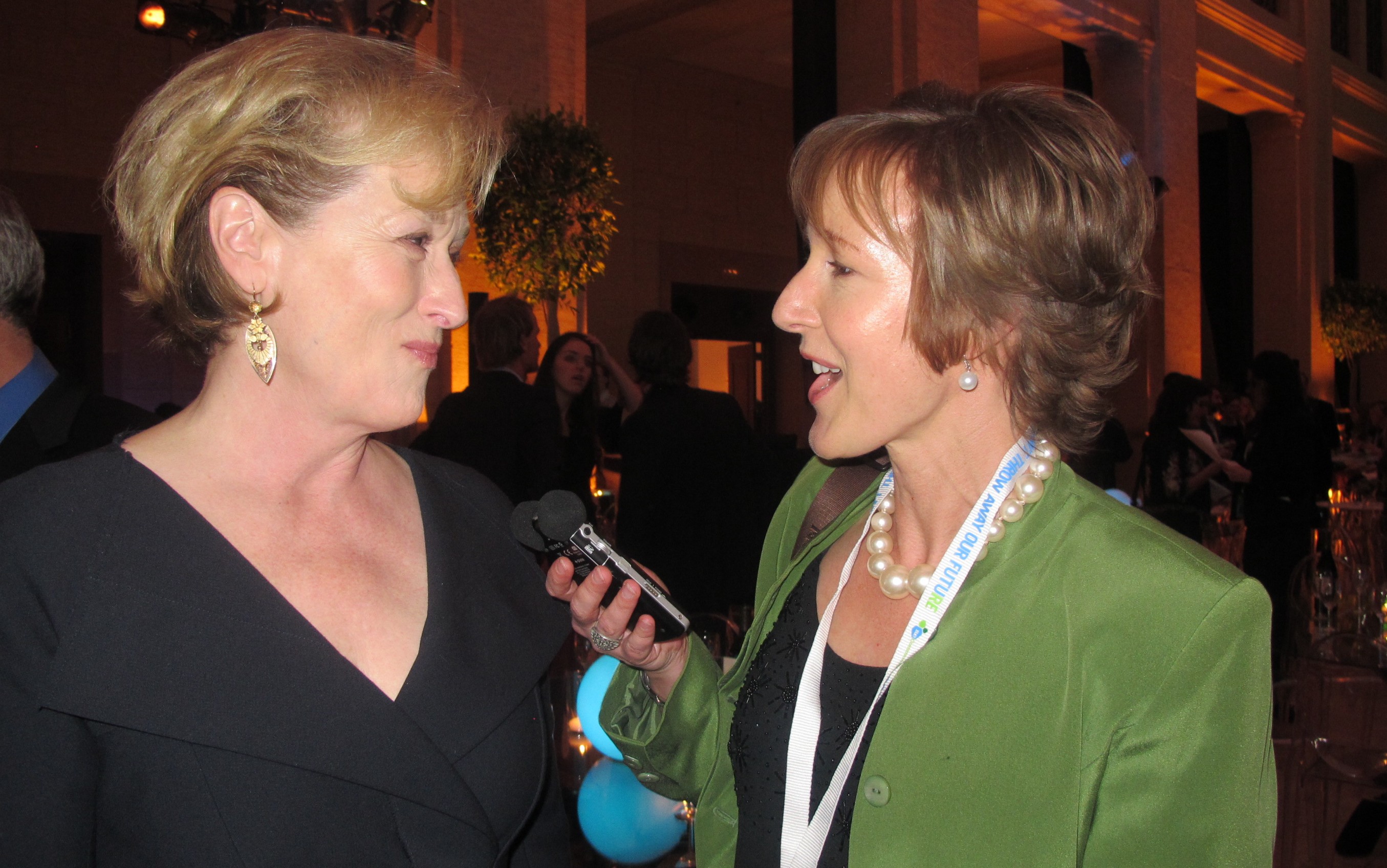
The first thing that strikes you about Meryl Streep is her grace and poise. Like a true royal, she glided into the throng of green designers and architects gathered at the Cradle to Cradle Products Innovation Institute Gala in San Francisco this week, completely unruffled by the crush of fans; the flash of cameras and smart phones; and the fierce security guards. Yet instantly, like a chameleon, Streep can switch from serene queen of the movies to cozy confidante. I found myself standing next to her and shook her hand. As you know, she’s renowned for her authentic accents in every exotic role she’s played, so I asked her, “Can you do a good Scottish accent?” She immediately leaned over and whispered in my ear, “I love the way they say murdererrrr!” Rolling those r’s as only a lass from Scotland – or Meryl Streep – can do. Then she laughed with that infectious burst of effervescence. Now that would make even The Iron Lady melt a wee bit.
But enough trivia. The best part is, I found her later that evening and she agreed to a Fresh Dialogues interview. We had a lively conversation about her green design guru and close friend William McDonough; and why she’s become an activist for the environment. Enjoy her hilarious tribute to McDonough below and check out the highlights of her interview…
Interview highlights
Why should we care for the environment?
We’re all part of the ecosystem. We’re all connected. You can’t go around in a bubble…
On why Bill McDonough inspires her
Unlike so many environmental messages which are negative: “don’t this…don’t that!” Bill approaches things in a positive, restorative, beneficial way…with a focus on abundance. His mantra is a beautiful thing: “Designing a safe, healthy and delightful world for the love of all children, for all species, for all time.”
He’s a fervent optimist. His cup is never half empty or even half full. It’s always full of water and air. We were both profoundly affected by similar things: Silent Spring (the book by Rachel Carson) and concern for the impact of toxins on children. He’s the consummate multi-tasker. He leaves me breathless.
On the roots of her environmental consciousness
It all goes back to being a mother. That’s the most invested relationship. You pay attention, perhaps for the first time. What is going in your child’s mouth? What’s her environment like? What will the future be?
In 1989 Streep cofounded “Mothers and Others” to raise awareness of toxic pesticides used in food production.
On how playing acclaimed chef, Julia Child influenced her green journey
We need to think about the provenance of our food. Where does it come from? Is it produced locally and with concern for the environment?
During her hilarious speech in San Francisco, Streep praised the work being done by Brad Pitt, William McDonough and Tom Darden through the Make it Right Foundationin New Orleans and beyond. The group began building green-designed houses for low income families displaced by Hurricane Katrina in 2008.
Does Streep consider herself a green activist?
In an interview with USA Today, she said, “We are all activists every day that we make a purchase. We vote daily with our credit cards; we demonstrate with our dollars.”
Today Streep helps raise awareness of toxins in food and the environment by supporting the work of the Children’s Health Environmental Coalition and is known to shop at Whole Foods and prefer locally produced goods. Her home in Connecticut is fueled by geothermal power.
We were delighted when Meryl Streep agreed to a Fresh Dialogues interview last month in San Francisco. We had a lively conversation about why she’s become an activist for the environment.
Meryl was charming and generous, but I left the interview feeling that I’d just talked with Margaret Thatcher’s younger sister. Perhaps my British accent sparked the Queen of accents channeling her inner Iron Lady?
Interview highlights
Why should we care for the environment?
We’re all part of the ecosystem. We’re all connected. You can’t go around in a bubble…
Unlike so many environmental messages which are negative: “don’t this…don’t that!” Bill approaches things in a positive, restorative, beneficial way…with a focus on abundance. His mantra is a beautiful thing: “Designing a safe, healthy and delightful world for the love of all children, for all species, for all time.”
He’s a fervent optimist. His cup is never half empty or even half full. It’s always full of water and air. We were both profoundly affected by similar things: Silent Spring (the book by Rachel Carson) and concern for the impact of toxins on children. He’s the consummate multi-tasker. He leaves me breathless.
On the roots of her environmental consciousness
It all goes back to being a mother. That’s the most invested relationship. You pay attention, perhaps for the first time. What is going in your child’s mouth? What’s her environment like? What will the future be?
In 1989 Streep cofounded “Mothers and Others” to raise awareness of toxic pesticides used in food production.
How did Julia Child influence her? Click here for more interview highlights.
Check out the video of Meryl Streep’s hilarious tribute to Bill McDonough.
Last week, Fresh Dialogues visited PlanGrid, the recent Y Combinator startup winner that’s tackling what some call the “insane paper” problem that the construction industry produces. Computer-Aided Design (or CAD) works well as a green and efficient solution for the design phase, but once on the field, architects, site managers and construction supervisors still have to lug around giant reams of blueprints. Thirty year old CEO Ryan Sutton-Gee explains how he had a lightbulb moment when the iPad came out and COO Tracy Young demonstrates their solution. Using the cloud, PlanGrid can upload up to 60,000 blueprints to an iPad, and enable construction teams to edit, update, tag photos and instantly share information as construction progresses. Sutton-Gee likens the on-site photo tagging ability to Instagram, with automatic uploads allowing construction teams to verify time, date and location information at each stage in the construction.
Here are some highlights from my conversation with Sutton-Gee and Tracy Young:
On the Paper Problem
“Our estimate is that $4 Billion was spent in 2011 just on paper in construction alone, which is a ridiculous. It’s an insane about of paper. It’s an insane amount of trees.”
On the PlanGrid Solution
“There are the hard cost savings of reducing paper and then there are the soft cost savings of saving time and reducing rework. On several projects, we’ve reduced the paper consumption by 90%.” PlanGrid CEO Ryan Sutton-Gee
“You could fill up all of downtown San Francisco with paper – that’s how many trees we’re saving.” PlanGrid COO Tracy Young
On Silicon Valley
“We are being used by very large Silicon Valley companies – that everyone is familiar with – to build some of their office spaces. (Apple’s new campus perchance?) People in Silicon Valley are always up with tech. They’re the early adopters in everything, including us.”
On Y Combinator and Startup Advice
“It was really great with Y Combinator. The most important thing that took a while to realize is that it’s actually not that risky…Even if everything had gone totally wrong for us, at worse I would have spent six months working on something I was really passionate about…That was the opportunity cost… If you’re in an industry and there’s a huge problem and there’s a technically feasible solution…go for it!”

 van Diggelen: Regarding the human cause of global warming, you say that your conclusions are stronger than that of the