Here come China’s tech giants. Last week, Alibaba and China’s Twitter-like Weibo announced massive IPO plans. Today, in Silicon Valley, China is front and center in the news. Let’s take a closer look at Chinese entrepreneurship in Silicon Valley. How will it change the tech innovation capital of the world? And will a longer term view take hold?
A version of this story aired on BBC’s Tech Tent on March 14, 2014. Listen to the podcast below: @17.35
The latest wave of Chinese immigrants to Silicon Valley is impacting everything from the housing market to the way business is done in the high tech capital of the world.
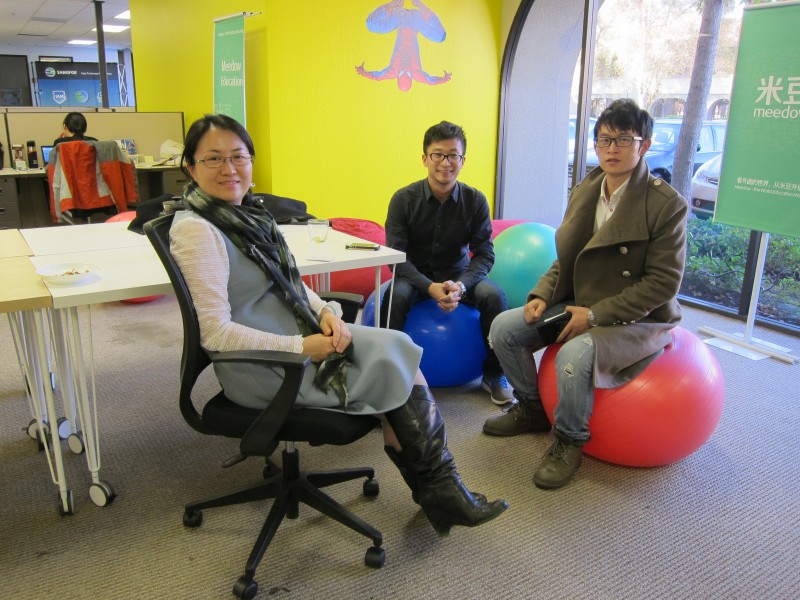
Ching-Lun Lin, student at Carnegie Mellon SV
Image 1 of 10
Banner says "Work harder!"
Stuart Evans, a Brit who arrived in Silicon Valley 30 years ago, has been studying the unique ecosystem of Silicon Valley for decades. Today, he teaches entrepreneurship at Carnegie Mellon Silicon Valley, and says he’s seen a sevenfold increase in student applications from China and South-East Asia in the last year.
Evans: “It’s been like a racehorse that’s been choked back in the stalls and now the gate’s open and the race is away.”
He’s witnessed millions of dollars from Chinese tech giants flooding into Silicon Valley startups; and incubators popping up for entrepreneurs arriving from Chinese tech hubs in Beijing and Shanghai. In Palo Alto, home of Stanford University, the number of home purchases by Chinese nationals has tripled since 2011. A local realtor recently reported that for every seven offers for a home, three of them will be cash offers from Mainland China. As well as teaching, Evans mentors young entrepreneurs at Innospring, a Silicon Valley based incubator that offers advice, funding and partnerships to fledgling Chinese startups and American ones seeking to expand in China. Here’s how he describes his role:
Evans: “A bouncing board to bounce ideas…to critique, to make connections, to suggest better ways to go about doing things.”
Better ways, and American ways. For example, he’s had to help young Chinese entrepreneurs adapt to the strict American legal system and US privacy concerns. Evans recalls telling a Chinese student that he might run into legal liability and privacy issues his new device for a car steering wheel.
Evans: “It seemed at first to hit a raw nerve…’Why not? Why don’t we just do it anyway?’ …was the entrepreneur’s initial response. Yet Evans found that they did eventually come round to an Americanview of the world.
Evans: “When you reason with people and show them the implications, they very quickly respond and come up with inventive solutions.”
Evans points out that there is no work/life balance in Silicon Valley: your work is your life. He says that fits well with the Chinese mindset and intense work ethic. It’s intensely competitive to get into the best schools in China.
Evans: “I’ve had students who would get up at 4 o’clock in the morning to be prepped before they went to school.”
Innospring founder, Eugene Zhang invites me to tour during a visit by a delegation of “20 under 20” college students from Jiangsu province in China.
Zhang: “Innospring is about capturing that positive energy…the big opportunities…the next Google or Baidu…the giants.”
So how are these Chinese entrepreneurs in Silicon Valley changing the way things are done? One of Evans’s entrepreneurs is Nan Zhong, cofounder of startup TIKL, a walkie-talkie app for smartphones. He describes a different mindset in the Chinese culture.
Zhong: “Letting go instant gratification is driven into my head…you go for what’s eventually going to be good for you, not necessarily what makes you happy at the moment.”
That long-term view colors the way Chinese entrepreneurs run their businesses he explains. They focus on growing market share and endure long-term losses to do so.
Zhong: “People take the pain, take the time, take all the hard work to grow an idea all the way to something that’s global.”
This contrasts with the short-term term view of many Silicon Valley startups, which often focus on being acquired or going public within two years. Evans agrees. In his experience, American and Indian entrepreneurs are generally happy to be acquired by companies like Google and Facebook; whereas his Chinese entrepreneurs prefer growth and autonomy, treating their startups like a precious baby.
Evans: “The idea of bringing up a baby and teaching it how to walk and learn as the company progresses is something that fits very well with the Chinese culture.”
Whether that longer term view takes root in Silicon Valley remains to be seen, but some influences already go both ways. Evans recalls the tale of a US colleague working at a startup in China who shocked his colleagues by cleaning up the tea cups on a Friday afternoon, a job typically done by the ‘ladies’ in the office, even the VPs. Gender and hierarchy boundaries were breached.
Evans:“It transformed the culture of the office with just that one act (finger click) and sent a message that this new way of doing things has implications.”
van Diggelen: “Do you think that’s rippling beyond that startup?”
Evans: “Yes, Silicon Valley is culturally diverse, intellectually homogeneous…it’s a heavily networked ecosystem and what works comes to the surface very quickly.” Instead of a clash of cultures at the surface, Evans says there’s a melding; creating what he calls ‘a global mosaic of talent.’ And Innospring is a focal point in that mosaic. Evans has witnessed a change in the way companies grow in Silicon Valley over the last 30 years. He points to the Chinese being an important part of the valley’s technical competency, with their strong math and software education, which increases opportunities for innovative collaboration.
Evans: “Even though they’re from a different culture and a different background, they speak the same language, technically.”
I suggest the melding that goes on in Silicon Valley in terms of innovation and business practices produces a special Asian Fusion, a bit like the fortune cookie, a Japanese-American creation, that’s largely known as “Chinese.”
Evans: “An Asian Fusion fortune cookie, wow (laughter)…at my age I try to steer clear of cookies…but the idea of fusion is something which is part of Silicon Valley’s DNA, it’s in the sharing and pooling of ideas that brings about the innovation in Silicon Valley.”
Find out more about Alison’s other contributions to and appearances on BBC
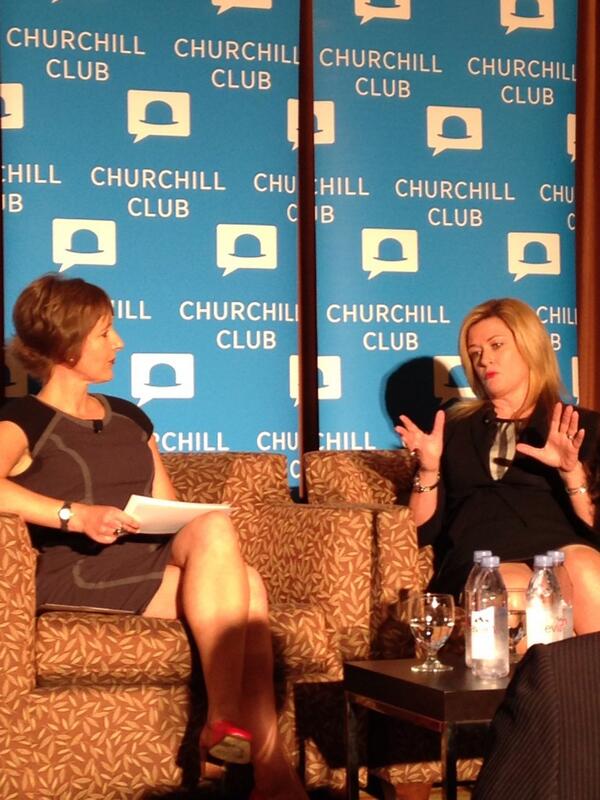
Will GM experts share their wisdom with Tesla to make the Model S less prone to fires? That’s the question I put to GM’s Chief of Electrified Vehicles, Pam Fletcher last week at the Churchill Club in Silicon Valley.
You’ve no doubt heard that three fires have been reported in Tesla Model S in the last five weeks. As we all know, three’s a trend. Granted, they weren’t episodes of random spontaneous combustion. Instead they were ignited by one high-impact crash and two high-speed encounters with metal debris which acted like a “pole vault” to puncture the undercarriage of the car and hence the battery. Although Tesla’s Elon Musk has declared, there won’t be a recall, it’s almost certain the National Highway Traffic Safety Administration will investigate. What needs to be done to make Teslas more impervious to battery puncturing road debris?
.
As you’ll see in the video, Pam Fletcher confirms that GM has sold 58,000 Chevy Volts since its launch in 2010 and after 300 million miles on the road, not one has had a similar fate to Tesla’s Model S. She acknowledges that there were fire issues in 2011 at the crash-testing phase, but emphasises no real-world incidents similar to the Model S have occurred.
Fires, Electric Cars and Achilles Heels
First some background. In 2011, safety regulators investigated Chevy Volt crash tests resulting in one battery pack catching fire and one smoking and emitting sparks. The troubling issue was the week-long delay between the crash test and the battery pack catching fire.
During our interview, Fletcher confirms that after the investigation, GM made no change to the battery cells, but did put “some additional reinforcement on the outside of the battery.”
It also implemented a process with first responders that includes depowering of the battery after a severe crash.
Ironically, Tesla got the highest safety ranking from regulators and has a first responders guide in place, however all parties seemed oblivious to the vehicle’s Achilles’ Heel. It obviously needs more durable undercarriage protection to prevent any more fiery “pole vaulting” episodes. To date, Elon Musk has been strongly resistant to such an approach. A recall will taint not only Tesla’s award winning brand, but entail extra costs and manufacturing delays for this relatively small auto company. To make matters worse, extra reinforcement will increase the weight of the Model S, and the extra pounds will have a knock-on effect on the vehicle’s range.
But it looks like Tesla’s Elon Musk may have to get some tips from GM on adequate car underbelly protection or find his own solutions.
It’s unlikely Tesla will change the configuration of its batteries. According to Reuters, Tesla’s battery pack stretches across the base of the vehicle and is made up of small lithium-ion battery cells, like those used in laptops. By contrast, GM uses large-format battery cells in a T-shape in the center of the Chevy Volt.
Fletcher was eager to move past fiery discussions and talk about adoption rates and “getting to scale.” She described the newly unveiled Cadillac ELR (a luxury electric hybrid based on the Chevy Volt) which will be available for test drives this week at the LA Auto Show. We also discussed autonomous cars, why EV adoption rates are so high in Silicon Valley; what to expect from the next generation Chevy Volt; and what surprised her about the thousands of Volt drivers on the road today.
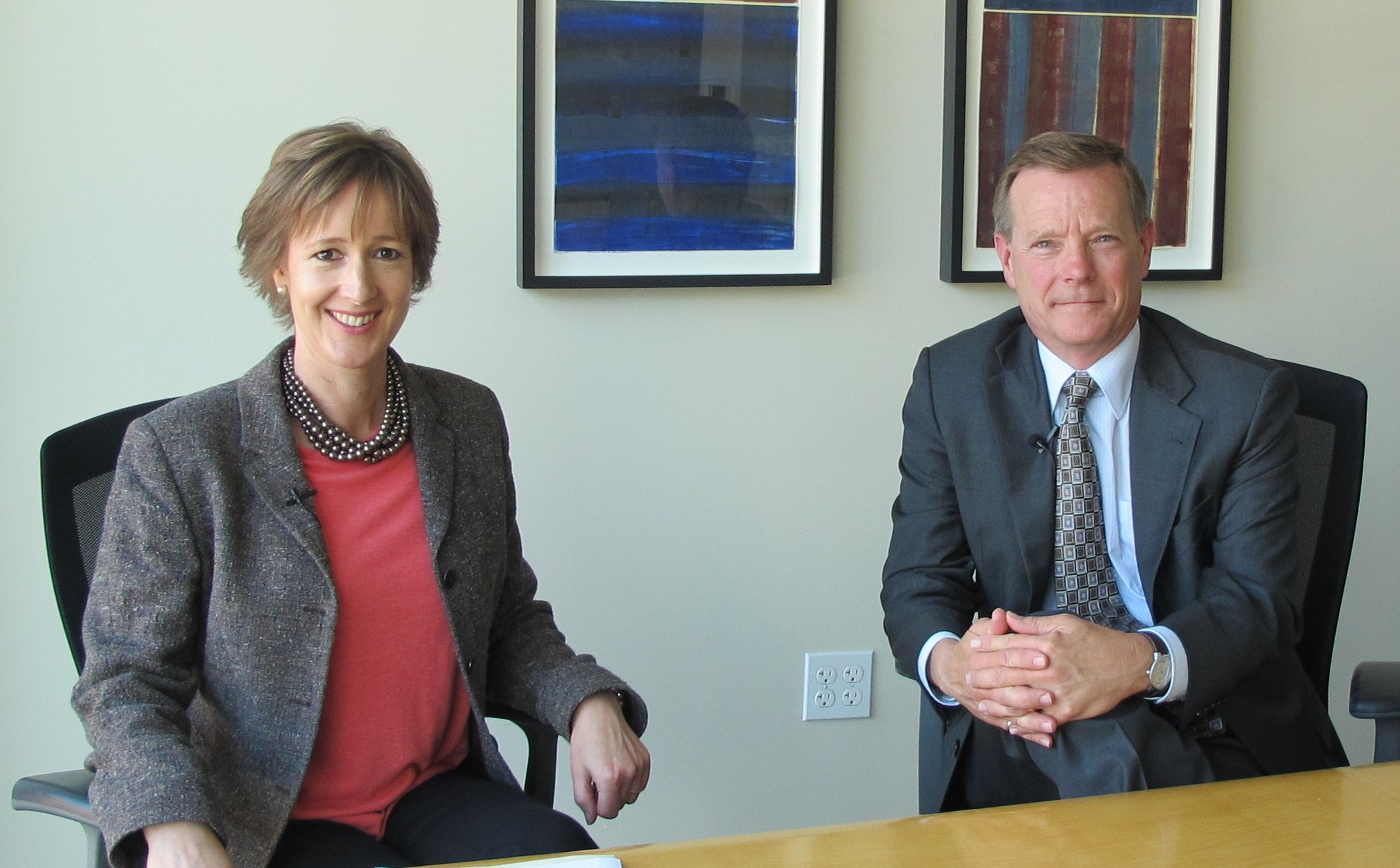
I sat down with Phil Williams of Webcor Builders to find out how the building industry is responding to climate change by quantifying a building’s environmental impact (water, CO2 production, etc) using Natural Capital Accounting (NCA).
“CFOs of major corporations are saying, ‘before it was random acts of greenness,'” says Williams. “Now I can start to measure our environmental impact.”
As he explains it, a global standard of measuring and quantifying a building’s impact can provide owners, renters, architects, and builders with valuable information with which to make key decisions about buying, renting, land use, building materials, energy systems etc.
Climate Earth’s White Paper “Valuing Natural Capital” states: “The objective of this project is to develop an estimate of the environmental costs of the greenhouse gas emissions, induced land use changes, and water consumption. For land use change and water consumption, environmental costs are dependent on where the activity takes place, and we developed local cost estimates to account for those differences. Greenhouse gas emissions are a global pollutant, and the costs are roughly indifferent to where the emissions take place, and so a single global number is sufficient to account for those costs.” The paper concluded that the Stern Review’s figure of $110/metric ton of carbon and carbon equivalent is appropriate.
.
.
“NCA takes some of those numeric evaluations – kilograms of CO2, liters of water, hectares of land – and puts them into economic evaluations that large corporations and nimble companies can look at, ” explains Williams. “These are not just environmental metrics, these are just financial metrics.”
He predicts that by the end of 2014, there will be recognized standards in Natural Capital Accounting for construction, apparel and other retail products.
Find out more about the Future of Natural Capital Accounting from the World Forum on NCA which takes place in Edinburgh, Scotland this November.
During our interview, Williams also explains the concept of making buildings “Future Ready” i.e. flexible enough to add solar, and other energy-making, energy-saving components after the building is completed.
“Future ready is a positive approach, it’s not about adding more, it’s not about ultimate flexibility,” says Williams. “It’s about providing the right amount of infrastructure to afford flexibility.”
This is part of a series on the Future of Green Building, sponsored by Webcor Builders. For more in the series, check out these videos and stories
Read more about Green Building stories featuring Meryl Streep, Susan Sarandon and Apple and by checking the Green Building tab above or clicking here
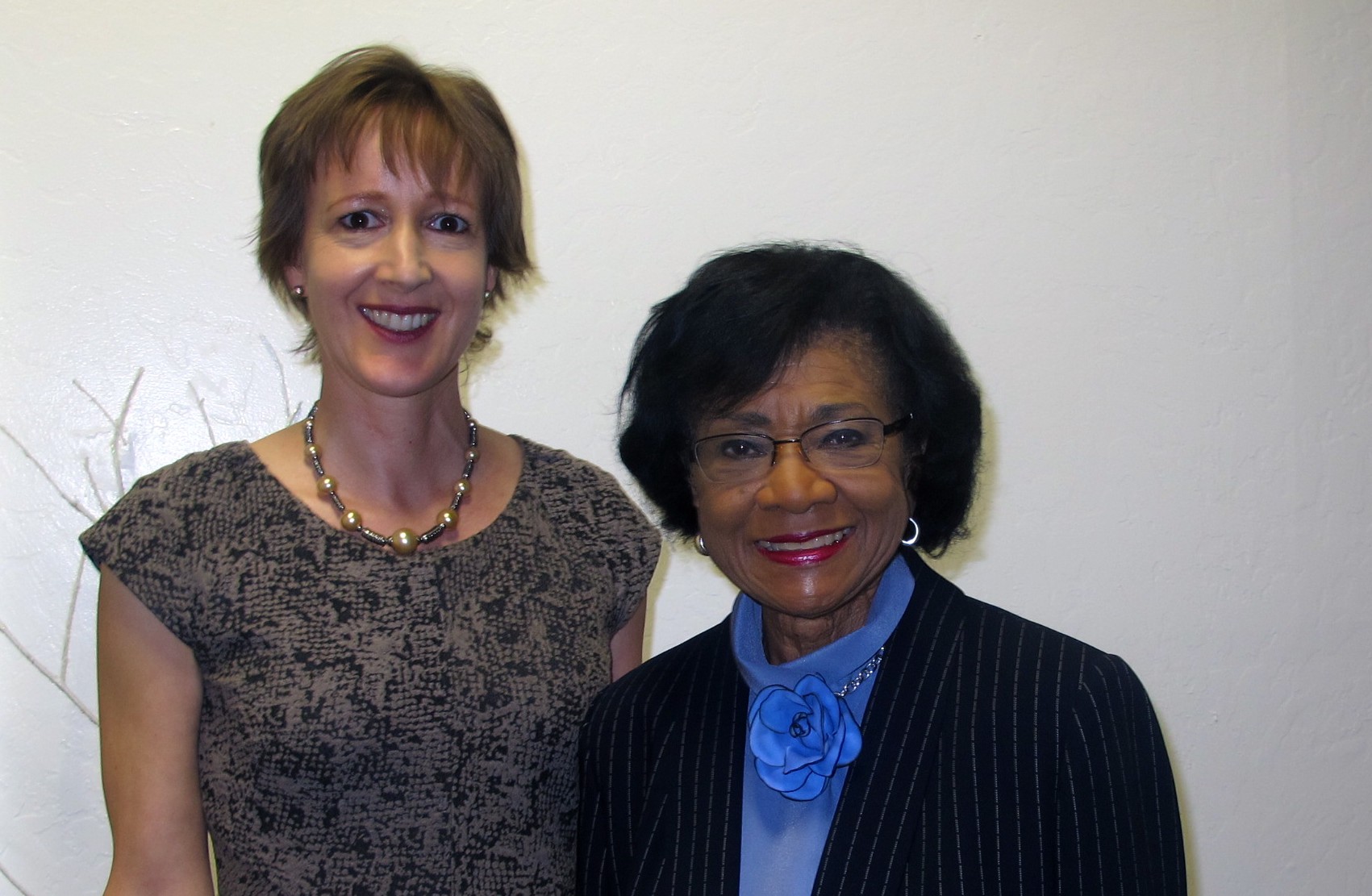
Fidel Castro, Muhammad Ali, Gloria Steinem. These are just a few of the icons that pioneering journalist Belva Davis has interviewed in over fifty years of reporting. This weekend, Davis receives the John F. Hogan Distinguished Service Award from the Radio Television Digital News Association (RTDNA) in Los Angeles.
Davis began her illustrious career in the 1950’s; became the first black woman to anchor the news on the West Coast and was host of KQED’s public affairs program, This Week in Northern California for almost 20 years. She talked to Fresh Dialogues this summer in Los Altos about why she admires PBS Newshour’s history making Judy Woodruff and Gwen Ifill; her memoir; and the need for both curiosity and passion in a successful career. Davis also explains her need to prove herself every day. “Go home if you don’t feel some sense of gratitude for the next day’s possibilities,” she says.
.
.
ALISON VAN DIGGELEN: Hello and welcome to Fresh Dialogues. Today I’m with pioneering journalist, Belva Davis. She has a new book and it’s called Never In My Wildest Dreams. Belva, thank you for joining me today.
BELVA DAVIS: Well thank you. This is a wonderful opportunity.
ALISON VAN DIGGELEN: So let’s talk about those wildest dreams. When did you feel your wildest dreams were coming true?
BELVA DAVIS: Definitely I know when I decided that this reckless course was the one I was going to take, and that is to try to break into television news reporting. And to do that without having an example of anyone that looked even slightly like me who was doing it, I think took quite a commitment, to say I’ll do what’s necessary…
ALISON VAN DIGGELEN: …And a lot of courage. So you really had no role models. Today we talk about role models and we can emulate this person or that. You had no one?
BELVA DAVIS: No one.
ALISON VAN DIGGELEN: If you were to go back to being 30 or 40 years old, what advice would you give yourself?
BELVA DAVIS: I always tell people, if you are not doing…Number one: if you don’t have curiosity about what you’ve chosen to do with your life, and if you don’t have passion for what you say you want to do with your life, you should keep looking.
ALISON VAN DIGGELEN: Right, so passion and curiosity. They’re both really important.
BELVA DAVIS: Right, because one keeps you going, and wanting to know more about what you’re doing. By wanting to know more, then you get better. You don’t just sit there from wherever point you entered whatever arena you’re in. And you have to have passion to give the extra time. You can’t just do something that at 5 o’clock you turn off a key. That just doesn’t work.
ALISON VAN DIGGELEN: And what about today? For young aspiring journalists, who are the good female role models today? Who would you point to and say: she’s got it right. She’s nailing it. Is there anyone you tune into?
BELVA DAVIS: (Laughter) I love everybody…
ALISON VAN DIGGELEN: You don’t want to pick favorites?
BELVA DAVIS: But I do think that the PBS team, you know Judy Woodruff and Gwen Ifill is hard to beat.
ALISON VAN DIGGELEN: Yes
BELVA DAVIS: I wouldn’t put them in the “young girl category” but they’re both really intelligent, smart, good reporters and I admire them.
ALISON VAN DIGGELEN: Yes
BELVA DAVIS: I’ve long…as a young woman…Soledad O’Brien I think has been a brave woman, you know raising her children and taking these really dangerous assignments. So, they’re still out there.
ALISON VAN DIGGELEN: I saw that wonderful interview with you and Judy Woodruff and you said something that really made me pause because there you are, you’ve been doing this for 50 years, and you said “I feel I still have to prove myself every day.”
BELVA DAVIS: Yes…I do.
ALISON VAN DIGGELEN: Talk about that. What is it that’s driving you? You don’t feel that hey, I’ve interviewed Muhammad Ali, I’ve interviewed Fidel Castro, I’ve interviewed…presidents…
BELVA DAVIS: You should go home when you don’t have anybody else you want to interview. You should go home when you can’t feel some sense of gratitude for the next day’s possibilities. The next day’s possibilities are what keeps you going forward. I mean if she (Sheryl Sandberg) talks “leaning in,” that keeps you going. Just realizing what could be, if you just do a little more, push a little harder, give someone else an opportunity.
ALISON VAN DIGGELEN: Wonderful, Belva Davis. We’ll leave it on that note. Thank you so much for taking time for Fresh Dialogues.
Cisco System’s CTO Padmasree Warrior discusses the “Lean In” Movement, and what lessons she’s learned in her remarkable career. Warrior, an influential Silicon Valley tech leader, on the Forbes List of 100 Most Powerful Women, says women shouldn’t hold themselves back, they should be “out there and leaning in to opportunities.”
.
.
Warrior emphasizes the importance of authenticity in leadership, letting people see “who you truly are.” Of course, being approachable…coaching, mentoring, and brainstorming ideas with your team are also key, she says.
On the question of finding balance in your life, Warrior is blunt. “I don’t like the word ‘balance,’” she says. “To me that somehow conjures up conflict between work and family…as long as we think of these things as conflicting, we will never have happiness. True happiness comes from integration…of work, family, self, community.”
Warrior dedicates Saturday as her digital detox day where she puts down her smartphone and busies herself with family and gardening, painting, cooking, even haiku. Check out her eclectic Twitter feed to learn more.
She told me that letting go of guilt is a vital lesson. “When my son was growing up, I was always guilty, no matter what I did, ” she says. “Make decisions and be happy with the decisions you’ve made. I tell myself in the long run, it’s the love, the quality of relationships that you have with your family, your friends and giving back to the community that matters.”
Here’s a summary of Warrior’s Seven Secrets of Success. Watch the video for all the details.
1. Be authentic, approachable
2. Mentor and coach others
3. Be out there and “lean in” to opportunities
4. Forget “balance” – integrate work, family, self, community
5. Avoid guilt
6. Be happy with your decisions
7. Think long-term and focus on relationship quality
The interview was recorded at SVForum’s Visionary Awards in Silicon Valley, June 26, 2013. Warrior was one of four honorees. Find out more about Warrior and her advice for getting more women in STEM.
Alison van Diggelen asks Fresh Questions and gets Fresh Answers. Find out more about her green interview series. And join the conversation on Facebook.
This is part of a special “Inspiring Women” series at Fresh Dialogues featuring Meryl Streep, Sheryl Sandberg, Jennifer Granholm, Maureen Dowd, and Belva Davis.