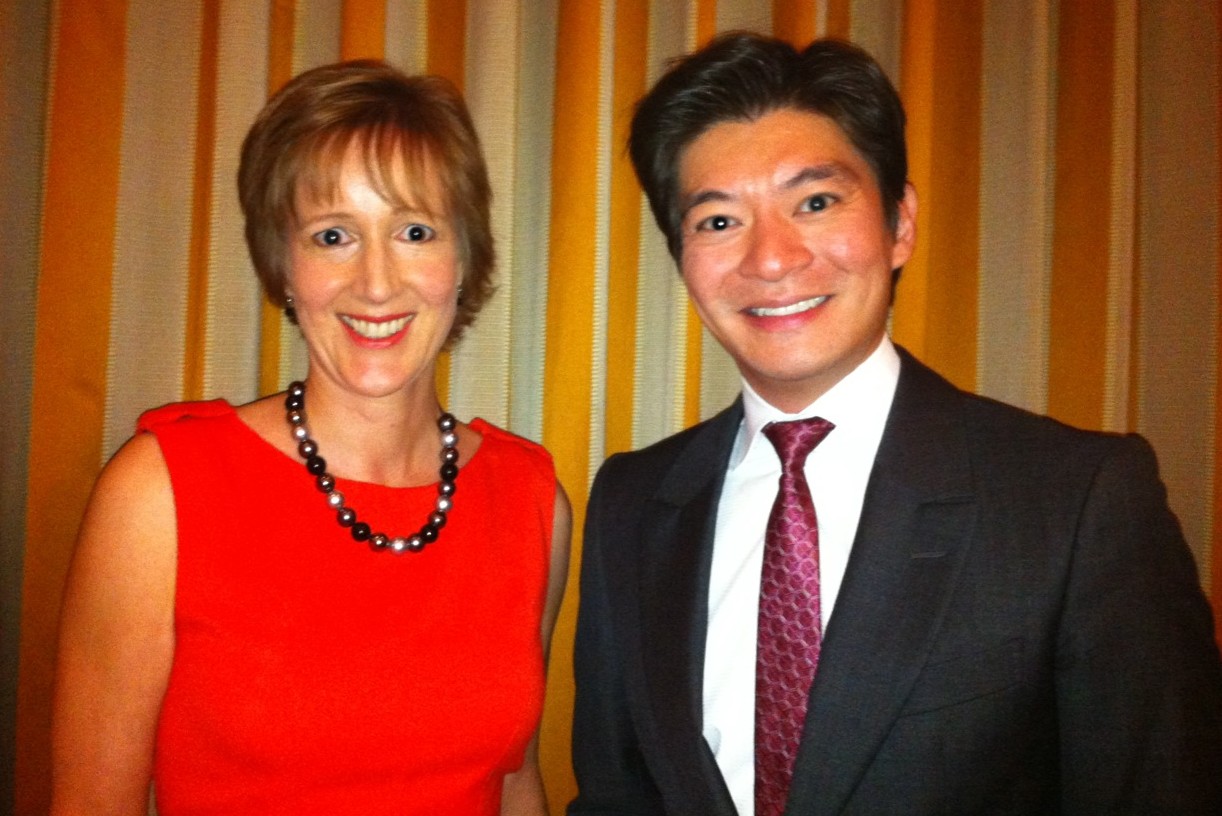
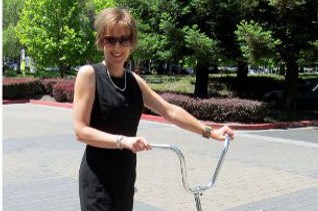
One day after Steven Chu defends his department’s handling of the DoE loan guarantee to Solyndra, we look at the impact of Solyndra on the venture capital industry. In this exclusive interview, Andrew Chung, the newest member of the Khosla Ventures investment team, shares his views on the Post Solyndra era. Will the failure of Solyndra have a significant impact on cleantech investment? How does Chung respond to critics who say that cleantech investment is a disaster?
The downside
“Downstream, there are other investors who are a bit more skittish about investing in following rounds…”
The upside
“In the past twelve months, we have three companies that have gone public and generated over $1.1B in profits for the firm. ..It’s possible to make money in cleantech and drive a lot of change and drive significant returns.”
The future
“It’s still relatively early…we are in the second inning of an extra inning game, in the development of this industry.”
“(At Khosla Ventures) we continue to be incredibly excited about the cleantech opportunity…we just raised a $1.1B fund, half of it is going to be in cleantech.”
.
.
Check back soon for more highlights from our interview with Chung:
On America’s comparative advantage vis a vis China
On what we can learn from China’s cleantech policies
Read more, see transcripts, photos and check out other exclusive interviews with Tom Friedman, Paul Krugman, Vinod Khosla and many other experts at Fresh Dialogues Archives and join the conversation at the Fresh Dialogues Facebook Page
Google is on a green spending spree. By July 2011 it had invested over $700 M in clean energy. Today the figure is over $850 M and set to grow (approaching $1 B as at August 2012). Fresh Dialogues asked Google: How does it choose green startups and projects?
He’s talking about large solar power tower projects, like BrightSource’s Ivanpah project in California’s Mojave Desert to which Google contributed $168 M; and one of the world’s largest wind farms, Alta Wind Energy Center, also in the Mojave Desert where Google invested $55 M.
.
.
In June this year, Google demonstrated its game-changing strategy by investing in SolarCity. This time it was a $280 M investment, to create a fund enabling the solar company to make residential rooftop installations more affordable (often eliminating the upfront cost for homeowners).
“Google is setting an example that other leading American companies can follow,” said Lyndon Rive, CEO of SolarCity. “The largest 200 corporations in the U.S. have more than $1 trillion in cash on their balance sheets. Investments in solar energy generate returns for corporate investors, offer cost savings for homeowners, create new local jobs…and protect the environment.”
Despite the departure of Google’s Green Czar – Bill Weihl – this week, Parag Chokshi confirms that “we have a strong team and our work will continue. ..we actually have several executives that work on our green initiatives … other executives include Rick Needham, who has led and oversees our $850M in clean energy investments; and Urs Hoelzle, who oversees our entire infrastructure and has spearheaded our energy efficiency work.”
This video was recorded at the Google Headquarters in Mountain View CA on July 8, 2011.
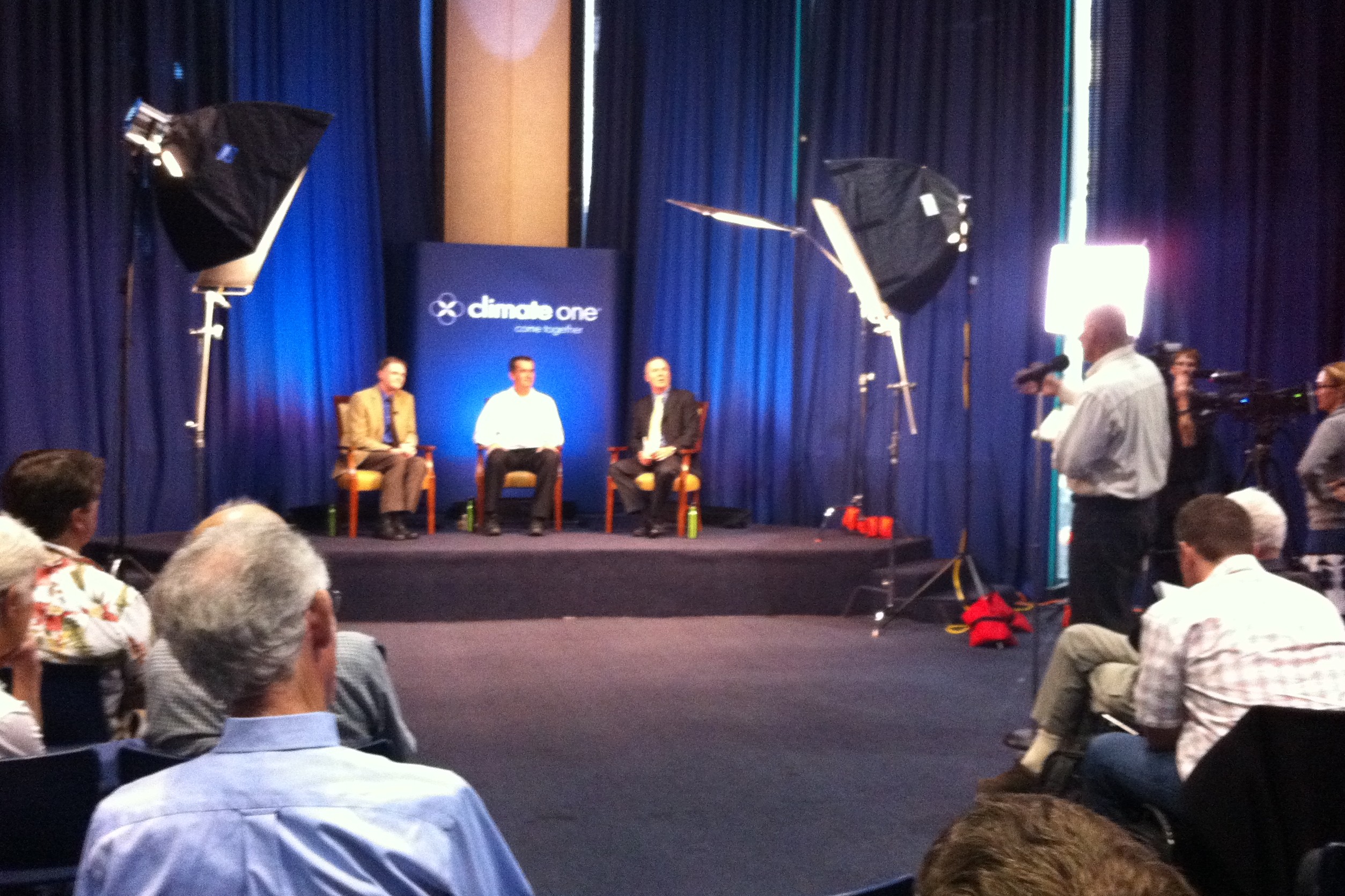
Climate One‘sGreg Dalton brought together a pair of climate experts yesterday at the Commonwealth Club to discuss the “Great Disruption” – Is it the end of the world as we know it? What will happen to the global economy when the world stops denying the realities of climate change?
Australian environmental business expert Paul Gilding, and Senior Fellow at the Post Carbon Institute, Richard Heinberg shared their wisdom in a lively dialogue with Dalton. Gilding’s latest book is The Great Disruption and describes how to fight-and win-what he calls The One Degree War to prevent catastrophic warming of the earth. It has even received a favorable review by Tom Friedman in his New York Times column. Heinberg’s tenth book is The End of Growth and describes exactly why this decade will be worse than the Great Depression; he predicts future global growth will be a zero sum game thanks to resource, climate and financial limits. Despite the rather apocalyptic theme of both authors, the near capacity audience was treated to some upbeat comments from Gilding coupled with some more cautionary responses from Heinberg. Here are some of the highlights:
On Change
“People’s ability to change is quite impressive – witness World War 2- we can end the denial and decide on a different future…the debate is how to act not whether to act.” Paul Gilding.
“During WW2, the enemy was visible. The U.S. has a larger capacity for denial. We will have to hit a wall before seeing change…it”s like a slow motion crash.” Richard Heinberg.
On Carbon Tax
“In Australia, a carbon tax is going through Parliament. The price is low…but every balance sheet will soon show the cost of carbon. (In OZ) The debate is over.” Paul Gilding.
On the Trigger
“The price of energy, food and transport will be the trigger point. Government must put in place the framework for change.” Paul Gilding.
On Clean Tech
“Exciting things are happening in renewables. Solar will be cheaper than coal within a decade. Then the game changes dramatically.” Paul Gilding
What a stimulating way to spend your lunch hour. Thanks to Greg Dalton for orchestrating a memorable – if sobering – event.
Read transcripts, see photos and check out our ARCHIVES featuring exclusive interviews with Tom Friedman, Paul Krugman, Vinod Khosla and many more green experts and visionaries…
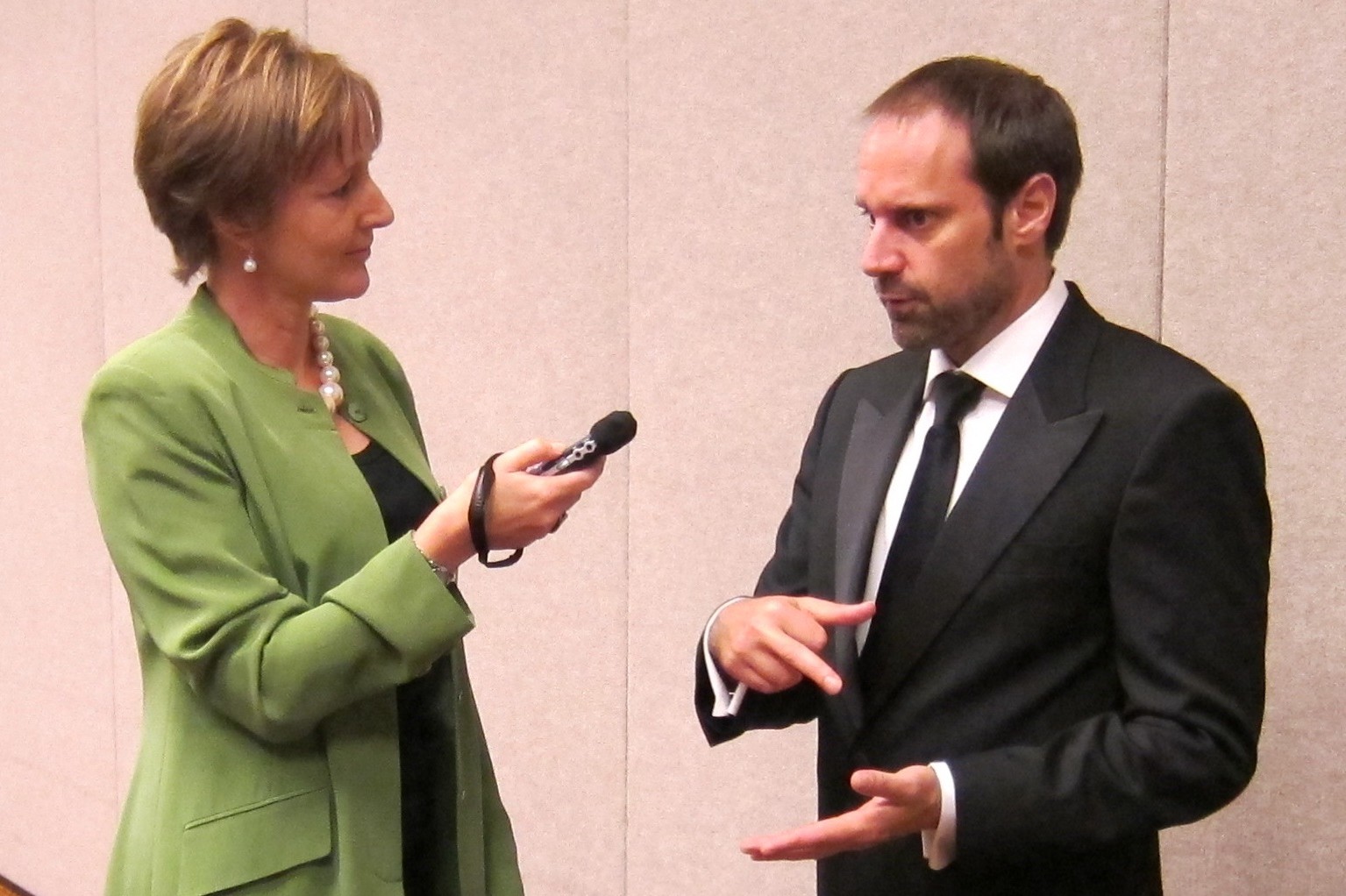
Last night, Jeff Skoll joined an eminent group of change-makers – Bill Gates, Al Gore, Gordon Moore and Queen Rania Al Abdullah of Jordan. He was honored with The Tech Awardstop prize, the James C. Morgan Global Humanitarian Award. This former eBay president, Skoll Foundationfounder, and billionaire champion of global peace and prosperity, was recognized for his energetic quest to find the answers to climate change, water scarcity and nuclear proliferation.
In an exclusive Fresh Dialogues interview, Skoll talked about the role of the tech community in making the world more sustainable. “Tech companies have a pretty big world view,” he said. “People here tend to have a better grasp of the bigger issues of the world…technologists can get ahead of these issues and create products that help.”
In 2004, he founded Participant Media, the Hollywood production company responsible for such provocative movies as An Inconvenient Truth, Waiting for Superman, and Fast Food Nation. Participant Media aims to “create entertainment that inspires”…and in several cases has achieved both box office success and created positive social action around the world.
So, will there be a sequel to An Inconvenient Truth? Skoll admits there is definitely something in the works, and it could even be a TV Show. Check out the Fresh Dialogues video for more details…
.
As if all this weren’t enough, Skoll recently founded The Skoll Global Threats Fund, led by former Google.org chief, Larry Brilliant. Top threat on their list of five? Climate Change. Let’s hope they have some brilliant success with their mission.
The Tech Awards gala also recognized 15 laureates from around the world for creating innovative technology solutions to benefit humanity. The winner in the Environment category was Agua Clara a Cornell University program that designs sustainable (gravity powered) water treatment systems to provide clean water to over 25,000 people in communities around the world every day. I talked briefly with young AguaClara coordinator, Daniel Smith who plans to use the $50,000 cash prize to scale up the impressive work his organization is doing in Honduras.
Check back soon for part two of the Jeff Skoll interview to hear what one thing we can all do to make the world greener.
Read transcripts, see photos and check out our ARCHIVES featuring exclusive interviews with Tom Friedman, Paul Krugman, Vinod Khosla and many more green experts and visionaries…
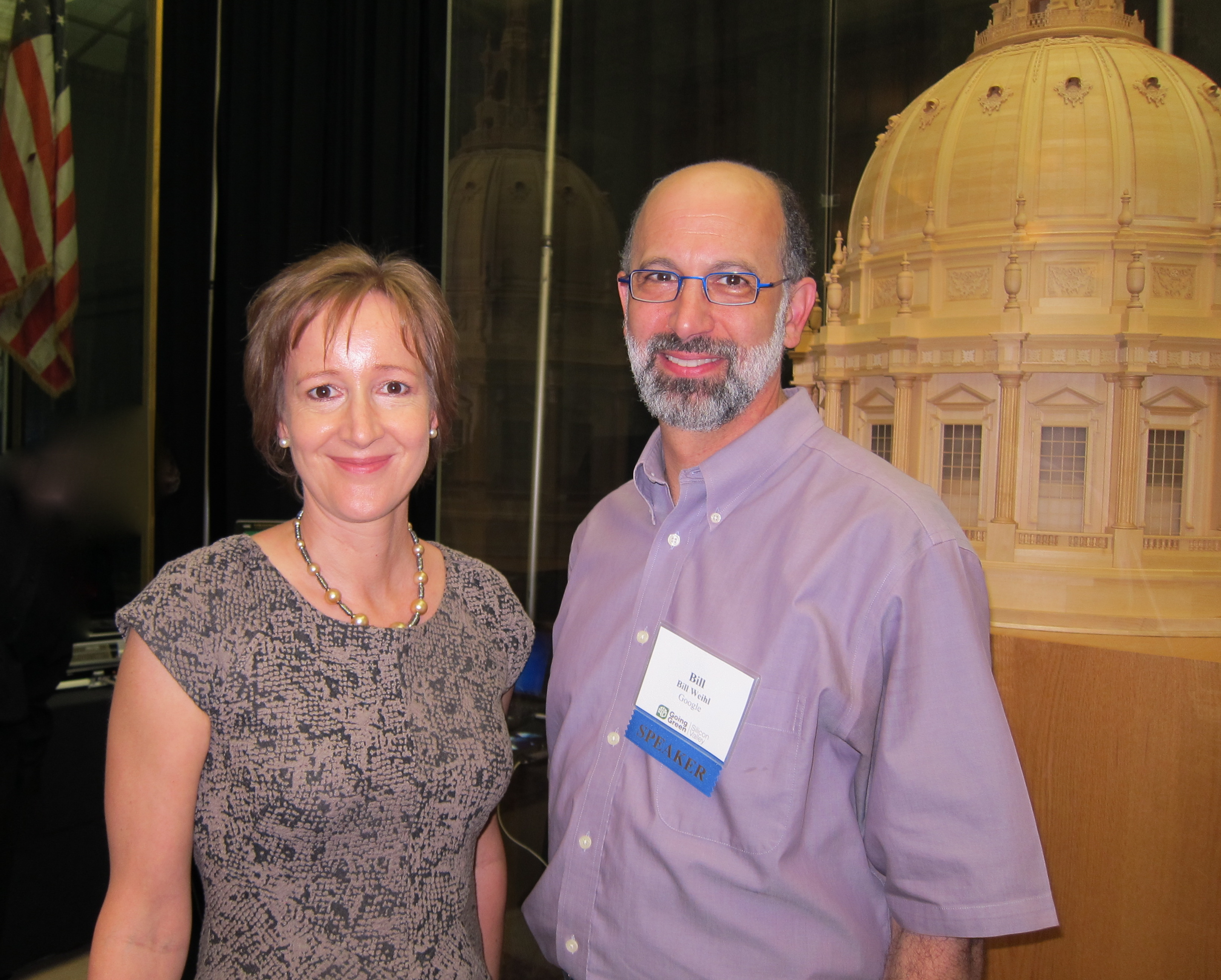
As the Solyndra aftermath continues to ripple through the green economy, the mood was distinctly upbeat at the AlwaysOn Going Green Conference at San Francisco’s City Hall yesterday. Google’s Green Czar, Bill Weihl confirmed that the company has spent over $850 Million in renewable energy projects (including its latest $75 Million solar project finance deal) and said, “Virtually everything we’ve done to be ‘green’ has made economic sense…we’re able to find creative solutions… that make us money (or) save us money.”
“What can we do to save energy, to be greener? We really try to look at things that other people can do, that can be replicated…”
I had the chance to chat with Weihl backstage and he dismissed the Solyndra debacle as mostly political. He doubts it will impact venture money flowing into the clean tech sector. Instead, he focused on the strides that Google continues to make in the green and sustainable energy sector. Here are video highlights of the event featuring:
Ray Rothrock, Partner, Venrock
Carrie Armel, Research Associate , Precourt Institute for Energy Efficiency, Stanford University
Gene Wang, People Power, CEO
Bill Weihl, Green Energy Czar, Google
.Read transcripts, see photos and check out our ARCHIVES featuring exclusive interviews with Tom Friedman, Paul Krugman, Vinod Khosla and many more green experts and visionaries…
How is Google greening its growing army of Googlers, on and off campus? Biodiesel buses, Google bikes…pogo sticks anyone?
I sat down with Parag Chokshi, Google’s Clean Energy Public Affairs Manager this summer and he explained some of Google’s employee incentives and green practices. Did you know that if you get to the Googleplex under your own steam – walking, running, biking…or on your pogo stick, Google will donate to a charity of your choice? And if you can’t bear to move from your cool pad in San Fran, and the thought of 36 miles on a pogo stick seems a stretch, Google will transport you to work in one of its special biodiesel buses. Wifi equipped of course.
There’s even a sizeable organic vegetable garden on the campus, so if you fancy getting dirt under your finger nails and communing with Mother Earth, Google’s your place.
Of course, Google also fanfares the usual green suspects:
solar power (one of the largest commercial installations in the Bay Area at 1.6 MW or 30% of the complex’s peak power use);
Bloom Energy Boxes (Google was one of the first customers for this efficient fuel cell power source);
But if you think working at Google is just one green Kumbaya center, remember it’s not just a holiday camp…Pay maybe the highest average in the tech industry (2011 Payscale Report) but according to anecdotal evidence and Google’s own job descriptions, expect a high-stress startup environment and the bureaucratic issues typical of any fast growing big company.