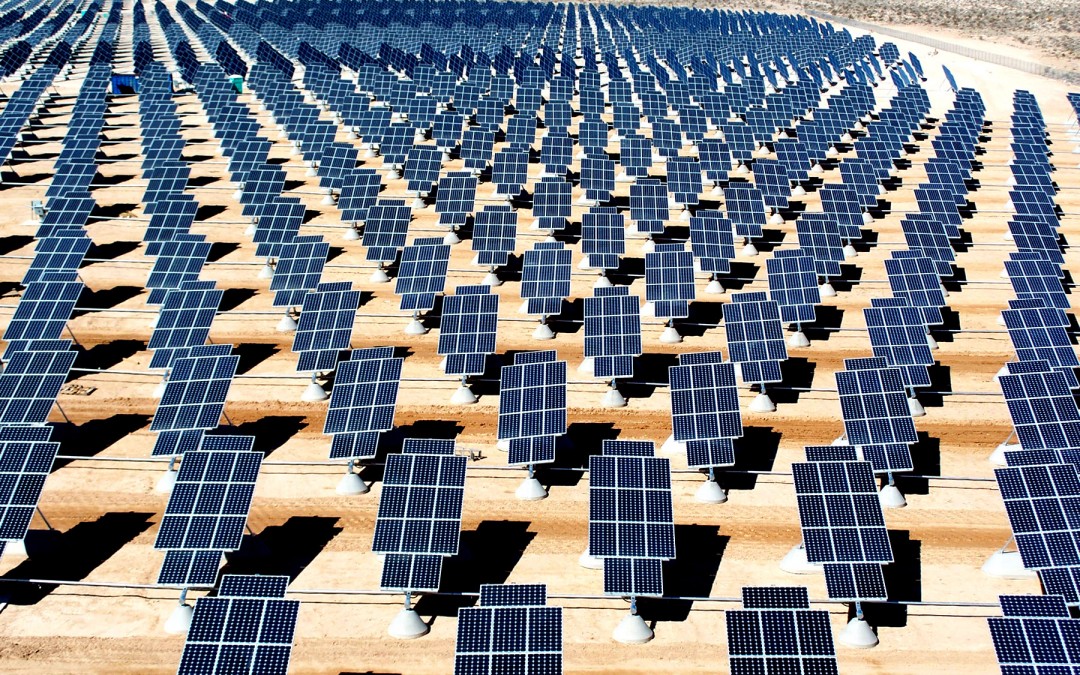
In announcing a massive, unprecedented investment in solar power by a private company, Apple’s Tim Cook said yesterday in San Francisco,
“We know in Apple that climate change is real. The time for talk is passed…The time for action is now.”
Here are three reasons the $850 M solar deal with First Solar makes sense:
1. Money saving: Apple signed a 25 year purchase power agreement which will guarantee the tech company a fixed price for solar power, under the market price for energy in California. Solar prices have declined dramatically in the last 40 years (today’s panels are 100 times cheaper than in 1977) and Apple has timed its agreement to profit from this trend.
“We expect to have a very significant savings because we have a fixed price for the renewable energy, and there’s quite a difference between that price and the price of brown energy,” Cook said.
2. Green Halo Effect: Not only will Apple benefit from a “greener than thou” reputation from their existing fans, but will inevitably attract more environmentally conscious consumers, especially Millennials who care deeply how their tech gadgets and the cloud’s data centers are powered. This will help in its battle with arch rival Samsung which it ridiculed last year in a hard hitting ad campaign.
In addition, in the race to attract and retain the top tech talent in Silicon Valley, Apple’s “green reputation” will be powerful.
“Other Fortune 500 CEOs would be well served to make a study of Tim Cook,” Greenpeace said in a statement.
3. Pioneer forClimate Change: Last year, Tim Cook famously told climate skeptics at an Apple shareholder meeting to “get out of Apple stock” if they don’t like his clean energy strategy. His visible passion on the issue revealed how strongly he feels about climate change and his commitment to reduce Apple’s carbon footprint.
“I want leave the world better than we found it,” said Tim Cook.
Under Cook’s leadership, Apple has forged ahead strongly with plans to get 100% of its energy from renewable sources. A massive data center in North Carolina is powered by huge solar farms and Bloom Energy’s fuel cells. I anticipate that Silicon Valley’s Bloom Energy will also be part of Apple’s new clean power strategy in California (check back soon for updates).
Apple’s trend-setting, clean energy market making reputation is already impacting other tech companies such as Facebook, Microsoft, Yahoo and Amazon, although Google gets the greenest star for its early action and massive investment in clean energy of over $1.5B.
Read more about Apple’s Green Halo and its battle with Samsung (BBC conversation)
This week, UC Santa Barbara’s Professor Nakamura (and two colleagues in Japan) received the Nobel Prize for Physics. Their big breakthrough? The Holy Grail of material science for many years: Blue LED technology. It not only enables high efficiency lighting (goodbye Edison’s incandescent bulbs, hello backlit smartphones, and 2300 feet headlights); but one day soon will help double the range of hybrid cars (thanks to its power switching applications).
A version of this story aired on BBC’s Tech Tent on Dec. 12, 2014. Listen to the podcast below:
To give you a sense of just how energy efficient these LED lightbulbs are, Prof DenBaars claims that if everyone in the United States replaced their old bulbs with LEDs, it would reduce the country’s electric light bill from $100 Billion to $20 Billion. Impressive.
Sweden’s Per Delsing gives it a global perspective: “A quarter of all energy consumption goes to illumination,” he said at the Nobel Prize press conference. As a result, any increase in efficiency and consequent saving of energy “is really going to have a big impact on modern civilization.”
While reporting for the BBC, I got a fascinating tour of UCSB’s Solid State Lighting and Energy Center and a chemistry lesson from Steven Griffiths, a grad student researcher. His colleagues Sang Ho Oh and Daniel Becerra also contributed valuable background information (see below for more photos).
Here’s a transcript of my conversation with Prof Denbaars (aka: all you ever wanted to know about LEDs but were afraid to ask):
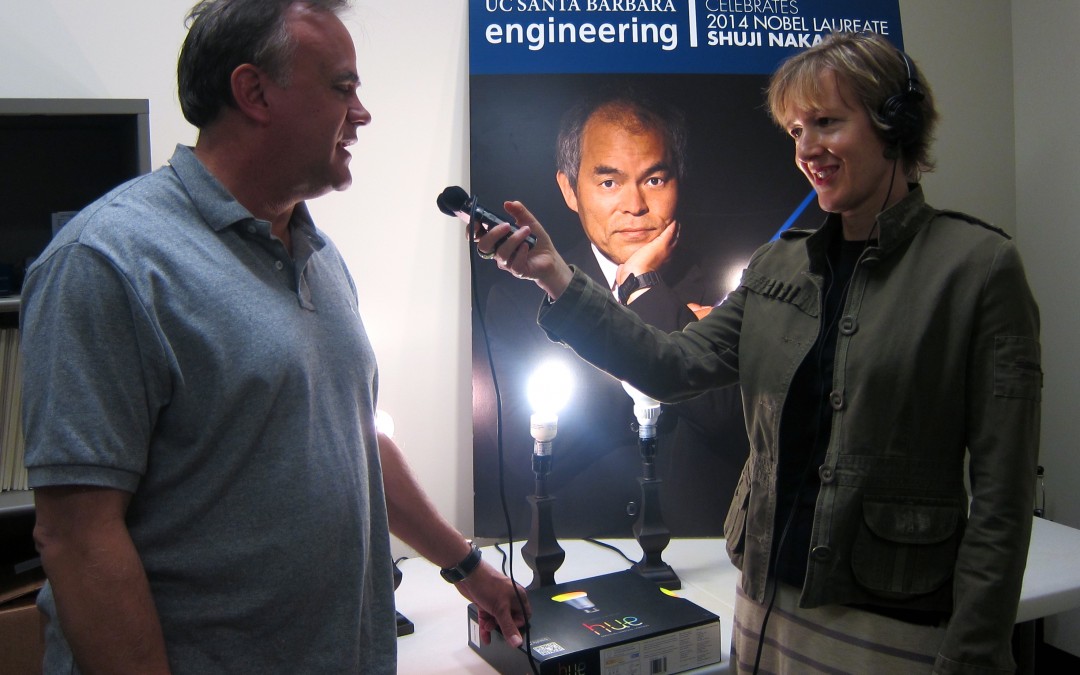
Alison van D: I’m here at the Uni of California Santa Barbara with the research team led by Prof Nakamura, the winner of this year’s Nobel prize for Physics. He earned the Nobel Prize for his blue LED breakthrough. I want to talk with Dr Steven Denbaars who is a research partner of the professor and start with the basics. What is an LED?
Prof DenBaars: An LED stands for a light emitting diode, it’s basically a semiconductor crystal which glows bright light, in this case, bright blue light when you apply electrical current to it.
van D: Can you explain how they’re used in smartphones, computer screens and in lighting?
Prof D: OK in smartphones the LED is used in combination with a phosphor on top of it to generate white light. That is, the blue is converted with a red and a green phosphor to produce a full spectrum of white light. That is the white light in your flashlight, you know when you take a picture, but it’s also the white light in back of your LCD screen. So it’s called the backlight. So all smart phones today use LED backlighting to do energy efficient displays.
van D: And tell me about the lighting aspect. Is it just the LED bulbs you find at the supermarket, is that the only application for LEDs in the lighting sphere?
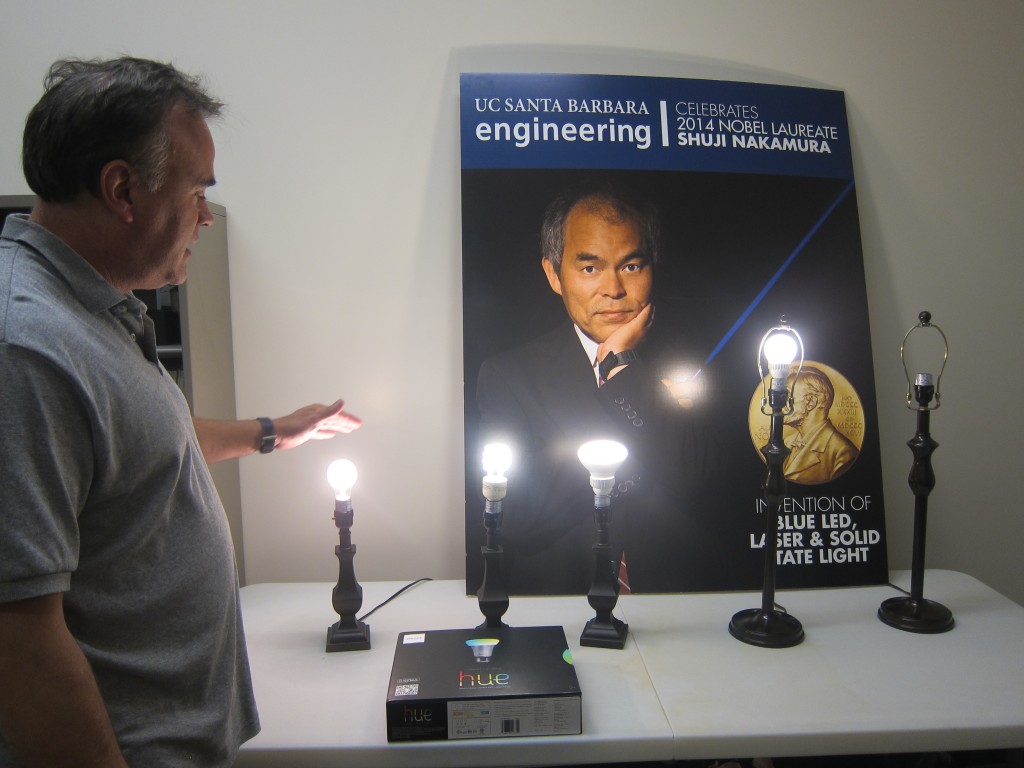
Prof D: Well that was the initial implementation, a bulb replacement or retrofit. But what we’re seeing is: now you can use the LED to add additional features to lighting, such as communications. That is, you can have your cell phone control the color of the light bulb or even communicate information between the light bulb and your cell phone or maybe even your Internet server to distribute information into the house. That’s just starting. We call that smart LED lighting.
van D: So can you explain how that works? You get an app on your phone and you can change the mood lighting of your home?
Prof D: Yes, you can change the color temperature from a sunset to a cold day in Sweden, maybe, I guess. 6500 Kelvin would look very bluish white…That is using the Bluetooth feature on your iPhone that communicates with the chip in the light bulb, which then changes the mix of the colors in the LED.
van D: Can you talk about the particular breakthrough?
Prof D: Both Akasaki, Amano and Nakamura basically developed the P-type Gallium Nitride which was the missing link in the quest for the Holy Grail of LEDs at the time. We had red and green, we didn’t have blue.
van D: And why was that the Holy Grail?
Prof D: The blue was the Holy Grail because…if you have a paint brush and you only have red and green, then you can’t make a painting, correctly replicate the visible spectrum. So we were missing a huge chunk of the visible spectrum. People have been looking for 40 years for the right blue illuminating semi conductor …
van D: So do you see in the future, is this LED technology going to completely replace Thomas Edison’s incandescent bulb?
Prof D: Well I think it will definitely become the dominant light source. The quality of the light is winning over the consumer, it’s very close to an incandescent as you can see from this demo here…we have a bulb from a US manufacturer which looks almost exactly like a normal light bulb. I think there will still be some uses where people still really like incandescent lighting but that’ll be more for design or decorative reasons. Basically, if you want to have a long life light bulb…that’s the other advantage, these things last for 20 to 50 years. An incandescent light bulb lasts 6 months. So you’re really throwing your money away when you buy an incandescent light bulb. The US spends about $100 B for electricity for lighting and LEDs could take that down to about $20 B, so we could save the US $80 B in electrical costs if we switched over to LEDs, if everybody switched over today.
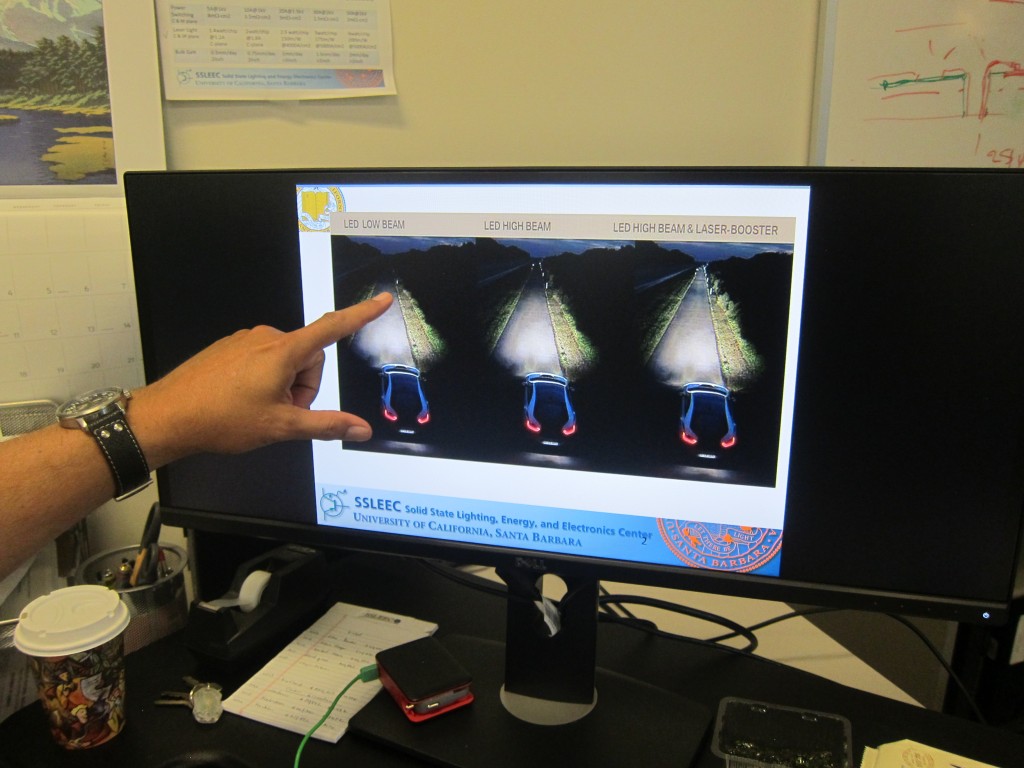
van D: Tell me about the LED laser headlights
Prof D: The laser headlight…you can see 700 meters in front of the car. Normal headlight is 150 meters. So you may think that this is going to scare the other driver, be bright, but it’s not any brighter to the other driver…it can be more tightly focused and columnated, projected on to the road. So this is a big safety advantage and it’s actually been released by BMW and Audi in Germany. Several thousand dollars per headlight but it’s a safety feature, because on the autobahn you drive about 240 K an hour, so you want to see 700 meters….
van D: So do you see that trickling through to all new cars within 5 years?
Prof D: Wow. The automobile industry is usually very slow to adapt. The LED headlight took about 5 to 7 years. Now you can see LED day-running lights everywhere, all newer cars. But the laser, which is the next generation of this lighting, will take 5 to 10 years.
van D: And what are you personally most excited about for the future of LEDs?
Prof D: Wow. I think it’s just to now be able to make a light bulb that’s smart enough to communicate, turn on and off when you need it. That’s very exciting. But also I think the real promise is: we can take lighting off grid. That is, you can make the LED, when you combine it with a solar cell completely renewable. That is, you just generate the electricity you want with a solar cell like this little solar powered LED lamp I have here, and therefore you don’t need electricity any more. Your light source, you just carry around with you. During the day time it charges up with a solar cell and at night it comes on. That would be the Holy Grail. We can become completely sustainable lighting without having to use electricity. This has the potential to save the world a couple hundred power plants of energy. More than a hundred nuclear power plants.
van D: Finally Professor Denbaars, is there anything else that you would like to share with the BBC listening audience?
Prof D: In electric cars it turns out you can use this as the power switching device (the thing that switches from the battery to the electric drive). Professor Nakamura and myself are also looking at it for power electronics. So Shuji’s (Nakamura) fundamental breakthrough of an LED is now impacting three major areas: not just lighting but it’s impacting displays, but now even electric cars.
van D: And how does that work? If you’re driving a Tesla or a Nissan Leaf, how is this LED technology going to make things better?
Prof D: I saw projections…it would take the Toyota Prius – which gets about 55 mpg – now the hybrid technology it would make it over 120 mpg…because it’s so efficient.
van D: How soon might we see this?
Prof D: This is a much harder problem to solve cos we’ve got to get the cost down and the scale up of the Gallium Nitride power electronics. I’ve seen lab demos… generally from lab demos to implementation it’s 5 years in this field of solid state that I work in.
van D: Are you already talking with Tesla and Nissan…?
Prof D: I can’t comment at all which car companies. But yes, we’re talking with car companies…they’re looking at it and the US government is putting a significant amount of money into this field. It’s called power electronics.
van D: Fantastic thank you.
And the research goes on. Researcher Steven Griffiths and his colleagues are working on further improvements in the Gallium Nitride (GaN) material to produce even higher efficiency LEDs and power swtiching. Below:
A pure nitrogen-containing glovebox is used to handle chemicals which are reactive in air.
The glovebox is used for alkali metals and ammonium salts, which are added to the reactors to aid in GaN growth.
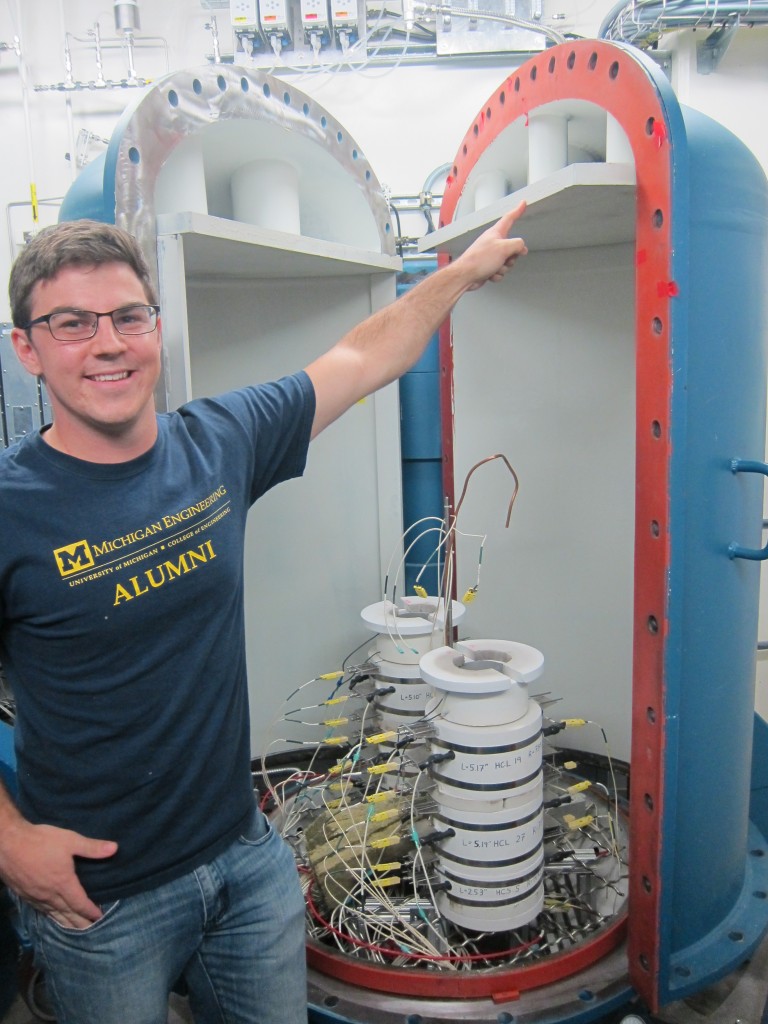
Below: Steven Griffiths shows the interior of a blast containment vessel, which when in operation contains ammonothermal reactors (not pictured) used to grow large gallium nitride (GaN) crystals. The blue vessel is the “blast containment vessel”, to “crush cans” (which dissipate projectile energy in the case of an explosion). The white cylinders are heaters, in which the “ammonothermal reactors” (not pictured) are placed when in operation. The blast containment vessels must be sealed due to the extreme temperatures (>500°C) and pressures (>2000 atm.) used for ammonothermal GaN growth. Ammonothermal growth uses large quantities of ammonia at the extreme conditions mentioned, therefore researchers in the lab space must be protected from explosion, fire, and chemical hazards.
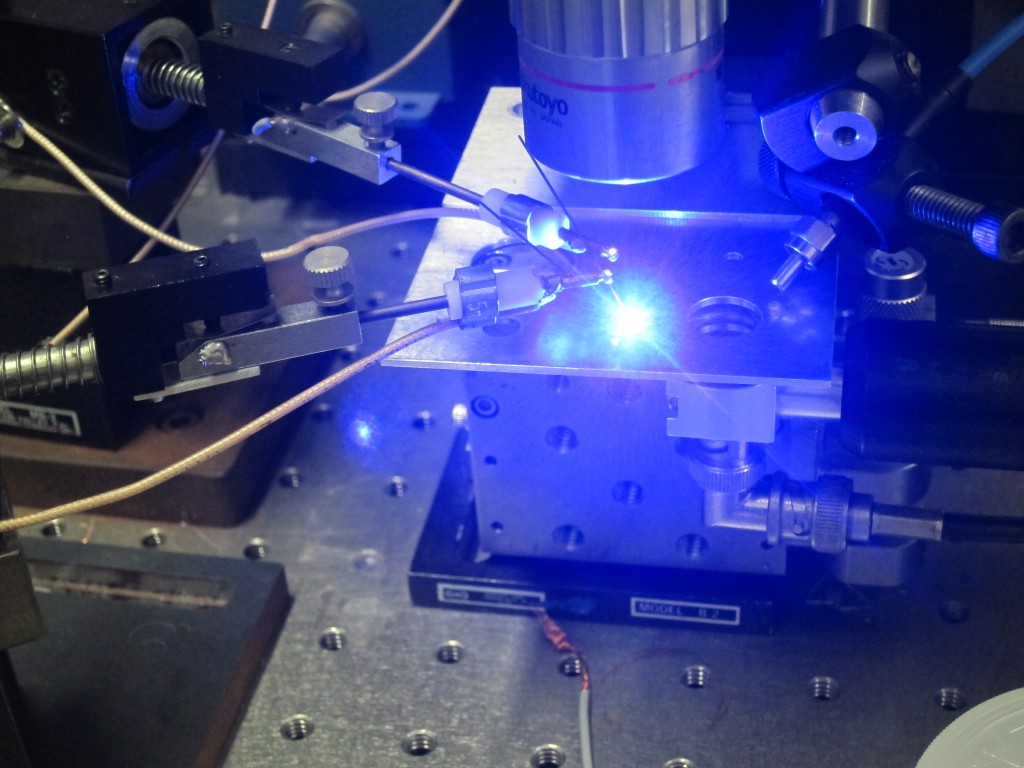
Below: Blue light emission from an LED. Blue light is produced when a bias is applied across the LED. Blue LEDs are composed of indium gallium nitride (InGaN) active layers sandwiched between positive (p-type) and negative (n-type) GaN layers, all of which are grown on a native (GaN) or foreign (Si, silicon carbide, sapphire, or gallium arsenide) substrate.
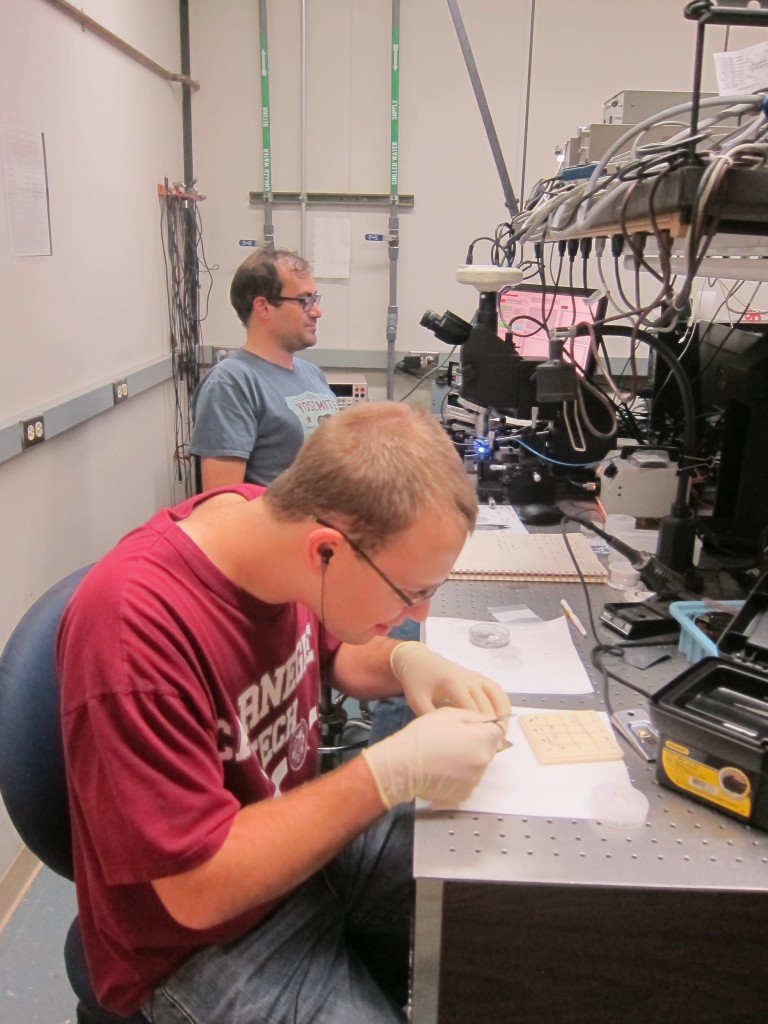
Below: Burhan Saifaddin (background) and Dan Becerra (foreground). The performance of blue LEDs is tested after crystal growth and device processing. Dan is applying metal to make electrical contact with the positive and negative terminals of the LEDs. Burhan is energizing the LEDs and monitoring their electrical operation/emission characteristics.
Silicon Valley is well known as the global hub of innovative technology. Can four weeks immersed in its unique ecosystem help inspire a new generation of global tech leaders? That’s the hope behind a program called Tech Women, launched by former Secretary of State, Hillary Clinton and now sponsored by the State Department.
Last month, over seventy tech women from Africa and the Middle East made a month-long visit to Silicon Valley. I met with several of them to explore what they learned, and how they plan to leverage technology to tackle their countries’ challenges when they return home.
A version of this story aired on BBC’s Tech Tent on Nov. 14, 2014. Listen to the podcast below: @20.00
Here is the full length transcript:
Tech Tent Host, Rory Cellan-Jones: One interesting aspect of the tech revolution is that women are playing a bigger role in the developing world than in places like the U.S. and U.K. Over 70 women from Africa and the Middle Easter have just wrapped up a month long visit to Silicon Valley, with the aim of picking up ideas for the technology they can use to tackle their country’s challenges when they return home. Alison van Diggelen met two of them…
Alison van Diggelen: They are two women with ambitious missions. They’ve got the tech savvy and now, after a month building connections and wisdom in Silicon Valley, they’re eager to launch their dreams back home.
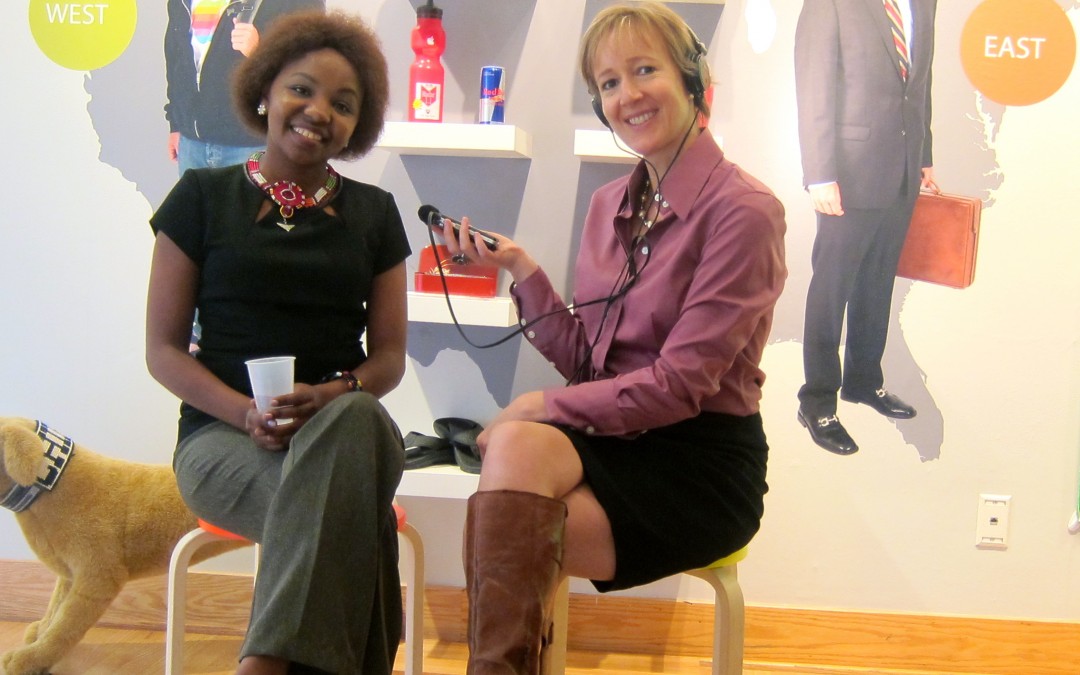
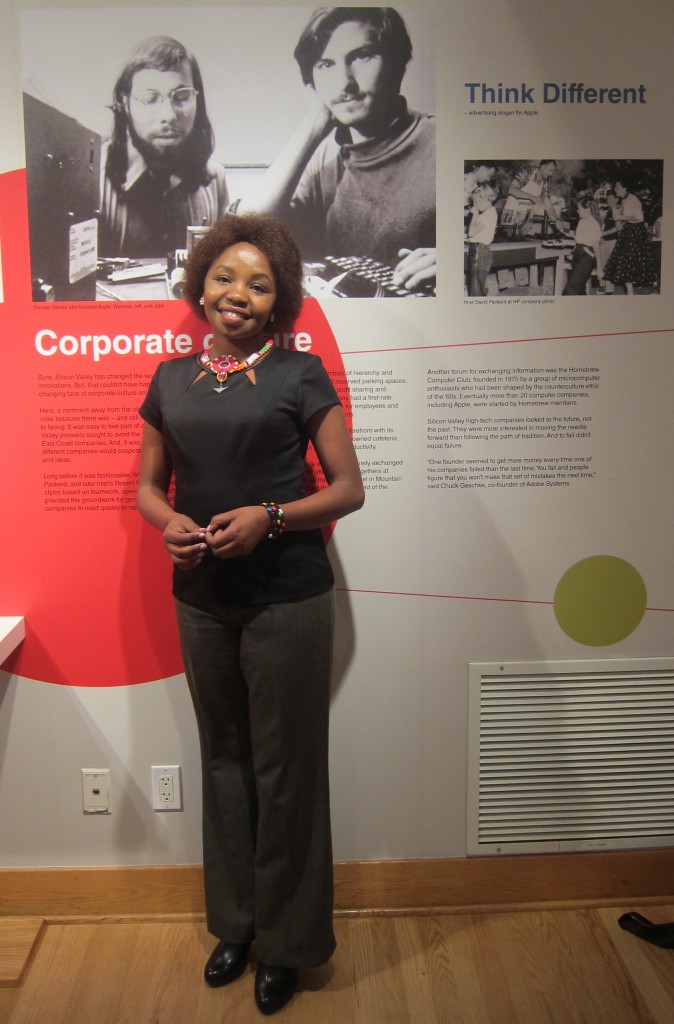
Meet Asal Ibrahim who wants to bring massive deployment of solar power to Jordan; and Serah Kahiu from Kenya who wants to jumpstart the science and tech economy in Africa by developing a network of science museums and labs across the entire continent.
Both have lofty goals, but they talk with such conviction and enthusiasm, it’s hard not to believe that these young women will change the world, at least their little corner of it.
I start by asking Kahiu about the current state of technology in Kenya.
Kahiu: “I use mobile technology in Kenya, it’s HUGE. It’s like magic because you can do transactions, money transactions on your mobile. You can pay someone from wherever in a country: school fees, bills. That one has revolutionized life in Kenya.”
She explains how Facebook is a vital tech tool for small businesses in Kenya.
Kahiu: “You can use your phone for Internet. That has really sparked business because you can advertise your product on Facebook, get someone to pay you through M-pesa and then put stuff on a public transport system and it’s transported to your client. That has made it so easy for people like farmers. You cut out the middleman. The farmer gets all the profit. This is huge, especially for women. The majority of small scale farmers in Kenya are women, so that has improved standards of living for many women in rural areas.”
We discuss her grand vision of creating a network of hands-on science and tech centers across Africa, starting in Juja, Kenya, a university town she describes as having “the same vibe as Silicon Valley.”
Kahiu:“We need to embrace more technology because 60% of Africans and youth in Kenya are under 35. We have a bulge of youth who’re not employed. Science and technology is the last frontier for job creation. We must prepare people for that. We import 80% of whatever we’re using. Why do we import? Why not make it in Kenya?
“If the governments of Africa invest in science and technology and put it on its pedestal as an accelerator of development, youth are encouraged to understand science better, and more importantly, to start companies.”
van Diggelen: “So you feel it needs an entrepreneurship spirit kick-started?”
Kahiu: “Yes, kick-started! There’s a need for that entrepreneurship. They’re learning theory, theory, theory.”
van Diggelen: “So commercializing these ideas?”
Kahiu: “It’s very hard…That’s what I want to do. I’ll sit in the gap between the education system and the industry and help people to see the possibilities that there are in science, technology, engineering and math.”
“Every Kenyan child that is being born deserves to know and understand technology. We don’t have a choice. If the world is accelerating the way it is doing, we’ll be left so far behind, we won’t even see the dust. I’m serious.”
“Science and technology should answer your problems. So, I meet people where they are and then we walk together …People care about drinking water, safer roads and availability of healthy foods for their kids. So these are their needs. So I’ll walk with my people from that point and we’ll walk towards particle physics…flying to the moon, or Mars…who knows? (laughter)”
(This interview took place at the Los Altos History Museum, which is currently featuring an interactive Silicon Valley exhibit, now through April 2015)
Asal Ibrahim is a 24 year-old student from Amman, Jordan. She’s been working at a (Vista Solar) solar company in Silicon Valley, soaking up the “can do” attitude.
Ibrahim is enthusiastic about the state of technology in Jordan today, but admits there are many opportunities for improvement.
I asked her how Silicon Valley’s tech obsessed culture compares to that of Jordan.
Ibrahim: “It’s very similar. Everyone is obsessed with technology: holding a smart phone, interacting on social media, using it in almost every aspect of life. On an infrastructure level it needs to be improved: transportation, education is employing technology a lot…we need to improve it way more.
“You can find anything from high tech schools to poor schools in Jordan. We have schools that are winning international competitions like Intel Science Fair or Microsoft Imagine Cup and compete worldwide with their Robotech, with their programming skills, website software. Some schools are more advanced than some universities in Jordan. We’re still lacking equipped labs for example, not only technological advances like IT, but also scientific labs.
“Jordanians are very into technology. They can contribute a lot if they get the chance. We have a lot of international companies that have offices in Jordan, and employ large amount of engineers, like Microsoft, Sony, Yahoo.”
Ibrahim’s goal is to encourage the massive deployment of solar power in Jordan, but she faces an uphill struggle.
“It’s not easy to push this kind of alternate power and challenge the big oil companies. We have to combine all the manpower we have, all the technology, knowledge, NGOs, advocates, to make this happen. It’s a dream that needs to be worked on at a national level.”
Ibrahim was part of a public private partnership that brought 200 Mega Watts of solar power online this year, but she’s determined to keep up the momentum.
“97% of our energy is imported, so if any of surrounding countries that provide us with oil or electricity have bad political situations, which is the case most of the times, we will be out of energy. Renewables are now 2% of energy share. It’s mostly oil now.”
So how has Ibrahim’s month in Silicon Valley inspired her?
“The most special spirit of Silicon Valley is how diverse it is. Having people from all over the world working for the state of technology, for the sake of entrepreneuring, for the sake of innovating, creating new things. How excited people are on the train in the morning – they feel happy, on a mission to accomplish…it has reached me.”
She’s learned an important lesson from her month in Silicon Valley:
Ibrahim: “No idea is bad. If you have a single idea, whether it’s a website, app, any innovation you think can change the face of technology, you should pursue this, because an idea dies if you don’t pursue it.
“It’s all inspiring to me. Everything is possible if you have the persistence and determination to make it happen. The Jordanian culture encourages girls and boys, men to study equally; they’re very encouraged to pursue careers in STEM, to pursue technological and scientific degrees. Being in a male dominated environment in technological companies, can be a bit frightening for girls and women…there is no challenge if you show confidence and if you have a dream to pursue, no one will stand in your way.”
Check back soon for my interview with Sierra Leone’s Fatmata Kamara who wants to bring solar power to rural areas of her country to improve the livelihood of rural communities and help in the fight against Ebola.
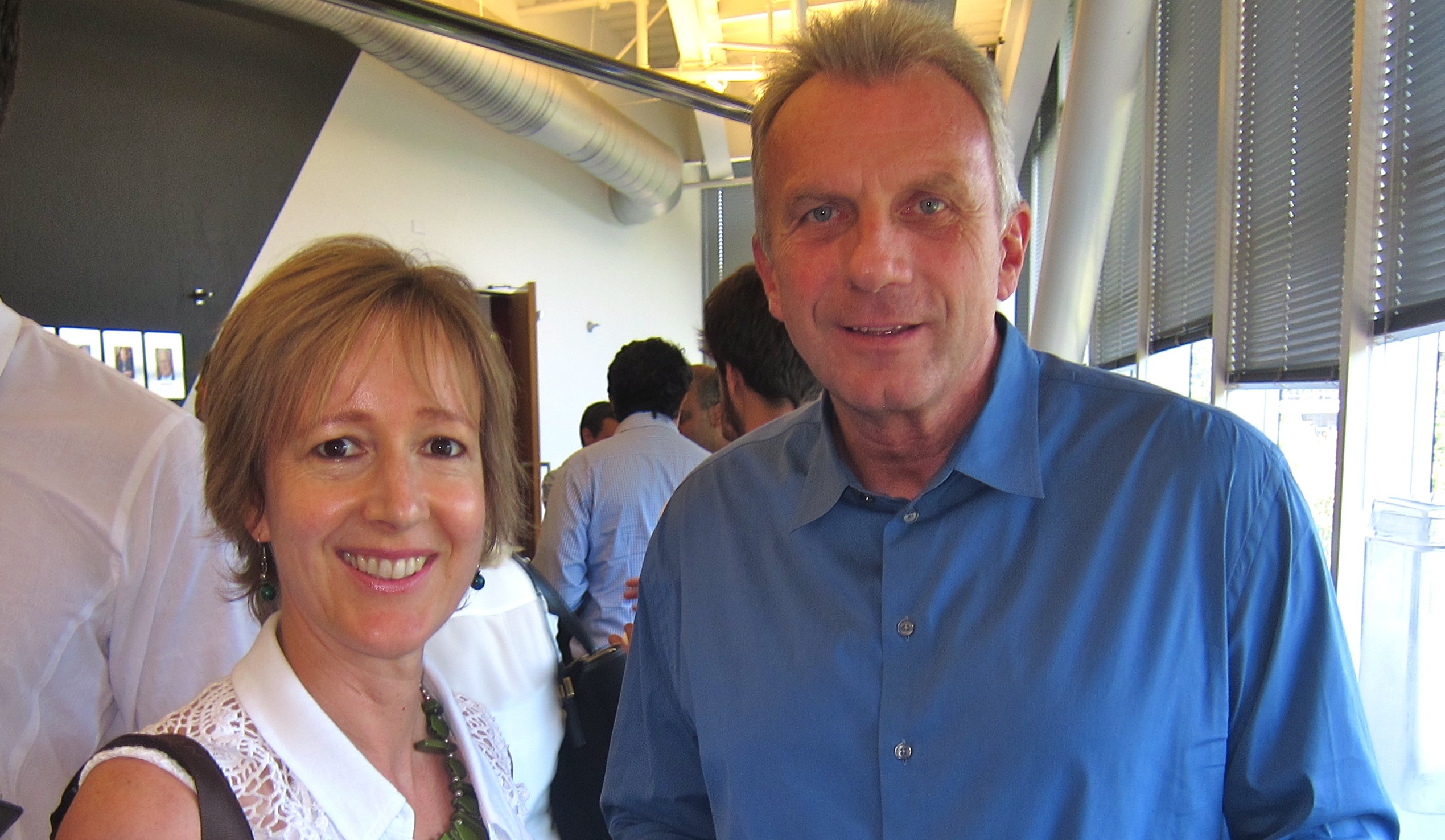
Energy was high today at the Y Combinator Demo Day, as a sea of young entrepreneurs jostled for attention – and funding – from a vast throng of Silicon Valley investors. I chatted with NFL Hall of Famer, Joe Montana who’s ditched his 49ers helmet for an angel investor hat these days (see the halo?) He was busy with the much buzzed about Helion Energy team which is working on “the world’s first commercial nuclear fusion reactor.” They hope to prove commercial scale fusion within 3 years by building a 50 Megawatt reactor in Redmond Washington, providing carbon emission-free power for 40,000 homes.
I’m curious to find out if the nuclear fusion company Tri-Alpha Energy, backed by Mad Men’s Harry Hamlin will consider a joint venture, or perhaps just some knowledge fusion?
Montana said he committed to four other startups today, including Backpack, a company that connects travelers to shoppers, cutting price differentials for items like medicine and electronics around the world; and Unwind Me, an on-demand massage app. Sign me up for that demo!
Here are photos from today’s Y Combinator Demo Day, where 75 startup teams presented and deep-pocketed investors like Jillian Manus looked for the next WhatsApp.
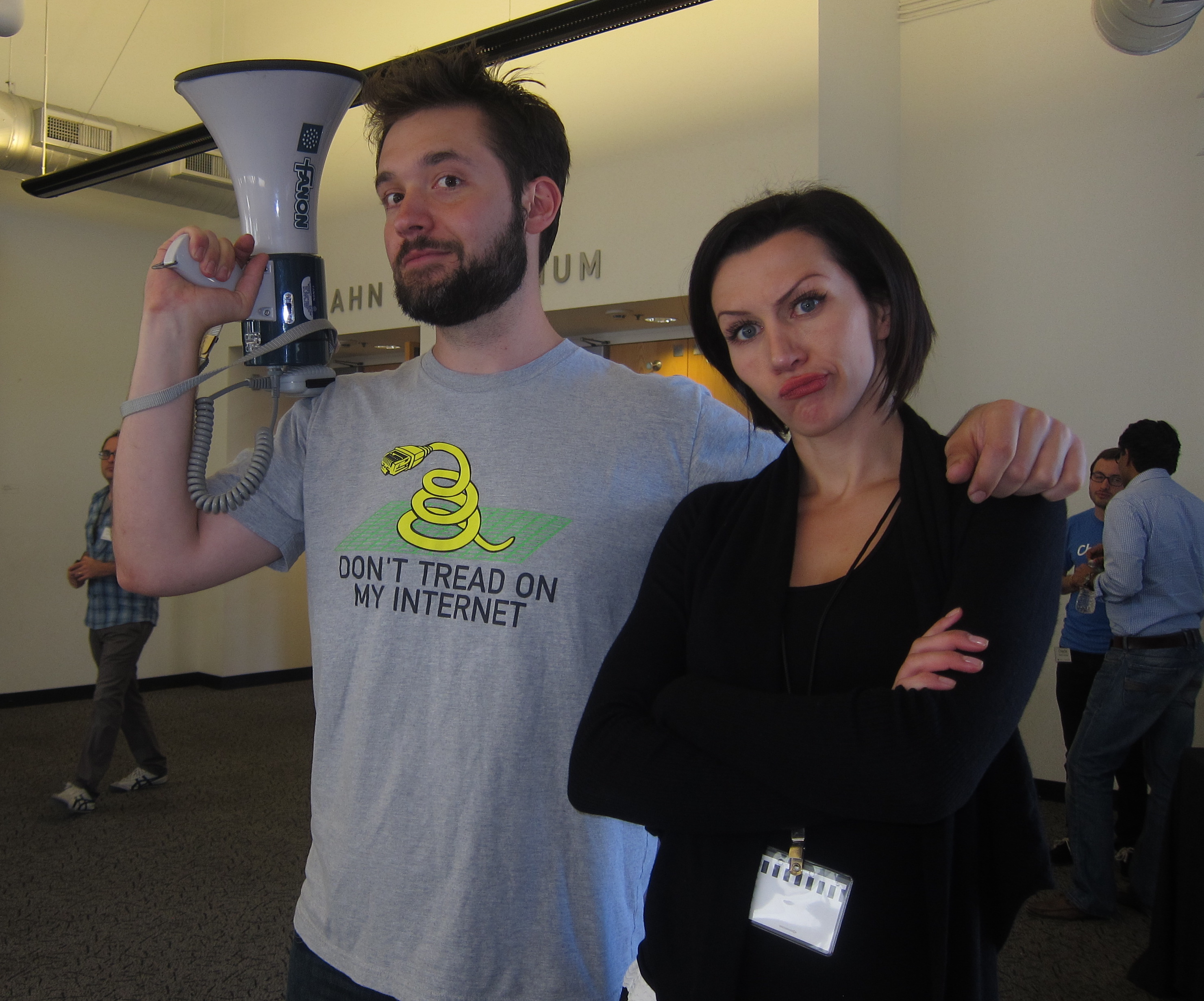
Alexis Ohanian (of Reddit fame) & Irina Lukashuk call time at Y Combinator.
Image 1 of 8
Photo credit: Fresh Dialogues
And some more (green tinged) highlights:
1. Edyn is a smart irrigation system for home gardeners and small farmers. Given California’s massive drought challenges, this one caught my eye. A huge Kickstarter success with a cool design by Jambox designer, Yves Behar, it’s set to go into production with Flextronics. Selling for $160, it could be a popular holiday gift this winter.
2. UPower is building nuclear batteries. This smart team, all MIT grads, describe their product as “a plug-and-play nuclear thermal battery.” Their target market is off-grid locations such as remote islands. I spoke with cofounder Caroline Cochran who emphasized the carbon-free, emission-free nature of nuclear batteries and assured me that they were addressing safety concerns around radioactive waste. According to a report by Kyle Russell at Techcrunch, “the reactor, in addition to being fuel agnostic (it can use thorium, uranium, or recycled fuel) can actually reduce the half life of existing waste, and spent fuel from it can be reused in another reactor with some processing.”
3. Beep is an operating system to make your speakers smart. Think: the Internet of “Audio-Things.” The ex-Googlers confirm that Beep already works with Pandora and Spotify and say you’ll soon be able to control your favorite NEST thermostat using your voice. It sounds like Star Trek’s Enterprise is closer than you think…
4. Vatler offers a valet service for workers, special event attendees, etc. Think: Uber for parking. As the CEO said in his presentation, drive into any big city (say San Francisco?) and “parking’s a bitch.” His team’s solution: an app to help you find an instant valet, using a quick tap on your phone. Quicker than looking, cheaper than parking.
5. The Immunity Project is developing a free vaccine to end AIDS and HIV. Frankly, it made all the earlier presentations seem trivial solutions to “first world problems” (except perhaps UPower) and got the audience’s most enthusiastic response. Find out more about this ambitious project here.
Big thanks to Y Combinator partner, Kat Manalac for the invitation.
Joe Montana photo credit: Vicki Thompson of SV Business Journal.
The event was held at the Computer History Museum in Mountain View where there’s a remarkable collection of photos by Doug Menuez in the foyer, featuring Silicon Valley tech luminaries, including the inimitable Steve Jobs. Check it out next time!
One day after the sweeping new rules to limit power plant emissions were announced by the EPA’s Gina McCarthy, China just announced a major carbon emissions cap. Yet the climate change deniers and the the coal lobby are campaigning to preserve carbon polluting energy. It’s valuable to reflect on why these new rules are critical to the future of mankind.
As McCarthy described it, “We have a moral obligation to the next generation to ensure the world we leave is healthy & vibrant.”
Others might be more direct: It’s climate change, stupid.
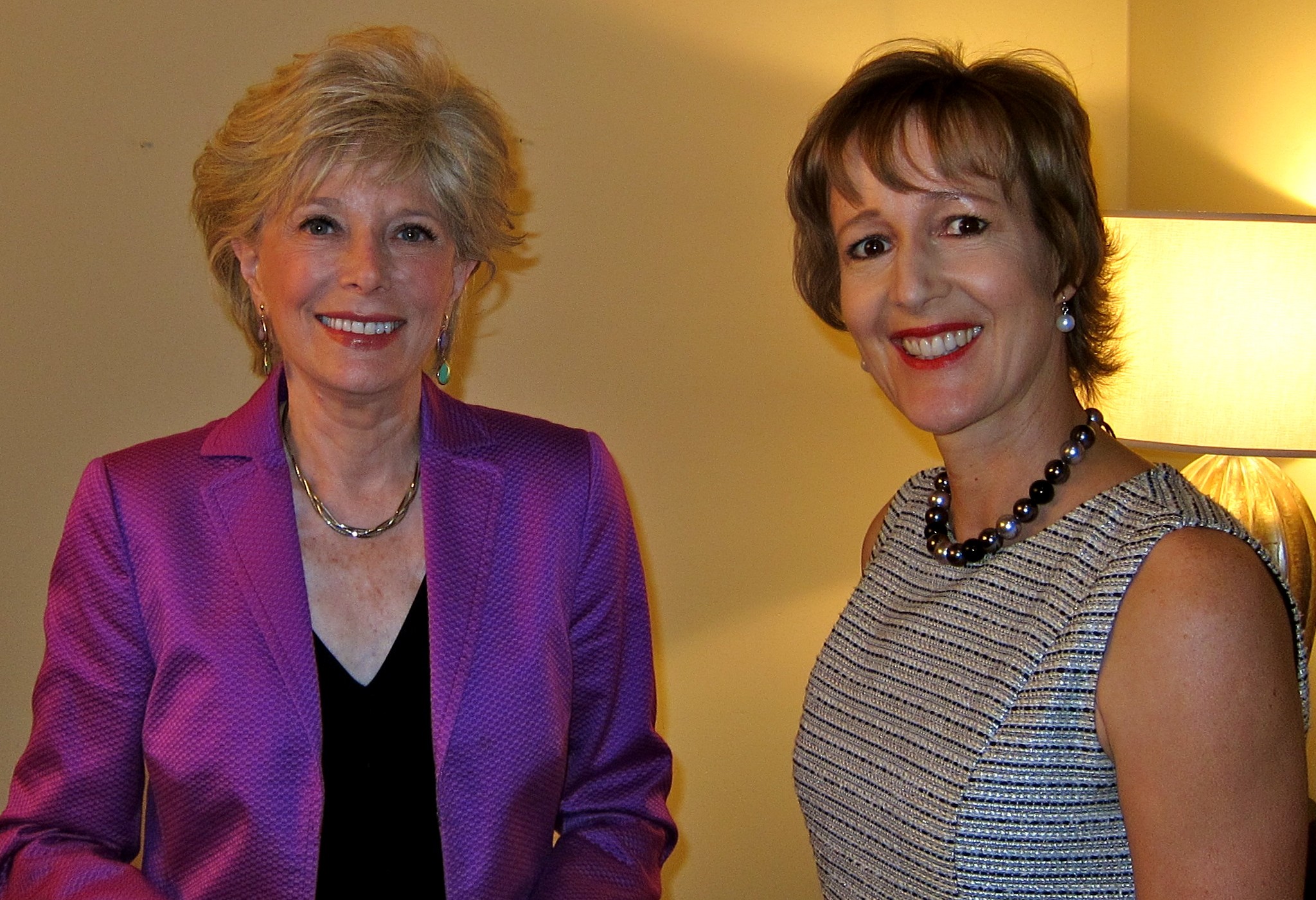
I recently interviewed CBS 60 Minutes Correspondent Lesley Stahl and she shared her emotional reaction to climate change. She witnessed the rapid ice melt in Greenland and reported about it for Years of Living Dangerously, the documentary series on climate change.
“I thought global warming needed an alarm bell rung before I went, but it was extremely emotional for me to see first hand the ice melt,” says Stahl. “…knowing what it’s going to do for the rest of the planet.”
Find out more about Stahl’s report for the Years of Living Dangerously series here. It’s produced by David Cameron and features reports from Tom Friedman, Matt Damon, Jessica Alba and Don Cheadle.
The interview was recorded at the Foothill College Celebrity Forum Series in Silicon Valley on May 15, 2014.
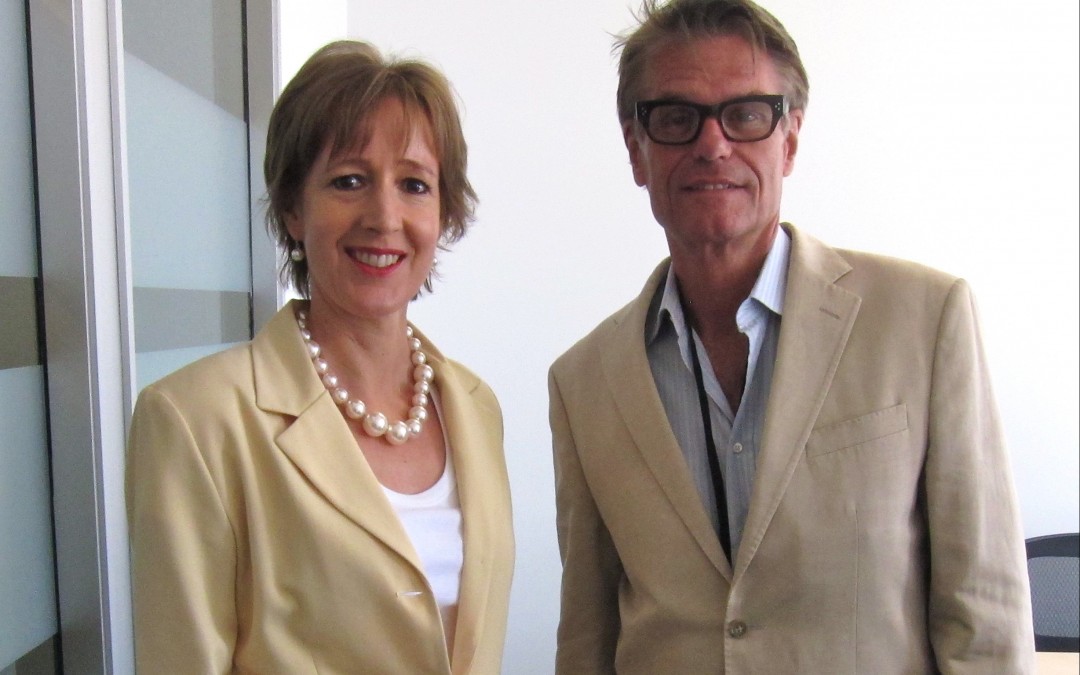
It’s amazing who you bump into at Silicon Valley conferences! Last week, it was Harry Hamlin of Mad Men fame. Turns out he’s a huge fan of Tesla Motors and Elon Musk. I put my Mad Men zeal aside and we talked internal combustion vs electric cars; the need for clean energy and why he thinks nuclear fusion, not wind and solar, is the answer. (Here’s a little primer on nuclear fusion if, like me, your physics is a wee bit rusty).
.
“I will never buy another internal combustion engine car,” says Harry Hamlin. The Mad Men star is completely enamoured by his Tesla Model S, and says it outperforms any car he’s ever driven, and he’s driven them all during his long and tumultuous acting career: from Aston Martin to Ferrari and Lamborghini to Porsche.
We discuss his vision for a clean energy future and he gives us a lesson from Einstein on nuclear fusion. You may notice a big smile on my face when he launches into an explanation of E=MC Squared. It was one of the most surreal moments in my eventful interviewing career. Hamlin may be a pretty face, but he’s also quite the intellectual.
He eschewed questions about his investments in clean energy, however Michael Kanellos of Forbes has written about the secretive company, Tri-Alpha Energy, with which Hamlin is connected. Kanellos also points out, that although nuclear fusion offers a tantalizingly abundant source of clean power, it’s not that easy to produce at scale. Hamlin may find it easy to “drive green” but the green energy bit is still a work in progress.
In other news, Hamlin confirmed that Mad Men is “an ongoing project,” so I think we safely can conclude he survives this weekend’s series finale. He also told me about his upcoming independent movies:
“The Erotic Fire of the Unthinkable” – in which he plays “the anti-hero.” Hamlin claims it’s not as X-rated as his sounds.
“The Fourth Noble Truth” – This movie about Buddhism recently won a prize at the Sonoma Film Festival.

 Prof D: Well that was the initial implementation, a bulb replacement or retrofit. But what we’re seeing is: now you can use the LED to add additional features to lighting, such as communications. That is, you can have your cell phone control the color of the light bulb or even communicate information between the light bulb and your cell phone or maybe even your Internet server to distribute information into the house. That’s just starting. We call that smart LED lighting.
  Prof D: The laser headlight…you can see 700 meters in front of the car. Normal headlight is 150 meters. So you may think that this is going to scare the other driver, be bright, but it’s not any brighter to the other driver…it can be more tightly focused and columnated, projected on to the road. So this is a big safety advantage and it’s actually been released by BMW and Audi in Germany. Several thousand dollars per headlight but it’s a safety feature, because on the autobahn you drive about 240 K an hour, so you want to see 700 meters….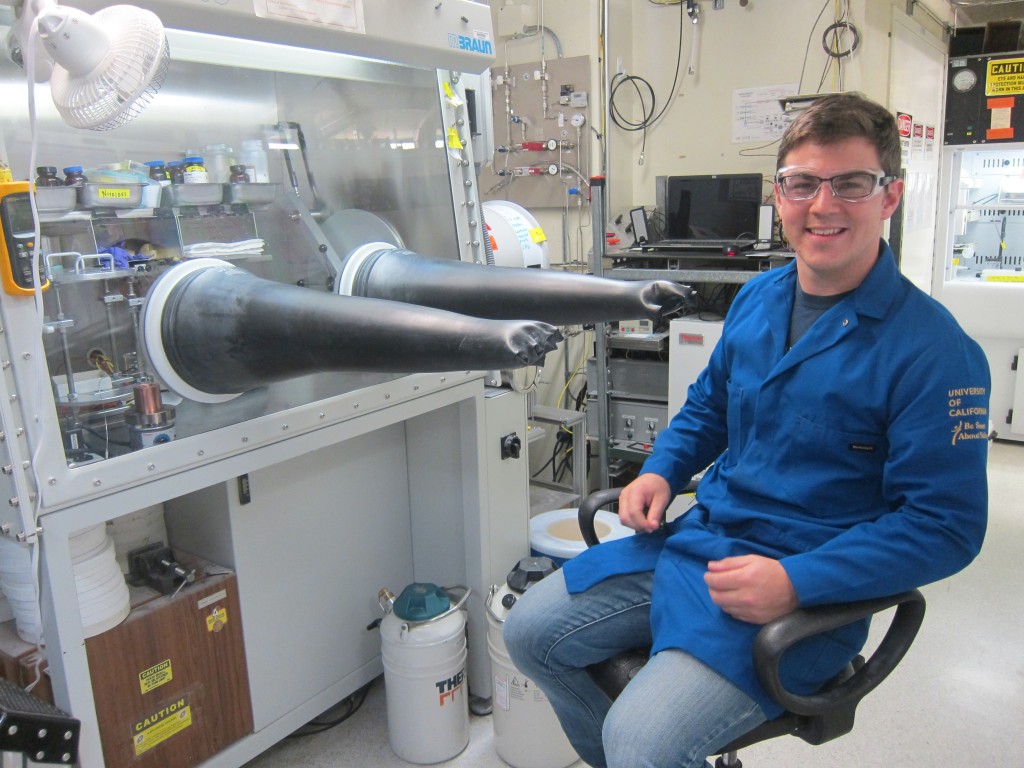

 We discuss her grand vision of creating a network of hands-on science and tech centers across Africa, starting in Juja, Kenya, a university town she describes as having “the same vibe as Silicon Valley.”