Beyond the obvious detail that Google’s new car is all-electric (which Katie Fehrenbacher points out is important), we explored why driverless cars may one day contribute to a cleaner and more efficient transport sector. Find out how below…
Here’s a transcript of our conversation. It’s been edited for length and clarity. Listen from 18:27 at the BBC World Service.
Bithrey: Google is to start building its own fleet of self driving cars…Let’s bring in our guests, Alison van Diggelen in San Francisco and Alex Frangos in Hong Kong. Alison… have you seen any in your neighborhood…Google trying out their self driving cars?
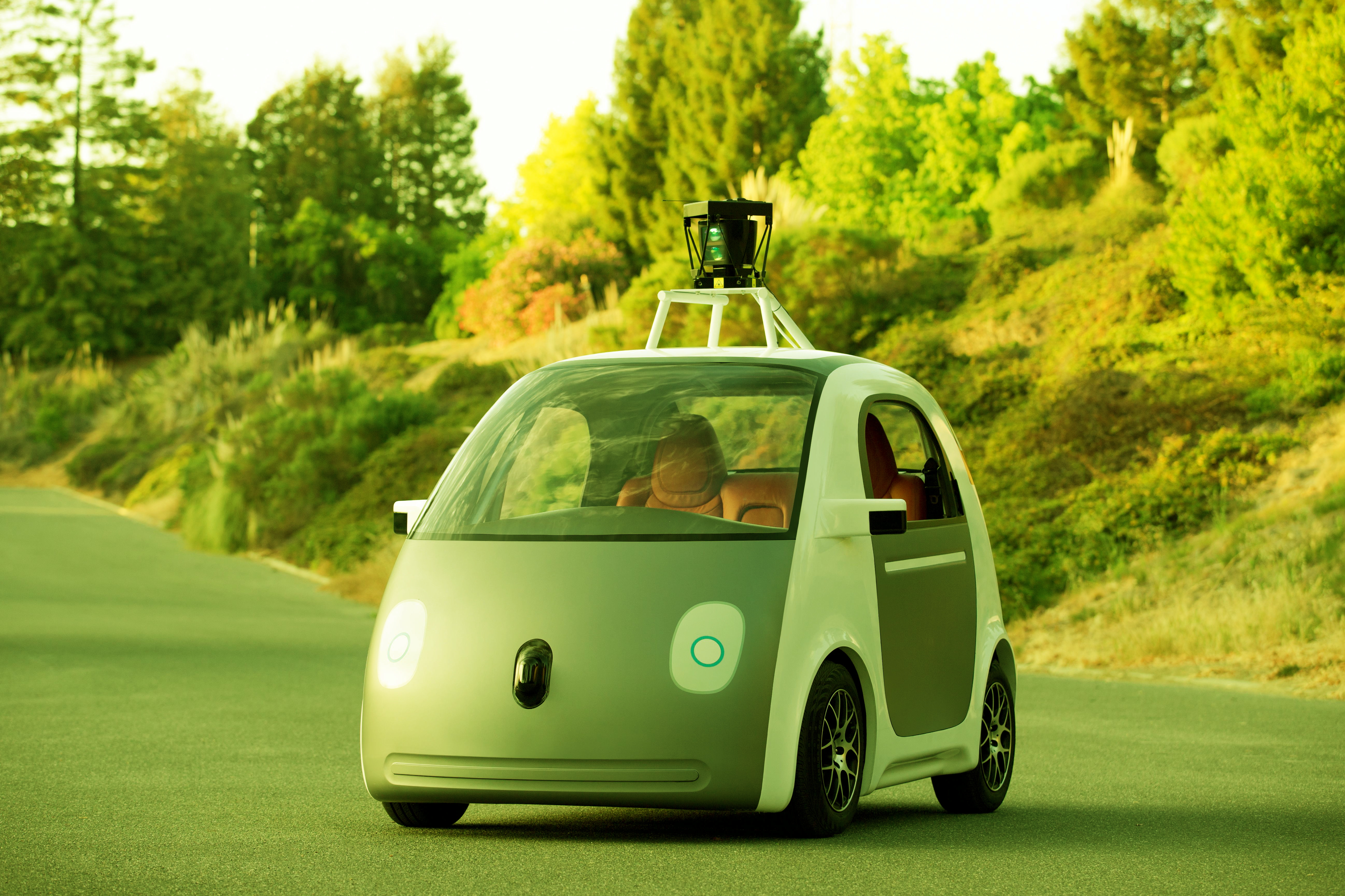
van Diggelen: I’ve seen many on Highway 85 between Mountain View and San Jose. You see them a lot, but I haven’t seen this particular one. What is unique about this is that it only goes 25 mph and it’s built from the ground up…they’re going to be building about 100 of them and we’ll probably see them in and around Google, they’re going to use it between buildings on their campus. That is the plan.
But what’s exciting about it from my point of view – I cover cleantech – and the beauty of self driving cars is that it can be a more efficient way to transport us. Self driving cars can allow “platooning” so cars can convoy really close together, you can get more cars on the road and it can include car sharing. And here’s an interesting example: in the future, you may be able to rent a car, and you may not want do the autonomous self drive car, but you just call it up on your app and it can deliver itself to your door. And that to me is an interesting, futuristic view of what they one day may be able to do.
Bithrey: (laughter) It is indeed. There are critics who say that… they could make traffic worse, and urban sprawl worse because people won’t have to drive any more. It will tire them out less if they’re not having to drive themselves, and so they may be happy to make longer journeys in these and thus be more polluting.
van Diggelen: Yes, that’s a possibility, however, the interesting thing with this car is that it is an electric car, so again that’s a greener alternative to your internal combustion engine. Another advantage of autonomous cars…is that you can have parking lots where you take your car to the edge of the parking lot and say, “Go Park Yourself.” It will have sensors on the car and in parking spaces, so those cars will be able to pack themselves in much more efficiently, so a more efficient use of available space. I take your point about longer commutes, but there are greener aspects to it too.
Bithrey: Alex Frangos in Hong Kong, is this the type of thing you’d like to try out? Would you trust a driverless car?
Frangos: I’d trust it probably as much as I’d trust all the other crazies who are on the road with me. Saying it’s unsafe is only in comparison to how unsafe it already is on the road, given how terrible drivers can be in various countries of the world. The thing that is, not troubling, but would take the enjoyment out of driving and misses the point, especially in the US of why people drive: the freedom and control it gives people. Or at least a sense of freedom and control to go where they want and do what they want… make a spontaneous turn or what not.
Bithrey: It’s just a more advanced version of cruise control isn’t it?
Frangos: No, I think it’s much more than that because you’re giving up control to the computer. So it could be a great improvement in life, but it would change what driving means, especially to Americans.
Bithrey: Yes, it might be slightly strange just having a stop/go button and not having all the other things we’re used to inside a car. OK, we’ll be back with you both on Business Matters on the BBC World Service….
Want to hear the entire show at the BBC? Listen here
Other topics we cover:
On collaboration: a group of four authors have collaborated on a single novel called “Keeping Mum.” We ask them how it’s possible to keep such a large group focused on a single plot. @26:40
On Maya Angelou: “This will resonate not just for novelists but for business people too. ‘People will forget what you said, people will forget what you did, but people will never forget how you made them feel’ (Maya Angelou)” @39:05
On Apple’s acquisition of Dr Dre’s Beats Electronics. Will it make Apple cooler? @45:56
Find out more about BBC conversations
In April, we discussed Apple’s green strategy (renewable energy supply, recycling iPods etc) on BBC Business Matters
Listen to my other appearances on BBC Business Matters re. how Fresh Dialogues began; the Dalai Lama in Silicon Valley; Scottish independence and much more.
Yesterday, I was invited to join the live BBC World Service show, Business Matters to discuss Apple’s green manifesto and its rivalry with Samsung. I was interviewed by the BBC’s talented Manuela Saragosa. Here’s a transcript of the highlights. Listen to the full interview here (green discussion starts at 26:00).
Saragosa: It was Earth Day on Tuesday… there’s been no dimming of the lights here at the BBC…but technology giant, Apple has been laying out its green manifesto to mark Earth Day. The company’s CEO Tim Cook put out a video, announcing a new scheme that allows any product made by Apple to be returned to the company for recycling.
Our guest, Alison van Diggelen is in California’s Silicon Valley. Alison, green business issues are your thing, what do you make of Apple’s manifesto? Is there substance to it do you think?
van Diggelen: I think there is substance to it. The reason they put out this video is: Greenpeace has been snapping at Apple’s heels for quite some time. I did a story a couple of years ago (for NPR’s KQED Radio) when they were looking at data centers. Greenpeace came up with their own quasi Apple ad (cunningly called iCoal), showing that every time you download something or send a photo on your iPhone, you’re putting more smog into the atmosphere. It was very clever and got Apple’s attention, and now they’re really moving ahead (According to a recent EPA report – Apple is now in the top 10 clean energy users nationally and uses 92% clean energy). One of their major data centers (in North Carolina) where they do Apple iCloud, has 100% green power: clean energy, using solar and fuel cells.
In the video, they’re doing a little chest thumping, saying “Look at us – here’s what we’re doing!” And of course, launching it on the week of Earth Day was a very clever move, a strategic move…
I do think Apple deserves to be lauded. It could do more, but I think shining a light on what it’s doing so far is good.
Saragosa: But it’s come a hugely long way. I know that in 2006, Greenpeace published its first guide to green electronics and at that point it rated Apple among the worst companies (it ranked 11 out of 14 companies). I suppose things have changed quite a lot since then.
van Diggelen: Yes. I think Greenpeace deserves credit for doing what it can to put the pressure on. This report it released went through all the major tech companies: Google, Apple, Facebook, Twitter (Amazon), saying: “Here’s what they’re doing folks!” Companies that you think of as pretty green and green advocates like Google, they’re not doing enough. They could do more.
The interesting thing with Tim Cook that your listeners will definitely be interested in is that at a recent shareholders’ meeting, someone stood up and said: “We don’t like what you’re doing with all those clean energy data centers. Couldn’t you be using your funds to make better products…do other things?”
Saragosa: But is that a widely held view?
van Diggelen: This is the interesting thing: Tim Cook struck back at them. He said: “We believe that we must make the world a better place.” He stood up and said this to the shareholders…”If you don’t agree with it, sell your shares! Which was quite gutsy of him I thought. Since then Richard Branson (CEO Virgin Atlantic etc) has said the same (He recently wrote, “Businesses should never be entirely focused on the bottom line…I would urge climate deniers to get out of our way!“) So I think it’s great to see high profile CEO’s like Tim Cook and Richard Branson are doing that, and saying: Hey! We need to think about the environment, we need to think about our impact on the environment. I’m cheered by that.
Listen to more of our discussion re Apple vs Samsung battle, copycats, tech recycling, and safe disposal of electronic goods.
We also explored attitudes to the environment and clean energy in Asia with David Kuo of the Motley Fool in Singapore; and discussed the devastating levels of pollution in China’s major cities.
van Diggelen: I recently spoke with Andrew Chung, who’s a Chinese American venture capitalist in Silicon Valley. He’s doing a lot of work in China and he was telling me about one of the (green) companies he’s investing in. The impetus in China is huge: they’re having to do it because the pollution is so intense, people are dying from the pollution.
One of these companies that’s completely addressing that is LanzaTech. They’re capturing the carbon monoxide pollution from steelmakers outside Shanghai and using it to create valuable fuel and chemicals, rather than ‘just’ capturing it. It’s a really interesting solution: a win win. A win for the environment, but it’s also a money maker and great for the steelmakers. So that’s the kind of play that’s going on in China.
Here come China’s tech giants. Last week, Alibaba and China’s Twitter-like Weibo announced massive IPO plans. Today, in Silicon Valley, China is front and center in the news. Let’s take a closer look at Chinese entrepreneurship in Silicon Valley. How will it change the tech innovation capital of the world? And will a longer term view take hold?
A version of this story aired on BBC’s Tech Tent on March 14, 2014. Listen to the podcast below: @17.35
The latest wave of Chinese immigrants to Silicon Valley is impacting everything from the housing market to the way business is done in the high tech capital of the world.
Ching-Lun Lin, student at Carnegie Mellon SV
Image 1 of 10
Banner says "Work harder!"
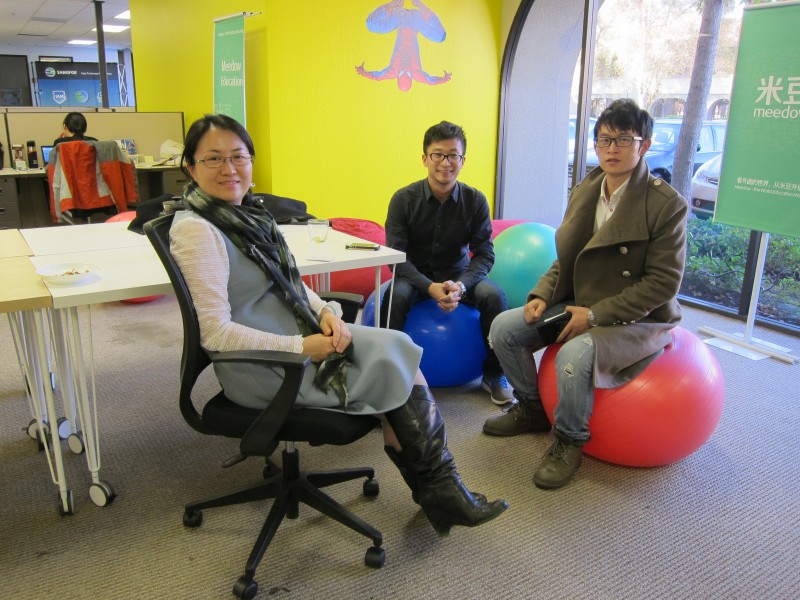
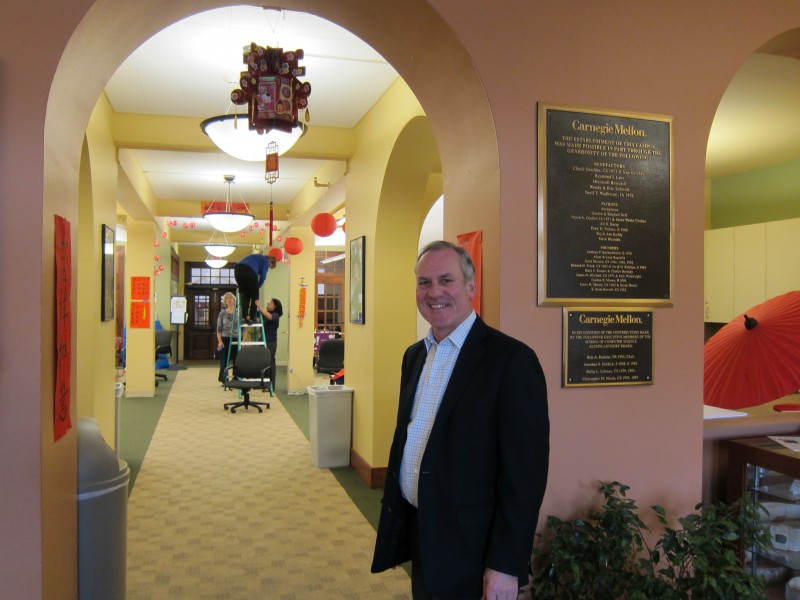
Stuart Evans, a Brit who arrived in Silicon Valley 30 years ago, has been studying the unique ecosystem of Silicon Valley for decades. Today, he teaches entrepreneurship at Carnegie Mellon Silicon Valley, and says he’s seen a sevenfold increase in student applications from China and South-East Asia in the last year.
Evans: “It’s been like a racehorse that’s been choked back in the stalls and now the gate’s open and the race is away.”
He’s witnessed millions of dollars from Chinese tech giants flooding into Silicon Valley startups; and incubators popping up for entrepreneurs arriving from Chinese tech hubs in Beijing and Shanghai. In Palo Alto, home of Stanford University, the number of home purchases by Chinese nationals has tripled since 2011. A local realtor recently reported that for every seven offers for a home, three of them will be cash offers from Mainland China. As well as teaching, Evans mentors young entrepreneurs at Innospring, a Silicon Valley based incubator that offers advice, funding and partnerships to fledgling Chinese startups and American ones seeking to expand in China. Here’s how he describes his role:
Evans: “A bouncing board to bounce ideas…to critique, to make connections, to suggest better ways to go about doing things.”
Better ways, and American ways. For example, he’s had to help young Chinese entrepreneurs adapt to the strict American legal system and US privacy concerns. Evans recalls telling a Chinese student that he might run into legal liability and privacy issues his new device for a car steering wheel.
Evans: “It seemed at first to hit a raw nerve…’Why not? Why don’t we just do it anyway?’ …was the entrepreneur’s initial response. Yet Evans found that they did eventually come round to an Americanview of the world.
Evans: “When you reason with people and show them the implications, they very quickly respond and come up with inventive solutions.”
Evans points out that there is no work/life balance in Silicon Valley: your work is your life. He says that fits well with the Chinese mindset and intense work ethic. It’s intensely competitive to get into the best schools in China.
Evans: “I’ve had students who would get up at 4 o’clock in the morning to be prepped before they went to school.”
Innospring founder, Eugene Zhang invites me to tour during a visit by a delegation of “20 under 20” college students from Jiangsu province in China.
Zhang: “Innospring is about capturing that positive energy…the big opportunities…the next Google or Baidu…the giants.”
So how are these Chinese entrepreneurs in Silicon Valley changing the way things are done? One of Evans’s entrepreneurs is Nan Zhong, cofounder of startup TIKL, a walkie-talkie app for smartphones. He describes a different mindset in the Chinese culture.
Zhong: “Letting go instant gratification is driven into my head…you go for what’s eventually going to be good for you, not necessarily what makes you happy at the moment.”
That long-term view colors the way Chinese entrepreneurs run their businesses he explains. They focus on growing market share and endure long-term losses to do so.
Zhong: “People take the pain, take the time, take all the hard work to grow an idea all the way to something that’s global.”
This contrasts with the short-term term view of many Silicon Valley startups, which often focus on being acquired or going public within two years. Evans agrees. In his experience, American and Indian entrepreneurs are generally happy to be acquired by companies like Google and Facebook; whereas his Chinese entrepreneurs prefer growth and autonomy, treating their startups like a precious baby.
Evans: “The idea of bringing up a baby and teaching it how to walk and learn as the company progresses is something that fits very well with the Chinese culture.”
Whether that longer term view takes root in Silicon Valley remains to be seen, but some influences already go both ways. Evans recalls the tale of a US colleague working at a startup in China who shocked his colleagues by cleaning up the tea cups on a Friday afternoon, a job typically done by the ‘ladies’ in the office, even the VPs. Gender and hierarchy boundaries were breached.
Evans:“It transformed the culture of the office with just that one act (finger click) and sent a message that this new way of doing things has implications.”
van Diggelen: “Do you think that’s rippling beyond that startup?”
Evans: “Yes, Silicon Valley is culturally diverse, intellectually homogeneous…it’s a heavily networked ecosystem and what works comes to the surface very quickly.” Instead of a clash of cultures at the surface, Evans says there’s a melding; creating what he calls ‘a global mosaic of talent.’ And Innospring is a focal point in that mosaic. Evans has witnessed a change in the way companies grow in Silicon Valley over the last 30 years. He points to the Chinese being an important part of the valley’s technical competency, with their strong math and software education, which increases opportunities for innovative collaboration.
Evans: “Even though they’re from a different culture and a different background, they speak the same language, technically.”
I suggest the melding that goes on in Silicon Valley in terms of innovation and business practices produces a special Asian Fusion, a bit like the fortune cookie, a Japanese-American creation, that’s largely known as “Chinese.”
Evans: “An Asian Fusion fortune cookie, wow (laughter)…at my age I try to steer clear of cookies…but the idea of fusion is something which is part of Silicon Valley’s DNA, it’s in the sharing and pooling of ideas that brings about the innovation in Silicon Valley.”
Find out more about Alison’s other contributions to and appearances on BBC

 Bithrey: (laughter) It is indeed. There are critics who say that… they could make traffic worse, and urban sprawl worse because people won’t have to drive any more. It will tire them out less if they’re not having to drive themselves, and so they may be happy to make longer journeys in these and thus be more polluting.