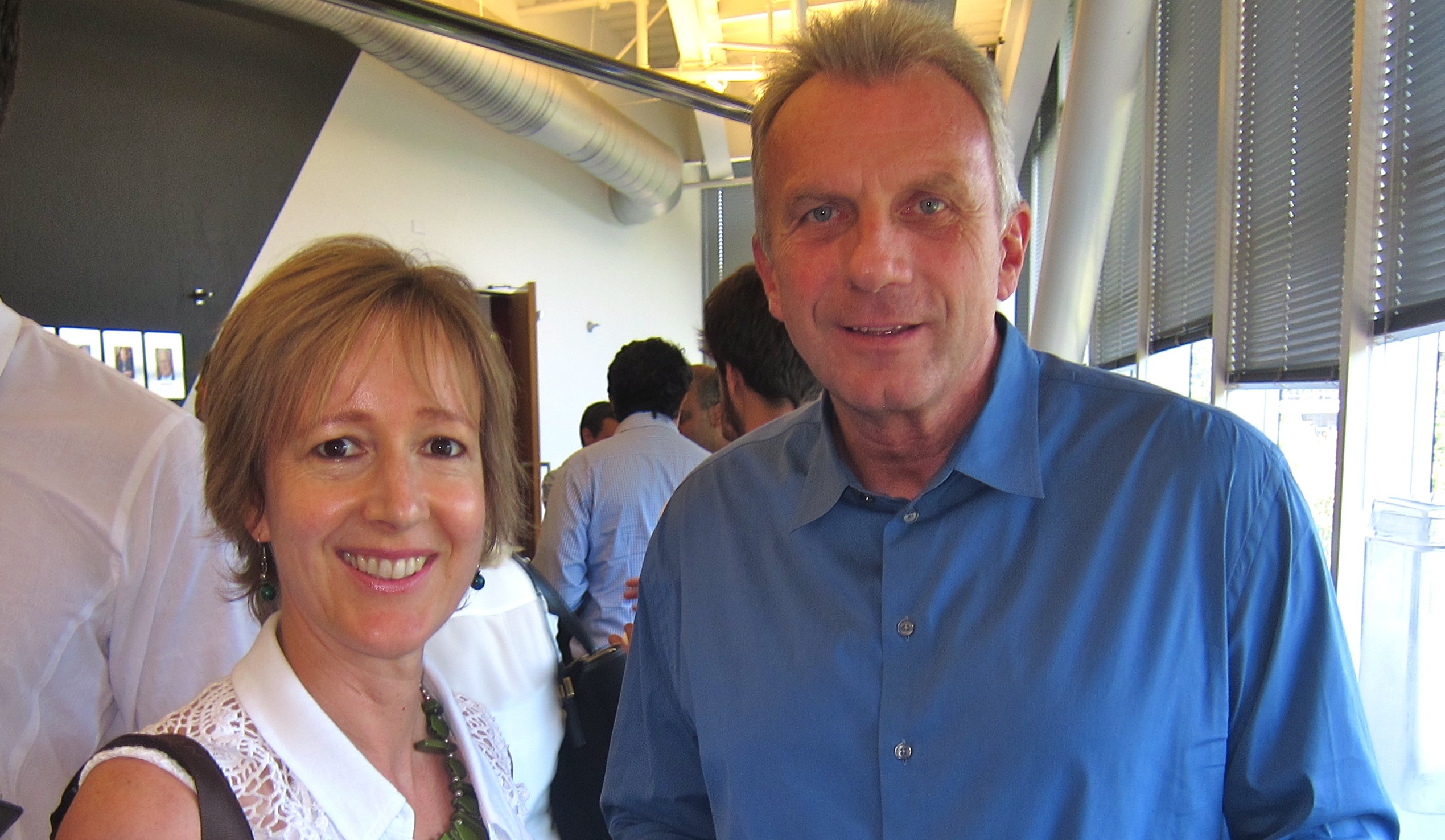
Energy was high today at the Y Combinator Demo Day, as a sea of young entrepreneurs jostled for attention – and funding – from a vast throng of Silicon Valley investors. I chatted with NFL Hall of Famer, Joe Montana who’s ditched his 49ers helmet for an angel investor hat these days (see the halo?) He was busy with the much buzzed about Helion Energy team which is working on “the world’s first commercial nuclear fusion reactor.” They hope to prove commercial scale fusion within 3 years by building a 50 Megawatt reactor in Redmond Washington, providing carbon emission-free power for 40,000 homes.
I’m curious to find out if the nuclear fusion company Tri-Alpha Energy, backed by Mad Men’s Harry Hamlin will consider a joint venture, or perhaps just some knowledge fusion?
Montana said he committed to four other startups today, including Backpack, a company that connects travelers to shoppers, cutting price differentials for items like medicine and electronics around the world; and Unwind Me, an on-demand massage app. Sign me up for that demo!
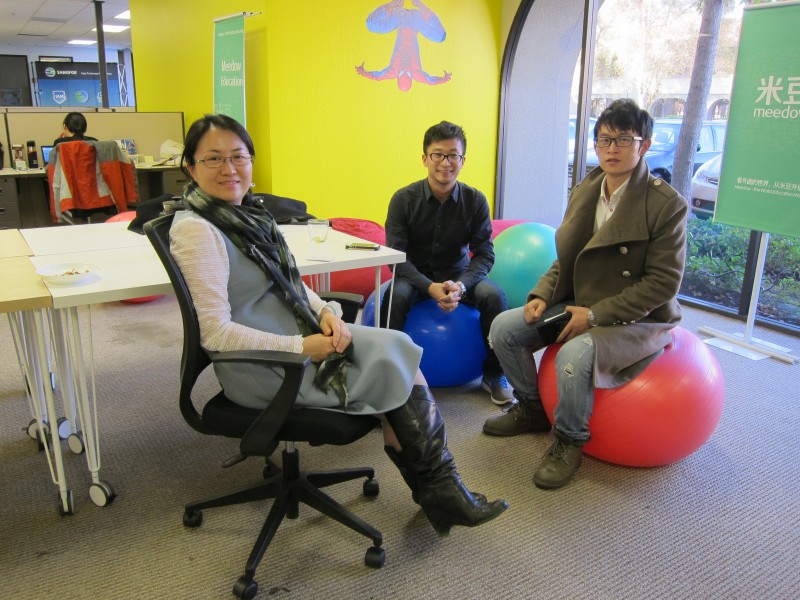
Here are photos from today’s Y Combinator Demo Day, where 75 startup teams presented and deep-pocketed investors like Jillian Manus looked for the next WhatsApp.
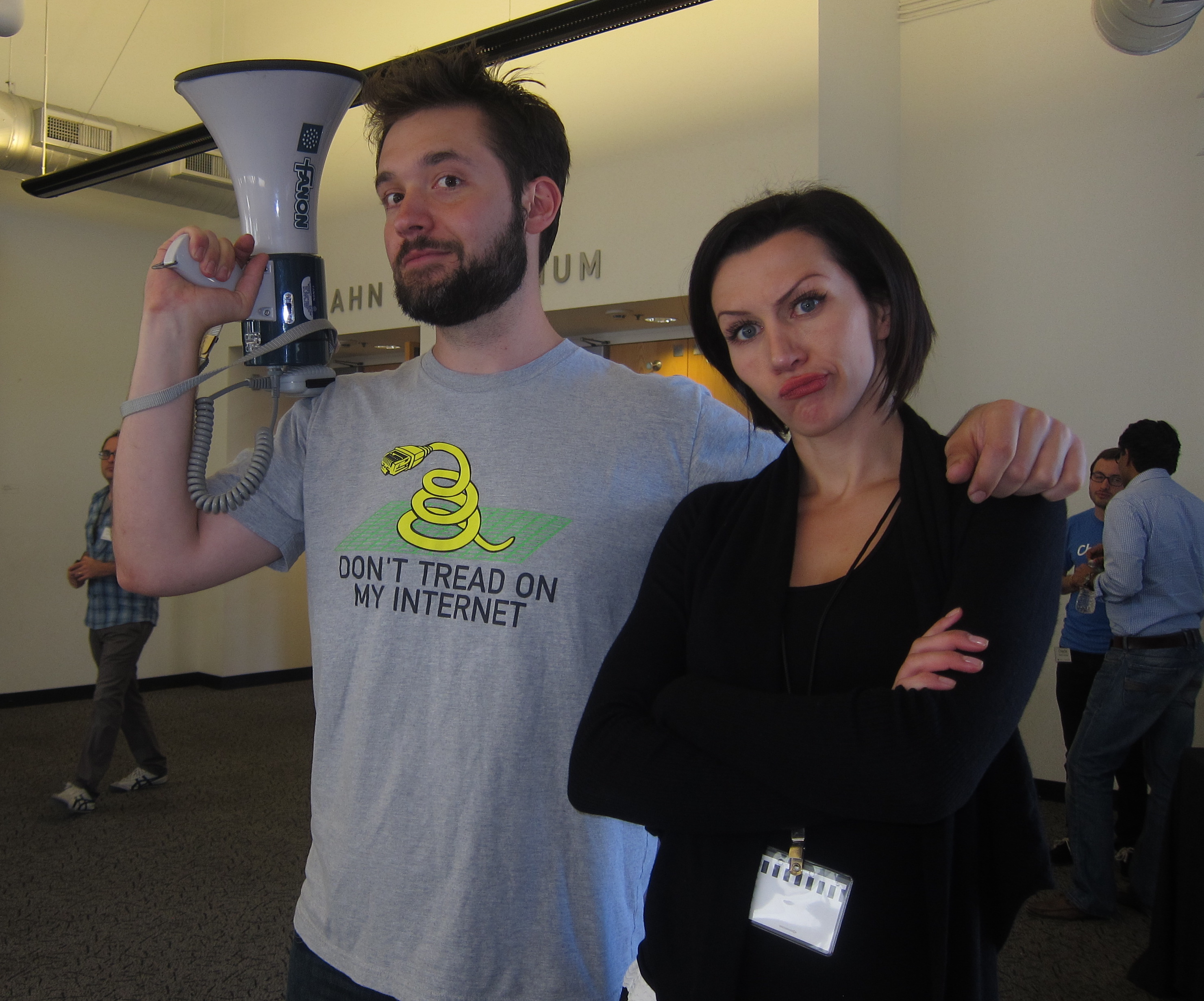
Alexis Ohanian (of Reddit fame) & Irina Lukashuk call time at Y Combinator.
Image 1 of 8
Photo credit: Fresh Dialogues
And some more (green tinged) highlights:
1. Edyn is a smart irrigation system for home gardeners and small farmers. Given California’s massive drought challenges, this one caught my eye. A huge Kickstarter success with a cool design by Jambox designer, Yves Behar, it’s set to go into production with Flextronics. Selling for $160, it could be a popular holiday gift this winter.
2. UPower is building nuclear batteries. This smart team, all MIT grads, describe their product as “a plug-and-play nuclear thermal battery.” Their target market is off-grid locations such as remote islands. I spoke with cofounder Caroline Cochran who emphasized the carbon-free, emission-free nature of nuclear batteries and assured me that they were addressing safety concerns around radioactive waste. According to a report by Kyle Russell at Techcrunch, “the reactor, in addition to being fuel agnostic (it can use thorium, uranium, or recycled fuel) can actually reduce the half life of existing waste, and spent fuel from it can be reused in another reactor with some processing.”
3. Beep is an operating system to make your speakers smart. Think: the Internet of “Audio-Things.” The ex-Googlers confirm that Beep already works with Pandora and Spotify and say you’ll soon be able to control your favorite NEST thermostat using your voice. It sounds like Star Trek’s Enterprise is closer than you think…
4. Vatler offers a valet service for workers, special event attendees, etc. Think: Uber for parking. As the CEO said in his presentation, drive into any big city (say San Francisco?) and “parking’s a bitch.” His team’s solution: an app to help you find an instant valet, using a quick tap on your phone. Quicker than looking, cheaper than parking.
5. The Immunity Project is developing a free vaccine to end AIDS and HIV. Frankly, it made all the earlier presentations seem trivial solutions to “first world problems” (except perhaps UPower) and got the audience’s most enthusiastic response. Find out more about this ambitious project here.
Big thanks to Y Combinator partner, Kat Manalac for the invitation.
Joe Montana photo credit: Vicki Thompson of SV Business Journal.
The event was held at the Computer History Museum in Mountain View where there’s a remarkable collection of photos by Doug Menuez in the foyer, featuring Silicon Valley tech luminaries, including the inimitable Steve Jobs. Check it out next time!
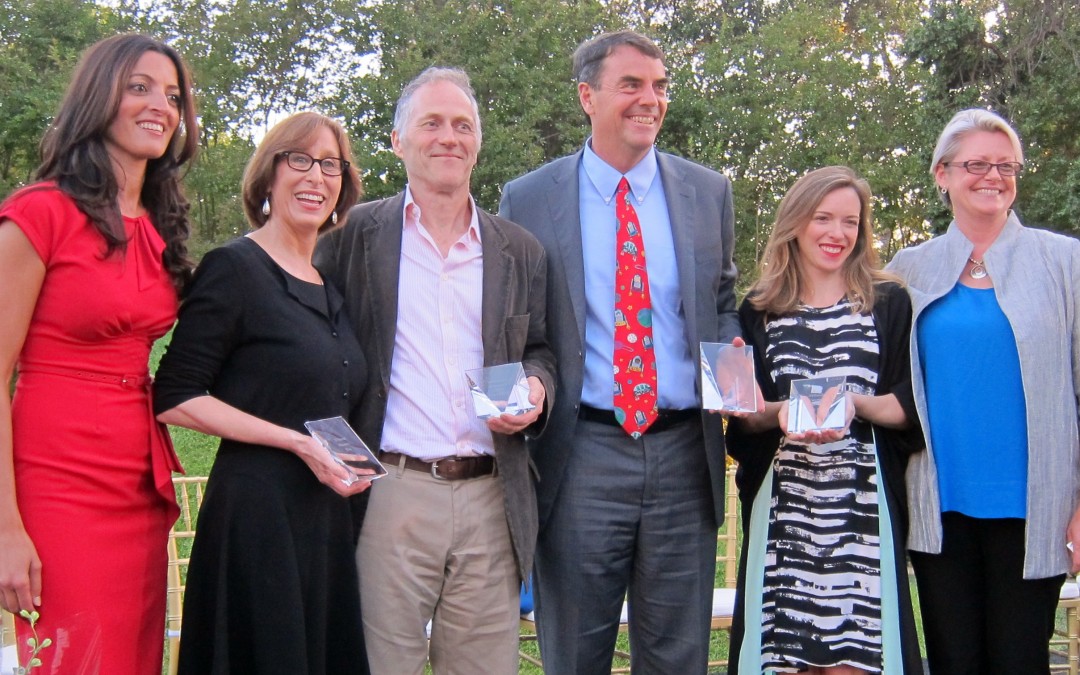
The dynamic new CEO of SVForum, Adiba Barney rolled out the red carpet this week for the 17th Visionary Awards. But despite all the glitz and glamor, there was a strong message: use tech to make the world better. Of course, each recipient has an impressive resume: Jessica Jackley, cofounder of Kiva; Tim O’Reilly, open source advocate and media producer; Tina Seelig, director of Stanford Tech Ventures Program; and Tim Draper, founder of Draper University and partner at DFJ Ventures. But how did each get where they are today and what can you learn from their journey?
Here are some of the lessons the visionaries shared at Tuesday’s event:
1. Ask: what if?
Jackley witnessed a new level of poverty while working in Africa and when she returned to Silicon Valley, she wanted to help change some lives, especially those with an entrepreneurial drive. She said, “People in Silicon Valley are always talking about the future…so ask: what if?”
Her inspiration? She was killing time at Stanford University one evening, and just happened to attend a talk by Muhammad Yunis, the Nobel Prize winning founder of “banker to the poor” Grameen Bank. His success helped launch the microlending phenomenon and inspired Kiva, a nonprofit microlender that’s now shared over half a billion dollars in startup funds with entrepreneurs around the world.
2. Have some accidents
Tim Draper confessed that he often discovered and backed companies like Skype by complete accident. Often he was actually looking for, or working on something else. His message: “If you want to be a visionary, go out and have some accidents!” And he proceeded to fling his glass of water into the crowd. Fortunately there were no injuries, though fellow journalist, Tom Foremski got the brunt of the baptism.
3. Go for love not money
Tim O’Reilly said “I urge you all: do things for love, with no expectation of return…celebrate the success of people who make a difference.” He described Silicon Valley as a place “for people who dream, who care…about stuff other than making an exit.”
Although he’s a big believer in the power of the markets, he underlined the obligation to “give back” and in his great literary style, he even quoted a passage from Victor Hugo’s “Les Miserables” to underline his point that an entrepreneur should think “much of others, and little of him (or her) self.” He’s recently embraced the vision of Jennifer Pahlka’s Code for America. It helps bring more top tech talent into government (e.g. the tech team that went to D.C. to help rescue HealthCare.Gov’s disastrous rollout).
“We need to fix government, not abandon it!” said O’Reilly.
4. Never miss an opportunity to be fabulous
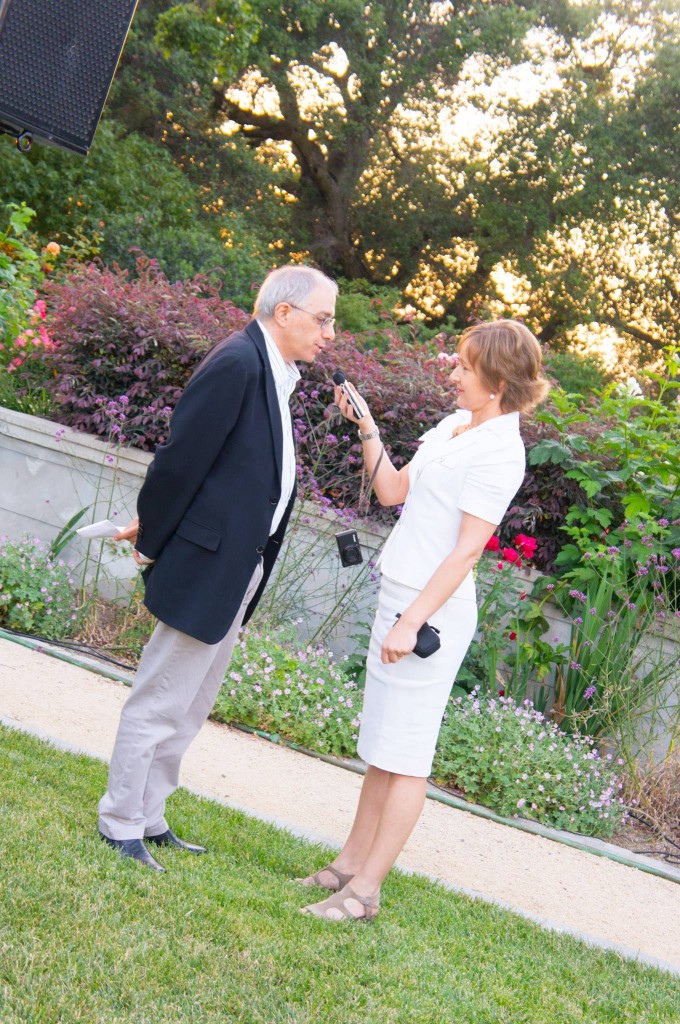
Tina Seelig is the epitome of Silicon Valley passion for entrepreneurship and technology; and urges us all to ask big questions. Her mantra is “never miss an opportunity to be fabulous” and although she didn’t say it, her energetic body language seemed to be chanelling Adele’s line from Rolling in the Deep: “Throw your soul through every open door!”
5. Have a passion for “Yes”
Steven Levy, a senior writer at Wired Magazine, and former honoree himself, introduced Tim O’Reilly and reminded everyone that behind every “no” is a “yes.”
“At the core of Silicon Valley is a passion for yes,” he said. “This is the place where people don’t look for reasons to say no…(instead) someone comes up with a crazy idea and they have permission to do it.”
Presumably he means, if you want to be a real tech visionary, there’s no place like Silicon Valley.
Check back soon for Fresh Dialogues interviews with Jessica Jackley, Tina Seelig, Jennifer Pahlka and Tim Draper.
This SVForum event took place at the home of Kelly Porter in Los Altos Hills on Tuesday June 3rd, 2014.
Here come China’s tech giants. Last week, Alibaba and China’s Twitter-like Weibo announced massive IPO plans. Today, in Silicon Valley, China is front and center in the news. Let’s take a closer look at Chinese entrepreneurship in Silicon Valley. How will it change the tech innovation capital of the world? And will a longer term view take hold?
A version of this story aired on BBC’s Tech Tent on March 14, 2014. Listen to the podcast below: @17.35
The latest wave of Chinese immigrants to Silicon Valley is impacting everything from the housing market to the way business is done in the high tech capital of the world.
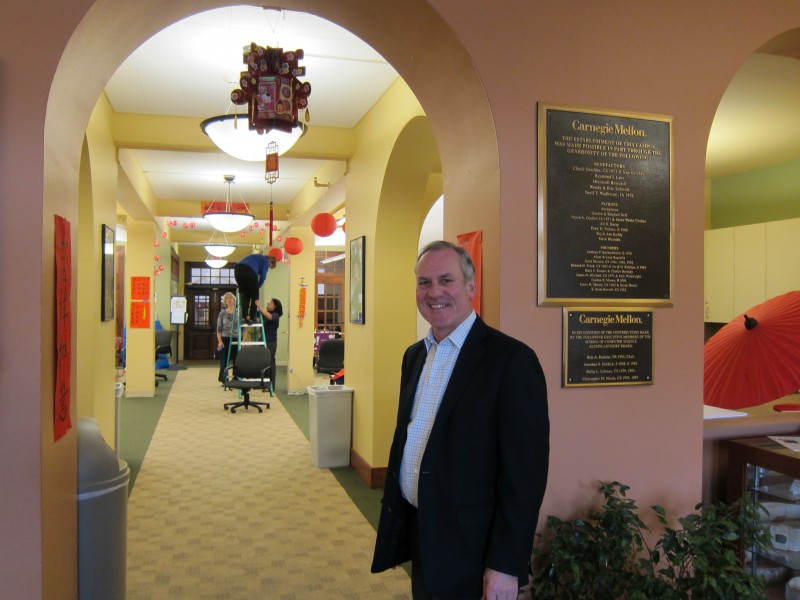
Ching-Lun Lin, student at Carnegie Mellon SV
Image 1 of 10
Banner says "Work harder!"
Stuart Evans, a Brit who arrived in Silicon Valley 30 years ago, has been studying the unique ecosystem of Silicon Valley for decades. Today, he teaches entrepreneurship at Carnegie Mellon Silicon Valley, and says he’s seen a sevenfold increase in student applications from China and South-East Asia in the last year.
Evans: “It’s been like a racehorse that’s been choked back in the stalls and now the gate’s open and the race is away.”
He’s witnessed millions of dollars from Chinese tech giants flooding into Silicon Valley startups; and incubators popping up for entrepreneurs arriving from Chinese tech hubs in Beijing and Shanghai. In Palo Alto, home of Stanford University, the number of home purchases by Chinese nationals has tripled since 2011. A local realtor recently reported that for every seven offers for a home, three of them will be cash offers from Mainland China. As well as teaching, Evans mentors young entrepreneurs at Innospring, a Silicon Valley based incubator that offers advice, funding and partnerships to fledgling Chinese startups and American ones seeking to expand in China. Here’s how he describes his role:
Evans: “A bouncing board to bounce ideas…to critique, to make connections, to suggest better ways to go about doing things.”
Better ways, and American ways. For example, he’s had to help young Chinese entrepreneurs adapt to the strict American legal system and US privacy concerns. Evans recalls telling a Chinese student that he might run into legal liability and privacy issues his new device for a car steering wheel.
Evans: “It seemed at first to hit a raw nerve…’Why not? Why don’t we just do it anyway?’ …was the entrepreneur’s initial response. Yet Evans found that they did eventually come round to an Americanview of the world.
Evans: “When you reason with people and show them the implications, they very quickly respond and come up with inventive solutions.”
Evans points out that there is no work/life balance in Silicon Valley: your work is your life. He says that fits well with the Chinese mindset and intense work ethic. It’s intensely competitive to get into the best schools in China.
Evans: “I’ve had students who would get up at 4 o’clock in the morning to be prepped before they went to school.”
Innospring founder, Eugene Zhang invites me to tour during a visit by a delegation of “20 under 20” college students from Jiangsu province in China.
Zhang: “Innospring is about capturing that positive energy…the big opportunities…the next Google or Baidu…the giants.”
So how are these Chinese entrepreneurs in Silicon Valley changing the way things are done? One of Evans’s entrepreneurs is Nan Zhong, cofounder of startup TIKL, a walkie-talkie app for smartphones. He describes a different mindset in the Chinese culture.
Zhong: “Letting go instant gratification is driven into my head…you go for what’s eventually going to be good for you, not necessarily what makes you happy at the moment.”
That long-term view colors the way Chinese entrepreneurs run their businesses he explains. They focus on growing market share and endure long-term losses to do so.
Zhong: “People take the pain, take the time, take all the hard work to grow an idea all the way to something that’s global.”
This contrasts with the short-term term view of many Silicon Valley startups, which often focus on being acquired or going public within two years. Evans agrees. In his experience, American and Indian entrepreneurs are generally happy to be acquired by companies like Google and Facebook; whereas his Chinese entrepreneurs prefer growth and autonomy, treating their startups like a precious baby.
Evans: “The idea of bringing up a baby and teaching it how to walk and learn as the company progresses is something that fits very well with the Chinese culture.”
Whether that longer term view takes root in Silicon Valley remains to be seen, but some influences already go both ways. Evans recalls the tale of a US colleague working at a startup in China who shocked his colleagues by cleaning up the tea cups on a Friday afternoon, a job typically done by the ‘ladies’ in the office, even the VPs. Gender and hierarchy boundaries were breached.
Evans:“It transformed the culture of the office with just that one act (finger click) and sent a message that this new way of doing things has implications.”
van Diggelen: “Do you think that’s rippling beyond that startup?”
Evans: “Yes, Silicon Valley is culturally diverse, intellectually homogeneous…it’s a heavily networked ecosystem and what works comes to the surface very quickly.” Instead of a clash of cultures at the surface, Evans says there’s a melding; creating what he calls ‘a global mosaic of talent.’ And Innospring is a focal point in that mosaic. Evans has witnessed a change in the way companies grow in Silicon Valley over the last 30 years. He points to the Chinese being an important part of the valley’s technical competency, with their strong math and software education, which increases opportunities for innovative collaboration.
Evans: “Even though they’re from a different culture and a different background, they speak the same language, technically.”
I suggest the melding that goes on in Silicon Valley in terms of innovation and business practices produces a special Asian Fusion, a bit like the fortune cookie, a Japanese-American creation, that’s largely known as “Chinese.”
Evans: “An Asian Fusion fortune cookie, wow (laughter)…at my age I try to steer clear of cookies…but the idea of fusion is something which is part of Silicon Valley’s DNA, it’s in the sharing and pooling of ideas that brings about the innovation in Silicon Valley.”
Find out more about Alison’s other contributions to and appearances on BBC
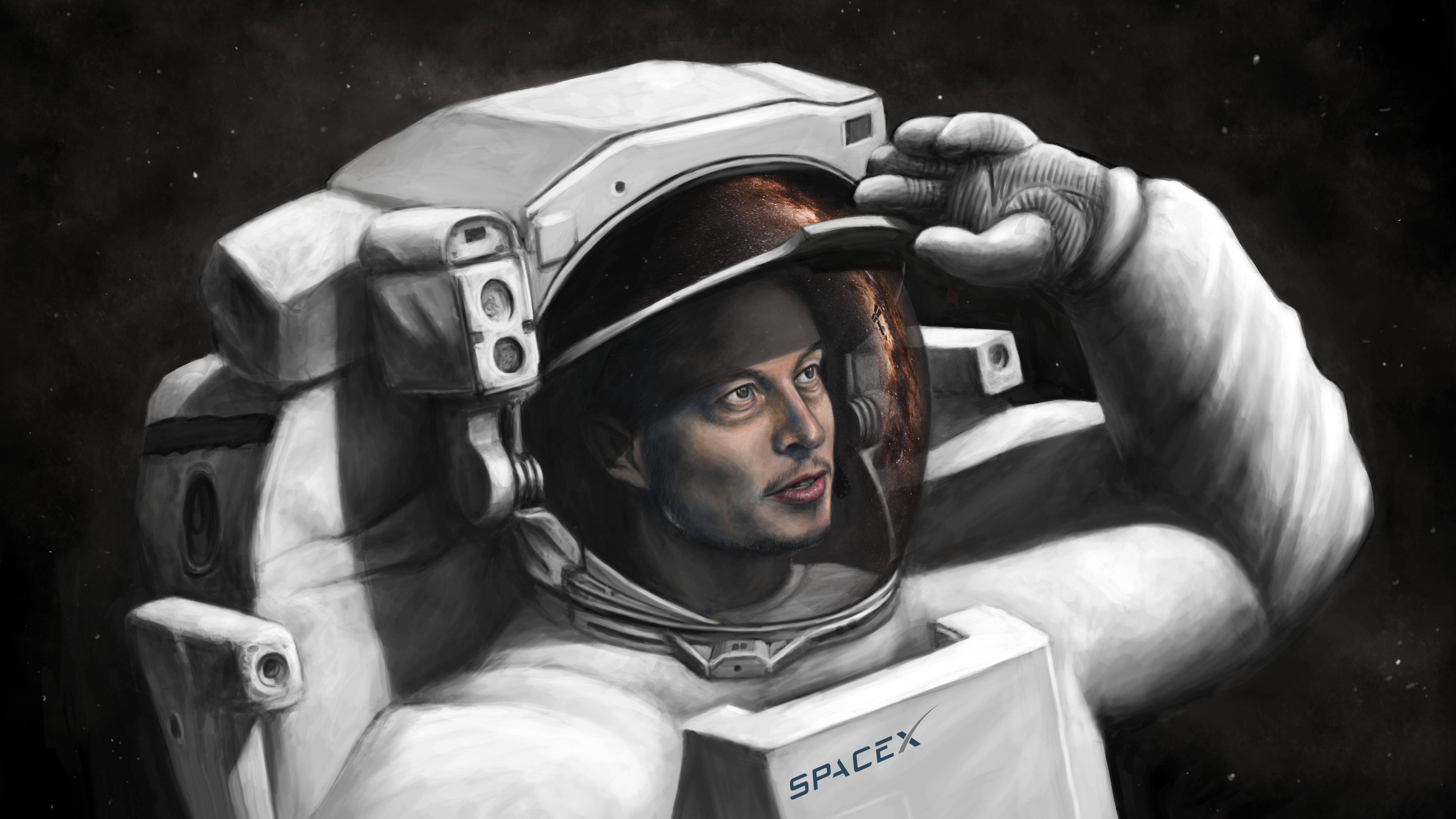
Elon Musk has been hailed as the next Steve Jobs, a serial disruptor and a genius. Others call him just crazy. Yet Musk has defied the naysayers and made remarkable innovations in both electric cars and spaceflight over the last ten years. But just how accurate is the Steve Jobs comparison?
“Most innovation is like a new melody,” writes Ted curator Chris Anderson. “For Jobs and Musk, it’s the whole symphony.”
Anderson’s analogy is right. Neither men do things in small measures. They seek to change the world.
I interviewed Elon Musk last year in one of his most revealing public appearances, and he exposed a complex character that is both deadly serious yet comedic at times; driven yet sensitive; single minded, and yet eclectic in his desire to change the world in multiple ways.
.
That sensitivity was apparent several times during our dialogue when his eyes welled up in response to my questions about the future of NASA, Neil Armstrong, and candlelight vigils for the EV1 (@28:35, 1:04:00 & 39:50 in the video). Steve Jobs was also known to weep.
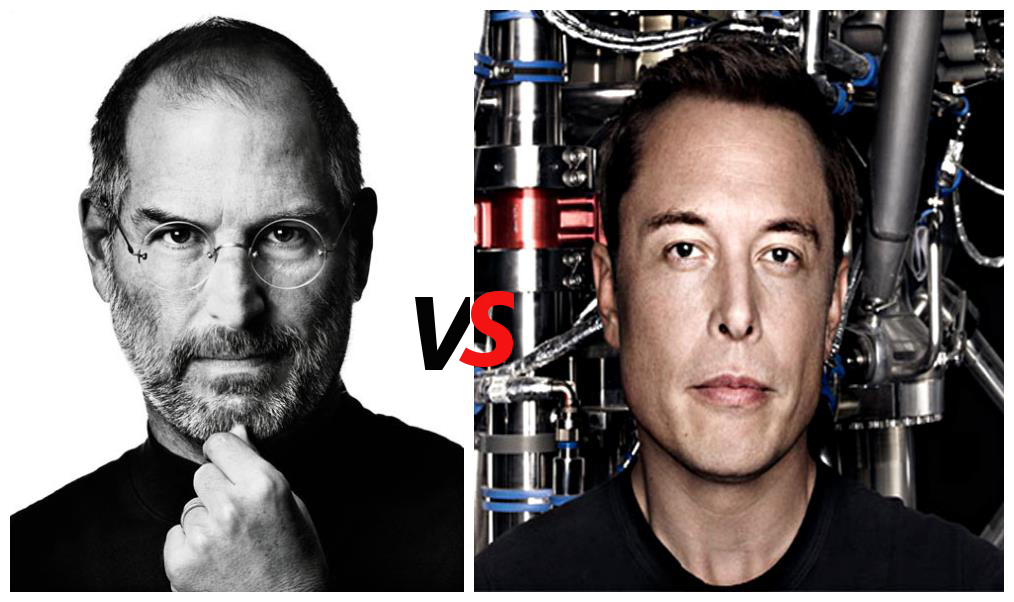
Musk has many traits in common with Jobs and yet in subtle ways their characters are distinct. Elon Musk vs Steve Jobs. The two did meet, but it didn’t go well.
Here are five revealing moments from our conversation that emphasize the common threads between the two businessmen.
1. Ability to Sell Great Ideas
Jobs used his infamous “reality distortion field” to push his teams hard to achieve much more that they thought was possible. His oft-quoted phrase was “insanely great” and his product launches were passionate and brash.
Musk is more pragmatic in his approach, he rarely uses buzzwords*, and although his product launches are often equally dazzling, his delivery is less assured, more halting.
*Granted, he does talk about getting a “money shot” of his greenhouse on Mars idea (@30:00 in the video).
“In the beginning there will be few people who believe in you or in what you’re doing but then over time… the evidence will build and more and more people will believe in what you’re doing. So, I think it’s a good idea when creating a company to … have a demonstration or to be able to sketch something so people can really envision what it’s about. Try to get to that point as soon as possible.” Elon Musk
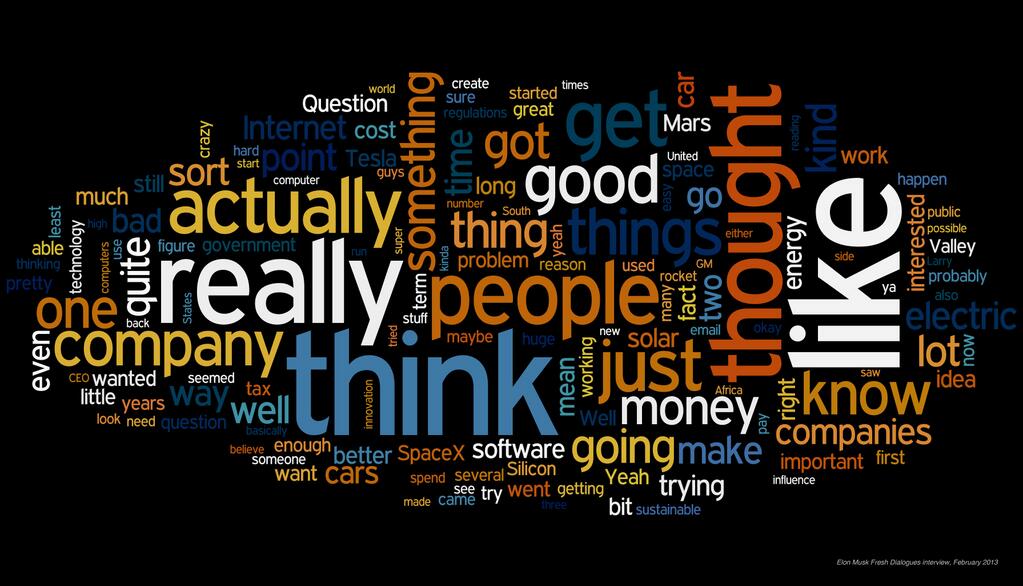
This Word Art of our 90-minute conversation reveals no catchy buzzwords, though the word THINK stands out prominently.
Stories abound of Steve Jobs’ intense attention to detail. He notoriously spent months agonizing over the internal layout of the Mac computer’s circuit board.
“I want it to be as beautiful as possible, even if it’s inside the box. A great carpenter isn’t going to use lousy wood for the back of a cabinet, even though nobody’s going to see it.” Steve Jobs
When his team failed to deliver on his vision, Jobs often flew into terrible rages. Case in point: the first fanless computer.
By contrast, Musk is known for his attention to detail and being a demanding boss, but he focuses his Vulcan rage at the media over issues like damning test drives, and Tesla car fires; and at foes such as auto dealerships.
His rage also turns inward. For example, when he discovered the wrong type of screw used in the Model S sun visors. He reportedly said, “they felt like daggers in my eyes.”
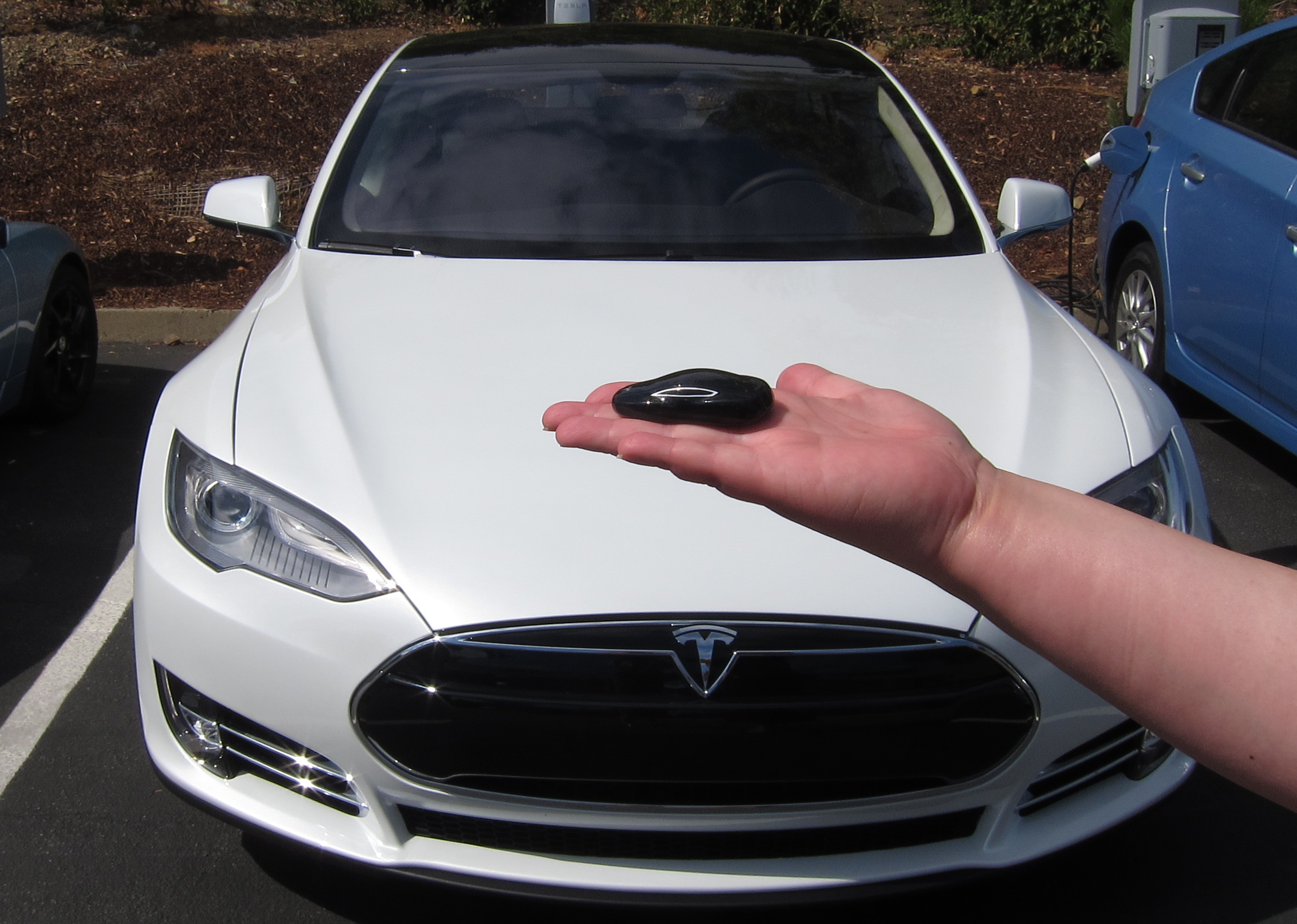
While doing pre-interviews with Musk’s colleagues, I heard a revealing story about his obsession with the Tesla Model S key fob. A colleague described how he agonized for weeks over the shape, the girth, the weight of the fob till it was just right. Take a peek at the end result and see if you think it was all worth it.
When I visited the Tesla factory (on assignment for KQED), I heard a similar story from the mechanics working on the iconic Model S door handles. Responsive door handles that sit flush with car doors looked like mission impossible, yet Musk and his team eventually prevailed. The result is so highly prized that my tour guide, Gilbert Passin (VP for manufacturing at Tesla) forbade me to take close-up photos of the components, for fear of copycats.
3. Ability to Think Differently Stems from Splendid Isolation
When I asked Musk if he was a lonely kid, he replied:
“I wasn’t all that much of a loner…at least not willingly. I was very very bookish.” Elon Musk
As a kid he was consumed by his own world, reading books like “The Hitchhiker’s Guide to the Galaxy,” and playing Dungeons and Dragons for hours. Musk found coding a piece of cake and created his own software at the tender age of 12. Thanks to his bookish childhood, his innovative ideas could flourish without being squashed by friends or family.
Similarly, Jobs had an isolated childhood, and was bullied at school. He did no competitive school sports and was obsessed by electronics and gadgets.
4. Deep Thinking
Although Jobs was less techie, more visionary; and Musk is a geeky engineer who prides himself on innovation using scientific first principles, both are deep thinkers.
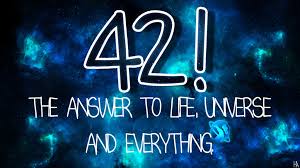
Elon Musk explained how Hitchhiker’s Guide to the Galaxy inspired him while he was looking for the meaning of life as a teenager.
“It highlighted an important point, which is that a lot of times the question is harder than the answer. And if you can properly phrase the question, then the answer is the easy part. To the degree that we can better understand the universe, then we can better know what questions to ask. Then whatever the question is that most approximates: what’s the meaning of life? That’s the question we can ultimately get closer to understanding. And so I thought to the degree that we can expand the scope and scale of consciousness and knowledge, then that would be a good thing.” Elon Musk
Walter Isaacson, the author of Jobs’ biography wrote that Jobs felt throughout his life that he was on a journey — and he often said, ‘The journey was the reward.’ But that journey involved resolving conflicts about his role in this world: why he was here and what it was all about. He had a lifelong interest in Zen Buddhism and they discussed whether or not he believed in an afterlife.
“Sometimes I’m 50-50 on whether there’s a God. It’s the great mystery we never quite know. But I like to believe there’s an afterlife. I like to believe the accumulated wisdom doesn’t just disappear when you die, but somehow it endures.” Steve Jobs
5. Impact
Although Musk isn’t yet the household name that Jobs has become, those who’re familiar with Musk’s work and genius compare him to Leonardo da Vinci and The Atlantic recently described him as one of the most ambitious innovators of this era. And what about Steve Jobs? He was described in the study as “a star of popular culture.”
Ouch!
During our interview, Musk shared the story of his brief encounter with the great Steve Jobs. The two were introduced by Google’s Larry Page at a party and Musk describes Jobs as being “super rude” to him. Nevertheless, this didn’t dent his admiration for the Apple guru. Here’s our dialogue:
Elon Musk: “The guy had a certain magic about him that was really inspiring. I think that’s really great.”
Alison van Diggelen: “Is it that magic that you try to emulate?”
Elon Musk: “No, I think Steve Jobs was way cooler than I am.”
Although Apple fans will agree strongly with that assessment, feedback at YouTube loudly contradicts Musk. Here’s one of the more polite reactions:
“Sounds just like Thomas Edison and Nikola Tesla. Except Elon Musk will probably end up being much more memorable than Steve Jobs :P”
As 2014 begins, Musk is still right, Steve Jobs is generally perceived as being “way cooler” than him. But that could change.
What will the history books conclude, in ten or twenty years from now? Steve Jobs certainly has big shoes to fill, but Elon Musk is already beginning to fill them. A lot will depend on Musk’s ability to see his grand visions come to fruition. First, he must complete his “Secret Master Plan for Tesla,” which includes the creation of a popular mass market electric car; and second, his vision of making space rockets reusable just like modern day jets.
One day, he may even achieve his life’s mission of dying on Mars, but as he describes it, “Just not on impact.”
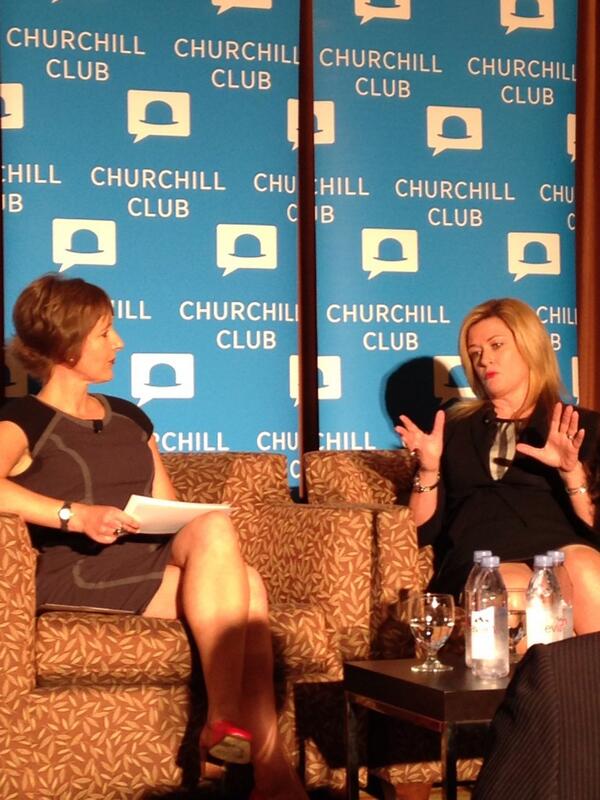
Will GM experts share their wisdom with Tesla to make the Model S less prone to fires? That’s the question I put to GM’s Chief of Electrified Vehicles, Pam Fletcher last week at the Churchill Club in Silicon Valley.
You’ve no doubt heard that three fires have been reported in Tesla Model S in the last five weeks. As we all know, three’s a trend. Granted, they weren’t episodes of random spontaneous combustion. Instead they were ignited by one high-impact crash and two high-speed encounters with metal debris which acted like a “pole vault” to puncture the undercarriage of the car and hence the battery. Although Tesla’s Elon Musk has declared, there won’t be a recall, it’s almost certain the National Highway Traffic Safety Administration will investigate. What needs to be done to make Teslas more impervious to battery puncturing road debris?
.
As you’ll see in the video, Pam Fletcher confirms that GM has sold 58,000 Chevy Volts since its launch in 2010 and after 300 million miles on the road, not one has had a similar fate to Tesla’s Model S. She acknowledges that there were fire issues in 2011 at the crash-testing phase, but emphasises no real-world incidents similar to the Model S have occurred.
Fires, Electric Cars and Achilles Heels
First some background. In 2011, safety regulators investigated Chevy Volt crash tests resulting in one battery pack catching fire and one smoking and emitting sparks. The troubling issue was the week-long delay between the crash test and the battery pack catching fire.
During our interview, Fletcher confirms that after the investigation, GM made no change to the battery cells, but did put “some additional reinforcement on the outside of the battery.”
It also implemented a process with first responders that includes depowering of the battery after a severe crash.
Ironically, Tesla got the highest safety ranking from regulators and has a first responders guide in place, however all parties seemed oblivious to the vehicle’s Achilles’ Heel. It obviously needs more durable undercarriage protection to prevent any more fiery “pole vaulting” episodes. To date, Elon Musk has been strongly resistant to such an approach. A recall will taint not only Tesla’s award winning brand, but entail extra costs and manufacturing delays for this relatively small auto company. To make matters worse, extra reinforcement will increase the weight of the Model S, and the extra pounds will have a knock-on effect on the vehicle’s range.
But it looks like Tesla’s Elon Musk may have to get some tips from GM on adequate car underbelly protection or find his own solutions.
It’s unlikely Tesla will change the configuration of its batteries. According to Reuters, Tesla’s battery pack stretches across the base of the vehicle and is made up of small lithium-ion battery cells, like those used in laptops. By contrast, GM uses large-format battery cells in a T-shape in the center of the Chevy Volt.
Fletcher was eager to move past fiery discussions and talk about adoption rates and “getting to scale.” She described the newly unveiled Cadillac ELR (a luxury electric hybrid based on the Chevy Volt) which will be available for test drives this week at the LA Auto Show. We also discussed autonomous cars, why EV adoption rates are so high in Silicon Valley; what to expect from the next generation Chevy Volt; and what surprised her about the thousands of Volt drivers on the road today.
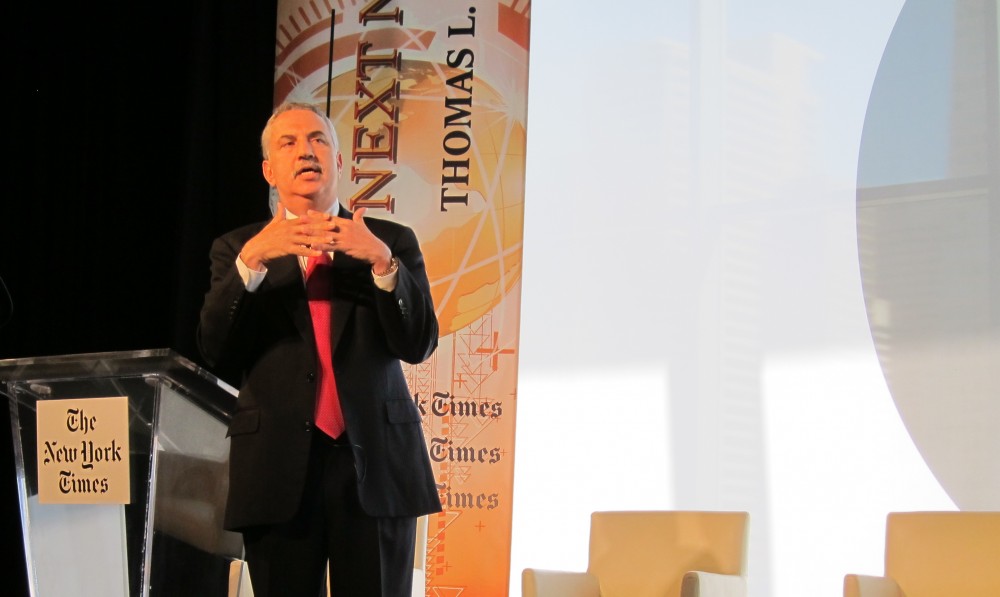
Tom Friedman assembled some of his favorite columnists, colleagues and CEOs last Thursday in San Francisco at the New York Times Global Forum to share their wit and wisdom about the brave new world of hyperconnectivity.
Friedman had five pieces of advice. Are you sitting comfortably? Then we’ll begin…
1. Think Like a New Immigrant
Friedman advises us to “Lean In” to this world of hyperconnectivity. (Yes, he’s also in awe of the multi-talented Sheryl Sandberg.) Specifically, Friedman urges us to be “paranoid optimists,” i.e. pursue opportunities more energetically, persistently and creatively than anybody else; and act with the YOLO attitude of a new immigrant while remembering that anything new can be taken away in a flash.
2. Think Like An Artisan
Friedman was obviously inspired by Steve Jobs biography here. He says: do your work every day with so much pride and extra effort that you want to carve your initials into it.
3. Always Be In Beta
In your mind, always think of yourself as a work in progress: iterate, polish, iterate. Think of FINISHED as a four letter word. Friedman thanks LinkedIn’s Reid Hoffman, for this Silicon Valley pearl of wisdom.
.
4. It’s A 401K World
It’s a world of free opportunity with defined contributions, but not defined benefits. The divide is no longer just digital; but motivational. Get motivated!
5. Think Like A Waitress
Not just any waitress, specifically the waitress at Perkins Pancake House in Minneapolis (Friedman’s hometown). On a recent visit, the waitress demonstrated her entrepreneurial spirit by bringing Friedman and his colleague extra fruit. As Friedman explains, “She didn’t control much, but she could control the fruit ladle. That was her source of ‘extra'”
Result: She earned a 50% tip. Moral of the story: try to become Friedman’s waitress on his globe trotting travels, and don’t forget those extra ladlefuls.
But seriously since that’s probably not feasible, try to emulate that savvy waitress: Be relentlessly entrepreneurial, change whatever you have control over, and find that new business or opportunity.
Friedman finished his speech with advice for President Obama:
1. In this new world of hyperconnectivity, there will be a growing number of “have-nots,” so safety nets will have to be reinforced and extended.
2. Get yourself a decent narrative to inspire the country, like President Kennedy did in the 60’s with space exploration. e.g. Make America the platform where everyone in the world will come to launch their own moonshot.
Check back soon for an exclusive Fresh Dialogues interview with California’s Leuitenant Governor Gavin Newsom who shares his passion for action on climate change and why he wants to be governor one day.
This event took place at City View, Metreon in San Francisco, June 20, 2013.

 4. Never miss an opportunity to be fabulous