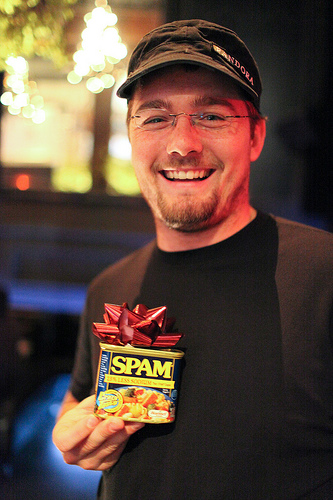
I caught up with Twitter officianado, Adam Jacksonat SDForum’s Teens Plugged in Conference last year. Since then, he’s founded TweetForMyBiz, a social media consultancy, based in San Francisco.
Moderator at this year’s conference, Mike Cassidy wrote an excellent column in the San Jose Mercury News about how teens embrace fearlessness in Silicon Valley. He writes:
“Tech CEOs have done plenty of hand-wringing about our schools’ declining ability to turn out the thinkers we need to keep innovation robust…The young entrepreneurs at the SDForum conference don’t make those worries go away, but they are a reason to hold onto hope. They are a generation that embraces the optimism, fearlessness and drive that have built Silicon Valley.”
Adam Jackson, who uprooted from Florida to San Francisco to pursue his entrepreneurial dreams as a young teen, is a great example of this fearlessness.
In this interview from the Fresh Dialogues archives, Adam talks about how to become a green influencer.
“If you have an idea to be more green, help the earth, then go for it, and try it out. See what happens and talk about it. That’s how you become an influencer, that’s how you become an expert. It’s not by re-quoting other people’s things. Or by trying to figure it out, maybe dabbling in it. You just have to jump head first.”
There are countless Silicon Valley wannabes all over the world, from Silicon Wadi in Israel to Silicon Glen in Scotland, but none rival Silicon Valley’s track record. Why is Silicon Valley the premier center of innovation? What is the secret of Silicon Valley’s success?
I joined Morton Grosser, a Silicon Valley venture investor, consultant and inventor in his Menlo Park workshop to discuss the history of Silicon Valley and the key ingredients that allow innovation to flourish here. As a former director of eight high-tech companies and strategy advisor to such stalwarts as Hewlett-Packard, Apple, Kleiner Perkins and many Fortune 100 companies, Grosser (or Mort, as he prefers) provides a unique perspective on what makes Silicon Valley successful.
Why did Silicon Valley grow here?
“Silicon Valley has an extraordinary meritocracy culture…it’s an accident of time and place.”
What is the Vital Ingredient?
“We’ve had a unique surplus of the four things that are necessary for an entrepreneurial culture…a great university or universities, smart young entrepreneurs, a source of capital, but most leave out the most important part:
What you really need is a culture of meritocracy. You need horizontality.”
The Father of Silicon Valley, Fred Terman‘s epiphany
“He noticed that science and engineering seminars were taught by 23-year-old graduate students, because those are the people making the progress…this was anomalous for the industrial world… Terman noticed this 70 years ago and he wrote about it in “Steeples of Excellence.” He said, if you could move this principle out of academia into industry you would have an enormous advantage over many other companies.”
How to build innovation – the Silicon Valley Way
“It’s not just the capital…it’s the intellectual environment, the ambiance, the acceptance, it isn’t merely mentoring it’s accepting…To build a culture that is unique; in which industrial companies would have the same structure, where young people have a voice, where new and creative ideas … flourish.”
On Creativity
“You don’t have to teach children creativity, you just have to get out of their way.”
Want to learn more?
The book “Regional Advantage” by Berkeley’s Dean of the School of Information, AnnaLee Saxenian, compares Route 128 (the Boston innovation hub) with Route 280 (Silicon Valley) and explores the reasons, as Mort puts it, “Why Silicon Valley succeeded and Route 128 did not… It comes down to the difference between horizontality and verticality.” In summary: Boston developed a system dominated by independent, self-sufficient corporations, whereas Silicon Valley developed a decentralized but cooperative industrial system.
Rolf Papsdorf, President of the Alternative Energy Development Corporation was a recipient of the 2009 Tech Awardsin Silicon Valley, for bringing renewable energy (zinc fuel cells) and empowerment to a small community in South Africa. Check out this exclusive interview with Mr. Papsdorf who discusses how to create a carbon neutral community, the advantages of zinc fuel cells (portability is a big plus) and why he wants to meet Al Gore.
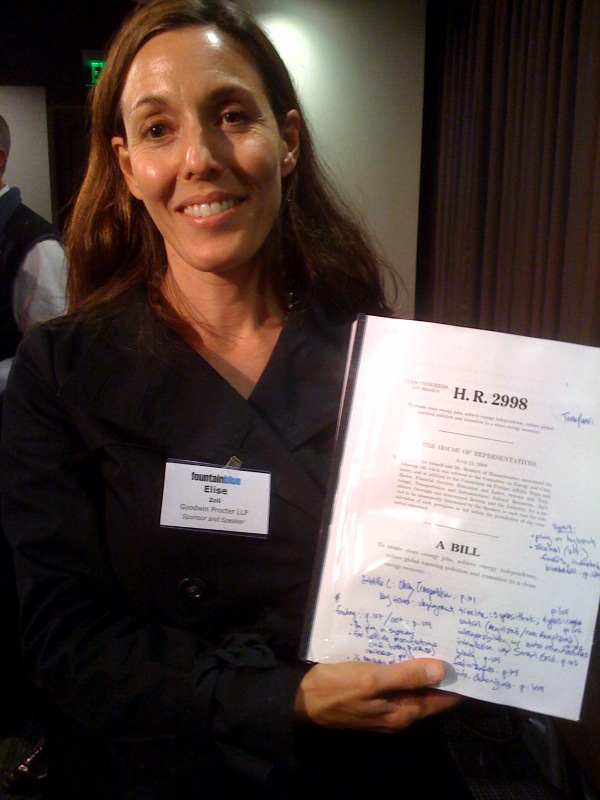
Elise Zoli, a partner with Goodwin Procter, is a specialist in energy and clean tech law; and teaches at MIT. I caught up with her at a Fountain Blue Green Transport Event where we discussed two hot areas in clean tech: energy storage and nuclear power. Elise explains the important role of energy storage in making solar and wind energy more reliable; and why she’d like to redefine energy storage to make it sexy. She’s coining a new phrase: “dispatchable renewable power.”
On making energy storage sexy
“Energy storage sounds like something that you don’t want to talk about, something that belongs in the closet. But the idea is to enable renewables (solar and wind) to have a greater chunk of the American demand…integrated storage flattens out the intermittency issues.”
On nuclear power
“The N word is difficult in the context of renewable …but most experts who look at climate change and energy security believe there is a significant role for nuclear. “
On nuclear waste and other impacts
“Nuclear has a favorable balance of environmental impacts. Every technology, even solar and wind, have their externalities. On balance, does it advance our climate change goals? The technology deserves to be considered.”
“For the traveling wave reactor they actually consume waste as fuel. The promise of the technology is to reduce waste…The material will be managed in place as opposed to having a long term waste repository.”
This is Part Two of the interview.
To check out Part One, where Elise explores the government’s role in clean tech and the stimulus package,click here.
The interview was recorded at the FountainBlue Clean Green Transport Conference in Santa Clara on July 6, 2009.
Rolf Papsdorf is bringing green power to the people of Africa. Thanks to the Silicon Valley based Tech Awards 2009, the rest of the world is hearing about it. His company Alternative Energy Development Corporationmanufactures zinc-air fuel cells to generate off the grid electricity for rural communities. His zinc-air fuel cell project, described as the largest in the world, brings light and energy to the village of Guyuni in South Africa, as well as job creation and online education to the community’s youth.
This project echoes – in a small way – the aims of Bloom Energy’s KR Sridhar, who aims to bring Power to the People with its fuel cell design.
On the fuel cells technology
“We’re the only company in the world which produces a low cost zinc-air fuel cells manually rechargeable…we’re proud to say that we have no carbon footprint and are totally renewable. We recycle the zinc oxide to make new zinc using solar energy.”
On how he’s empowering South Africa
“Our passion really is empowerment. We supply them with basic electricity, we have skills development programs so that they can earn an income…only 3% of (the community) income goes towards energy, the rest is disposable income.” Rolf Papsdorf
Check back soon for the VIDEO of this exclusive Fresh Dialogues interview
Read the transcriptand listen to this exclusive Fresh Dialogues interview – KR explains how the Bloom Energy fuel cell will change the world and give power to the people.