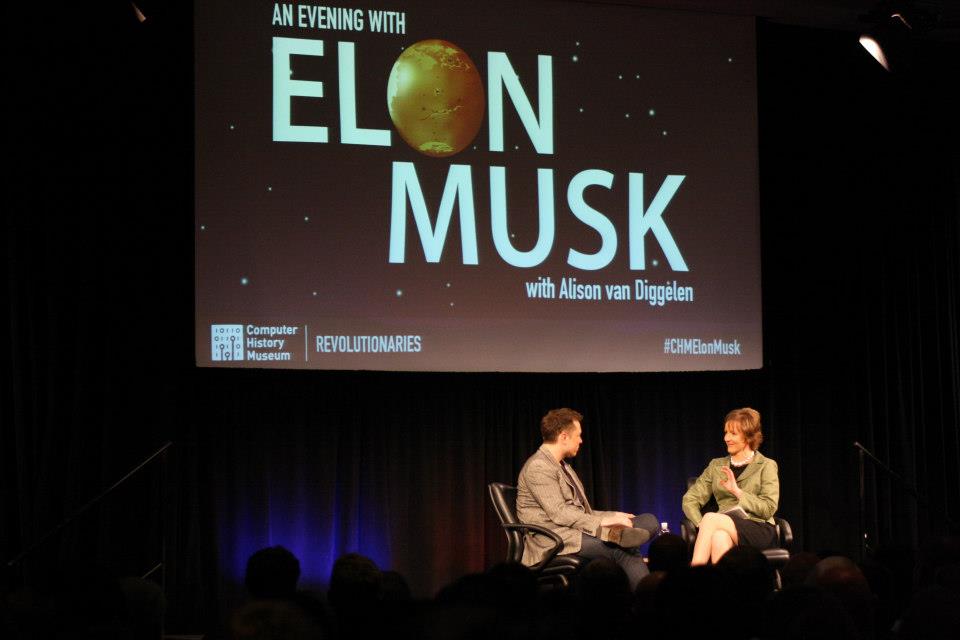
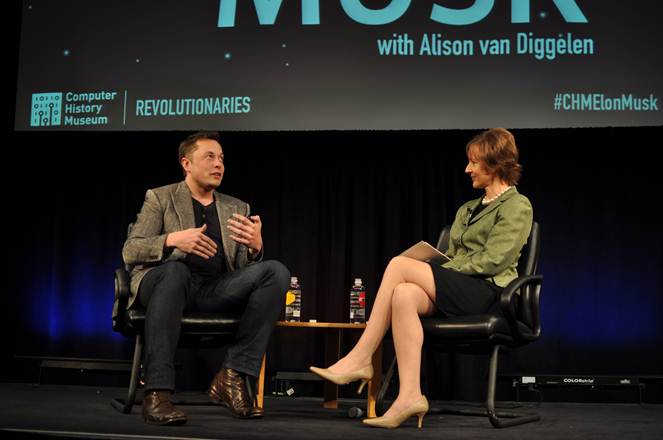
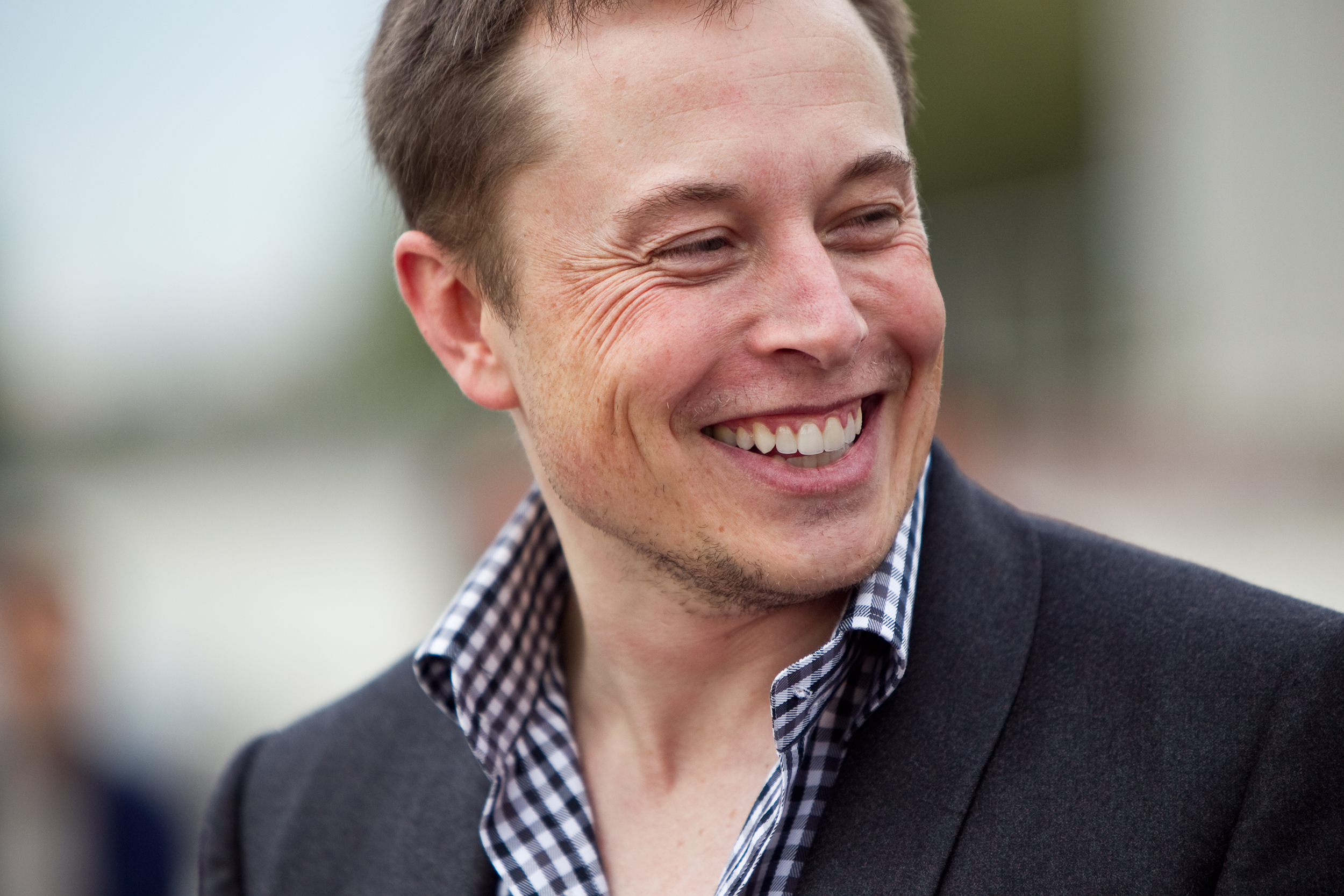
On Tuesday evening, Elon Musk, CEO of Tesla Motors sat down with me at the Computer History Museum in Mountain View to discuss his life’s work. During the hour long interview, he gave a detailed account of Tesla Motors’ early days and how he became the reluctant CEO.
Why reluctant? Well, he was in the throws of getting his other little startup off the ground…the rocket company, SpaceX. If you missed that story, SpaceX has become the de facto replacement for NASA’s space shuttle and serves the International Space Station.
.
But back to electric cars…Here’s what Elon said:
“I really didn’t want to be CEO of two startups at the same time. It was not appealing. And shouldn’t be appealing by the way, if anyone is thinking that’s a good idea. It’s a terrible idea.”
And yet, he’s somehow making it work. Tesla’s Model S was picked as Motor Trend’s Car of the Year 2013 and he doesn’t seem quite so reluctant these days. In this transcript excerpt, he also offers this advice to entrepreneurs:
“In the beginning there will be few people who believe in you or in what you’re doing but then over time, as you make progress, the evidence will build and more and more people will believe in what you’re doing… it’s a good idea when creating a company to have a demonstration… a good mark up or if it’s software to have good demoware, or to be able to sketch something so people can really envision what’s it’s about.”
The interview aired this week on KQED radio and the podcast is now available on this page. Or listen here
Here’s a transcript excerpt.
The Reluctant Tesla CEO: Transcript of January 22, 2013 Interview with Elon Musk
Alison van Diggelen: Shortly after founding SpaceX, you then got interested in electric vehicles and I understand you watched the vigils for the death of the EV1, when they were all smashed. Talk about that and why you felt even after founding SpaceX: ‘I have to get involved with Tesla.’
Elon Musk: Yea, well. My interest in electric vehicles goes back a long time…goes back 20 plus years.
Alison van Diggelen: To the dating scene…(Musk refers earlier in the interview to the fact that in his college days, he used to bore dates with his fascination with electric cars and says, ‘it was not a winning combination…but recently it’s been more effective.’
Elon Musk: Exactly and in fact the original reason I came to Silicon Valley was to work on electric vehicle energy storage technology. I thought that big car companies would develop electric cars. It was obviously the right move and I thought that was vindicated when General Motors and Toyota announced…General Motors was doing the EV1, Toyota did the electric RAV 4, the original one. And they made these announcements and brought those to market and I thought: well this is great, we’re going to have electric cars, GM is obviously going to do the EV2 and 3 and then just keep getting better. Everything would be cool.
And then when California relaxed its regulations on electric cars, GM recalled all of the EV1s and crushed them into little cubes, which seemed kind of nutty. So in fact, the people didn’t want their EV1s recalled…
Alison van Diggelen: Yes…
Elon Musk: In fact they tried court orders to stop the cars from being recalled. They held a candlelit vigil, OK in the yard where the cars were crushed…now…
Alison van Diggelen: Did you attend that vigil?
Elon Musk: No, I did not.
Alison van Diggelen: You’re moved by it.
Elon Musk: Well certainly, I mean, it’s crazy…When was the last time you heard about any company… customers holding a candlelight vigil for the demise of their product? Particularly a GM product? (laughter) I mean what bigger wake up call do you need? Like hello! The customers are really upset about this. They’d really prefer if it didn’t get recalled. So that kind of blew my mind. So it was like ‘wow.’
And then we had the advent of lithium ion batteries which really is one of the key things to make electric cars work, but it’s still nothing. And so in 2003, I actually had lunch with one of the other cofounders of the company JB Straubel (now CTO of Tesla Motors) who was actually working on a hydrogen airplane or something. He mentioned to me the tzero car that was done by AC Propulsion.
AC Propulsion are the sort of guys who had actually been on the EV1 program and they took a gasoline sports car, a kit car and outfitted it with lithium ion batteries, consumer grade cells, and they created a car which was essentially the precursor of the (Tesla) Roadster, and had very similar specifications: sub 4 seconds zero to 60 mph, 250 mile range and also a two-seater sports car. But it was quite primitive. It didn’t have a roof for one thing. At all. And none of them had doors. But it didn’t have any safety system at all, no air bags, it wasn’t homologated, so you couldn’t sell it. So in order to sell that car, in order to create a commercial version of that car, there was a fair bit of work that was required.
I kept trying to get AC Propulsion to commercialize the tzero, and I said: ‘Look, I’ll fund the whole effort, we really need to do this.’
But they just refused to do it. They wanted to make an electric Scion. Which in principle sounds good, but in fact it would have cost $75,000 and nobody wants to buy a $75,000 Scion.
The technology was just not ready. There was just no way to make a good value proposition.
Alison van Diggelen: What was it that compelled you to say: ‘I have to be CEO here and lead this company.’ Why not just say: ‘I’ll help you JB and get this rolling’?
Elon Musk: Well I really didn’t want to be CEO of two companies. I tried really hard not to be actually. Yes. So AC Propulsion finally said…I told AC Propulsion: ‘If you’re not going to do this, I’m going to create a company to do this.’
And they said well, there’s some other guys who’re also interested in doing that and you guys should combine efforts and create a company. And that’s basically how Tesla came together.
And then we had a lot of drama (laughter). But since I’d provided like 95% of the money, so I could have been the CEO from day one… but I really didn’t want to be CEO of two startups at the same time. It was not appealing. And shouldn’t be appealing by the way, if anyone is thinking that’s a good idea. It’s a terrible idea.
…
Alison van Diggelen: It’s one thing to have all those wonderful ideas in the shower and at Burning Man, but it’s another thing to build, motivate and retain a team of excellent people. Can you talk about some tips and some things you’ve learned that obviously work for you?
Elon Musk: Yeah. Well a company is a group of people that are organized to create a product or service. That’s what a company is. So in order to create such a thing, you have to convince others to join you in your effort and so they have to be convinced that it’s a sensible thing, that basically there’s a some reasonable chance of success and if there is success, the reward will be commensurate with the effort involved. And so I think that’s it…getting people to believe in what you’re doing – and in you – is important.
In the beginning there will be few people who believe in you or in what you’re doing but then over time, as you make progress, the evidence will build and more and more people will believe in what you’re doing. So, I think it’s a good idea when creating a company to create…to have a demonstration or if it’s a product to have a good mark up or even if it’s software to have good demoware, or to be able to sketch something so people can really envision what’s it’s about. Try to get to that point as soon as possible. And then iterate to make it as real as possible, as fast as possible. I think that makes sense.
Last night Elon Musk, CEO of SpaceX and Tesla Motors joined me in conversation for the Revolutionaries Series at the Computer History Museum in Silicon Valley. We explored his journey from South Africa to Silicon Valley and beyond and he was exceptionally candid about his entrepreneurial highs and lows. He also shared a fascinating glimpse into the future…flying cars, hyperloops and Mars, oh my! His eyes welled up as he spoke with deep emotion about Neil Armstrong, the need for space exploration and the impassioned vigils after the death of the EV1. But he also displayed a great sense of humor throughout the interview. Did you know he plans to die on Mars? Just not on impact.
.
Here is the transcript of our conversation:
Here’s the podcast from KQED:
On the chances of a SpaceX IPO this year
Not likely. Elon explained that he’s not in a hurry to make SpaceX a public company because the short term desires of shareholders would conflict with the company’s longer term goals (which included manned space flights to Mars).
On flying cars
He anticipates the production of flying cars in the near future (and he wasn’t talking about the acceleration of Tesla’s Model S). In response to my question: will it be an Elon Musk production? he demurred. But when I asked, is someone going to do it? He replied: someone *is* doing it.
On the inspiration for Tesla Motors
Musk had the audience roaring with laughter when we discussed the wailing and gnashing of teeth that occurred after the forced recall of the EV1. He said, “How often do customers have candlelight vigils for the end of life of a product? Especially a GM product?”
On being an entrepreneur @38.0 on video
Remember that failure is the most likely outcome. Only do it, if you’re compelled to do it and are willing to eat glass and stare into the abyss.
“If you don’t eat glass you are not going to be successful,” Elon Musk
On the importance of sleep
Musk recommends getting a good night’s sleep, as you’ll be more productive. Despite running two companies and having five children, he averages 6 hours a night. Less than that and he admits to getting grumpy and achieving much less.
On the environment @55.0-1.00.00 on video
He says putting hydrocarbons into the atmosphere is “the world’s dumbest experiment“…We’re playing a lethal game of Russian roulette with the atmosphere and every year, we’re adding another bullet.
The hour long interview will appear on the Computer History Museum YouTube channel next week and air on KQED TV in April. Check back soon for more photos and more details on inspiration, innovation and SolarCity. Check out #CHMElonMusk on Twitter for more audience reaction.
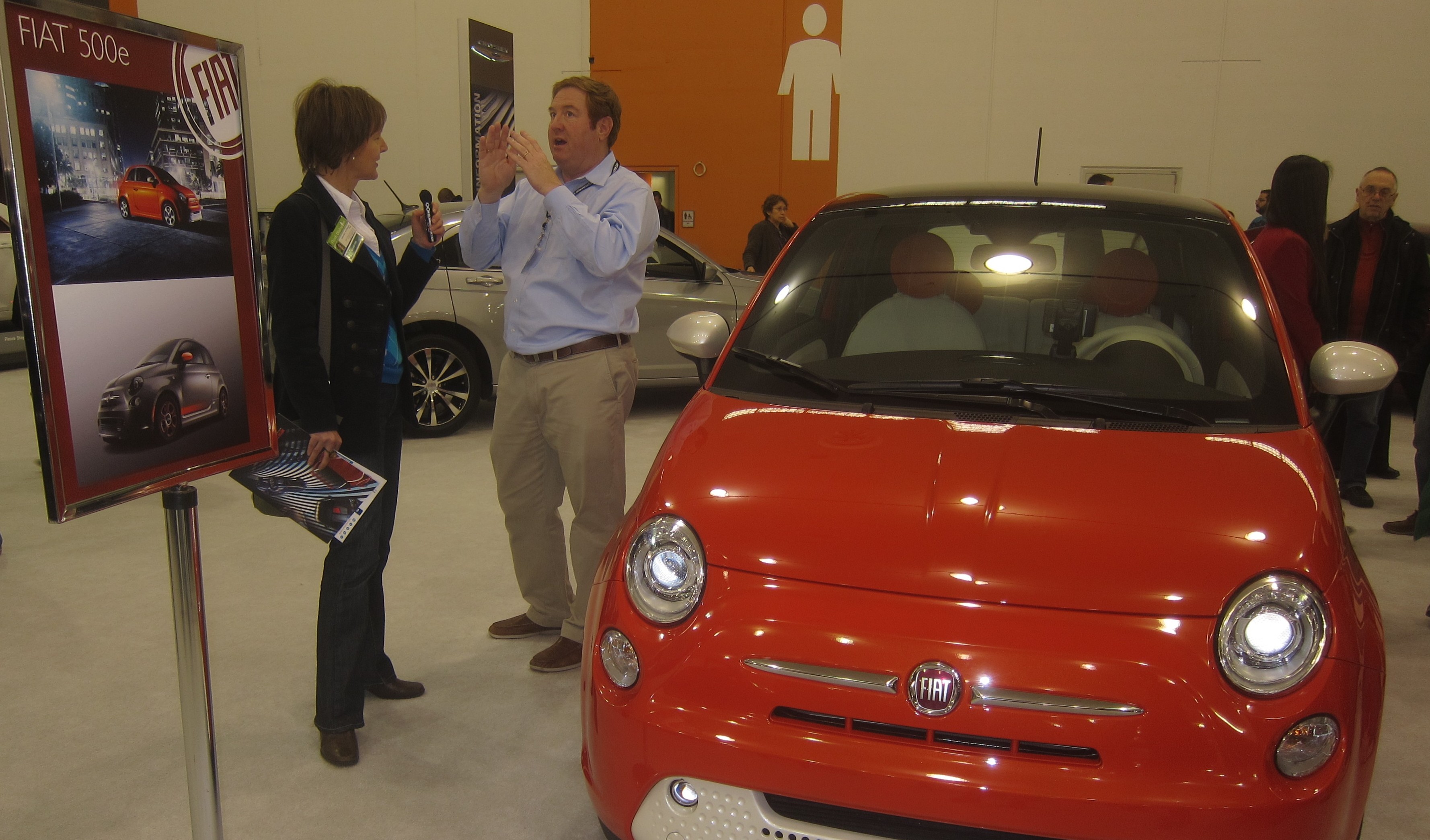
Electric vehicles made a big impact last week at the 2013 Silicon Valley International Auto Show. Steve Smith, President of the Silicon Valley Auto Dealers Association gave Fresh Dialogues a tour of the electric offerings Sunday from Fiat, General Motors and Ford; and explained that the affluent, well educated Silicon Valley market is particularly open to EVs. This year shows a surge in the number of electric and hybrid vehicles from major players. It’s significant that even Cadillac has announced a hybrid coupe, featuring both lithium-ion battery and a four cylinder gas engine.
Smith confirmed that even consumers not ready to go all-electric are focused on fuel economy statistics this year. The cute new Fiat 500e got an EPA 116 miles per gallon equivalent combined fuel economy rating (122 MPGe city and 108 MPGe highway) and the company estimates fuel costs of $500/year. That would keep your average Hummer driver on the road for, umm, maybe a month?
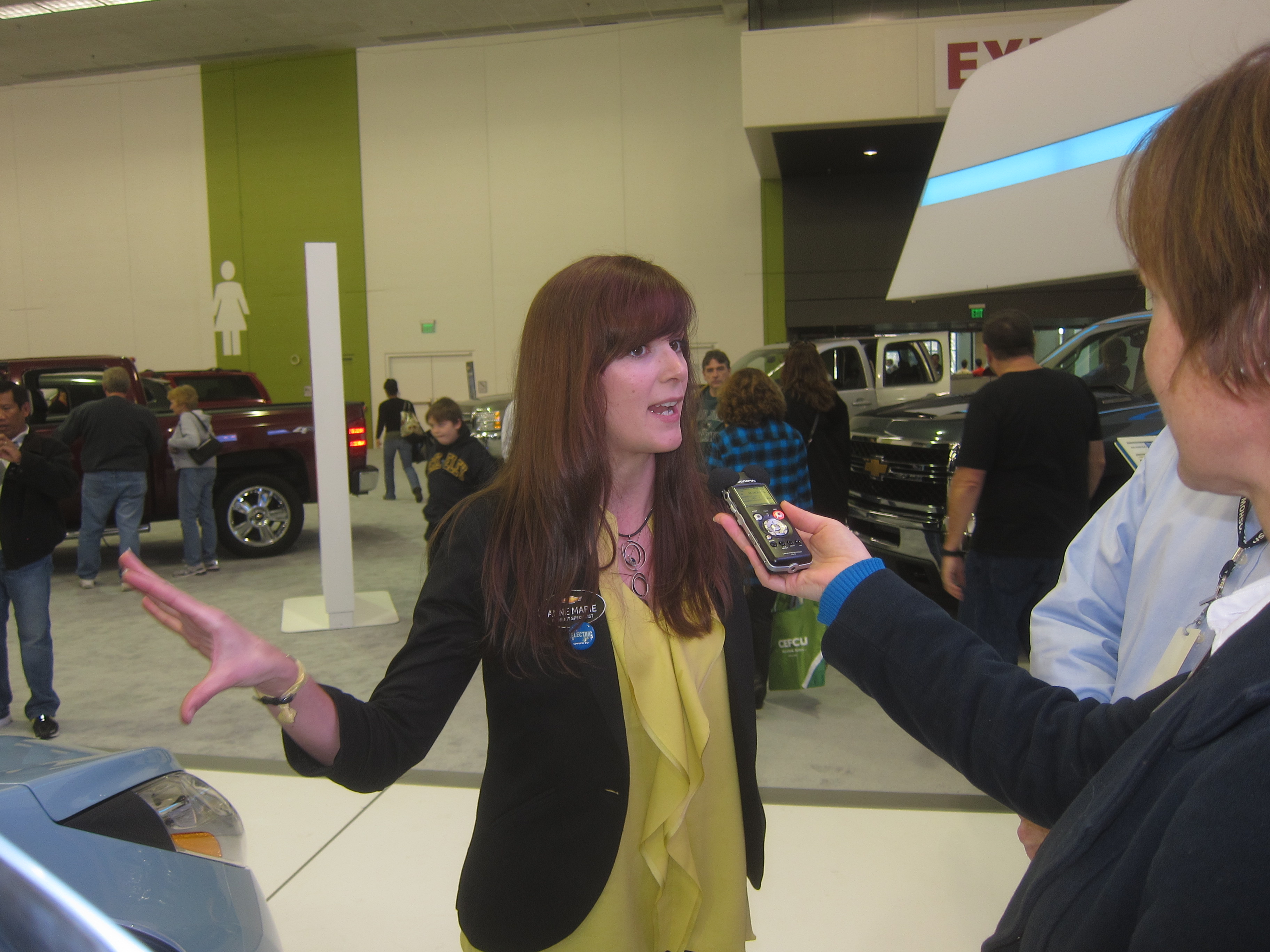
The new Chevy Spark looked cute and compact in powder blue, but spokesperson Anne-Marie Damman confirmed that for now, the 80-mile range EV will only be available in California and Oregon. The reason? They’re the only states with sufficient charging infrastructure in place. Although California’s EV infrastructure leads the way, it’s also suffering growing pains.
Tesla’s all electric Model S was missing from the line up in Silicon Valley, but its Model X made a big splash at this week’s Detroit Auto Show. Check out some of the Silicon Valley Auto Show highlights in the slideshow below.
The all electric Chevy Spark
Image 1 of 17
Anne-Marie Damman: the Chevy Spark will have an 80 mile range and only be available in CA & OR, Alison van Diggelen of Fresh Dialogues
Check back later this month for the full interview with Steve Smith of SVADA on what makes the Silicon Valley Auto Show so unique and why he thinks car sales will spike this year.
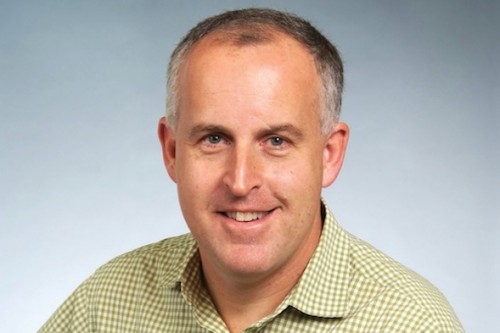
This week, I spoke with Diurmuid O’Connell, VP of Business Development at Tesla Motors and he confirmed the company is not just focused on sexy fast cars but connectivity and energy storage.
“The totem of social acceptance is no longer personal mobility, it’s personal connectivity…the smart phone,” says O’Connell, citing the company’s massive 17 inch touchscreen which offers everything from navigation, to climate control to web browsing. He describes how it gives consumers the ability to upgrade a vehicle immediately and remotely; a useful benefit especially for what he calls “the perfect navigation system.”
“The screen can be updated in real time to improve not just the entertainment and climate control aspects but actually the performance of the vehicle,” he adds.
O’Connell also shared some details of Tesla’s push into energy storage. I asked him if the focus was on utility scale storage or distributed energy storage and he made reference to Bloom Energy – the Sunnyvale based fuel cell maker – that has a business model aimed at both sectors. Energy storage is something that many experts describe as the holy grail for advanced energy systems and Tesla has a large team of engineers working hard on the challenge at its Deer Park, Palo Alto facility. When I pressed him on future breakthroughs, O’Connell admitted the team is making good progress and said an announcement was likely within the next 12 months.
The video was recorded at SVForum’s CleanTech breakfast, moderated by Rob Shelton of PwC, in Silicon Valley on October 16, 2012. Check back soon for more on Net Zero buildings and other clean tech innovation trends.
Today on Bloomberg News, Tesla CEO, Elon Musk, ever the space junkie, described the new 100-strong Tesla supercharger network like this: “it will feel like alien spaceships landed at highway rest stops….a beacon of hope and inspiration.”
Tesla announced details of its superchargers network on Monday September 24th.
The new fast chargers will boost the existing west coast network that enables EV drivers to journey from Canada to Mexico using slower level 2 chargers. Meanwhile, terrestrial Tesla spokesperson Christina Ra shared more mundane details of the company’s new supercharger network during our recent test drive of the Model S.
“It’s intented to solve the conundrum of the road trip, long distance travel,” said Ra. “So we will have superchargers along frequently traveled roadways, for example between LA and San Francisco, to enable charging during road trips.”
It is anticipated these fast chargers will be located at Harris Ranch, Coalinga (for the LA/San Francisco travelers) as well as dozens of other locations like Tesla, Newport Beach to connect popular Tesla centers across the country.
Power Nap?
Tesla is eager to emphasize the speed and convenience of these super chargers, but let’s face it, no matter how cosmic, the experience won’t be as rapid as a five-minute pit stop at the gas pump.
“It doesn’t really modify your behavior,” says Ra. “It takes about a half hour to replenish 150-160 miles of range.”
Fresh Dialogues asked: Time for a cuppa coffee or a perhaps short nap? Indeed. The practice might add a whole new dimension to the term power nap.
Ever the pragmatist, Ra confirmed, “Time for lunch…bathroom break.”
Three intrepid Model S drivers just completed the first coast to coast drive, from San Francisco to D.C. Perhaps they can test drive some of the new superchargers on the return leg?
Click here for live video and full details of the Tesla superchargers network on Monday September 24th, 8pm (or beyond).
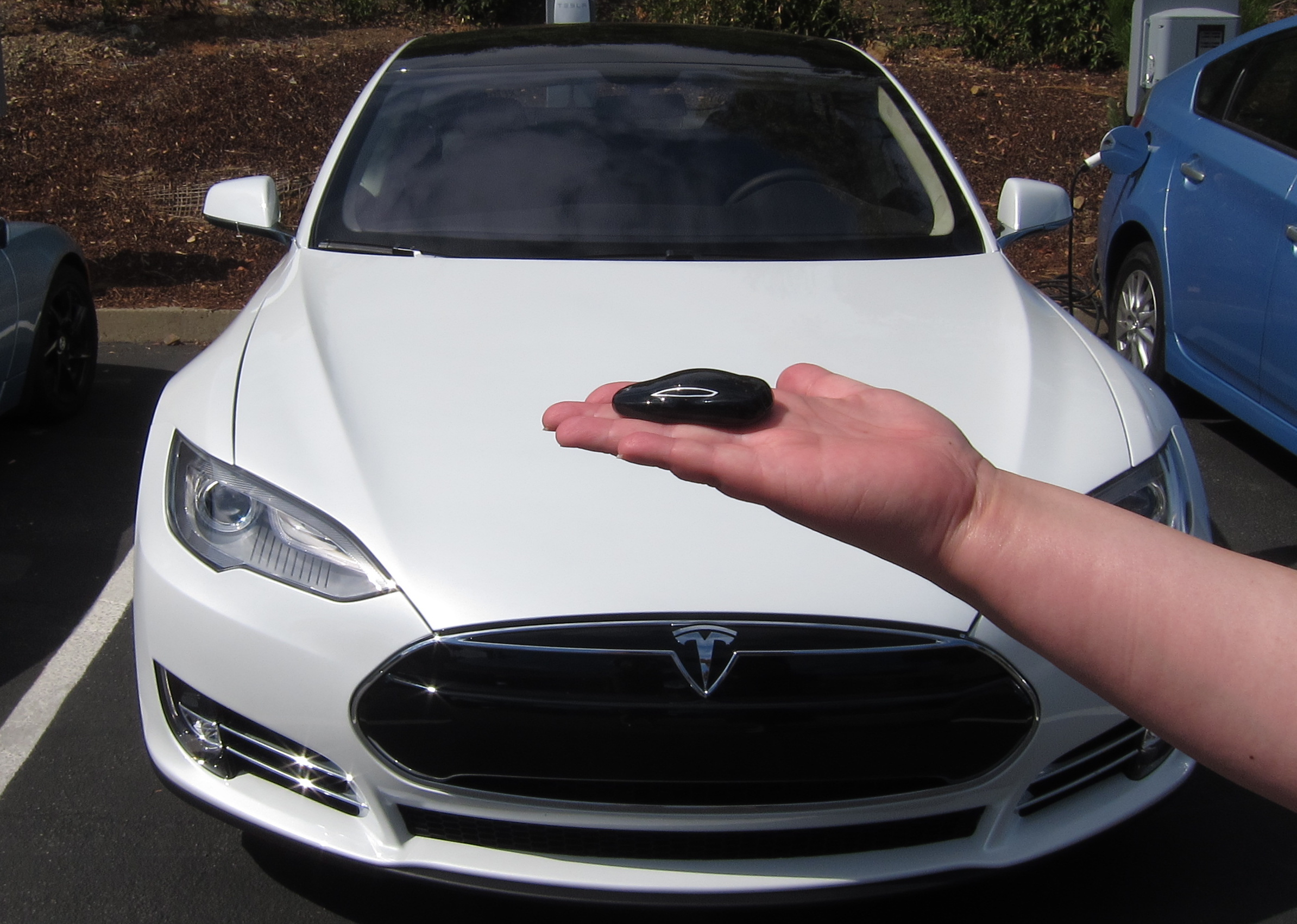
In June, Fresh Dialogues toured the Tesla Factory and last week we finally got behind the wheel of the finished product: a Model S Performance. It’s an impressive vehicle: sleek, stylish and powerful. Very powerful. The acceleration felt like a rocket. We took it 0-50 in about four seconds and thanks to its low center of gravity, it was easy to handle on the winding hill roads around Palo Alto. Going 60 plus on Highway 280 felt smooth and effortless. You gain speed so fast, it’s quite formidable, especially for this Toyota Prius driver. In the latest test drive, Motor Trends confirmed a 0-60 mph time of 3.9 seconds; faster than Tesla’s own specs of 4.4. That makes it the fastest American sedan.
I’d heard about the ‘sensitive’ accelerator pedal and wondered how it would be in the confined space of the Tesla HQ parking lot? But I found it easy to navigate and control both in forward and reverse gears. Backing into a parking space was a cinch thanks to the rear camera.
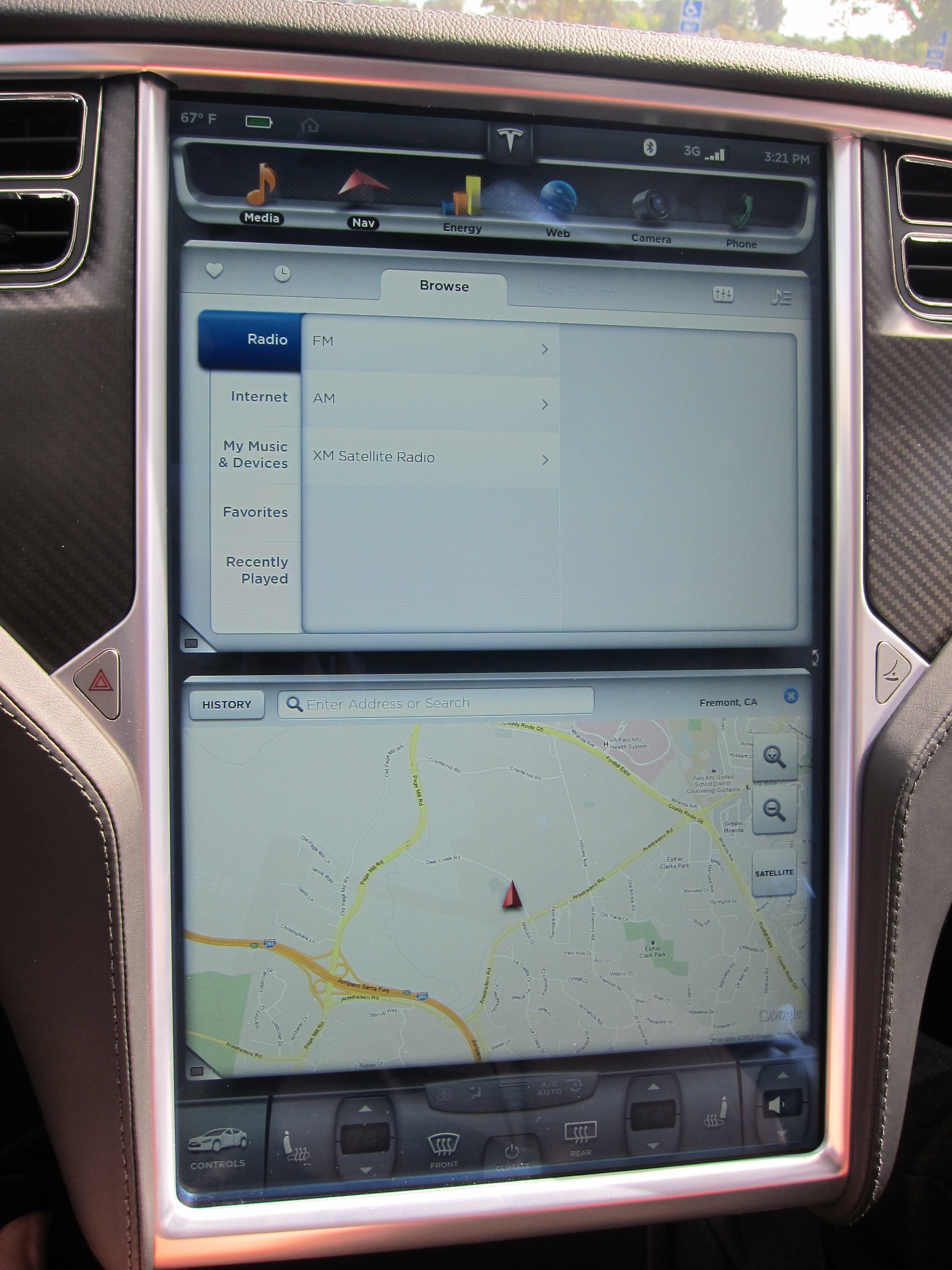
The massive 17-inch touch screen looked like it could be a major driving distraction, but having experienced its utility, I’m more appreciative. Glad to see that most functions can be controlled from the steering wheel, including the impressive sound system. Spinal Tap fans will be delighted to learn that the volume goes to eleven (really!); a spec no doubt dictated by Tesla product architect, Elon Musk with tongue firmly in cheek.
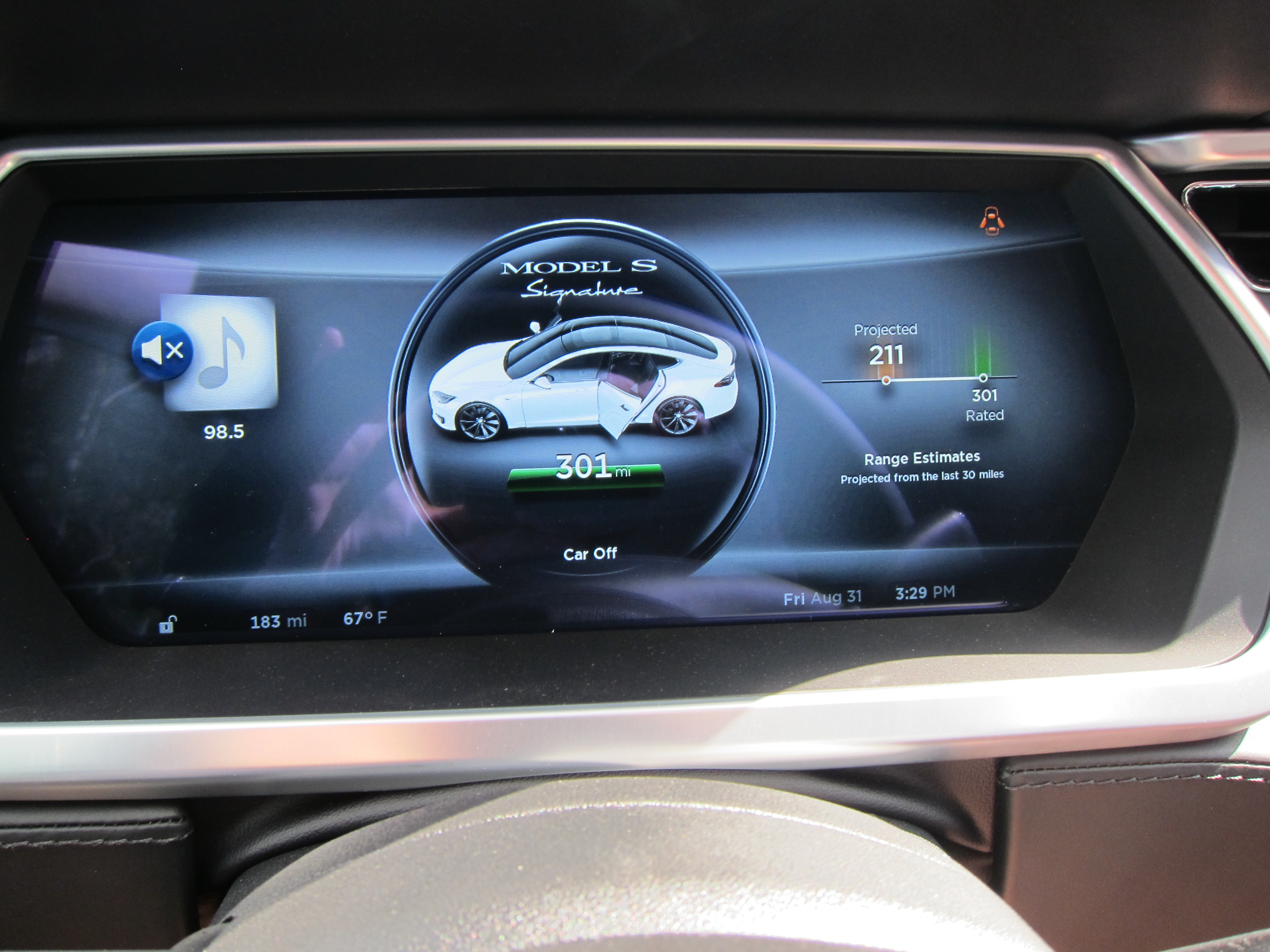
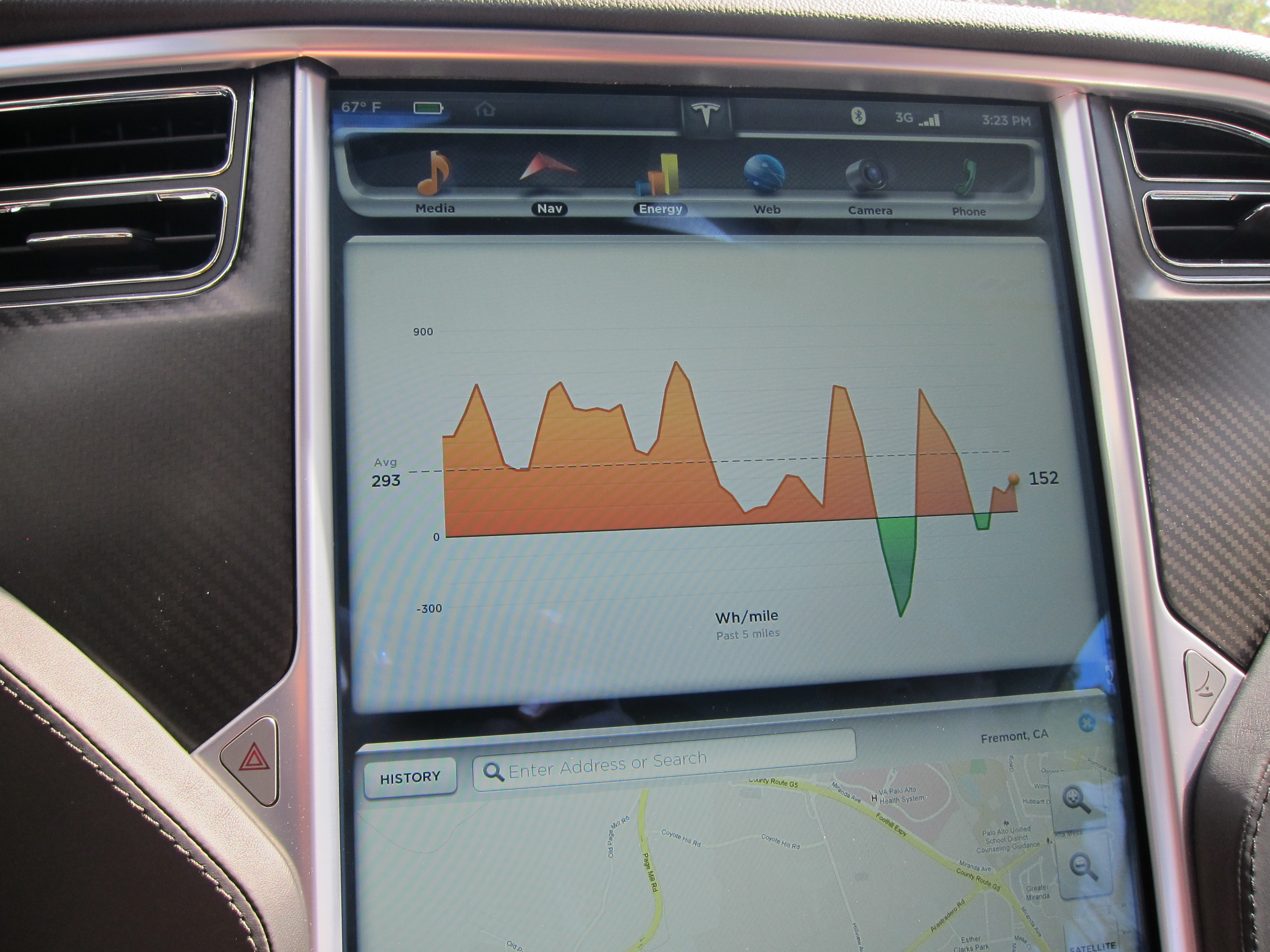
You can choose what appears on your dashboard: energy consumption, range, media, climate control, etc.
Tesla’s Christina Ra explained the energy charts and how the range is impacted by all that powerful acceleration.
The regenerative breaking was very noticeable (see green shading on graph). The second you take your foot off the accelerator, you feel it kicking in, giving you more control and increasing the range of the car. It’s rated 265 miles by the EPA, but the way we were driving, the projected range fell to 192. To get the maximum range, Tesla recommends an optimum speed of 55 mph, with the windows up and no A/C.
Two criticisms:
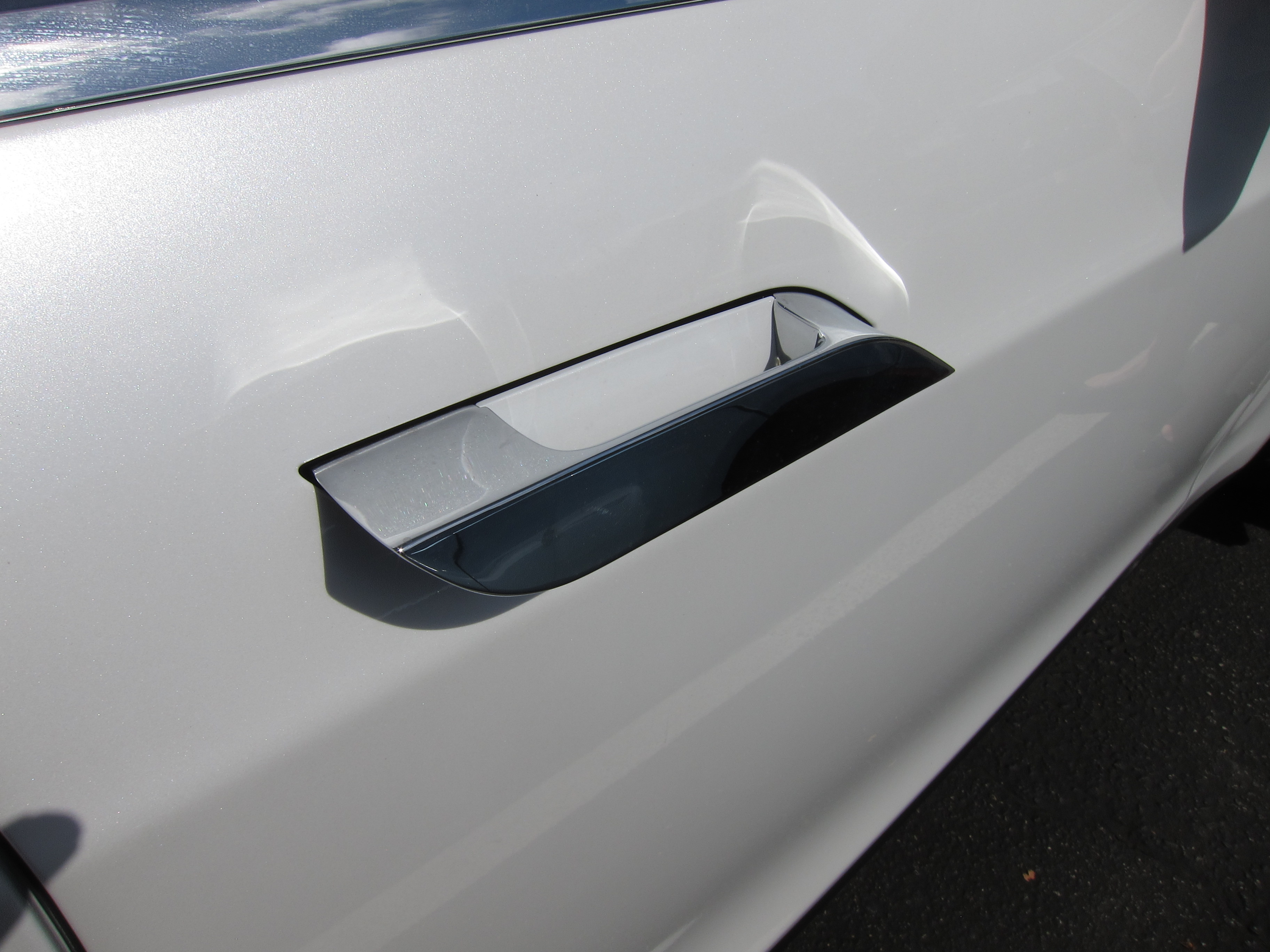
1. These snazzy door handles certainly look and act cool. Tesla Factory worker Charles Lambert said it best, they’re distinctive and sexy. According to reports, they’re not just eye candy, they actually improve the aerodynamics of the car. I understand they’re fitted with an anti-break-your-fingers release mechanism, but when I checked it out, the handle gave me a good finger squeeze – not in a good way. It stung. Maybe I’m extra sensitive, but I think Tesla should consider adjusting the specs, just a tad.
2. When you get in the car and sit down in the driver seat, the car switches on. Touch the foot break and the motor is on and ready to go. But when you stop, it feels disconcerting not to have an “off” button. Say you pull over to make a phone call… or enjoy the sunset? I’d be more comfortable knowing this super powerful motor is definitely off. And isn’t suddenly going to take off….
Overall though, a remarkable driving experience and a giant leap up from my beloved Toyota Prius. Made in Silicon Valley is definitely a plus.

 Three intrepid Model S drivers just completed the