In San Francisco, the tech community continues to face an angry backlash for pushing out locals, artists and the elderly. Meanwhile, 50 miles south, Google has announced plans to partner with the City of San Jose to build a tech village dubbed “The Grand Central Station of the West.” Experts see this South Bay development as a way for Google to “do it right” and build an inclusive development around a transport hub with lots of public open space and affordable housing.
Why are some people calling it a new template for the tech campus? Alison van Diggelen reports on a tale of tech in two cities for the BBC World Service…
Photo caption: Google plans to rethink office space in Silicon Valley and use large translucent canopies to blur the distinction between buildings and nature. Source: Google (Charleston Rendering)
[Atmos: Train, bus atmos at Diridon station, in downtown San Jose]
Glen Abbott: If the same tech gentrification happens in Santa Clara, which it is…’cos Google just bought up what’s available in Santa Clara, it just sends the housing prices up… people can’t afford to live here..
San Jose resident (retired union organizer): I am in support of anything that will bring jobs with dignity and a living wage … and we don’t just import a bunch of high dollar, high tech electronic gurus into our area…
Alison van Diggelen: These are just two of San Jose’s residents who have concerns at the proposed development benefiting rich techies, to the detriment of the wider community. One lives in a trailer park, one has been homeless.
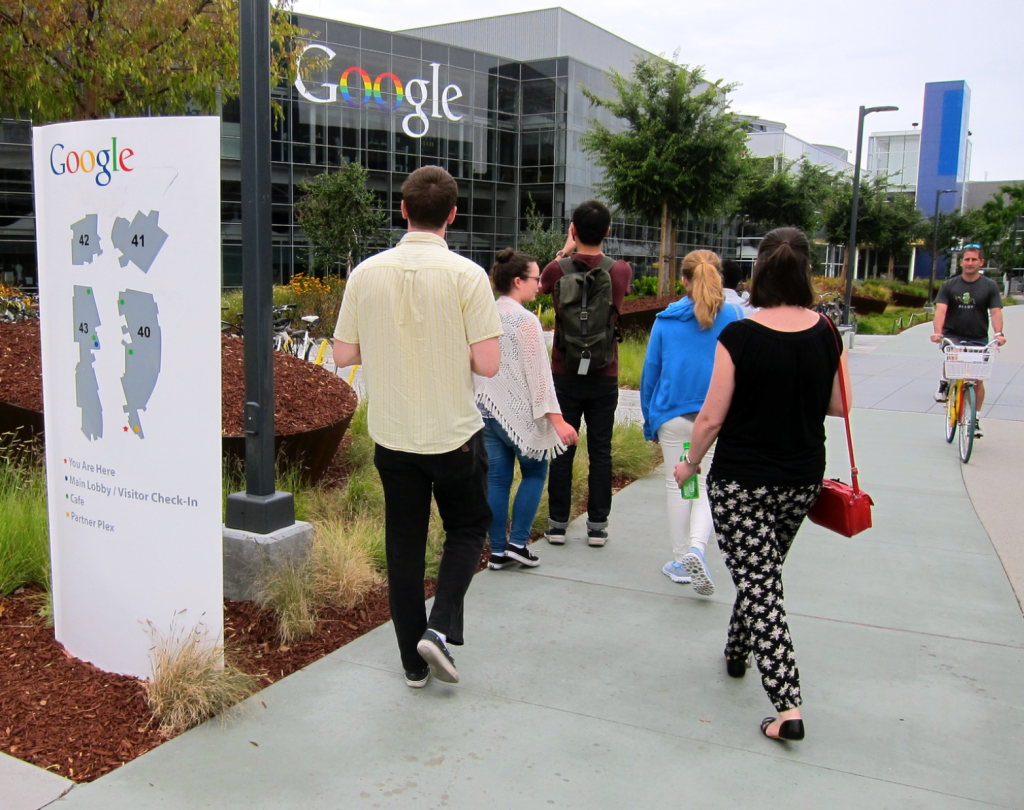
This summer, Google announced a plan to create a massive campus for up to 20,000 employees in San Jose’s city center, the South Bay city that calls itself “The capitalof Silicon Valley.” Google’s vice president of real estate outlined the company’s vision for the Diridon Station development at a council meeting…
Mark Golan: South Bay has been Google’s home for over 20 years now. We have thousands of Googlers who’re residents of San Jose. Google shares the City’s vision for the development of the Diridon area. …we are excited about the possibility of bringing a state of the art office, housing, retail, amenities, civic plazas, parks, and open spaces to the downtown San Jose area, all connected via an incredible mass transit system and integrated with the surrounding community.
Photo: Visualization of HSR San Jose by California High Speed Rail Authority (image is preliminary and subject to change)
Kim Walesh: Google will be the first major tech company to consciously decide to grow near transit. It’s an opportunity to get it right…a counterpoint to traditional Silicon Valley campus development – a human scale, urban place….we’re not even calling it a campus. That can connote inward looking like Facebook or Apple.
This is a totally different concept it says: Let’s put our innovation employees right in the heart of downtown in an open campus environment with well designed parks and plazas for all sorts of people to enjoy and interact. That’s where innovation comes from…
Bob Staedler of Silicon Valley Synergy is an expert in tech developments and a frequent advisor to the City Council. He describes this Grand Central Station vision…
Staedler: You’re going to have a multi-modal transport hub that could be 150 feet up in the air, having four separate modes of transportation from bus to high speed rail, to light rail to Uber drop-off to traditional cars, and a campus integrated in there…
technology integrated into it like you’ve never seen before: you walk in and you see where exactly is the train on a map; and you see with technology where you go with light up boards, similar to what you see in Singapore and Tokyo….a 21st century transit station …
Staedler: Apple has created the spaceship as they call it, it’s really more of a fortress monument, a monument to Steve Jobs. What we’re looking at with Google is creating an urban fabric with employees and the population and the transit station all integrated into one.
San Jose’s Mayor, Sam Liccardo insists this proposed Google campus is critical to the future of Silicon Valley and the city…
Mayor Sam Liccardo: Silicon Valley has developed on the suburban model a lot of tilt up, one and two story tech campuses surrounded by a sea of parking – there are inherent challenges in the sustainability of that model. We’re running out of land and God’s not building any more. We have horrible congestion on freeways and it’s not an affordable place to live.
We need to develop differently – we’re trying to retrofit a city built for automobile into a city built for people. We need to attract Silicon Valley’s talented, creative people…if we cannot attract the 20-30 year olds to live here, they will be somewhere else…We’ve got a vision for the Grand Central Station of the West… We’ve seen what they’re doing in London…it doesn’t hurt that they have a few bucks.
Alison van Diggelen: Sowhat have they learned from San Francisco’s tech experience?
Sam Liccardo: We’ve seen how intense the tech backlash has been in San Francisco. We’ve got a strong focus on building affordable housing… address concerns about displacement, pressure on the cost of living.
Liccardopoints out that this development may be long in coming…a decade even…
Sam Liccardo: This is not going to happen tomorrow: We’re not going to have 20,000 Googlers descending from parachutes…
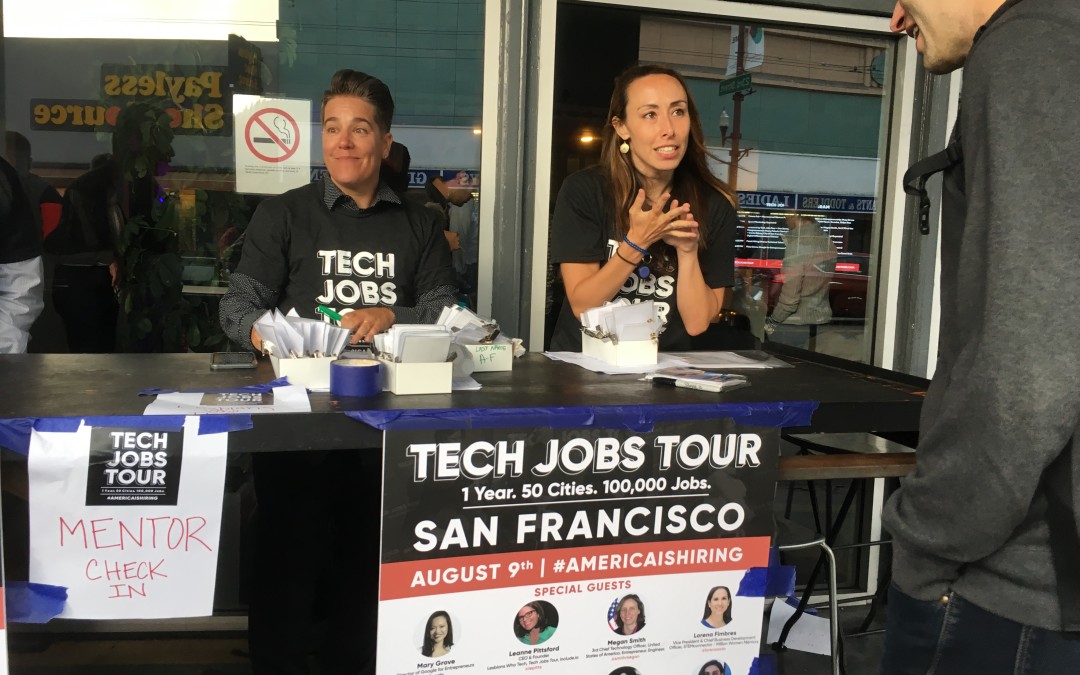
It’s estimated that there are over half a million tech job openings in the United States. A new initiative, the Tech Jobs Tour aims to connect “non-traditional” talent with tech job opportunities. It targets women, people of color, LGBTQs, veterans and disabled workers. Alison van Diggelen attended the San Francisco stop, on assignment for the BBC World Service.
“This is a crisis. There are so many open jobs. We have to come together as a country and solve this problem. We’re bringing people together…making connections to the Googles and Amazons of the world,” Leanne Pittsford, Founder Lesbians Who Tech
“Let’s make it so people can really build their own creative confidences, so that we can field the whole American team, the whole world team,” Megan Smith, former CTO for the Obama Administration
Or to the segment below, which includes bonus material that didn’t make the final BBC cut: a provocative rap by cyber security student, Chris Brooks (starts @6:00).
Here’s a transcript of the segment and a longer version my report (including highlights from Chris Brooks’s rap):
BBC Click Host, Gareth Mitchell: There are half a million vacancies in technology in the United States, so lots of people re-skilling. To help that along is a Tech Jobs Tour. It’s part road show, part boot camp, part job center. Alison van Diggelen was taking part in one recently. The tour rolled into San Francisco…
[Event atmos fade in…]
On stage:Service designer, front end designer, UX designer, full stack developer…
Alison van Diggelen: This is the Tech Jobs Tour. Stop number 8 on a 50 city tour of the US. Its aim: to connect “non-traditional” talent with tech job opportunities. This national initiative target women, people of color, LGBTQs, veterans and disabled workers.
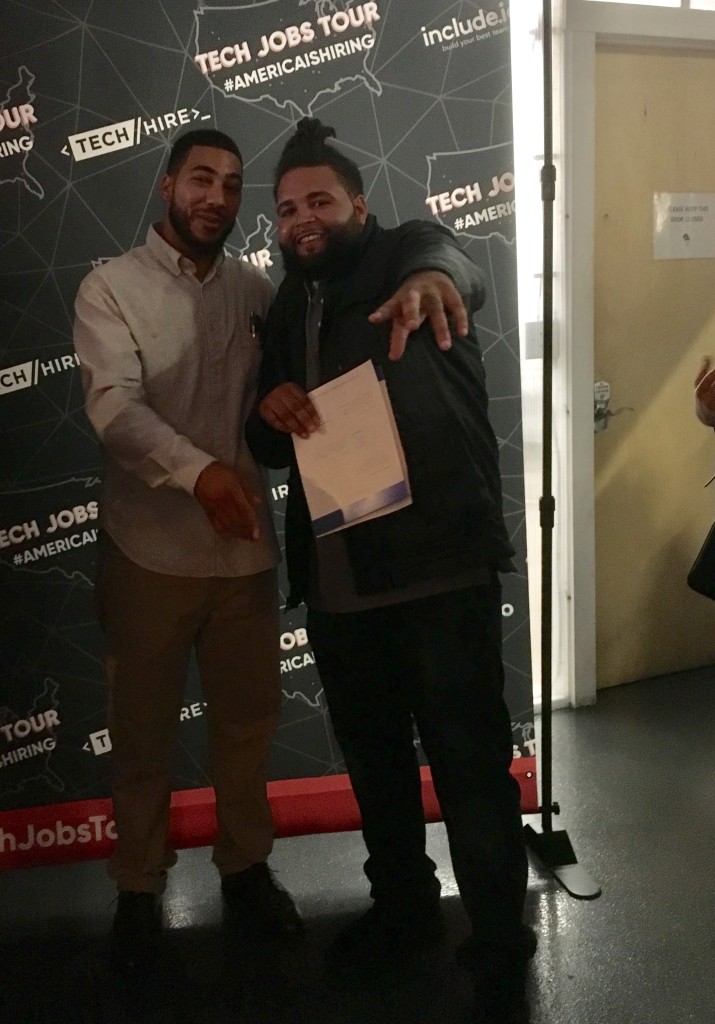
Chris Brooks is here with his brother Dontay. They’re doing a 6-month coding bootcamp at the Stride Center in Oakland. Their dream jobs? Cyber security…
Dontay: We saw the opportunity for school and we just ran with it. We seen this conference right here and it looked exciting. We want to network, get our names out there. You gotta show up to do anything!
Alison van Diggelen: Do you feel through tech you can make your life better?
Chris Brooks: Taking advantage of any opportunity, any avenue we can go down…Really, I’m just trying to get my foot in the door…
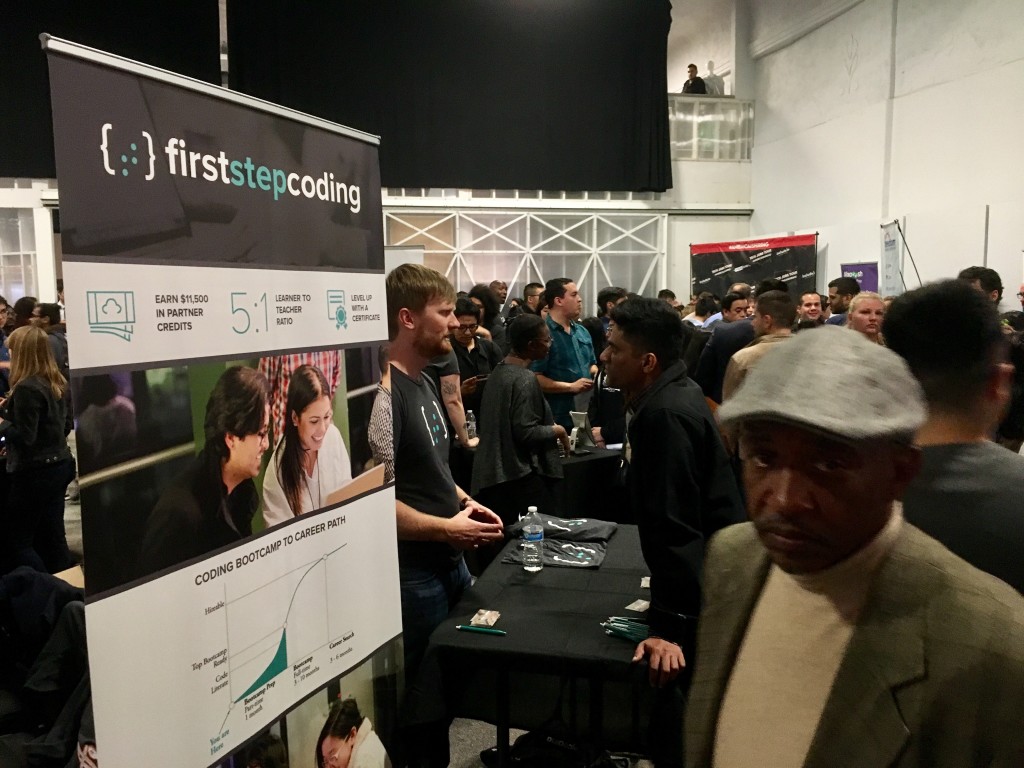
Alison van Diggelen: The brothers are part of an eclectic group of aspiring techies who queued up around the block for this rare chance to meet some tech movers and shakers. I spoke with an Air Force vet, ex-entertainers, burned-out math teachers, fashionistas and an unemployed retails workers.
Megan Smith, former CTO of President Obama’s White House is one of the keynote speakers tonight and a powerful advocate for diversity…
Megan Smith: It’s like a career fair meets kind of a revival…All around are people from this community desperate for talent. 2000 people signed up tonight…people are coming out, they want to understand. The businesses need this talent. Really, it’s an ecosystem lift.
Alison van Diggelen: The evening features onstage Q&A with diverse speakers, face time with reps from major tech companies via “speed mentoring” and lots of networking opportunities. Tech Jobs Tour founder, Leanne Pittsford, paints their mission in stark terms, describing the half a million unfilled tech jobs…
Leanne Pittsford: There’s talent everywhere. This is a crisis. There are so many open jobs. We have to come together as a country and solve this problem. We’re bringing people together…making connections to the Googles and Amazons of the world.
Megan Smith extends that message globally.
Megan Smith: Let’s make it so people can really build their own creative confidences, so that we can field the whole American team, the whole world team. People would opt in with the passion of what they want to solve…
Alison van Diggelen: Be that social justice, the environmental crisis, poverty, etc…As well as tech hubs like Silicon Valley, the Tech Jobs Tour is stopping at a regions hardest hit by tech disruption and job off-shoring including Tennessee, Kentucky, and Wisconsin.
Leanne Pittsford: We really need investment in the middle of the country in places that typically don’t get funding from Silicon Valley.
Pittsford is also a women’s rights activist and founder of Lesbians Who Tech, an advocacy group.
Leanne Pittsford:We believe in intentional inclusion…there’s no way to remove bias. We’re programmed to hire people like us…that feels less risky. We believe in quotas, setting goals: all of our speakers…50% women, 50% people of color. We urge companies to set the same type of quotas…goals.
Photo caption: Stride Center instructor, Willie Lockett brought his class to the Tech Jobs Tour in SF. Photo by Alison van Diggelen, Fresh Dialogues
Alison van Diggelen: Pittsford says that about 60% of new technical people are getting their education* from short online courses and coding boot camps…a more affordable path for what she calls “non-traditional” talent. *It’s a trend highlighted this week by Hari Sreenivasan on the PBS Newshour
I chat with Audrey Zwibelman, one victim of tech disruption. A former apparel merchandiser at Macy’s, Gap and Levi’s. She’s doing what she describes as a mid-career pivot.
Audrey Zwibelman: My job moved to NY. It’s an industry that’s kind of dead or dying. The customer is shopping in a different way…
She’s bullish about training and job opportunities both here in Silicon Valley and across the world.
Audrey Zwibelman: No matter where you live, you can find those resources online. The remote accessibility that everyone has to be part of a company, means that people can work wherever they are. I think the opportunities are kinda limitless.
Leanne Pittsford sums up her goal for the Tech Jobs Tour…
Leanne Pittsford: Helping American innovation thrive… changing the face of tech and helping American innovation thrive. Diversity is better for your products, your team, and your bottom line. It affects all of us as an industry and as a country.
We have a community here today that is working really hard to change the landscape…trying to build a strong pipeline that represents the diversity of America…so if you’re hiring…
Alison van Diggelen: As yet, the model is unproven, but the team is traveling in hope.
Bonus Material
Here are highlights from Chris Brooks’s rap:
Chris Brooks: Climbing up a mountain
Young brother how come
Everybody’s dying by these guns?
I keep walking without one
Not trying to kill my brother
I’m trying to kill an album
Sell my story
Cos a good income’s a good outcome
Coming in due time
Millennials’ new minds
They tell them you look here
I tell you, you’re too blind
Just take a look around
My brother you’ll soon find
That the world is yours
Don’t let the hesitation haunt you…
Photo caption: Chris Brooks and his brother Dontay. Both are cyber security students at the Stride Center in Oakland.
As dramatic images of the Texas floods pour in, it’s timely to ask: would a tech mindset help cities be more responsive and efficient in their disaster response? The concept of transforming the culture of a city hall by adopting a tech approach is what I’ve been exploring this month for the BBC World Service. How would an agile, innovative tech mindset help to fix problems and meet community needs more quickly? My report aired this week on Business Matters and fellow guest Duncan Clark, Chairman of BDA, shared his perspective from Beijing.
Alison van Diggelen reports from Silicon Valley, on how a tech mindset is helping transform San Jose’s City Hall.
“I’ve been really encouraged with how willing people are to try new things. We’re seeing a culture shift here at city hall, that is interested in learning about technology and process improvement and customer driven innovation,” Erica Garaffo, Data Analytics Lead at San Jose City Hall
Here’s a transcript of the segment, edited for length and clarity:
The BBC’s Fergus Nicoll: We’ve been talking about urban management and weather. Time now to talk about simple urban management in the context of cities that aren’t content to wait for federal infrastructure investment. Alison’s been investigating this in San Jose, in the heart of Silicon Valley…
Alison van Diggelen: Some city managers are not holding their breath with the current administration in D.C. The Trump administration is behind on all major promises (infrastructure investment, tax reform etc.); so, here in San Jose, they’re adopting a tech approach to make City Hall more efficient, accessible and responsive to community needs like flooding. San Jose is leveraging its location in the heart of Silicon Valley to lead the charge. I’ve been exploring their game plan and I started by visiting Diridon Station, the main transport hub in San Jose’s city center, to find out from the locals what they think of the city.
[Atmos: Train, plane, bus traffic in downtown San Jose]
Glen Abbott: What public works you see being done are extensive street modifications and drainage that go on and on and on and never seem to reach completion! Somebody is buttering somebody else’s toast…
Chelsea Conrad: There’s a lot of graffiti and trash I’ve noticed…I think it should be cleaned up…It’s kind of an eyesore…
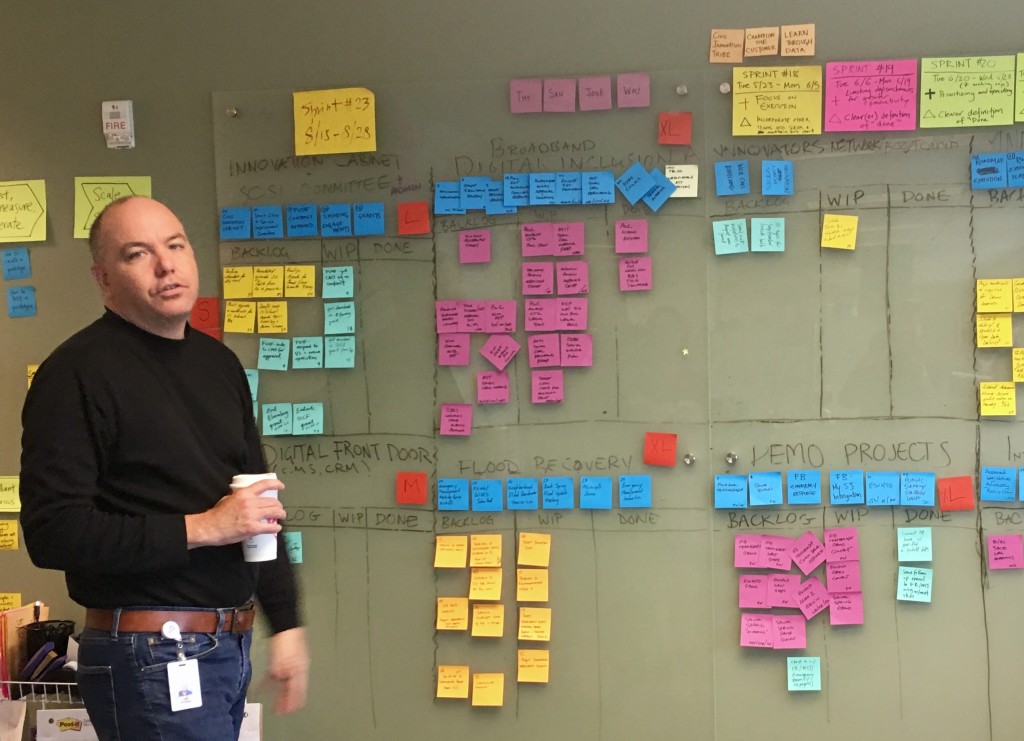
Alison van Diggelen: Meet Kip Harkness. He’s deputy city manager of San Jose, the self described “Capital of Silicon Valley.” Harkness dresses a la Steve Jobs in black turtleneck and blue jeans. A former Director at PayPal; today he wants to bring innovation and the “speed of business” to civic life in San Jose. With the enthusiasm of a tech evangelist, he demos the city’s latest release on his smartphone: It’s an app called “My San Jose”
Kip Harkness:Here we are at City Hall – you can see the pinpoints that are requests…you can see illegal dumping. Lots of illegal dumping!
Kip Harkness:It’s excites me. Now we know what the issues are. About 10,000 people have already downloaded the app…
Alison van Diggelen: He’s assembling what he calls “a tribe of innovators” to transform City Hall.
Kip Harkness:So we found some graffiti…it asks me if I want to take a picture. It confirms the location. Done, submitted, reference request is in there. Hopefully over the course of the day it will be processed in the system and that status will be updated.
[Atmos: scrum meeting discussion with Michelle Thong…laughter…]
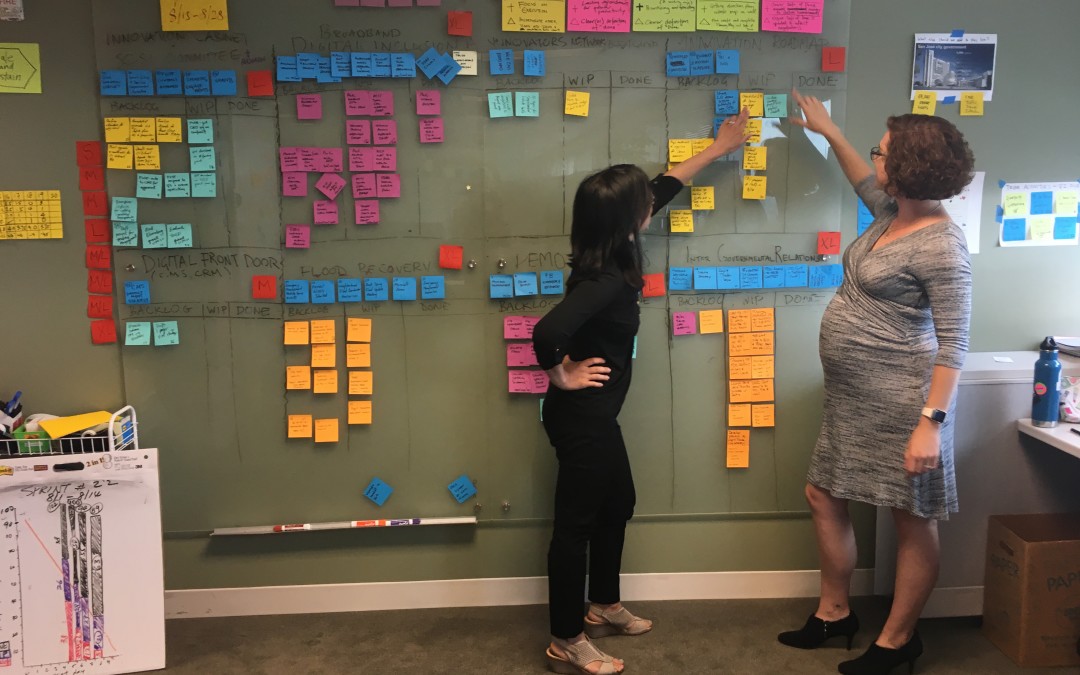
Alison van Diggelen: I meet his “tribe” on the 17th floor of City Hall just before their daily “scrum” – a 15 minute standup meeting. Participants move sticky notes across a giant board to show the progress of their projects. An entire wall becomes a super-sized multicolored spreadsheet. Harkness enthuses about the nimble goal-setting approach and team peer pressure which speeds up action…
Kip Harkness:Championing the customer, learning from data and iterating to improve set apart the tribe. In typical government you do it all at once and push it out the door. We have a scrum cycle – a 2 week process, we reset goals, we evaluate how well we did. Every day we check in on our progress. Running government on scrum, as agile, is a completely different mindset from the traditional 5-7 years plans that characterize our history.
Alison van Diggelen: Erica Garaffo leads the team’s data analytics. She says her background in industrial engineering taught her about process improvement and ways to streamline business operations. She’s finding that can make big difference in delivering community services.
Alison van Diggelen: Would you say you “think different”?
Erica Garaffo: Yes! [laughter] Having the data lens affords me interesting perspective… from data we can see patterns, get insights, and we can take action… I’ve been really encouraged with how willing people are to try new things. We’re seeing a culture shift here at city hall, that is interested in learning about technology and process improvement and customer driven innovation…
Alison van Diggelen: San Jose’s Mayor, Sam Liccardo is helping drive this tech-centered approach.
Mayor Liccardo: We’re blessed to serve a community that’s the most innovative in the world…We’ve tried to create a platform here in the city for innovation – from great companies all around us, from our budding entrepreneurs. We’ve got a program called “Unleash your Geek” that’s got hundreds of folks from San Jose State University and others coming up with ideas to help us solve civic problems.
Alison van Diggelen: The City is partnering with Facebook to launch “Terragraph” in downtown San Jose – a new wireless internet system they say will offer the “fastest free wifi in the world.” It’s also partnering with a dozen tech companies to launch an autonomous vehicle pilot program on city streets.
Of course, San Jose is not unique in adopting a tech mindset. Many global cities are getting techie, from London to Singapore, and Berlin to Nairobi. But as Harkness point out, San Jose has a huge comparative advantage:
Kip Harkness: Literally down the street we have Adobe, the Paypal HQ, Cisco HQ in San Jose…Intel, Apple, Facebook, Google all within 30 miles of our city hall building. We can open up and chunk out our problems to all these tech companies and create a living laboratory for them try out new approaches, new tech and for us to learn from that secret sauce of Silicon Valley.
Fergus Nicoll: Great piece Alison. We’ve got some new expressions for you today: “running government on scrum;” “chunking out programs”… Is this going to work in China, Duncan?
Duncan Clark: China has a top down belief in technology. A lot of the senior officials are engineers themselves…sometimes they place too much emphasis on this. The key factor is the people in China are embracing technology, particularly through their smartphones. One example would be these Mobikes….where you can hop on a bike anywhere in Beijing or Shanghai or across the country. These are dockless bikes, so you don’t have to return them as you would in New York, London or Paris. You leave them anywhere, they have a GPS, and that’s contributing to a reduction in traffic… This is the private sector: Alibaba and Tencent are backing companies like these. The government also is also very on the ball on tech…
Continue listening to the BBC’s Business Matters program, as we discuss:
The potential benefits and synergies from the Whole Foods-Amazon merger
The Hyperloop: why it’s a crazy idea; and yet why it’s unwise to under-estimate Elon Musk’s latest brainchild.
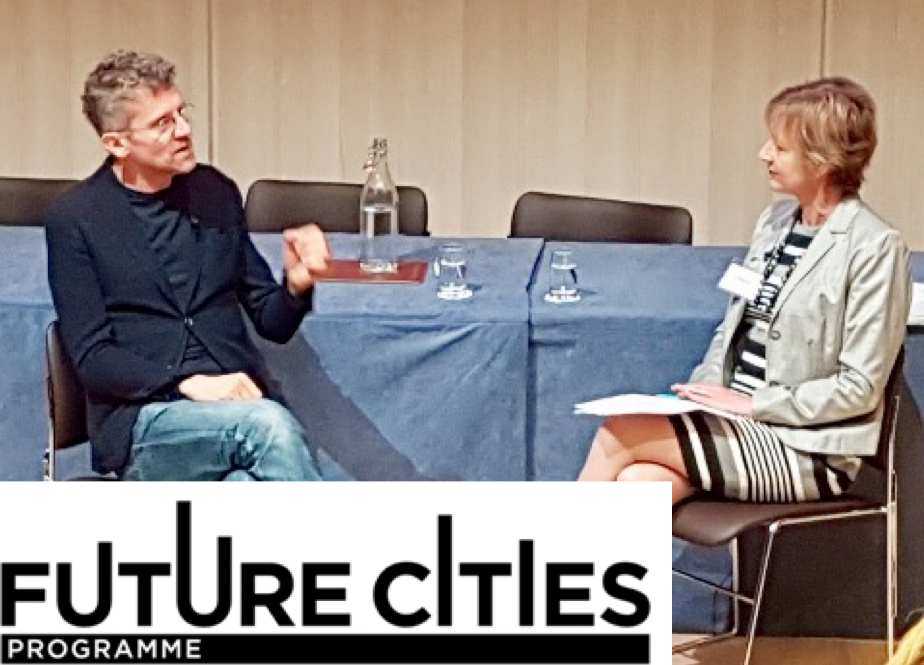
Photo caption: MIT Professor, Carlo Ratti in conversation with Alison van Diggelen at the Future Cities Conference, Jesus College, Cambridge on July 18, 2017.
On Monday, I joined the BBC’s Roger Hearing and Delhi journalist Madhavan Narayanan to discuss future cities and the role of technology in making them more efficient and sustainable. Listen to the podcast at the BBC’s Business Matters (Future Cities segment starts at 26:34)
Or listen to the audio clip below:
.
Here’s a transcript of our conversation (edited for length and clarity):
BBC Host, Roger Hearing: Alison, you’ve been having an interesting time recently. You’ve been looking at the concept of Future Cities, in fact you’ve been over in Europe I believe? Give me a picture of what you’ve been doing and what you’ve been hearing.
Alison van Diggelen: I was back at Cambridge University, in England last week, exploring the role of technology in shaping our future cities. The Cambridge Future Cities Conference assembled experts from academia, policy making and business to explore the challenges and opportunities facing cities. I interviewed Professor Carlo Ratti. He’s Director of the “Senseable City” Lab at MIT. “Senseable” as in sensors. He and his team are adding sensors to everything from trash to taxis to discover patterns, inefficiencies and opportunities to reinvent future cities, and make them greener and more sustainable. His team collaborated with Uber to test the feasibility of car-sharing and the Uberpool in New York. They found that in theory, everyone could travel on demand with just one-fifth (20%) of the number of cars in use today. He calls it the future mobility web.
Prof. Carlo Ratti: If you think about the future you can imagine something that we started calling a mobility web. A mobility web means the potential to know in real-time all the potential for transportation in the city both for people and parcels. Think about what happens today, you need to open one app, then another app…Imagine if all of them were combined… Then you can do something similar to what you do today with Kayak or Expedia, you can scan all your options – it’s like a mobile web that can radically change the way we look at mobility both for people and for goods.
Roger Hearing: Madhavan, you’re in Delhi. Can you imagine that kind of thing working in a city like Delhi? Would you be able to take transport to the point where you could be aware where every car or bus or lorry is at any given moment?
Madhavan Narayanan: Let me take a cynical view of what these guys at Stanford etc. do…I call them the Marie Antoinettes of our time. “Let them have high tech” is the new “let them eat cake.” Tech innovations have to be much more culturally sensitive and pragmatic for things to come on fast. People are not trying to reduce the carbon footprint here…people are trying to save money. High techies need to hire more sociologists and anthropologists and instead of talking to each other in an echo chamber of technologists. It will catch on in a zig-zag way…We do not need California idealism, we need Asian pragmatism.
Roger Hearing: Do you take that point on board Alison?
Alison van Diggelen: Absolutely. One of the refrains people heard at the conference was: let’s get out of our silos here: use this multi-disciplinary approach. We need collaboration, we need to think about different cultures and communities. In America 42 hours a year are lost due to traffic congestion(per commuter) and I imagine it’s even worse in Delhi. There’s a huge holy grail shining out there…we can drive towards that; there are huge gains to be made. The technology is there, we just need to implement it.
Roger Hearing: California has adopted new things very easily and quickly. Is it a place where people are already beginning to put in place the things you were talking about in Cambridge?
Alison van Diggelen: Yes, it’s definitely being experimented with. There is a project with driverless cars coming to the city of San Jose. They’re talking with ten different driverless car companies. These demo projects, these pilot projects are really important to understand how future cities can be more efficient and more sustainable.
Roger Hearing: At the back of everyones’ minds, when they think about integrated public transportsystems, future cities, smart cities is:What happens if someone hacks in? At this event, you did tackle the issue of security?
Alison van Diggelen: We did indeed. The answer is layers of security. The technologists need to outsmart these hackers who have nefarious aims. I spoke to Professor Ratti about this and he framed the importance of security in memorable and stark terms…
Prof. Carlo Ratti: With some of these technologies we can really have cities that are more sustainable, they’re more sociable as well, but we need to look at at least two issues – one is the possibility of hacking. We all know what happens if a virus crashes our computer, but usually nobody dies. But what if that was a driverless car? So how to make sure our cities cannot be crashed? The other is what happens to the data that is generated by the Internet of Things. We’re making a digital copy of our physical space, our physical cities – then it’s very important who has access to the data, what for, and that’s one of the big conversations of our time.
Continue listening to hear our discussion:
What is Mark Kleinman at the Greater London Authority (GLA) doing to accelerate the adoption of technology in London?
Why does Madhavan Narayanan think we need a SWOT approach to privacy and security in future cities?
Find out more about Future Cities
The Future Cities Conference in Cambridge assembled some of the brightest minds in urbanism and land economy today. Find out more about their research and projects here:
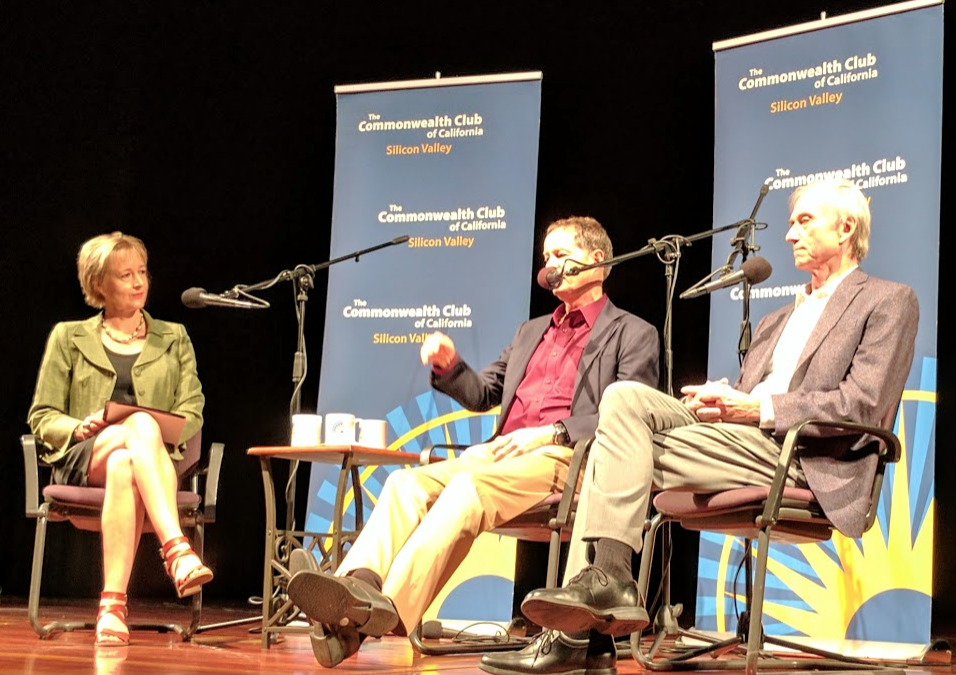
Days after my interview with John Mackey at the Commonwealth Club on May 1st, he began a courtship with Amazon that led to an agreed acquisition of Whole Foods by the global commerce giant. The courtship is something Mackey describes as “truly love at first sight.” Our conversation took place as news circulated of a potential bid by Albertsons grocery chain and reveals some of the motivations behind Mackey running so fast into the arms of Amazon.
During our tumultuous conversation – we were interrupted several times by angry PETA protesters – we also discuss his book “The Whole Foods Diet”; how a PETA member helped change his views on animal products; and what he thinks is the most environmentally conscious single act we should all do.
“How many of you are parents out there? So what wouldn’t you do for your children? You’d do almost anything wouldn’t you? That’s how I feel about Whole Foods….it’s my child, I love it. I’ve given almost 40 years of my life to nurture and develop it. There’s almost nothing I’d not do to protect it, to help it to flourish.” John Mackey, CEO of Whole Foods
Here’s a transcript of our conversation, edited for length and clarity:
Alison van Diggelen: As a public company, how can you balance long term goals such as healthy eating with short term goals like maximizing profits for this quarter?
John Mackey: Whole Foods now has shareholder activists who want to force us to sell the company. The very short term profit mentality has entered into our shareholder base. Whole Foods has always had this purposeful long term perspective. We’re now faced with the biggest challenge in the history of our company. Can we stay independent to fulfill our mission or are we going to be sold out to the highest bidder for short term gains? Stay tuned…
Alison van Diggelen: Is Whole Foods something that you are personally attached to forever? Do you anticipate on your deathbed you’ll still be CEO of Whole Foods?
John Mackey: I hope not. I’ll be dead pretty soon. (laughter)
Alison van Diggelen: Do you have a retirement plan in place?
John Mackey: I’m moving to Florida… No! I haven’t taken any compensation at all from the company for 10 years. I’m doing it because I just love it. It’s the purpose of my life. I’m a servant leader. I’m just trying to serve Whole Foods and help it to prosper.
How many of you are parents out there? So what wouldn’t you do for your children? You’d do almost anything wouldn’t you? That’s how I feel about Whole Foods….it’s my child, I love it. I’ve given almost 40 years of my life to nurture and develop it. There’s almost nothing I’d not do to protect it, to help it to flourish. However, there comes a time when daddy has to leave and that time is not yet, I hope…
Alison van Diggelen: So you’re going to hang on to it till…
John Mackey: I’m not hanging on to it…If it’s appropriate, what my heart calls me to do, I’ll continue to lead it. There will come a time when it’s not appropriate any longer and I believe I’ll have the wisdom and the grace to recognize it and I’ll leave. But I don’t think that time is right now.
Continue listening to the podcast to discover Mackey’s tips for entrepreneurs, how Whole Foods was almost destroyed by a flood; and his challenge to Nobel Prize winning economist, Milton Friedman.
Other highlights:
On environmentalism (@55:00 in the podcast) :
If people think of themselves as environmentalists, that would entail completely eliminating the consumption of animal foods. That’s the most environmentally conscious single act you could do.
On how Mackey reconciles libertarian stance with government action on climate change (@57:00 in the podcast)
We need government regulations. The government is the umpire that sets certain standards to make sure that we have a good society. I’m not an anarchist…I believe in government that’s well defined and stays within its appropriate boundaries. Certainly setting environmental standards is a very important function of good and responsible government. It’s always a matter of what standards, to what degree.
Alison van Diggelen: Do feel part of the role of the president is to advocate for action on climate change?
John Mackey: When I go out in public that there are really four topics I try to not to talk about: politics, religion, sex or GMOs. You’re guaranteed to make people angry. I can’t afford any more protesters wherever I go.