This month, the modern space race is really firing up. Three of the world’s most exciting entrepreneurs are vying for supremacy in space exploration: Elon Musk of SpaceX, Jeff Bezos of Blue Origin and Richard Branson of Virgin Galactic.
Last week, I joined Rob Young on the BBC World Service to explore: who’s most likely to win today’s space race; and what’s motivating them?
Richard Branson is focused on taking tourists into space. His Virgin Galactic company offers sub-orbital space flight for a cool $250,000 a ticket. He plans to be one of Virgin’s first “citizen astronauts” later this year.
Elon Musk and Jeff Bezos have much more ambitious goals – to establish colonies in space. But that’s where their missions diverge: Bezos wants to create a colony on the moon and on multiple giant space stations orbiting the Earth. He just released detailed plans for Blue Origin’s “Lunar Lander.”
“We will go back to the moon,” Bezos says, “This time to stay!”
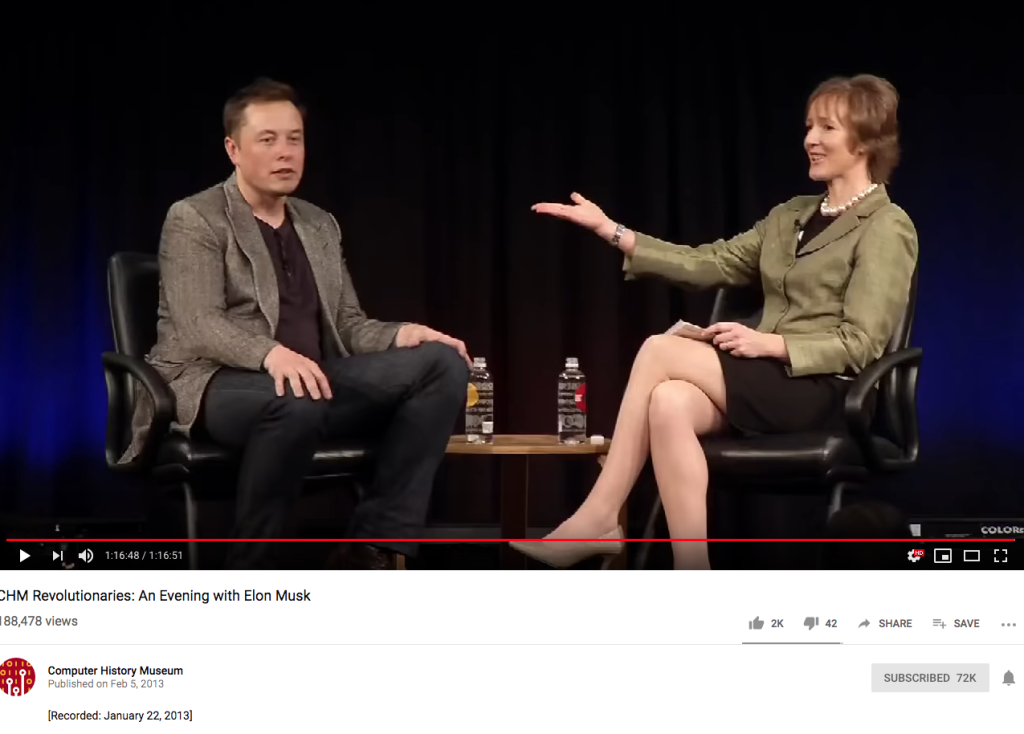
But Musk has even loftier goals. He famously told me, “I want to die on Mars, just not on impact!”
Musk envisions a thriving colony on Mars. To fund that mission, he has created a booming SpaceX business, launching private satellites into space, as well as offering rocket-courier service to the International Space Station. But Musk is also vying for a slice of the Trillion dollar internet connection business.
This month, SpaceX’s plans to launch its first 60 satellites in the Starlink mission to bring fast internet connection to billions of the world’s unserved population. Bullish as ever, Musk’s ultimate plan is for 12,000 satellites in low earth orbit.
Rival, OneWeb, backed by Richard Branson has more modest plans for a 600 satellite constellation. The race is on!
The BBC’s Rob Young started by asking my fellow guest, Liz Gwynn, Prime 7 TV Anchor (from Wagga Wagga, Australia) if she’d take up Richard Branson’s invitation to go for a ride on Virgin Galactic’s VSS Unity. Her answer made me chuckle!
Here’s a transcript of some of our conversation:
Rob Young: Which of the billionaires will win this space race?
Alison van Diggelen: I’d put money on Elon Musk. He’s defied naysayers time and time again. His company – SpaceX – has pioneered reusable rockets which has driven down the cost by a factor of four.
This summer, they plan to be the first private company to launch astronauts to the International Space Station. Previously, it’s just been superpowers.
Rob Young: Is it a serious business, or just bragging rights?
Alison van Diggelen: Elon Musk has had a lifetime ambition. He’s famously said: I want to die on Mars. Just not on impact!
He’s doing it for the adventure, but also as an inspirational objective, and something that can make humans a multi-planetary species. It’s a big dream, a big vision.
***
Find out more
Our BBC conversation moved on to Clean Energy and California’s ambitious goals to decarbonize its energy sources. Listen to the BBC World Service @42:30 when we discuss Governor Gavin Newsom and his bold stance on clean energy.
Perhaps you weren’t shocked by the college applications scandal that recently broke in the United States? I must confess, I was deeply upset because it reveals a low tide mark in our society’s ethics today and underlines the absence of integrity in so many people’s lives. But I’m also saddened because “Operation Varsity Blues” has wider implications for our colleges and our communities. Fresh Dialogues host, Alison van Diggelen reports for the BBC World Service.
(Photo credit above: Daniel Gaines Photography via Breakthrough Silicon Valley)
The stories of college applications doctored with photo-shopped pictures of athletes; blatant bribery and cheating on SAT scores made my blood boil. So I was delighted to have the opportunity to share my views on the BBC World Service.
These rich elites – venture capitalists, actors and prominent business people – confused their privilege for merit; and by cheating they crushed the hopes and dreams of the least fortunate and most deserving students in our communities.
The BBC’s Fergus Nicoll asked me about the reputation damage to schools and I shared an interview I did recently with former President of Stanford University, John Hennessy. At the time, he was outraged at colleges “debasing themselves” and forgetting their values in the pursuit of athletes over academics. Watch the video (@3:00): Hennessy is known for his tact, but here, his anger is palpable.
Previous commentators on the BBC program, including Stephanie Studer of the Economist in China, and Kay Hymowitz of the City Journal in New York, talked about the destruction of meritocracy. That’s definitely under threat, both here and around the world. But who’ll suffer most from this scandal?
The hard working students and families from less advantaged communities. Like the inspiring students at Breakthrough Silicon Valley, a nonprofit here in California, that works to mentor and nurture first generation immigrants to achieve their college dreams. For them, it’s a double whammy: First: The opportunity cost. For every rich kid who got into college through a side door, there’s a student who worked like a Trojan to get the scores necessary to win a place, and lost out. But it’s more than that: What will this scandal do to the aspirations of these students and families who feel that the playing fieldjust got even steeper? And more broadly, how will our communities suffer if these well deserving youth lose out on taking their shot at a better future? The opportunity cost is both acute and enduring, both personal and wide ranging.
Is it too much to hope that colleges and communities can return to decent values and bring ethics back from its long holiday?
We should all be outraged when such revered institutions fail our society by creating shortcuts for those with wealth and privilege when they could be a powerful force for equity in our society.
Certainly, the staff and students of Breakthrough Silicon Valley are frustrated. As Diana, a high school junior, put it, “I’m sad but not shocked. I’ve always known that there are people who play the system, it just hurts to have this out there when I’m working so hard to get my shot.”
For the past five years, my team has cheered Diana on as she works incredibly hard to get to college. She grew up in a family that grapples with the constant stress of financial instability. They got home internet access just last month, and few in her community have gone to college, but Diana is blazing an impressive path. She has a 4.29 GPA while enrolled in the most rigorous courses her district offers. She founded a community service club and helps facilitate Breakthrough’s after-school program for 7th graders. She is proud of her community service, her persistence, and her identity as a strong Mexican-American woman. Diana is not just “qualified” to attend college, she is ready to lead when she gets there.
When colleges reinforce class divisions through legacy admissions and bend to the will of deep pockets, they miss out on students like Diana. Read more here. (NB: Names have been changed to protect student privacy)
The Paradise Camp Fire is the deadliest wildfire in California history. Why is that?
To date 79 people have died and almost 700 are still missing as the fire still rages on. Here in Silicon Valley, we’re processing the tragic devastation and choking in a blanket of smoke and misleading statements from our president, who blames forest mismanagement for the tragedy. Head of the California Professional Firefighters organization called the president’s claim “inane, ill-informed, ill-timed and demeaning to victims and to our firefighters on the front lines.”
I was invited to share my perspective on the BBC World Service and it felt good to call a lie a lie. NPR has explained its policy of not calling out Trump’s lies. I think it’s a complete cop out and agree with the listener who wrote: “To fail to identify a lie as a lie is a gross failure of journalism.”
“Donald Trump’s tweet at the weekend said, “There’s no reason for these massive fires…except forest management.” It’s over-simplification and it’s a downright lie. His aim is to distract and undermine the widely accepted role of climate change in these mega fires…the big picture is: climate change is causing longer droughts, hotter air, drier soil, faster winds and is creating these mega fires. So, thinning the forest is one thing, but the longer term thing is: we need to do more for climate change. We need to reduce our carbon footprint, and we need to encourage more clean energy.” Alison van Diggelen
Photo credit: Cpl. Dylan Chagnon, U.S. Marine Corps.
The BBC’s Fergus Nicoll is co-host of the program, Business Matters.
Here’s a transcript of our conversation (edited for length and clarity):
Fergus Nicoll: You’d think you were at a safe distance, Alison, but I guess there’s got to be knock-on effects weather-wise, smoke-wise, almost across the whole state?
Alison van Diggelen: It feels like California is on fire. Paradise (the town at the epicenter of the fire) is an ironic metaphor for California. The state is paradise for many but is rapidly becoming a hellish inferno. I’m 200 miles south-west of the Camp Fire and the air quality is terrible. We’re being advised to stay indoors and not exercise outside. It’s affecting almost every person in the Golden State.
Fergus Nicoll: Governor Jerry Brown said over the weekend, “Managing all the forests everywhere doesn’t stop climate change. Those that deny climate change are contributing to the tragedy.” He said, “The chickens are coming home to roost.” Is that what everybody’s talking about behind these headlines?
Alison van Diggelen: Absolutely.Donald Trump’s tweet at the weekend said, “There’s no reason for these massive fires…except forest management.” It’s over-simplification and it’s a downright lie. His aim is to distract and undermine the widely accepted role of climate change in these mega fires. There is a short-term solution in mitigation: doing some controlled thinning of forests and relaxing the logging rules, which the state law makers have done this summer. But the big picture is: climate change is causing longer droughts, hotter air, drier soil, faster winds and is creating these mega fires. So, thinning the forest is one thing, but the longer term thing is: we need to do more for climate change. We need to reduce our carbon footprint, and we need to encourage more clean energy.
Fergus Nicoll: I know these are issues you talk about on Fresh Dialogues. What about water? What about the shortages that California has had? Is it a problem fighting fire because there’s insufficient water?
Alison van Diggelen: That again is Donald Trump’s oversimplifications and a distraction. Water shortages (for fire fighting) aren’t a problem. Oroville Dam is very close to where the Camp Fire is burning and in Malibu, you’re right next to the ocean. So there’s really no issue about water shortages for putting out the fires. That is not the issue. Again it’s distracting…it’s point over there when we should be addressing the real issue of climate change.
And one other issue that a lot of people don’t know about is that nights in California have warmed nearly three times as fast as days during the fire season, so lower night time humidity means that the fires are growing and blazing overnight. That didn’t used to happen. So again, the finger points to climate change.
Fergus Nicoll: Alison, thanks for that. This is Business Matters, we’re live on the BBC.
Over 100 Americans die every day from opioid overdose, that’s about 40,000 a year. What can be done to reverse the recent spike in fatalities? In San Francisco, a team of public health workers is focused on treating the most vulnerable: homeless people on the city’s streets. My latest report for the BBC explores how this special ops “Street Team” is finding and convincing people to get the latest medical treatment, wherever they are.
It’s a timely issue as next month, San Francisco voters will decide if the city’s largest businesses, many of them tech companies, should pay a special tax to help fund more homeless shelters and addiction centers like the one I visited. The debate is dividing the tech community. Marc Benioff of Salesforce says “homelessness is everyone’s problem” and backs the special tax, but others like Twitter’s Jack Dorsey say it’s “unfair.” Love it or loathe it, the ballot measure proposes more funding and action to tackle homelessness and drug addiction in our most vulnerable population. These are complex and deep rooted problems with no quick fixes, but I applaud Marc Benioff and others like him for taking a stand.
Several medical workers and a heroin addict shared their ‘dream’ solutions to homelessness and addiction in the city. Their answers may surprise you.
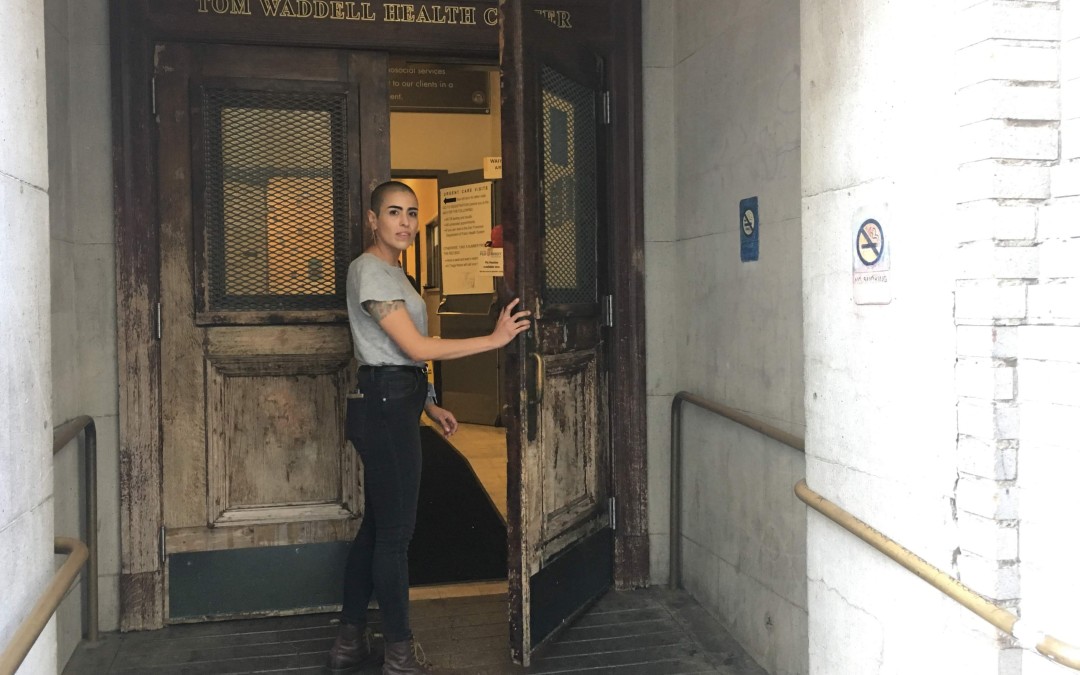
If I had a magic wand, I’d just flash over the Twitter building, the Google building and say: hey guys, how about some compassion for folks, some kindness? When somebody talks to you in the street, look them in they eye. Planting that little seed of compassion and kindness goes a long way and I think that’s how the larger change in our city would happen. There’s a lot of hostility, a lot of misinformation. So if I had a magic wand, I’d just like flash it and say: compassion, compassion, compassion…kindness and a safe injection site! Ana Cuevas, health worker at the Tom Waddell Health Center, SF Public Health [Pictured above]
Here’s a transcript of my full report. A shorter version aired on the BBC World Service on October 24, 2018.
Atmos: San Francisco city street sounds: bus, cars, fans, people…
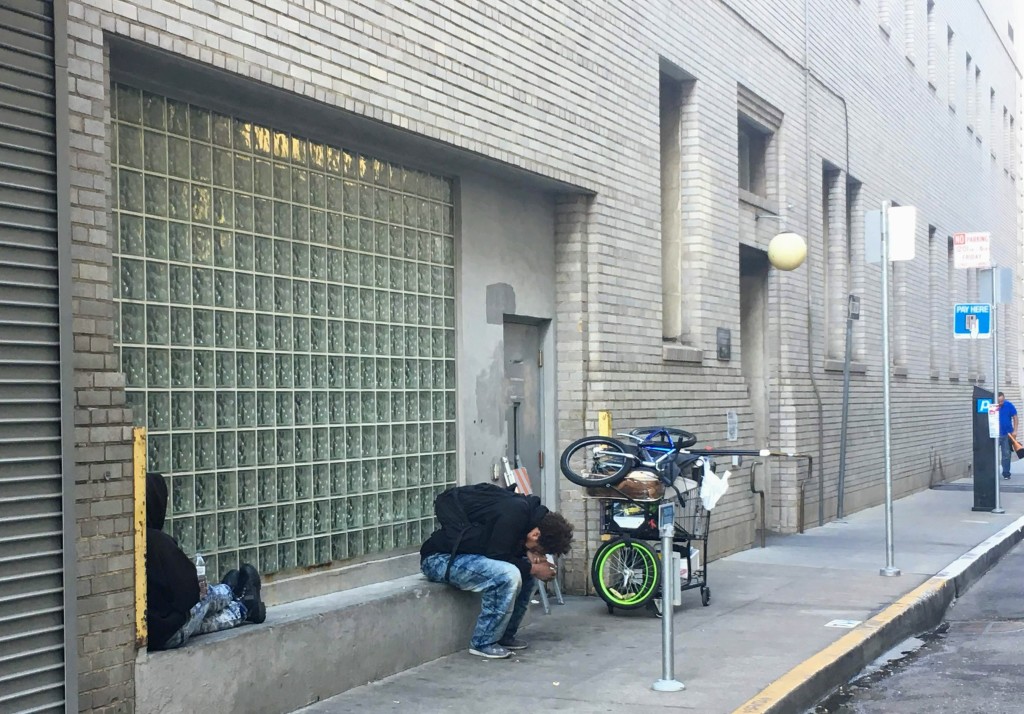
Alison van Diggelen: I’m here at City Hall in the center of San Francisco. Within yards of the building’s gleaming dome, there are clusters of homeless people, huddled in doorways, sprawled on pavements, or slowly pacing the streets.
Every week, Dr Barry Zevin and his team walk the city streets to build rapport with homeless people with addiction problems and offer on-the-spot treatment. Once trust is established, they encourage patients to visit the city’s public health clinic. Today, there’s a steady stream of homeless people…
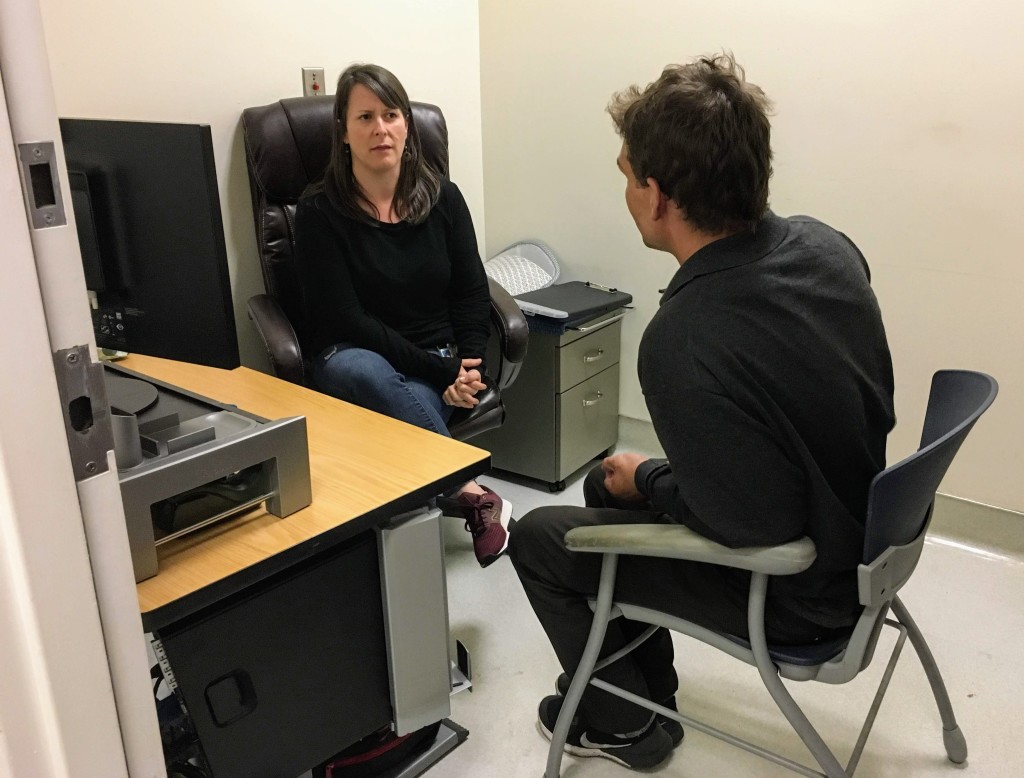
Alison van Diggelen: Inside this clinic, known as the Tom Waddell Health Center, I meet James (not his real name) a former medic in the United States army, who recently started treatment for heroin addiction.
James: Right now I got a prescription refilled, and the doctor was like: do you need a shelter bed for tonight? Are there other things I can do for you? I’m very impressed with how kind and helpful they are…going above and beyond to find what else they can do for me.
Alison van Diggelen: James, who’s 30, has been prescribed buprenorphine to help wean him off his opioid addiction. Buprenorphine is a daily pill that reduces opioid cravings and the extreme physical pain of withdrawal. Despite being an addict for over ten years, James sincerely wants to change.
James: This medication allows me to do a detox less painfully and I no longer will have intense cravings for the substance of abuse. It’s definitely more comfortable than cold turkey…
Alison van Diggelen: James has been homeless in SF for about five months, after moving from Seattle. Being on the streets compounds his challenges as he faces fear and loneliness, as well as drug dealers.
James: I moved to this city not knowing a whole lot about it, so the areas I go, I’ve only operated in them under addiction scenarios. So being on something that blocks the receptors…I’m not so prone to go back to using it and therefore I can operate in these areas where there’s a lot of environmental triggers without having to…feel the same feelings of craving, to want to use.
Alison van Diggelen: Sarah Strieff is a registered nurse with the SF Public Health’s “Street team”. They regularly walk the city streets to identify vulnerable patients in need of healthcare and detox. As they pound the pavements, how does she and her team convince homeless people like James to start treatment?
Nurse Sarah Strieff [pictured above]:There’s two ways we identify people: our own outreach and street presence; and through other agencies in the city that bring people to our attention.
Alison van Diggelen: Sarah, who wears ripped jeans and a T-shirt explains how being inconspicuous, non-threatening is key to their outreach.
Sarah Strieff: It’s casual, we dress down, we don’t wear uniforms.
Alison van Diggelen:No lab coats?
Sarah Strieff: No lab coats. No! We talk to people where they’re at…We’ll go to Golden Gate Park, the Haight, Bay View…I do see a lot of people hanging out in the Tenderloin.
Alison van Diggelen: The clinic serves between 10 and 20 homeless people during its daily 4-hour clinic. No appointments are necessary and you don’t need insurance. Ana Cuevas works with Sarah on the “Street Team.”
Ana Cuevas: We try to build a relationship first and check in with folks. That’s the reason why our program is so successful. Everyone who works here sees people first, then patients. Check in and ask what they need and try to deliver, not impose my own agenda on them.
Alison van Diggelen: The clinic delivers a comprehensive health care treatment plan, prescriptions for detox medications and even helps patients find a roof for the night.
Starting conversations about drug use is a sensitive process, and it takes weeks, months, even years for the Street Team to build trust with people on the street and at needle exchange facilities. For that reason, I wasn’t allowed to go on their rounds with them.
Ana Cuevas:It’s not hello: what’s your social security number, what’s your medical history? No, it’s like: who are you? How can we help you? We just listen… we just go with the flow.
Alison van Diggelen: Ana Cuevas describes the process as “Motivational interviewing” which involves a lot of listening, and no judgment.
Ana Cuevas:If someone comes in and says: Hey Ana, I’ve been using a lot. I’m not going to say: you shouldn’t do that! (instead): what are your thoughts around that? What’s happened with that? And then just kinda carry that conversation like that. One of the biggest problems with health care is that there’s often not enough time to listen. That’s the root of motivational interviewing: being present, listening and then figuring out solutions together.
Alison van Diggelen: Dr Barry Zevin is the Medical Director of Street Medicine and his team treats about 500 homeless patients a year, many of whom are addicted to opioids.
Dr Barry Zevin:When we treat them with buprenorphine or methadone – long acting, continuous stimulation of these receptors in the brain, without the sudden highs and sudden withdrawals that come with a short acting drug – these longer acting medications can really change and repair what the dysfunction of the brain is and all of the physiological stress responses people have. The physiology of someone using street opioids has really gone wrong, and that causes depression, anxiety, stress, physical disease, decreases in the immune system…a whole cascade of things go wrong that can go right when we replace that with long-acting, high affinity to the opioid receptor in the brain medication.
Alison van Diggelen: The health worker, Ana Cuevas, recalls a twenty year-old woman the team was able to help and within a week she was reunited with her family and on the road to recovery.
But Dr Zevin admits such cases are outliers.
Dr Barry Zevin:We’re in era of fentanyl contaminated drugs. It’s found its way into the drugs…They’re super potent…The risk of overdose is much higher now than it was 5 years ago. I’m talking with people every day and any day they’re at risk from having an overdose or fatal overdose bc of this new trend in drug supply.
Alison van Diggelen: The clinic treats a small percentage of the estimated 20,000 intravenous drug users in San Francisco, but Dr Zevin insists it has ripple effects. By targeting the most vulnerable people and achieving results, he’s convinced it inspires others to get treatment. He considers it a remarkable success that about one third of his patients are still in touch with the team and on treatment after a year.
Dr Barry Zevin: I always describe our model as effective but not very efficient.…We see them a lot. Once a week is not enough for some patients. With the level of instability, the level of things that can happen to people..If people are in a street or a park or a shelter, it’s a lot easier to bring the medical care to them, than wait in an office for them to finally make it to an appointment.
Alison van Diggelen: This SF program is just one of several similar schemes across the United States in Boston and in Texas. They’re often run in conjunction with needle exchanges and low barrier shelters, so that addicts can get the full support they need. Is the solution policy changes, more shelters and more funding? Healthcare worker, Ana Cuevas offers a more profound insight.
Ana Cuevas:Honestly, the most challenging part is changing the way our larger community views our population. Our folks, a lot of their humanity has been taken away…
If I had a magic wand, I’d just flash over the Twitter building, the Google building and say: hey guys, how about some compassion for folks, some kindness? When somebody talks to you in the street, look them in they eye. Planting that little seed of compassion and kindness goes a long way and I think that’s how the larger change in our city would happen. There’s a lot of hostility, a lot of misinformation.
So if I had a magic wand, I’d just like flash it and say: compassion, compassion, compassion…kindness and a safe injection site!
Alison van Diggelen: This viewpoint is echoed by James, the drug addict who recently started treatment.
James:It’s a matter of empathy I think. I would ask anybody in charge of policy…people might not seem kind or deserving of help, but they’re all people who may be in different stages of grief or suffering and to realize that it takes kindness to bring it out.
Alison van Diggelen: What are his hopes for the future?
James:I’m trained as a chef, I worked as a medic in the military. There’s things in both these fields I’d like to be doing…
What makes Madonna the ultimate female bad-ass role model? On the eve of Madonna’s 60th birthday, I was invited to join the BBC’s Roger Hearing in London and Bloomberg’s Enda Curran in Hong Kong to discuss the queen of pop’s controversial life and legacy. How has she redefined what it means to be a woman in her 60’s?
“In the realms of entertainment, whether you’re an actor or a musician, as a woman you’re supposed to fade away in a dignified manner when menopause kicks in. Madonna hasn’t done that and I think that’s a great, great thing. Why should women have to make this dignified exit because no one is asking men to do that?” Fiona Sturges, Culture critic at the Guardian, Financial Times.
Here is some of our conversation: Roger Hearing: Now Alison, you’re a fan, aren’t you?
Alison van Diggelen: I am a fan. How I’d describe Madonna is: She’s the ultimate bad-ass female role model. She’s fearless, creative, unpredictable and that makes her super compelling. I also have to praise her for her Billboard Music Awards speech in 2016. This was before #MeToo and she talked out misogyny, the double standards for men and woman. She appealed to women to reach out to other strong women, to learn, to collaborate and to be inspired. That’s a message that we cannot get tired of hearing.
Roger Hearing: But what makes her a role model?She’s been pretty controversial in lots of ways that many people thought was not appropriate, and wasn’t a good role model for anyone…
Alison van Diggelen: She’s a pioneer. She doesn’t accept the norms and conventions and I think that what she’s doing as a 60 year-old is: she’s going to reinvent what we think of a 60 year-old woman. I say: good on her! She makes some crazy choices in what she wears and what she does, but she’s always pushing the envelope, making us question what is “OK”? I think that qualifies her as a role model, even if you don’t like 100% of her choices.





 James: Right now I got a prescription refilled, and the doctor was like: do you need a shelter bed for tonight? Are there other things I can do for you? I’m very impressed with how kind and helpful they are…going above and beyond to find what else they can do for me.
 Alison van Diggelen: The clinic delivers a comprehensive health care treatment plan, prescriptions for detox medications and even helps patients find a roof for the night.