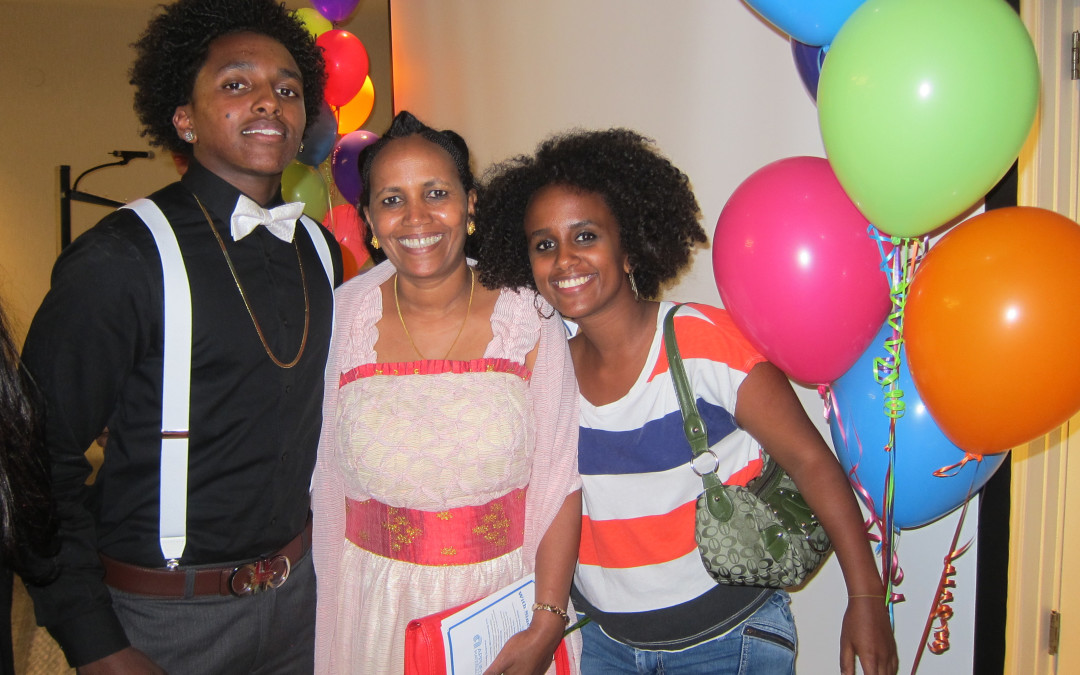
(Photo: Thanks to Breakthrough Silicon Valley, Nahom Zeratsion (left) got a scholarship for Bellarmine College Preparatory and will be attending San Jose State University this Fall)
In Silicon Valley, it’s easy to focus on the bright stars of tech and innovation. But what about those people who don’t feature on the home page of TechCrunch and can barely afford their rent? Today, Silicon Valley’s income inequality is jaw-dropping; average incomes of the top 5% of households are about 30 times higher than the average incomes of the bottom 20% ($500,000 vs $15,000). One startup has a long-term vision and is successfully breaking the cycle of poverty in some Silicon Valley neighborhoods by helping low income students get a college education.
80% of students are first in their family to attend college
62% of students live in gang-impacted neighborhoods
And yet, 96% of these students get into 4-year colleges, 4% into community colleges.
Earlier this year, I sat down with Melissa Johns, the Executive Director of Breakthrough Silicon Valley to find out how she and her team achieve such impressive stats, and how their program has a ripple effect on the wider community. Although the majority of the nonprofit’s revenue comes from the tech community, its limited budget means the team can only reach a few hundred students every year. With a proven and successful platform like this, imagine what could be done if tech juggernauts like Google, Apple and Cisco stepped up to help scale this program?
The BBC World Service was curious to explore this less glamorous – and yet inspiring – side of Silicon Valley and aired my interview on Business Matters.
Here’s the podcast
And here’s a transcript of our conversation (edited for length and clarity):
The BBC’s Roger Hearing: Alison, you’ve been looking at the people who work in Silicon Valley…and income inequality in the area?
Alison van Diggelen: Yes, there’s a growing gap between the rich and the poor in Silicon Valley. It’s quite stunning. Last week, I interviewed the Executive Director of Breakthrough Silicon Valley. It’s a nonprofit that’s helping low income students break out of poverty by getting a college education. That’s the ticket to success in Silicon Valley and beyond.Melissa Johns runs the six year program: tutoring, mentoring and college counseling and her team has impressive statistics (see above). I talked to Melissa about the many shortcomings of California’s public education system. She told me that on average there’s only one college counselor for every 700 students in California’s public high schools. That’s one thing she would like to fix.
Melissa Johns: I don’t know how we’re going to do the things we need to – to fill the STEM pipeline of future engineers or Silicon Valley is going to crumble. We need to find more women for leadership positions in our Fortune 500 companies. How are we going to achieve all that when the vast majority of our population is left behind because they’re attending schools that are under resourced and they have college dreams with no real connection to a college counselor who can help them walk through the very complex process?
Roger Hearing: But Alison, I gather that there’s a huge number of dropouts there in Silicon Valley high schools?
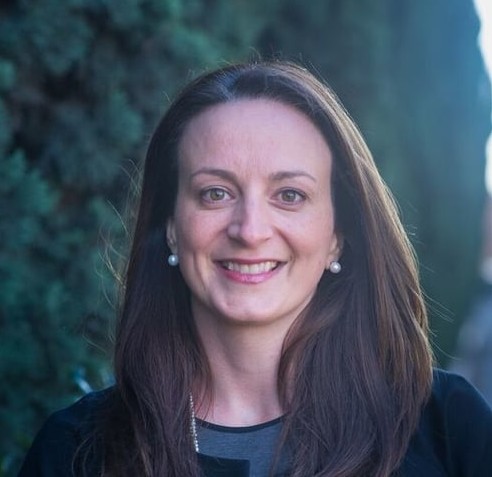
Alison van Diggelen: Yes, there’s a lot of talk here about the dropout crisis. East San Jose, in the heart of Silicon Valley has dropout rates as high as 30% in some communities and the majority of that are students who complete high school but don’t meet the minimum level of credits to graduate. But the good news is: there are a number of nonprofits working to have an impact, and these Breakthrough students are having an enormous impact on their communities. It’s like the multiplier effect in economics. Here’s Melissa Johns (below) explaining The Ripple Effect.
Melissa Johns: When I look at the tremendous obstacles a student has to overcome to become the first in their family to graduate from college. There’s a huge amount of culture shock… but also there’s a lot of fighting that impostor syndrome…I’m so impressed by students who can fight all of that inner talk that tells them they can’t do it and persevere. So they can then have an economic future that they can be proud of and excited about because they get to choose a career and not just a job. They start a positive ripple effect for any younger siblings, any neighbors, any cousins, who look at what their achievement is and say: well if she did it, I can do it too! The expectations that change in a family, in a community are amazingly impressive.
Roger Hearing: Alison, what’s interesting about this is the area we’re talking about, Silicon Valley: massive high tech businesses. Are they willing, interested in employing people from these kind of communities and trying to take advantage of the education they’ve got?
Keep listening to hear more about:
Diversity in Silicon Valley
How the Singapore education system compares
The challenge of social mobility: How Breakthrough kids are choosing careers, not just jobs, and breaking out of the cycle of poverty.
Find out more about Silicon Valley nonprofits bridging the college gap:
City Year (uses Americorps, a government funded program to work in schools),
College Track (largely funded by Laurene Powell, the widow of Steve Jobs)
Please Note: Links to all my BBC contributions on Fresh Dialogues are to my personal portfolio of audio and text. Copyright of my BBC broadcast works remain with the BBC.
Sometimes I wonder if anyone is actually listening to my late night conversations with London on the BBC World Service. Well, I just found out that, YES they are. And some listeners are even sharing these conversation with influential people.
This summer, my producer told me that my conversation with the BBC’s Fergus Nicoll was used for “training purposes” at the BBC’s headquarters in London. We were discussing my interview with Instagram’s COO Marne Levine and how male champions can really help women succeed in business.
Curious? I was too.
Here’s a link to the featured clip at the BBC and a shorter (90 second) version below:
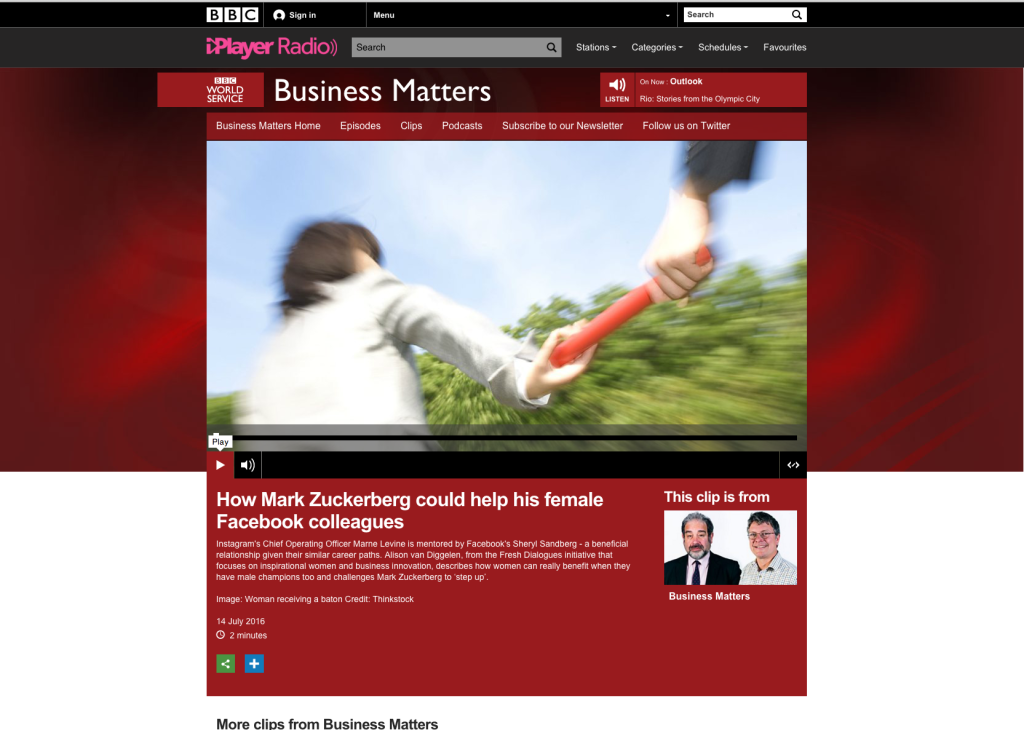
Instagram’s Chief Operating Officer Marne Levine is mentored by Facebook’s Sheryl Sandberg – a beneficial relationship given their similar career paths. Alison van Diggelen, from the Fresh Dialogues initiative that focuses on inspirational women and business innovation, describes how women can really benefit when they have male champions too and challenges Mark Zuckerberg to ‘step up.’
Here’s a transcript of our conversation (edited for length and clarity):
Alison van Diggelen: One thing that female entrepreneurs in positions of leadership have told me that will help, is for women to have male champions. People like Mark Zuckerberg and Google’s Sundar Pichai have to step up and be champions of women and make it easy for their teams to not just attract, but retain women. Offering childcare on-site is a large part of that…
Fergus Nicoll: So making sure that the onus is not always on female executives to have female mentees?
Alison van Diggelen: Yes, absolutely. It has to be shared. One of the things that was repeated time and time again at the Bay Area Women’s Summit, where I interviewed Marne Levine (COO of Instagram), is that the United States doesn’t have universal paid family leave. Quite a few companies in Silicon Valley are offering it (often in paltry amounts, by European standards), but it needs to be federally mandated in order for the U.S. to remain globally competitive. That was one of the messages that came over loud and clear.
It’s well accepted here (in Silicon Valley), the advantages of diversity: having males and females on the team can increase the bottom line, creativity, innovation and meeting the needs of this diverse clientele. That’s well proven, but these companies are having to step up and try harder to attract and retain these women.
Find out more about inspiring women in business:
TaskRabbit’s CEO, Stacy Brown Philpot is one of the few black, female CEOs in tech. What is she doing for women and diversity in tech?
BBC host Roger Hearing, Seoul Bureau Chief for the Economist Stephanie Studer and I had a lively conversation about the gig economy, as well as fashion fumbles (like cargo shorts) and cool alternatives (like utility kilts).
Listen to the podcast at the BBC (Episode titled: Bank of England Lowers Interest Rates): TaskRabbit segment begins at 26:46
Or listen to the TaskRabbit segment below:
Here’s a transcript of our conversation (edited for length and clarity)
Roger Hearing: Alison, I know you’ve been looking into something that is a strange concept: the gig economy. Tell us, what is the gig economy?
Alison van Diggelen: It’s beenborrowed from the music industry, Roger. Workers who work in the gig economy don’t have regular full time work, but work in “gigs” like at Uber, Lyft, AirBnB, Etsy, Upwork and TaskRabbit. I’ve been speaking with Stacy Brown-Philpot. She’s the CEO of TaskRabbit. It’s a website and app that matches job seekers with jobs – like house cleaning, shopping, delivery and handyman jobs.
It was founded in 2008 and was one of the first companies in the gig economy. Stacy told me how the company launched its international operation in London in 2012, and it did a pivot. It changed its “bidding for a job” model to a “direct hire” approach. This was a huge success in London but when they tried it back in the United States, they faced a severe backlash from contractors here. Yet, they stuck to their guns and last year the business grew 400%.
I first asked Stacy what advice she would give to other businesses about staying the course, when they try to pivot and face similar challenges.
Stacy Brown-Philpot: Know exactly what it is that you are focused on and don’t lose track of that. Stay laser-ly focused on what that goal is…despite the noise that comes into the market place, stay focused and believe more than anyone else and you can get there.
Alison van Diggelen: There are a lot of critics of the on-demand economy saying that it doesn’t offer a living wage, benefits to workers…this whole “Uber issue” of independent contractors not employees…Can you give me your perspective?
Stacy Brown-Philpot: Our Taskers are independent contractors – they can work in a flexible way and that is the No.1 reason why they stay. We have a very low churn: 10%. The flexibility that we’re able to offer our Taskers is unparalleled and necessary.
What needs to happen is that the regulations and policy has to change…to support the sharing economy. When you look at structures we’re working under…these were created in the 1900’s and they no longer apply…we need something that adapts to the technology-enabled businesses that we operate under today.
Alison van Diggelen: What specifically would you like to see as far as regulation change?
Stacy Brown-Philpot: One of the tradeoffs we face is the ability to offer training and more transferable skills to our taskers…We’d love to see regulations evolve to support that. We’d also love to see opportunities to access healthcare and retirement.
We empowered this community to create a social safety net for Taskers who really want the flexibility to work in a meaningful way, so we have a responsibility to also partner with them to do other things like have health care and retirement savings.
Alison van Diggelen: Let’s talk about diversity – you’re a rare person, you’re black… you’re a female CEO in Silicon Valley. Talk about the pros and cons of that.
Stacy Brown-Philpot: The pro is that I stand out…whenever I walk into a room and try to meet somebody…I say: trust me, you’ll find me…you’ll see who I am. (laughter)
But the con is that I stand out. Sometimes I look around and wish there were more people who look like me. At TaskRabbit over 58% of our staff are women, we have 11% African Americans – It’s a stated goal to increase those numbers. I feel a responsibility – just to feel more welcome wherever I go – to increase those numbers, and encourage everybody in our industry – not just for the sharing economy – but the tech industry overall to do the same.
Alison van Diggelen: What specifically do you do?
Stacy Brown-Philpot: We have goals around targets that we measure in hiring, so whenever we bring someone in that we want to hire, we want to make sure that population of people we’re interviewing is a diverse population of people. We also do things culturally in terms of our off-sites and events to make sure everybody can bring their whole selves to work because many of our new hires come from referrals….if you feel you can bring your whole self to work and bring someone who’s different and they be a great candidate for the company. (Brown Philpot also told me TaskRabbit has teamed with the Congressional Black Caucus to help increase the company’s diversity.)
Alison van Diggelen: Talk about your wildest dreams for where TaskRabbit can be in 5-10 years?
Stacy Brown-Philpot: Task Rabbit should exist everywhere in the world. We’re creating everyday work for everyday people – this is a phenomenon that is global and so I want to be global as a company. Millions of families are time starved, countless people are looking to find work, and they’re looking for an opportunity for growth and creating a meaningful income. That’s an economic responsibility that we take seriously. We’re shaping the future of work.
Roger Hearing: Does it change the future of work? These kinds of companies: Uber, Etsy etc?
Alison van Diggelen: There’s a lot of anecdotal evidence… and according to the US Census, the gig economy was the fastest growing employment sector last year. A study by Intuit predicted that by 2020, 40% of American workers will be these independent contractors – it’s currently about 30% – and this will have knock-on effects. Here in the U.S. we don’t have a national health service so these people working these gig economy jobs don’t have health benefits through their employment, so there are things that will have to change.
Roger Hearing: It hasn’t all been roses, as you alluded to in the interview. There was a revolt against TaskRabbit. Tell us more about that…
Alison van Diggelen: They originally had a bidding process and the Taskers felt they had more control that way. After trying out this new on-demand service they got a huge backlash. They learned a lot of lessons -one of which was: you can’t overdo the communications. A lot of people didn’t understand the changes. Stacy Brown Philpot worked previously at Google for almost 10 years and she used her product experience there to stay the course. She recalled when a new version of Gmail came out, people hated it and hated Google for introducing it…People are opposed to change she found.
In the end, they’re saying the Taskers benefited and TaskRabbit benefited and it was a win win. It was a vocal minority who opposed the change.
***
Continue listening for more discussion…
The Economist’s Stephanie Studer explains why Uber was effectively banned in South Korea and why gig economy companies like TaskRabbit may face cultural and other challenges if they try to launch in the region. We also discussed trust and safety issues; and what TaskRabbit is doing to ensure Taskers are trustworthy and reliable.
And finally, Roger Hearing explored the business fashion trends in London, Silicon Valley and Seoul and was surprised to learn about the popularity of the utility kilt here in the San Francisco Bay Area.
Will the fatal Tesla crash slow or even derail the development of self-driving cars? That was the topic we discussed on this week’s BBC World Service program, Click.
Despite complaints by consumer advocates that Tesla should disable its autopilot feature and not beta test “an unproven technology” on the public, Tesla is standing by its strategy. Today the BBC’s Dave Lee reported from the Gigafactory that Elon Musk has no regrets about how Tesla rolled out the autopilot.
“We have the internal data to know that we improved people’s safety, not just in fatalities but in injuries.” Elon Musk, CEO Tesla at Gigafactory, July 26 2016.
Remarkably, federal regulators at the Department of Transport (DOT) and the National Highway Traffic Safety Administration (NHTSA) appear to be siding with Tesla and urging a “full-steam ahead” approach. They’re focused on self-driving technology’s potential to save lives.
“No one incident will derail the DOT and NHTSA on its mission to improve safety on the roads by pursuing new life saving technologies. We…can’t stand idly by while we wait for the ‘perfect.’ We lost 35,200 lives on our roads last year. We’re in a bad place and we should be desperate for new tools that will help us save lives. How many lives might we be losing if we wait?” Mark Rosekind, Head of the NHTSA at the Automated Vehicles Symposium, July 20 2016.
The NHTSA is expected to release its new guidelines for self-driving (autonomous) cars any day now. I’ll post a link to them here as soon as they’re available.
Listen to our Tesla autopilot discussion below or at the BBC Click Podcast. The first broadcast aired on the BBC World Service at 2:30pm PST on July 26th.
Here’s a transcript of our discussion (a shorter version aired on the BBC).
BBC Click Presenter, Gareth Mitchell: Now the first death of a Tesla driver on autopilot earlier this year was bound to overshadow the recent Automated Vehicle Symposium in San Francisco last week. But those at the meeting were also looking forward, at the latest innovations in driverless cars. BBC contributor, Alison van Diggelen was there for us, and she’s been telling me a bit more about what was being discussed.
Alison van Diggelen: The 3-day symposium assembled some of the top government authorities, academics and tech experts in the field of automated vehicles. The main topics included: the promise and challenges of automated vehicles; the federal guidance about to be released; and whether the Tesla crash will derail the development of automated vehicle technology. Mark Rosekind Head of the National Highway Traffic Safety Administration (“Nitsa”) spoke about all three topics and emphasized the technology’s potential to save lives.
Mark Rosekind: We’re not in a good place that we’re trying to make better. We lost 35,200 lives on our roads last year. We’re in a bad place and we should be desperate for new tools that will help us save lives. How many lives might we be losing if we wait? We have to do everything we can to make sure the new technology doesn’t introduce new safety risks, but we also can’t stand idly by while we wait for the “perfect.”
Reports around the country seem to be sounding the alarm: they are shocked, shocked (!) to discover there’s vehicle automation that’s already here…they’re demanding to know: where was the government to stop this?
We know there will be incidents that occur with highly automated vehicles and NHTSA will always be ready to use its authority to investigate and take whatever action is necessary
New highly automated vehicles offer enormous opportunities for learning…When something goes wrong,…that data can be taken, analyzed and the lessons can be shared with all automated vehicles.
No one incident will derail the DOT and NHTSA on its mission to improve safety on the roads by pursuing new life saving technologies.
We’re writing the Declaration of Independence, not the Constitution. It’s the first step that will lay the road map to the next generation of vehicle technology – a harmonized approach not just across states but perhaps even internationally. It’s an approach that’ll provide certainty to manufacturers, to make sure you’re focused on safety in the right ways.
We see a future where disabled people can reclaim independence and freedom in a personal vehicle. We even see a future when a fully automated car can relieve the occupants of all driving responsibilities, leave them free to read a book, make a phone call and yes, catch a few more Pokemon.
Gareth Mitchell: There was also talk of innovation, refining the technology and one UK voice in particular. Who was this, Alison?
Alison van Diggelen:Ian Forbes is head of the Center for Connected & Automated Cars, a joint policy unit of the UK government. I chatted to him briefly after his presentation, where he gave a flavor of the opportunities and challenges ahead. Forbes played a short video that showed a junction in a UK city. The simulation showed that connected & autonomous vehicles bunch closer together when they approach the red light. This means that when the light turns green, more cars can go through, making that junction more efficient. He says it was a result they weren’t expecting…and they expect further simulations will help predict other benefits of self-driving cars. He also talked about the importance of public perceptions and behavior. They’re starting a 3 year study…
Ian Forbes: In the UK we share a problem with everyone in this room. Like everyone here, we can see the potential benefits: fewer crashes, more efficient transport, new high value jobs. It’s also likely we face the same challenges: how do you design a regulatory framework when so much of the future technology is uncertain? How do you get maximum value for your research so that it delivers something new? One tool in our toolbox is Micro-simulation using agent based models to understand the impact of different transport scenarios to inform our future transport traffic predictions.
Gareth Mitchell: Finally Alison, the meeting was overshadowed by the tragic death of a driver in autopilot mode in a Tesla. What kind of reflections were there about how that leaves the whole driverless project?
Alison van Diggelen: I spoke with a number of conference attendees from the academic and tech worlds, including Bob Denaro, a member of United States’ Transport Research Board (TRB) and venture capitalist advisor to Motus Ventures. He reframed the the Tesla crash in its historical context, talking about the Wright brothers and one of their early passenger deaths, during a demo for the U.S. army. So I think that gives the Tesla crash an interesting historical context. He and a lot of people said, this seems a disaster short term but in the long term, it’s going to be a small bump in the road.
Bob Denaro: If we look at early days of aviation – the Wright brothers killed (one of) the first passengers….Frankly I’ve been surprised that the public reaction has been more muted than I feared it would be…I don’t think it’s going to be that big of an impediment to our progress and the speed of our progress.
The traditional automotive approach is: let’s test exhaustively over years and then put it on the market. Sometimes we make mistakes…maybe there are fatalities, recalls…The approach that Tesla is taking is: let’s put it out there early, before it’s completely done – let’s learn quickly, and because of the software updates over the air, let’s make changes…They may be on to something there.
My advice to Elon Musk would be: yes, be careful, make sure you test it, understand the results…But this approach – as different as it is to the traditional approach – just may be a better approach to minimizing the accidents we have to have along the way before we get close to perfection.
Bonus material:
Ian Forbes shared a video that didn’t make the final cut. With a little help from Queen Elizabeth and a humorous Tweet, he sent ripples of laughter throughout the global audience. Here’s the transcript (it’s a wee bit awkward).
The Queen (via video): My ministers will ensure the United Kingdom is at the forefront of the technology for new forms of transport, including autonomous and electric vehicles.
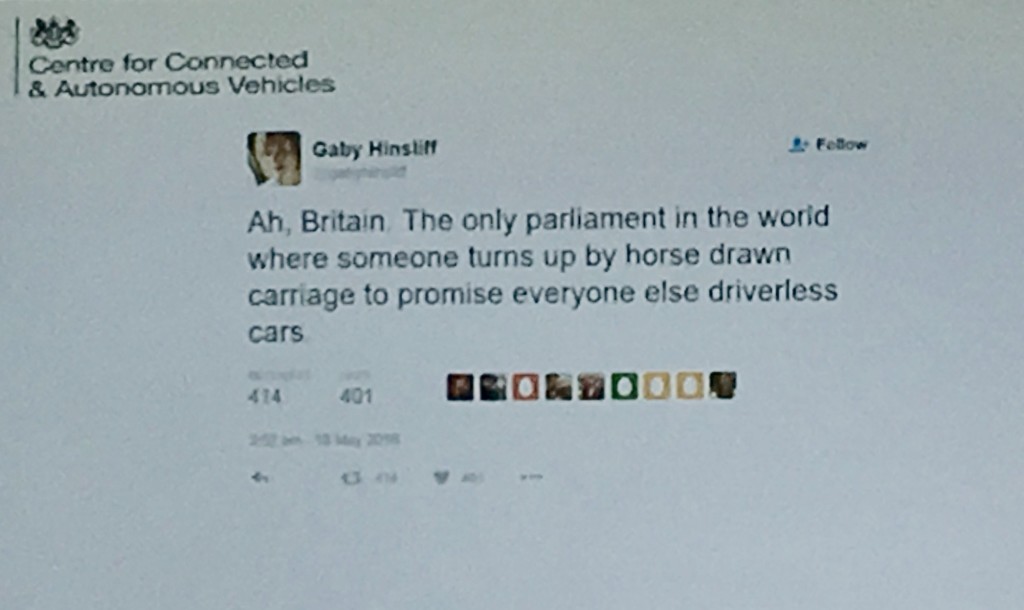
Ian Forbes: That was the Queen, in the UK, back in May setting out the future legislative program of the UK government. My favorite response was on Twitter: Ah Britain – the only parliament in the world where someone turns up in by horse drawn carriage to promise everyone else driverless cars.
Instagram recently announced it had reached a big milestone: half a billion users. The BBC asked me to interview the company’s COO, Marne Levine to explore the company’s appeal and find out why video – and new products like Boomerang – are helping fuel that growth.
“We’re certainly marching towards a billion…and even beyond a billion. Today, video is exploding on Instagram… In the last six months, consumption increased by more than 40%…Sometimes people want sight, sound and motion to tell their stories. ” Instagram COO, Marne Levine
Listen to the Instagram interview and discussion below or at the BBC’s Business Matter’s podcast (Instagram segment starts at 26:40 on BBC podcast).
.
Here’s a transcript of the conversation, edited for length and clarity:
BBC host, Fergus Nicholl: Do you use Instagram? A new study says that half the Fortune 500 companies use it for marketing. Alison, you’ve been talking to a bigwig at the company about its recent announcement that it’s reached the magic number of half a billion users?
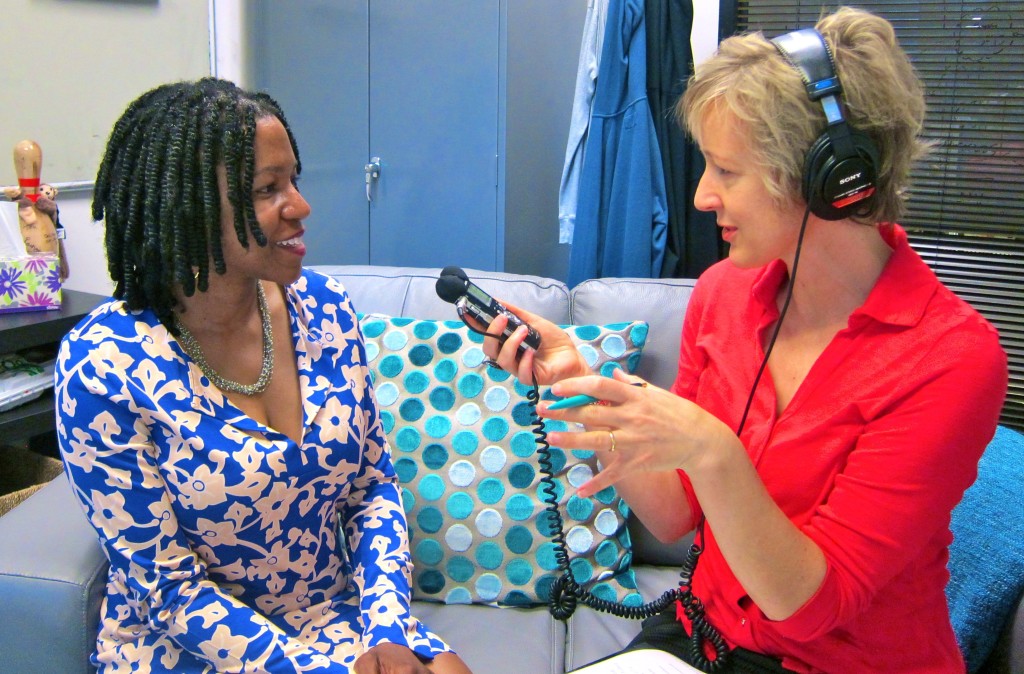
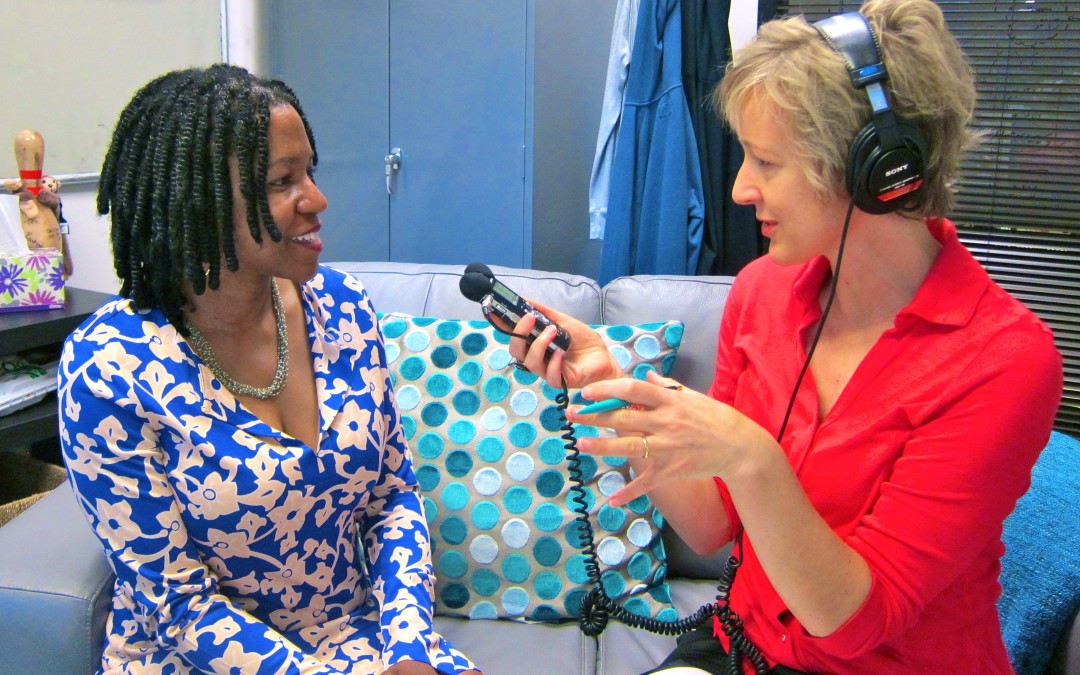
Alison van Diggelen: That’s right. I interviewed Marne Levine. Instagram is very well known as a place where youth congregate, especially teenagers…they use it to reach their friends and share cool things…a lot of these users are women. But they’re not the only ones making up this figure of half a billion users. I asked Marne how entrepreneursare using Instagram to attract more business…
Marne Levine: There are so many different stories of small businesses, big businesses that have grown through the Instagram community. A woman named Isha Yuba in Germany – has “Art Youth Society.” She started by designing a bracelet, she posted a photo of it. Somebody inquired and suddenly she has a thriving business. She has turned her passion into livelihood. A lot of businesses have started to advertise on Instagram. We now have more than 200,000 advertisers…the vast majority of those are small businesses.
Alison van Diggelen: You’ve added about 100 million users in about 9 months. Obviously the next milestone would be one billion…Any ideas when that might happen?
Marne Levine: We’re certainly marching towards a billion…and even beyond a billion. When we have more people on the platform, it really benefits the Instagram community – we get a wide range of perspectives, new windows into different things that are happening around the world.
Those could be big events like the Olympics…that’s probably how I’m going to experience the Olympics, through Instagram. Lots of people are sharing ordinary moments, epic moments and everything in between.
Alison van Diggelen: Why do you think Instagram is doing so much better than Twitter, that seems to have plateaued?
Marne Levine: We’re constantly trying to thinking about: what would add value to the community? We listen to feedback, continue to innovate so people can tell their stories in different ways. When Instagram started it was really all about photos. Today video is exploding on Instagram… In the last 6 months, consumption increased by more than 40%.
Sometimes people want “sight sound and motion” to tell their stories. Sometimes it’s not necessarily just a straight video….I don’t know whether you know Boomerang? Cool little looping videos that take ordinary moments and turn them into fun and delightful moments.
Alison van Diggelen: You posted one of your son going up and down the stairs?
Marne Levine: I did! Somebody once said this to me and this is how I now think about it: Motion is the new filter.
Alison van Diggelen: Your CEO persuaded the Pope to go on Instagram. Tell us about that…
Marne Levine: The Pope is looking to inspire lots of people. What he told our CEO, is that a lot of times….people will show him an image to get over the language barrier…Images are the most powerful way to connect, because they transcend borders, language, cultures, generations. You look at the image and instantly connect. He understood that there’s a new global language of images. In this case 500 million people are contributing to that new global language of images – it could be images that are documenting the plight of refugees… images of hope and opportunity. That can be really inspiring…
(End of interview)
Fergus Nicholl: She could be VP for sales, as well as COO. She does a pretty fantastic job of selling…But just to zoom in on one of the questions I thought was very sharp: this question of plateauing.
You were talking about Twitter, and people might also think about Snapchat…I wonder whether Instagram is doing really well just because it’s in vogue. Maybe, in a year’s time there’ll be something else?
Alison van Diggelen: I think that’s the constant challenge of Silicon Valley companies, of social media companies in general. They have to keep innovating. They can’t just put out this cool platform and assume that people will come to it. She talked about how they listen to feedback…because not everyone loves Instagram. They recently changed their algorithm to make (the feed) not just strictly reverse chronological order and that caused push-back from certain users, so she underlined how they try to listen to their users and please as many users as possible.
They’ve also launched “business profiles” to allow businesses, like the entrepreneur mentioned, to get the word out and reach their target audience. And of course, over 50% of the users are in this very sought after demographic of under 35-years old. So it’s a great way for companies, business and media outlets to reach this young demographic.
Continue listening to our discussion on the BBC podcast (Starts at 33:00):
What can be done to increase the number of women in business?
How has Facebook’s Sheryl Sandberg influenced Marne Levine?
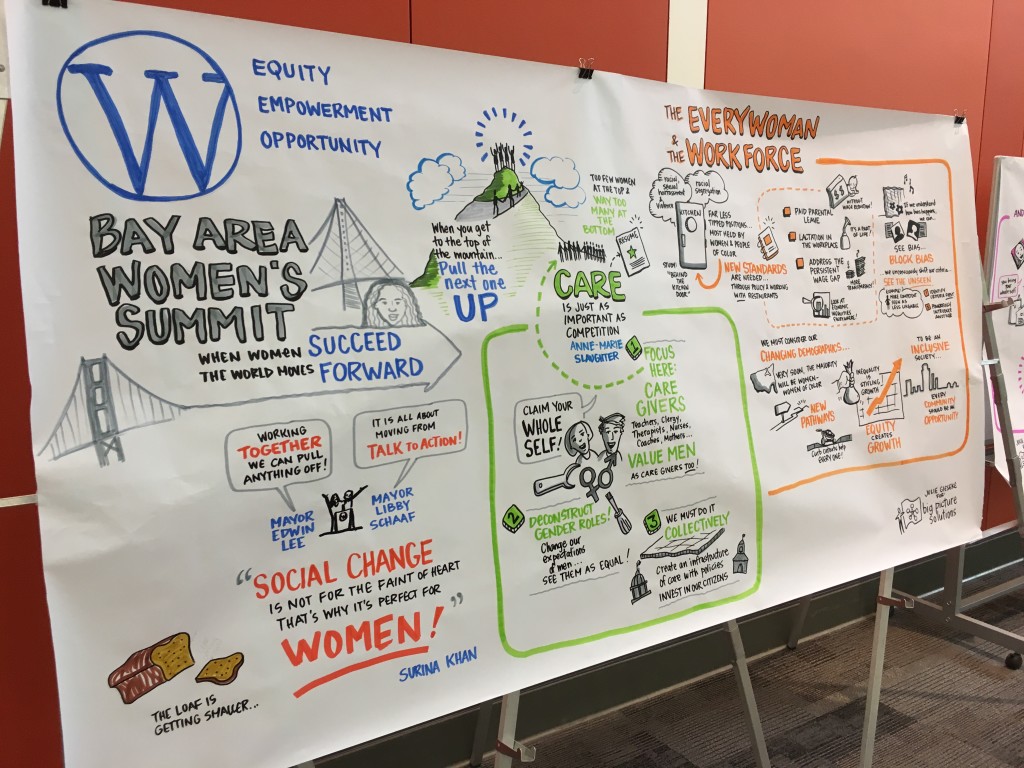
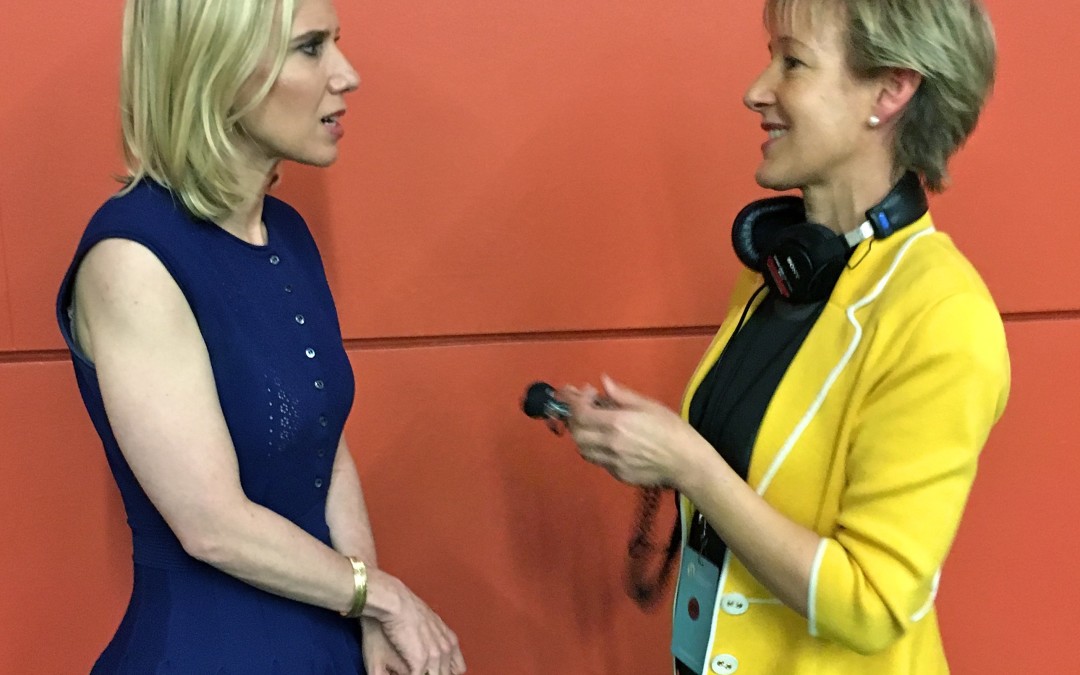
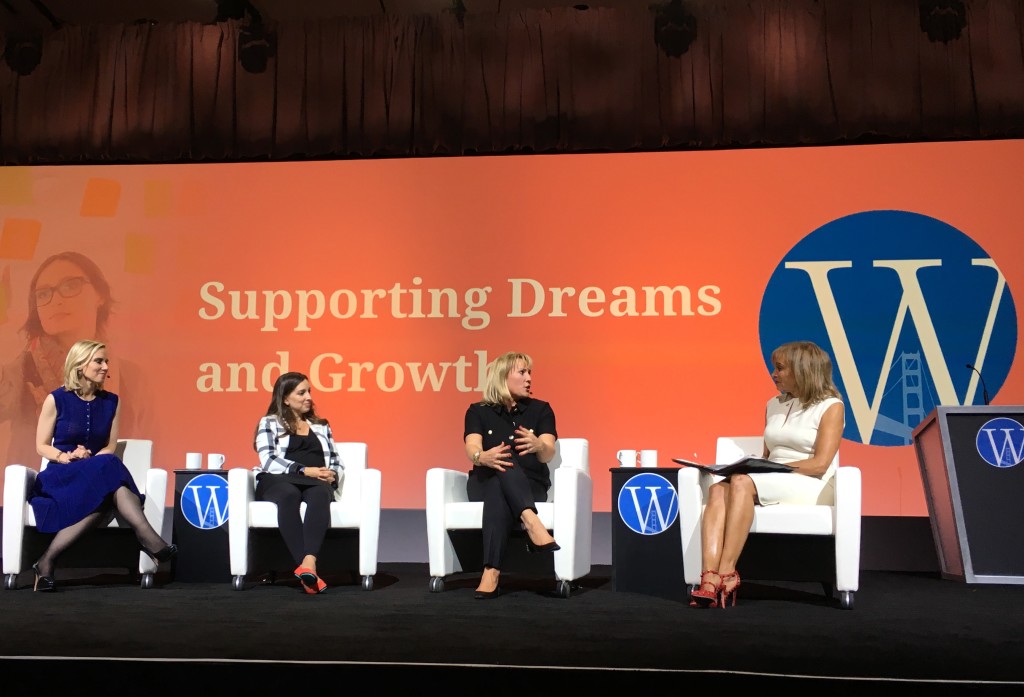
The interview took place at the Bay Area Women’s Summit on June 21st. The Women’s Foundation partnered with the mayors of San Francisco and Oakland to host the event.

 Melissa Johns: When I look at the tremendous obstacles a student has to overcome to become the first in their family to graduate from college. There’s a huge amount of culture shock… but also there’s a lot of fighting that impostor syndrome…I’m so impressed by students who can fight all of that inner talk that tells them they can’t do it and persevere. So they can then have an economic future that they can be proud of and excited about because they get to choose a career and not just a job. They start a positive ripple effect for any younger siblings, any neighbors, any cousins, who look at what their achievement is and say: well if she did it, I can do it too! The expectations that change in a family, in a community are amazingly impressive.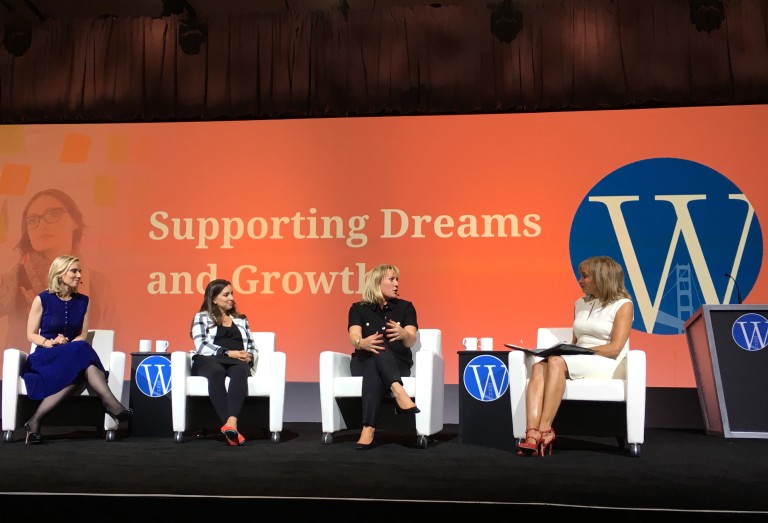



 Marne Levine: We’re certainly marching towards a billion…and even beyond a billion. When we have more people on the platform, it really benefits the Instagram community – we get a wide range of perspectives, new windows into different things that are happening around the world.

