Elon Musk continues to make ambitious plans for Tesla Motors, some even call them “ludicrous.” Not content to make a niche product for electric vehicle enthusiasts, he now wants to conquerthe mass market, competing in the major leagues against GM, BMW, Ford et al. Musk is promising an annual production of 1 million cars by 2020, a staggering increase from last year’s paltry: 76,000. Is he insane?
On a conference call with Musk and media colleagues this week, Alison van Diggelen, host of Fresh Dialogueslearned that Musk is still calm and laser-focused on executing his “Tesla Master plan.” This year is crunch time for Tesla. The future of the company rests on the timely and efficient production of the Model 3, Tesla’s smaller, mass market car. Will demand stay strong, despite intense competition and reservation holders threatening to cancel due to his position on Trump’s economic advisory team? Musk seemed to flounder a bit on this question and refused to disclose the latest reservation numbers, for fear of analysts “reading too much into them.”
During the discussion of Tesla’s 2016 financial results, some anomalies arose. Despite continuing to make massive losses (due to capital investment in the Tesla Factory and the Gigafactories), its share price is still in the stratosphere. Tesla might produce a small fraction of GM and Ford’s output, but the company is valued on par with them. What gives?
“The recent run-up in Tesla stock has less to do, in our view, with anything around the near-term financials, and more to do with the nearly superhero status of Elon Musk,”Barclays analyst, Brian Johnson.
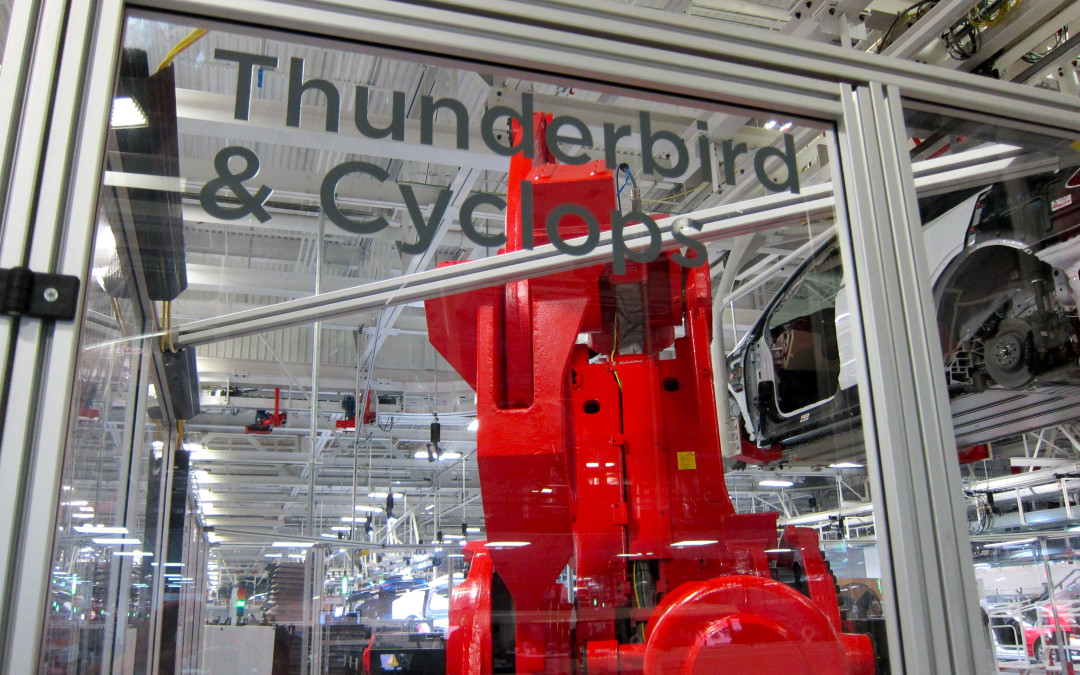
Superhero status? More ludicrousness…The superheroes Tesla is focused on are the mighty robots on the factory floor. Musk has named them after X-men superheroes, like Cyclops and Thunderbird (see photo above); and they’re the ones that’ll have to earn their superhero status as manufacturing goes into top gear in the next few month.
“Tesla is going to be hell-bent on becoming the best manufacturer on earth.” Elon Musk
The BBC’s Fergus Nicoll invited me on Business Matters to help explain more.
Here’s a transcript of our conversation (edited for length and clarity):
BBC Host, Fergus Nicoll: Tesla stock has hit record highs, soaring 50% since December. With investor confidence growing that Tesla will deliver its Model 3 on time. Let’s explore this with Alison in Silicon Valley. Before we get into the nitty gritty of Model 3, and the other numbers, I know you watched Elon Musk do the webcast that go with the Q4 figures. What kind of presentation did he come up with?
Alison van Diggelen: I listened to the (live conference call) podcast. Elon Musk was on the podcast with his (retiring) CFO, answering questions from the media. They were generally upbeat. Elon Musk always over-promises how soon his vehicles will be delivered, but he is confident that they’re going to start deliveries of their Model 3 in July of this year, for employees first…beta testing for employees. He’s hoping for the mass rollout starting in September of this year. They’re pretty bullish about that.
Fergus Nicoll: Here’s the thing: Tesla has a valuation pretty close to Ford. But compared to Ford it makes about five cars! So what are we seeing? A massive future priced into that?
Alison van Diggelen: That’s right. Last year, Tesla delivered 76,000 vehicles (compared to Ford’s 2.5 million), but Elon Musk is very bullish. He’s aiming for the factory to produce 500,000 cars by the end of 2018, and one million a year by 2020. He’s ludicrously ambitious. Brian Johnson, who’s an analyst with Barclays, called this run up in the Tesla stock more “Elon Musk superhero status” than short term financials. What Elon Musk says, he often delivers….eventually.
Tesla merged with SolarCity, the rooftop solar provider, so that is also giving an upside. They’ll be able to cut costs: Tesla showrooms will also become showrooms for the SolarCity solar panels. They’re also doing the other side of the equation: energy storage….
Fergus Nicoll: The household and business batteries.
Alison van Diggelen: Exactly.
Fergus Nicoll: The thing is, Americans drive insane distances. Electric cars have to go a long way….the infrastructure has to catch up with the company?
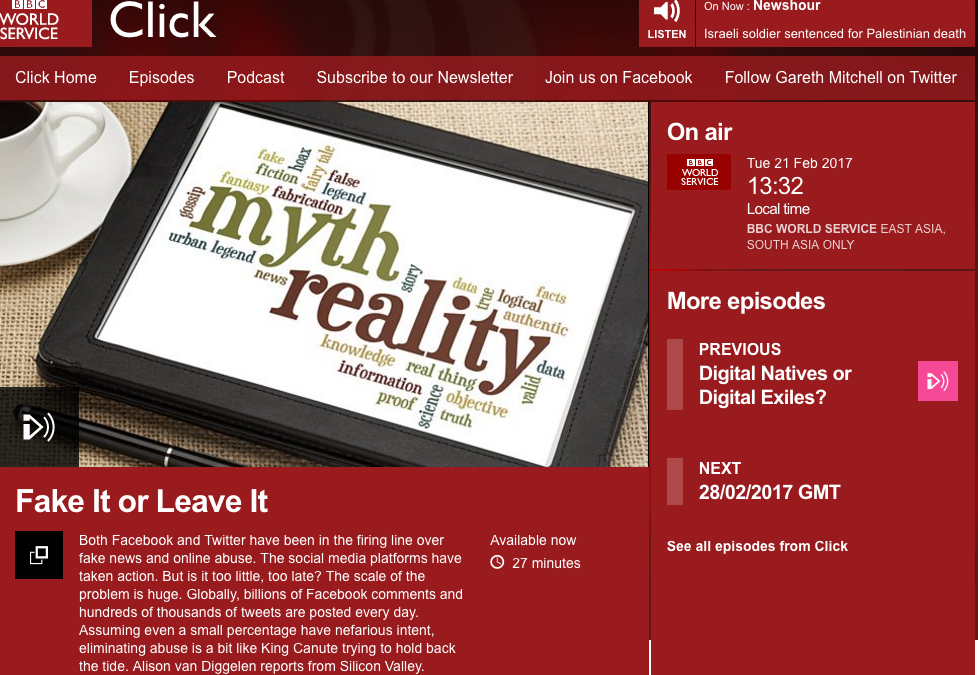
Online, how big is the actual fake news epidemic? No one knows for sure, but the the scale of the problem is potentially huge. Facebook has almost 2 billion users, Twitter has over 300 million; and according to Pew Research, about 60% of Americans get some news from social media. Assuming even a small percentage of users have nefarious intent, eliminating fake news and online abuse is a bit like King Canute trying to hold back the tide. But after accusations of Facebook turning a blind eye on its rampant fake news and potentially impacting the U.S. election; the pressure to effectively and transparently root out fake news and online abuse is likely to intensify, especially with upcoming national elections in Europe.
“I think fake news impacted the election, just by the sheer volume… It can change your perception of the world…Even people who understand news and research can be tricked by fake news.”Adam Schrader, one of 25 former editors in Facebook’s fact-checking team. The entire team was fired by Facebook last summer, just before the election.
Here’s a transcript of my report, edited for length and clarity.
Click Host, Gareth Mitchell: Misinformation is nothing new, as we heard last week from classics professor, Mary Beard.Today fake news has become a news story in itself. It’s becoming political, it’s undermining social media organizations, and mainstream media. Twitter and Facebook are taking action, but with so much being posted, isn’t it a bit like King Canute trying to hold back the tide, trying to monitor and correct fake news? Our Silicon Valley reporter Alison van Diggelen has been seeking some answers from the big social networking companies and catching up with CEOs of startups, people like this:
Jessica Rothenberg-Aalami: Technology has always been a source of incredible opportunity, unlimited potential pathway and it’s always been destructive.
Alison van Diggelen: Jessica Rothenberg-Aalami is just one of many critics who argue that social network platforms are not doing enough to curb the dark side of the internet.
Jessica Rothenberg-Aalami: I work in community technology access centers…Everybody tells me worldwide, if you have 100 countries…with all these community access centers, isn’t that wonderful? You can bring digital media, books to that village. I say: it’s always double sided – by day maybe it’ll be used for education, and health access, and how to get a better job. But by night it becomes a digital brothel…
Alison van Diggelen: What should be done about that?
Jessica Rothenberg-Aalami: Own it! Twitter not taking a stand around the blatant misogyny and hate language… strange politeness in the face of atrocity is very frustrating.
Alison van Diggelen: What do you feel people like Sheryl Sandberg, Mark Zuckerberg, the Twitter board should do?
Jessica Rothenberg-Aalami: There’s a responsibility to – at the very least – do one or two steps. Untruth is seen as truth because it’s relayed over a screen with a picture. You believe somebody’s story…If that story is a blatant lie, have a way to say “untrue.” Hashtag untrue.
Kara Swisher interviewed Sheryl Sandberg about why she didn’t attend, or even post, about The Women’s March. Sadly, Swisher didn’t ask Sandberg what she’s doing about fake news on Facebook. Next time, let’s hope!
Alison van Diggelen: I took Rothenberg-Aalami’s complaints to Twitter who gave an off-the-record account of their completely new approach to abuse online. Twitter’s VP, Ed Ho, is leading the online safety efforts (via @TwitterSafety) and last week demonstrated his “test-fast, fail-fast, adjust-fast” mantra by rolling out a new feature – eliminating user list notifications – and then promptly reversing it within hours, after an avalanche of user complaints. Last year, Twitter formed a Safety and Trust Council, partnering with over a dozen organizations to tackle online abuse. One of the members, Emma Llanso, a director at the Center for Democracy and Technology, cautions against a one-size fits all solution.
Emma Llanso: The same tools that can be helpful in protecting against harassment by blocking abusive content and taking down accounts can be weaponized themselves if you don’t have the right safeguards in place.
Alison van Diggelen: Without careful protections, trolls can use blocking tools to silence their victims. Although Twitter has promised an open dialogue, Emma Llanso is concerned about lack of transparency.
Emma Llanso: If I had my druthers, we’d be getting a whole lot more reporting from Twitter about the numbers…what is the scope and scale of the content moderation? What is the level of content that gets removed, what are biggest issues? It would help people pin down: harassment, terrorists content, hate speech…How are these moderation processes affecting public discourse?
Alison van Diggelen: As for fake news, why can’t Twitter and Facebook simply flag or censor what they deem fake? Llanso has this advice:
Emma Llanso: That puts way too much power in the company’s hands…Having one centralized decider is a really risky dynamic to set up…
Alison van Diggelen: I asked Facebook to comment and was directed to Mark Zuckerberg’s first post on fake news: We do not want to be arbiters of truth, he wrote.
“Our approach will focus less on banning misinformation, and more on surfacing additional perspectives and information, including that fact checkers dispute an item’s accuracy.” Mark Zuckerberg
Adam Schrader: I think fake news impacted the election, just by the sheer volume of it that appears… Facebook has a bubble problem. It can change your perception of the world…Even people who understand news and research can be tricked by fake news.
Alison van Diggelen: Schrader told me he routinely flagged between 50 and 80 fake stories a day. He questions Mark Zuckerberg’s claim that fake news on Facebook is less than 1%.
Adam Schrader: I would question that statistic. I think it would be much higher…in the 5-10% range.
Alison van Diggelen: Since December, Facebook has begun partnerships with five media outlets, including the Associated Press and Snopes, that flag “suspect” stories…. But the AP’s Lauren Easton, told me that it’s only fact checked 36 stories since the project began. Facebook recently announced fact checking collaborations with German and French media. With national elections there this year, the pressure for Facebook and Twitter to tackle the deluge of fake news and abuse will only intensify. Gareth Mitchell: So Bill Thompson, misinformation is nothing new is it?
Bill Thompson: I have a problem with the term “fake news” but the issue’s been around for a long time. In 2010, my Wikipedia entry was hacked to declare that I’d had a heart attack and died. I corrected it. (Today) it seems to me that there are actually four different things going on:
There’s the thing that was fake news, which is overt lying by people who want to get clicks on their website and make money.
2. There’s fake news which is propaganda, designed to promote a particular ideology.
3. There’s just out and out lying, like Bill Thompson is dead…May be a joke? For whatever reason.
4. And then there’s stuff you don’t want people to read, which they* call fake news to distract you from what they’re really saying.
The problem that Facebook, Twitter, and everyone have is that no single tool, or approach or set of practices can possibly deal with all of those, so there will always be some material that fails to get stopped or fails to get flagged. We do need to be a better educated and more aware population to look out for these sorts of things, and not instantly believe everything we read on a screen, just because it’s on a screen.
Gareth Mitchell: I absolutely agree and that extends to things that people listen to on this radio program, any information you receive. Check it out for yourself.
Bill Thompson: Learn how to check it.
Gareth Mitchell: It’s always been an important skill…all the more pertinent given what’s going on in these times.
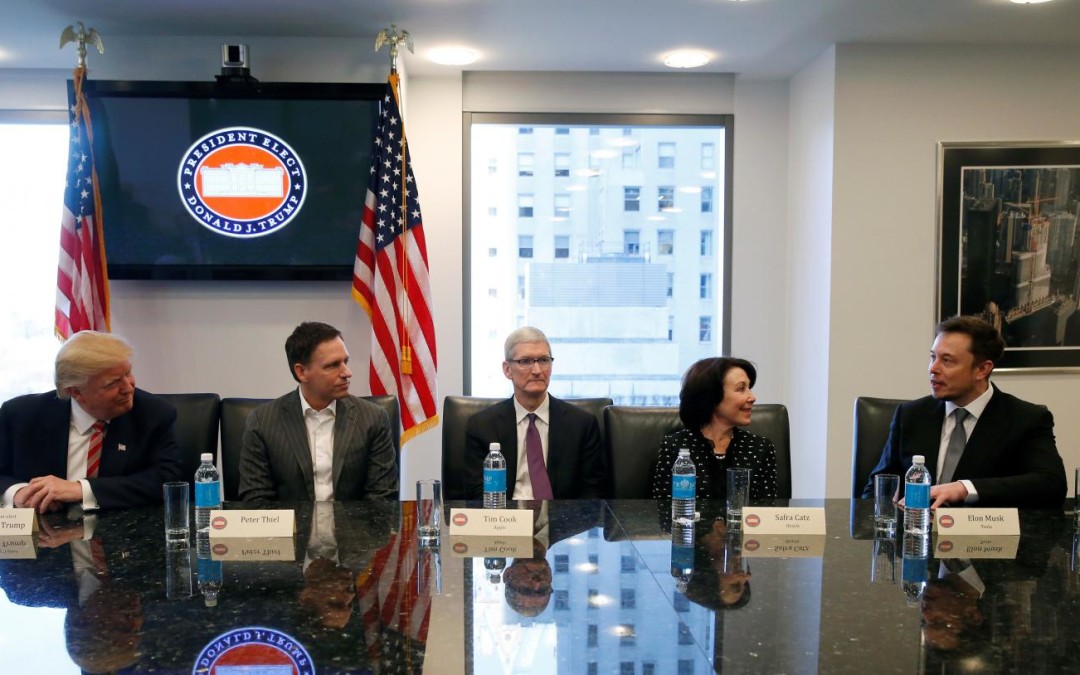
Since Tesla CEO Elon Musk joined the Trump business advisory team in December he’s been under intense pressure to step down. That pressure intensified this month after Donald Trump signed an executive order banning immigrants from seven countries with Muslim majorities. On February 2nd, Musk’s colleague, Uber CEO Travis Kalanick pulled out of the Trump team after a widespread #DeleteUber campaign went viral and his employees urged him to withdraw.
“Joining the group was not meant to be an endorsement of the President or his agenda but unfortunately it has been misinterpreted to be exactly that,” wrote Kalanick to his staff.
Musk faced a barrage of similar criticism, with some saying he’s a crony capitalist and others claiming to have cancelled their orders for Tesla Model 3.
Last week, I joined the BBC’s Fergus Nicholl on the BBC World Service program, Business Matters. We discussed Silicon Valley tech’s furious reaction to the Trump travel ban and Elon Musk’s high pressure predicament.
Listen to the podcast excerpt below (it includes commentary from the always provocative Lucy Kellaway):
Here’s a transcript of our conversation (edited for length and clarity):
Fergus Nicoll: Elon Musk has run into Twitter trouble…when he spoke to Mr. Trump in person and when he was seen having a drink with Steve Bannon in the White House, a lot of people said: “What on earth are you thinking?” And he came up with a fairly strong defense…
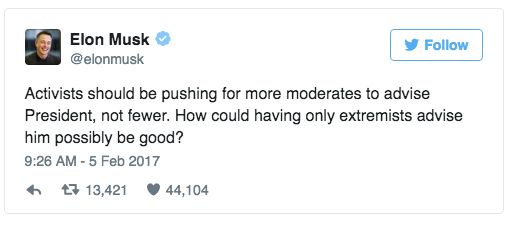
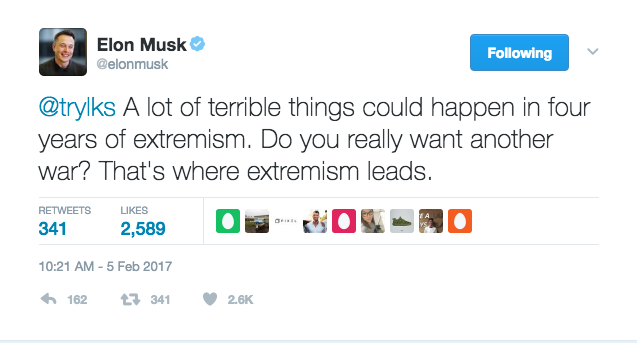
Alison van Diggelen: His key message is: “Activists should be pushing for more moderates like him, to advise the president not fewer.” And he asks, “How could having only extremists advise him possibly be good?”
.
Alison van Diggelen: He’s faced a lot of criticism, people even saying they’re cancelling their orders for the next generation of cars, the Tesla Model 3. He is under this pressure, but he is a powerful influencer, a poster child for Donald Trump’s manufacturing jobs being in the U.S. Musk is an idealist, he wants to save the planet. He’s bringing his message of climate change and green jobs, almost as a Trojan horse, into Trump’s meeting rooms. I think a lot of people who think about this deeply deeply, are not having this knee jerk reaction and saying don’t associate with Trump. Instead they’re saying this might be a good conduit for Trump hearing this green point of view.
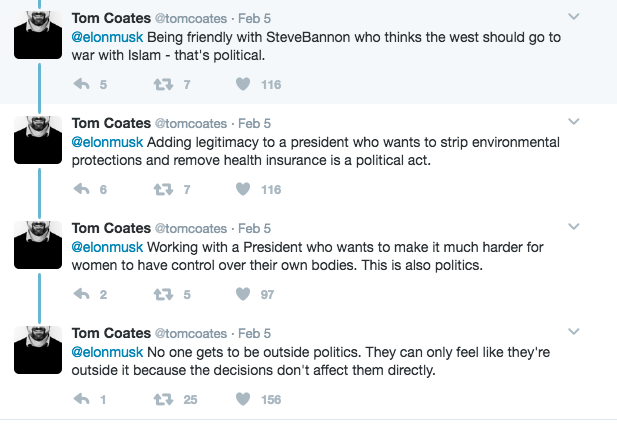
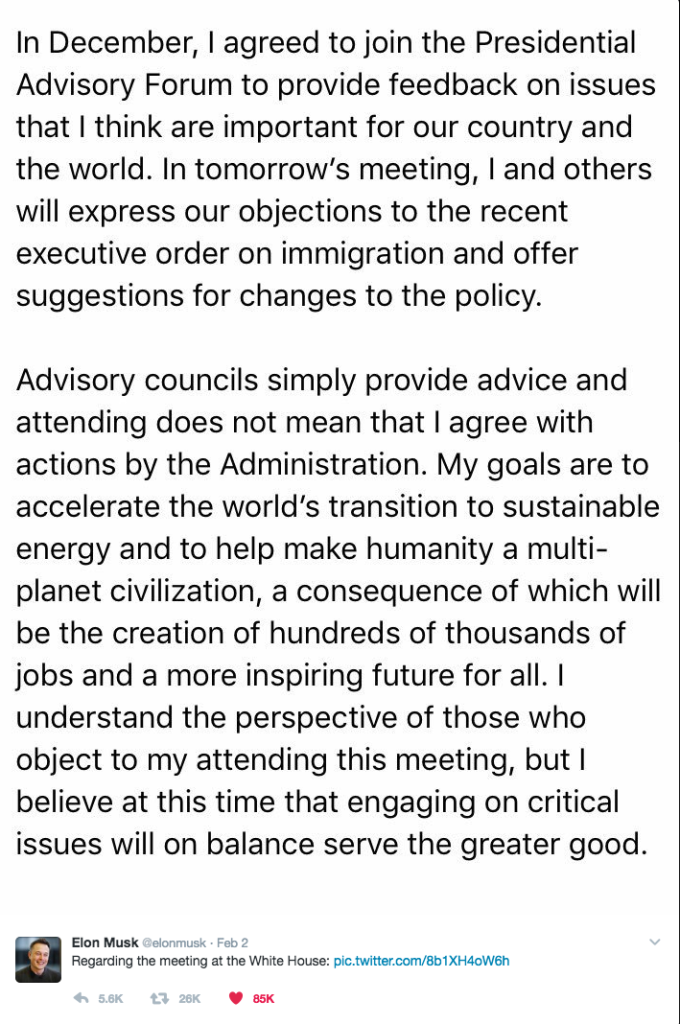
Here is some of the pushback Elon Musk received on Twitter and his responses:
In the beginning…there was no word from Silicon Valley tech leaders on Donald Trump’s presidency, despite his kingly proclamations: Let there be Two Pipelines, Let there be a Wall…Let there not be TPP!
But on the seventh day, tech leaders arose against Trump’s dominion over them when his immigration order unleashed chaos for their people. And so, on the 16th day, they filed a legal brief saying the order inflicted “significant harm on American business, innovation and growth.”
Today in San Francisco a US Court of Appeals will decide oral arguments in the case: State of Washington et al. vs Donald J. Trump et al..
I joined the BBC World Service’s Business Matters last night to report on Silicon Valley’s furious reaction to Trump. Venture capitalist, Jean-Louis Gasse spoke for many in the valley:
“The danger with an administration or a president like Donald Trump is that he gives permission to lie…to be offensive, to be homophobic, to be xenophobic. Cultures are nothing but a system of permissions and those come from the top. When you see the President of the US lying – you have to stand up and say: it’s a lie!”Jean-Louis Gasse, Silicon Valley venture capitalist
Here’s a transcript of our conversation (edited for length and clarity) and a longer version of my report:
Fergus Nicoll: Donald Trump says he is pro-business. But a lot of businesses, it seems, are not pro-Trump. They’re certainly not in favor of his attempt to restrict immigration. Almost 100 mainly tech companies have filed an amicus brief arguing that the ban – already the subject of a separate legal process – inflicts significant harm on American business. Who’s signed up? Apple, Google, Microsoft, Facebook, Twitter and belatedly Tesla. I’ll hand over to Alison in a moment – but first, let’s hear from Emily Dreyfuss at the tech news website Wired in Boston.
Emily Dreyfuss: By some estimates, half of unicorn startups in America were founded by an immigrant. These big companies, Apple, Google, Facebook: they depend on H1-B visa holders. 85,000 H1-B visas go to the tech community every year in America. This is affecting their bottom line. Yes, there is some risk but I think these technology companies are calculating that together they are stronger which is why they’ve signed on to this amicus brief. I think what we’re seeing here is a clash of ideology and business acumen. In this instance, Trump saying he’s pro-business is actually just talk.
Fergus Nicoll: Is that a fair summary then, Alison…the way it’s seen on the west coast?
Alison van Diggelen: Trump is saying that he’s pro-business (and I believe he intends to be), but it looks like his immigration ban has not been thought through… as to the impact it’s going to have on business. It’s been severely criticized .
I’ve been closely watching Silicon Valley’s reaction to the Trump presidency since inauguration day. When Trump issued that immigration order some Silicon Valley leaders were compelled to break their silence and take action. It’s an issue that’s split the US in two. A CNN poll shows about 53% oppose the ban. But today Trump has said that negative polls about the travel ban are “fake news.” He accused the NY Times of making up stories and sources. So my report explores why Trump is getting under Silicon Valley’s skin via this travel ban and the role of lies and fake news.
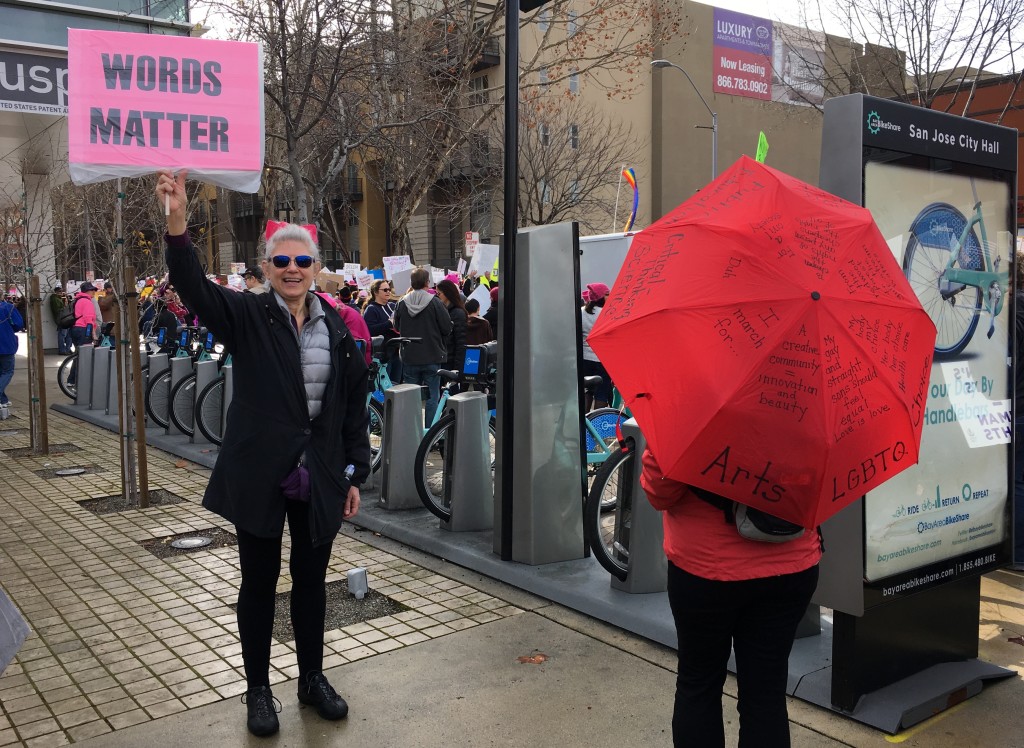
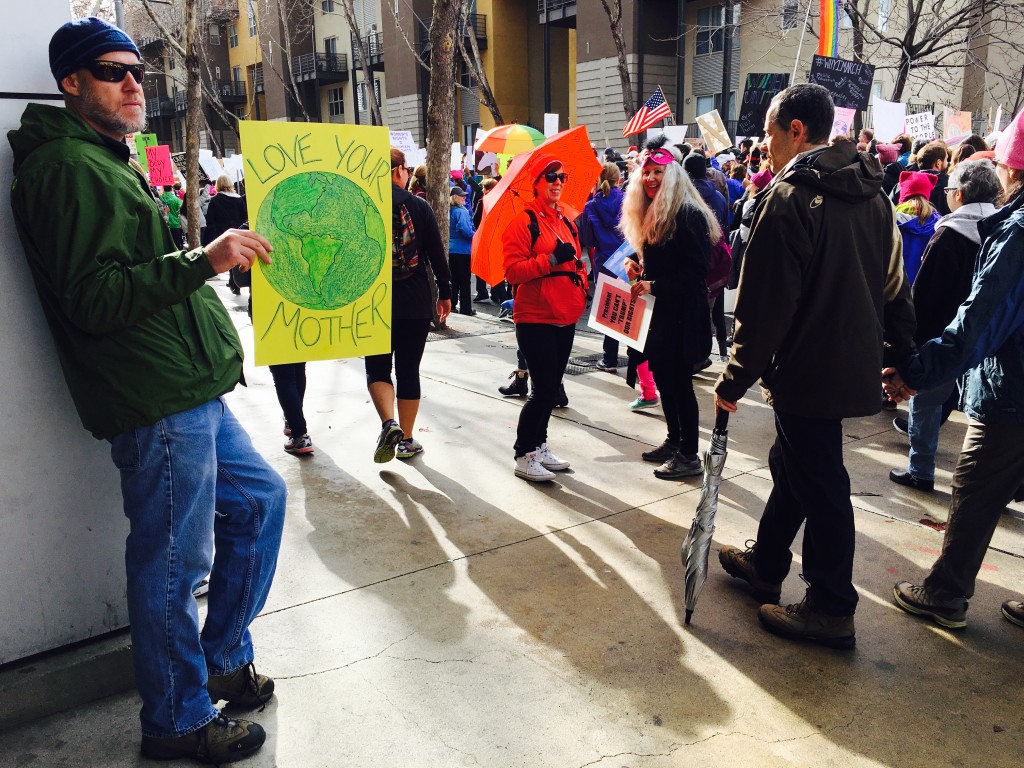
The day after he was inaugurated, Silicon Valley took to the streets to protest. Tens of thousands of marchers carried placards saying “Stop the hate”; “Words Matter”, and “Never Again.” I asked Patrick Adams, a local science teacher…What’s your message for Trump?
Patrick Adams: Get out of the way…this is a tsunami, this is people who care deeply about what this country really stands for – which is inclusion and love and hope – it’s unstoppable. This idea: that the trickle down economics of neoliberalism and the strange backward thinking of racism is going to lead us to a better world? It’s not, it’s a dead end.
Alison van Diggelen: In the first week of Trump’s presidency, it appeared like “business as usual” here in SV. On day seven, Trump’s immigration order lit the fire under SV.
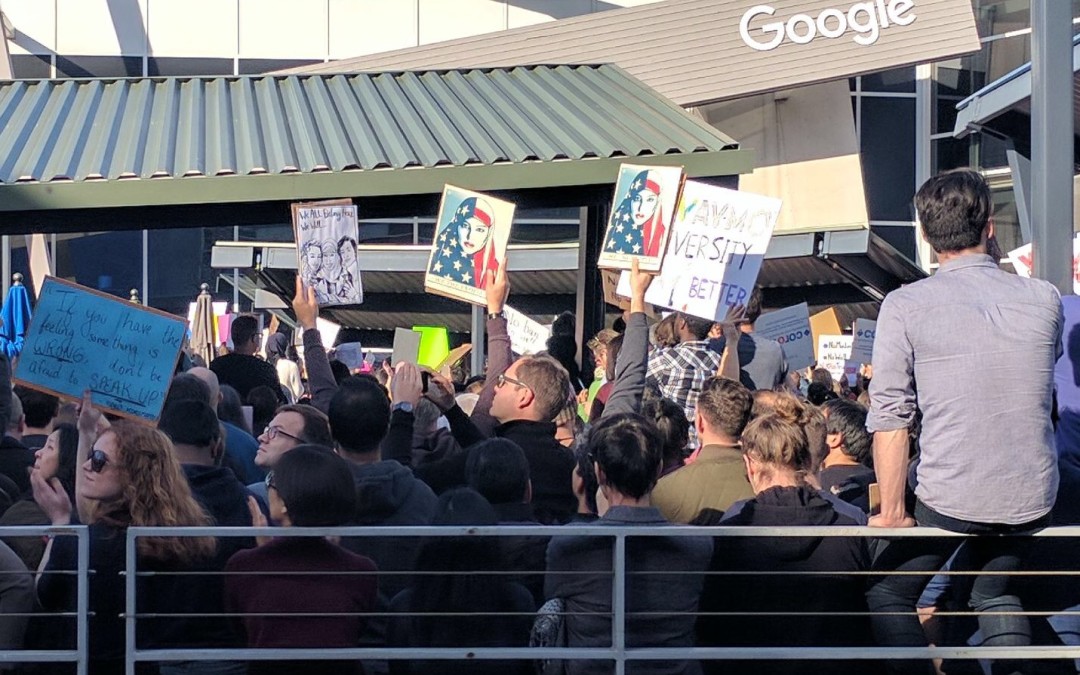
By day 10, protests had broken out at several tech campuses; and business leaders came out of their bunkers to voice concerns about the order’s morality, not just its economic impact. It was personal: almost 60% of Silicon Valley engineers are foreign born.
I spoke with Meg Whitman, CEO of Hewlett Packard Enterprise, a company born here in 1939:
Meg Whitman: Our view is that this was a mistake. We are a nation of immigrants and a broad-brush sweep of seven countries, of Muslims in those seven countries, is not what America is. So I hope that the president rethinks…
If you think of the innovation that’s been done in the valley over the last 75 years, much of it is from people who came here from someplace else … that’s an economic engine of the country and an economic engine of the world…
Alison van Diggelen: Alphabet’s chairman, Eric Schmidt even described the Trump administration actions as “evil” but many responses were muted.
I contacted companies, from oil to solar; from startups to Fortune 500, but many declined to talk, even LinkedIn cofounder Reid Hoffman who was an outspoken critic of candidate Trump. Why the silence?
Is it the prospect of Trump unleashing his Twitter followers? Kevin Surace, CEO at Appvance, a software company, sums it up:
Kevin Surace:No one wants the current leader of the free world to unleash something against them. And frankly as a CEO of a corporation, it’s your duty to your shareholders to not have the US government hate you…the last thing you want is the president saying: I’ve had it with your company, I’m going to slap tariffs on you…
Alison van Diggelen: Surace emphasizes that the stock market is up over 8% since the election and the Dow hit the symbolic 20,000 point milestone last month. Trump even hosted a “cordial” tech summit with many of the valley’s leaders. Three juicy carrots are now dangling their way: the prospect of infrastructure investment, a corporate tax cut and a huge tax break for the repatriation of $2.5 Trillion in corporate profits lying offshore.
Kevin Surace: If that all comes back to the US, it’ll be the biggest boom to the US economy, possibly ever. For the next 10 years, the economy will be on fire.
Alison van Diggelen: Nevertheless, venture capitalist, Jean-Louis Gasse addresses the disquiet in Silicon Valley. He points to H1-B visa concerns as well as a flood of uncertainties:
Jean-Louis Gasse: The stock market is up, up, up right now which we know could turn around on a dime…
It’s not good for biz to have too many uncertainties on immigration, on trade wars, on interest rates, on spending, on building a wall with Mexico…
Alison van Diggelen: Gasse was Steve Jobs’ right hand man when Apple first expanded into Europe. I asked him to sum up the Valley’s reaction to Trump:
Jean-Louis Gasse: They’re waking up to the fact that just like you need clean air and clean water… you need clean information for society to be healthy. It’s an issue of conscience for the people in tech to get up and say we’re going to fight fake news – especially the ones that stem from the top. The danger with an administration or a president like Donald Trump is that he gives permission to lie. … to be offensive…to be homophobic, to be xenophobic… Cultures are nothing but a system of permissions and those come from the top. When you see the President of the US lying – you have to stand up and say: it’s a lie!
Continues….
Check back soon for part II when we discuss:
Elon Musk’s role in Trump’s economic advisory council and why his decision to stay is so controversial, especially after Uber’s CEO stood down.
And Silicon Valley Leadership Group’s CEO Carl Guardino’s advice to Trump.
It’s day four of the Donald Trump presidency and he’s already infuriated women’s rights campaigners, the environmental movement and free trade advocates by signing controversial executive orders. Tech mastermind, Steven Levy put it best in his latest tech report: God help us all.
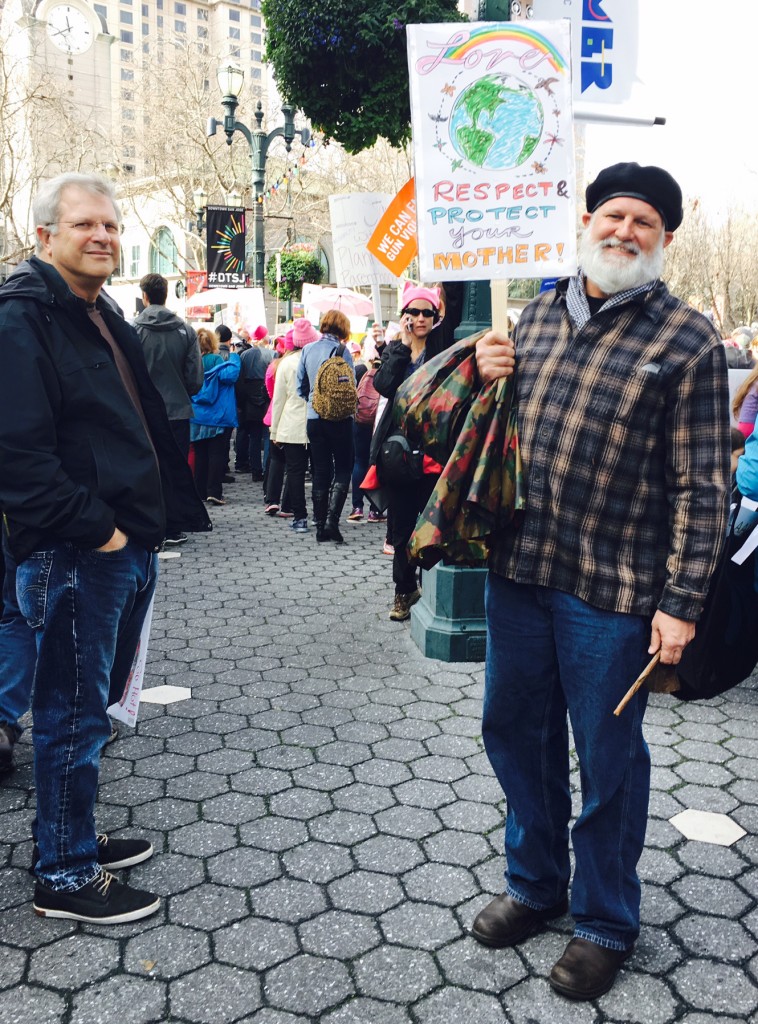
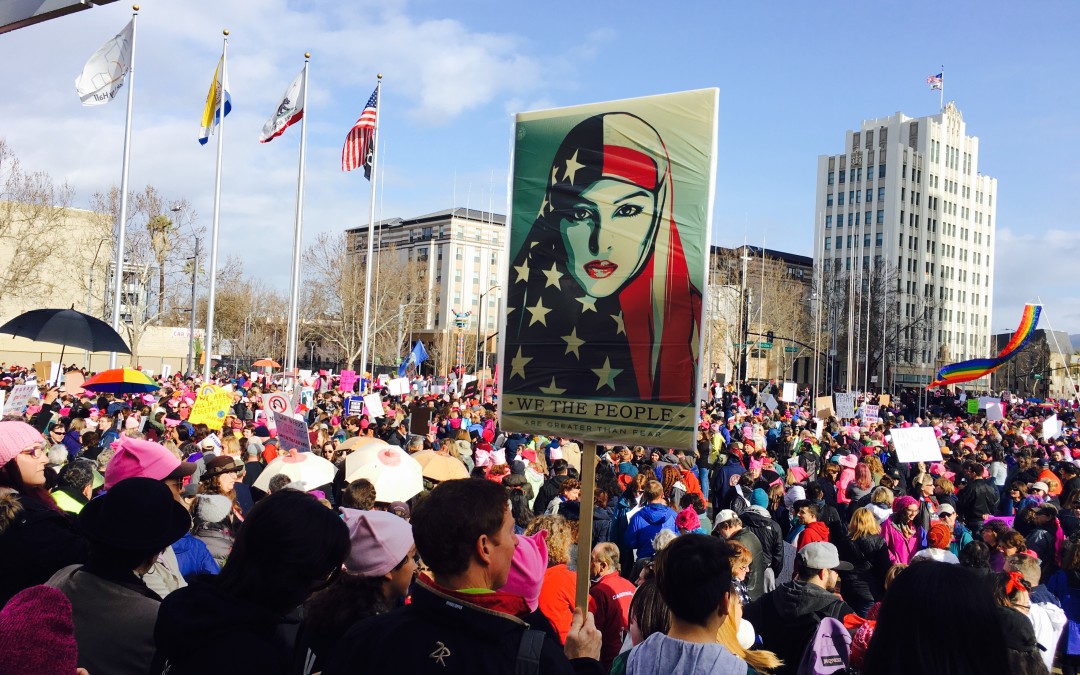
Millions around the world took to the streets within hours of Trump’s inauguration, in anticipation of these actions and more to come. The San Jose Women’s March took place here in Silicon Valley on Saturday, and in my twenty years in the South Bay, I’ve never witnessed such an outpouring of alarm, dismay and rage. One 70-year old educator I interviewed said that this was the first time in her life, she’s ever felt the need to stand up and take to the streets: not for women’s rights, not for civil rights, but to protest Trump’s presidency. And she was fired up. Today, my report aired on the BBC World Service.
One protester had this message for Silicon Valley tech leaders:
“Lead with faith, lead with truth, and lead with a kind of human dignity that is absent in a lot of our daily conversations…They gotta get rid of the fake news, people are being led down a kind of primrose path, thinking that by being angry and violent they’re going to create a better world for the future…that’s not the path, the truth, the reality that everyone can see here today,” Patrick Adams, science teacher at Bellarmine College Preparatory School in San Jose
Gareth Mitchell: The President Elect became President on Friday….the crowds were back on the streets on Saturday, this time in protest at the new administration. The marches around the world were led by women, but in Silicon Valley, the tech people, male and female were venting their concerns too, along with scientists, and entrepreneurs, all of them worried by Trump’s stance on trade, innovation, science and the climate. It comes in an era of disquiet about Facebook and fake news, of post truth and cyber threats. To gauge the sentiment, our reporter in Silicon Valley, Alison van Diggelen, was at one of the marches.
Alison van Diggelen: I’m here at the San Jose Women’s March in the center of Silicon Valley and the women are out in force…
Alison: That was Yogacharya O’Brian, founder of the Center for Spiritual Enlightenment and one of the rally’s powerful speakers.
Alison van Diggelen: Silicon Valley took to the streets in record numbers on Saturday to protest the country’s new president. Donald Trump’s proposed tax cuts and infrastructure investment could benefit the tech community; the U.S. economy and many of those marching in Silicon Valley. As could his plans to repatriate millions of dollars of tech companies’ overseas profits. Last month Trump even hosted a cordial summit with some top tech leaders. Despite all this, many in this community are fearful of what his presidency might mean for innovation, transparency, multiculturalism, and social progress.
Nick Shackleford: I’m here because of Trump’s election…he is bringing America back in time instead of leading us forward. As a nation we need to go forward and not backwards.
Alison van Diggelen: Here in the world tech center of innovation, what do you expect from this community of innovators?
Nick Shackleford: Like you said, we are innovators and I think we’re going to continue to innovate and lead the country – and sometimes the world – in the innovations that are being developed here in the Silicon Valley. And we have a lot of millionaires and billionaires who are liberal, believe in the cause and are true Californians and they will continue their fight, be it with their money, and their power or just lending their voice to causes that are important to our nation.
Alison van Diggelen: What would you say to Mark Zuckerberg and people like him with power?
Nick Shackleford: I think Mark Zuckerberg did not to enough to stop the fake news. I think he cared more about (getting it re-shared and) his personal stake in his company…and he can’t convince me otherwise. He’s to blame for a lot of the fake media.
Alison van Diggelen: What would you have him do?
.
Nick Shackleford: I’ve reported about 100 things in the last six months and nothing has been in violation of their policy, but I’ve seen other people get the same picture and be sent to Facebook jail for it. So he’s not consistent, there needs to be more transparency on this fake news fight.
Patrick Adams: They gotta get rid of the fake news, people are being led down a kind of primrose path thinking that by being angry and violent they’re going to create a better world for the future…that’s not the path, the truth, the reality that everyone can see here today.
Alison van Diggelen:Patrick Adams was one of many men who came out to support the women’s march. Like many protesters who couldn’t keep quiet, he was energized by the proliferation of fake news, and Trump’s use of “alternative facts” which continues this week in the heated dispute over his inauguration numbers. Adams had a message for Silicon Valley’s tech leaders….
Patrick Adams: Lead with faith, lead with truth, and lead with a kind of human dignity that is absent in a lot of our daily conversations …Everywhere I go I see wonderful, amazing, beautiful people working together to make this future happen and I also see people who’re giving up…either to escape into an alternate world of the Internet or they want to pretend that this doesn’t affect them. But if affects everyone. Everyone is involved.
Yogacharya O’Brian: We do not wait for you to lead with sons and with daughters in hand, with husbands and with wives, lovers and friends by our side…we march!
Crowd chanting, cheering
[End of report]
Gareth Mitchell: What do you make of the comments you heard there, Bill Thomson?
Bill Thomson: It was fascinating to hear via Alison’s excellent report just how confused people are, and how uncertain they are; and how many different perspectives there are. For me, as a member of the press, what we need to be doing is reporting effectively on what’s actually happening, not just reporting on an agenda set by politicians…So the limitations on women’s reproductive rights, the Keystone XL pipeline, the Dakota Access pipeline, the Transpacific Trade Partnership, the nomination of the Supreme Court justice, are all far more important than the size of Trump’s inauguration crowd.
There’s a real sense from Alison’s report that many people are confused because they don’t know what’s actually going on and are trying to project on that. It’s the role of us in the press to cut through that and be much clearer about what’s actually happening and not get dragged into debates or agendas set by other people.

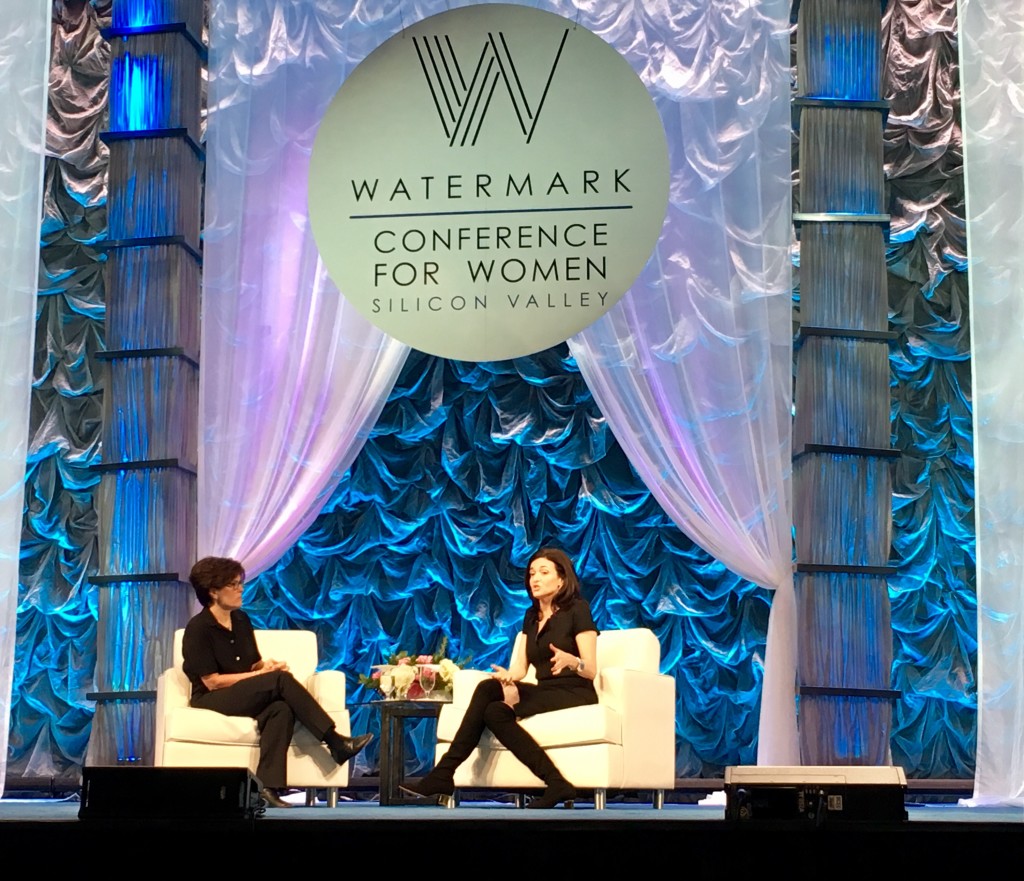 Kara Swisher interviewed Sheryl Sandberg about why she didn’t attend, or even post, about