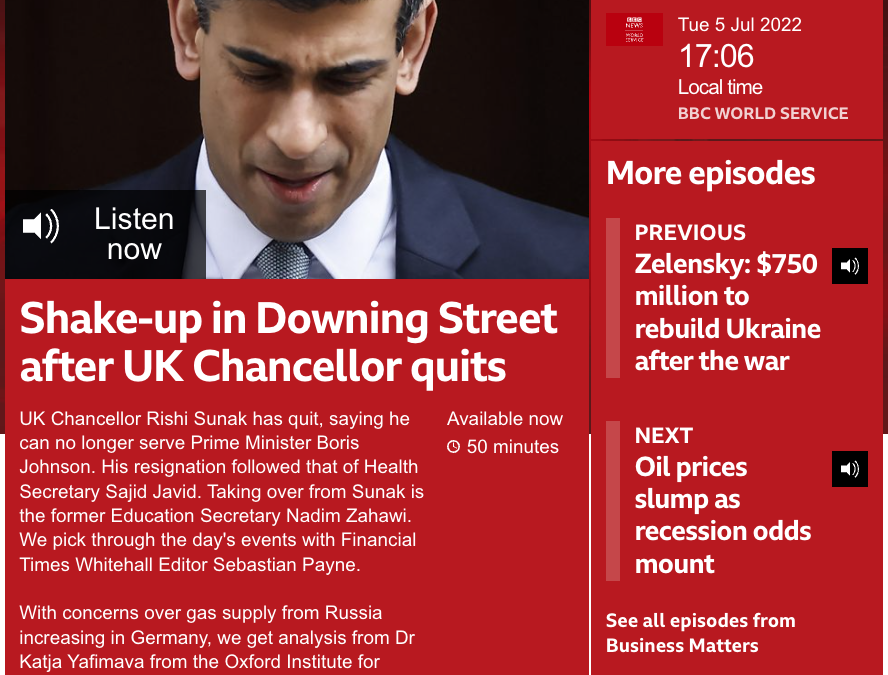
As a regular guest on the BBC’s Business Matters, I’m often asked to predict the future. I often feel ill-equipped to do so. But this week, freshly returned from London, and experiencing the British Summer of Discontent for myself, I had a strong feeling that Prime Minister Boris Johnson’s days were numbered. So I shared my prediction live on the BBC on Tuesday evening. Today, less than 48 hours later, I woke to the news that Boris Johnson has announced his resignation.
“I think it’ll be a matter of hours or days before Boris Johnson is pushed out.” Business Matters July 5th, 2022.
Here’s a transcript of the segment, edited for length and clarity.
BBC host, Sam Fenwick: Two of the UK government’s most senior ministers have resigned from Boris Johnson’s cabinet, plunging the government into a major crisis… There has been no reaction in the stock market to the developments in UK politics. Alison, what about in the States? Perhaps better news, bigger news there?
Alison van Diggelen: It’s not headline news here. One of the stories in the New York Times was: Who is Rishi Sunak? He’s not a household name here yet. But it’s clear the tide has turned. Boris Johnson has lost the trust of many of his influential colleagues and I expect Sunak might replace him when he is forced out.
And of course, this comes in the larger context of this climate of unrest and the term The Summer of Discontent applies to parliament, as well as the union action that’s sparking right across the country.
Sam Fenwick: Boris Johnson’s integrity is in question. Is it possible for a leader to come back from something like that when their honesty is being questioned?
Alison van Diggelen: The good parallel with the United States is Donald Trump. He, like Boris Johnson, seems to have a teflon outer coating: nothing seems to stick to him, to date! But with Boris Johnson, it seems the tide has turned and his propensity for obfuscating and lying means he’s going to get his comeuppance in the next few days. He failed to show any humility or change in strategy in the wake of the vote of no confidence will come back to bite him.
…I think the integrity of politicians around the world is in question and I think it’ll be a matter of hours or days before Boris Johnson is pushed out.
More Green Dialogues
I always try to focus on good news from the world of green tech when I’m on the BBC, so you might also be interested in hearing about our discussion of the new ballot measure to promote Electric Vehicles and boost forest management and fire prevention in California.
I can only imagine you share my disgust and horror at what’s going on in Ukraine. It’s heart breaking. This week on Fresh Dialogues, we get an intimate look at the war, from a Ukrainian in Silicon Valley who has team members on the front lines. Highlights of our interview were picked up by the BBC World Service. I asked Sergey Lubarsky what’s likely to happen in the next few days and week. He explained why he expects an apocalyptic escalation of violence in Ukraine and how that could be averted.
“The world has never been that close to a nuclear holocaust. Never. You have a deranged person with a nuclear strike capabilities who has nothing to lose. He has zero regard for human life….Putin is irrational. He cannot back off, has no exit strategy. He’s not going to be killed by his cabinet members.” Sergey Lubarsky, tech entrepreneur.
[Photo credit: Nicole, a half Russian, half Ukrainian girl attending an anti-war protest by Kaylee C Greenlee Beal, San Antonio Express News]
This week, I reached out to Lubarsky who was born in the Eastern Ukrainian city of Kharkiv, close to the border with Russia. Today, Lubarsky is a Silicon Valley based tech entrepreneur with a team of 15 in Ukraine. He shared:
powerful stories from colleagues on the front lines of the Ukrainian resistance.
why President Zelensky is “the George Washington of Ukraine.”
the worst case scenario he expects, and how it might be prevented.
BBC Host, Fergus Nicoll, invited me on Wednesday to share highlights of my interview on the BBC World Service program, Business Matters. We also discussed, with Peter Ryan of ABC in Australia, the propaganda war in Russia and Ukraine; the role of cryptocurrency; and how President Zelensky and his cabinet are expertly leveraging social media to rally support from tech companies and the Western world to meet their urgent needs. I also added my perspective on Donald Trump’s latest speech, when he calls the U.S a “stupid country” and praises Putin’s “smarts”. Given what’s happening today in Ukraine, in my view, it should make his Republicans supporters examine their consciences.
This week’s Fresh Dialogues podcast includes highlights of the BBC program and some powerful extracts from my interview with Sergey Lubarsky. Here is a transcript of some of our conversation (edited for length and clarity):
Sergey Lubarsky: I’ve never had Ukrainian by passport. I left (31 years ago) holding a Soviet passport. Until the first invasion in 2014, I would never consider myself Ukrainian because it was a moot point, I’m bilingual.
Alison van Diggelen: How do you feel about that now?
Sergey Lubarsky: I’m proud to be Ukrainian. I’m so proud of my people. A week ago if you asked me, I’d have said there’s corruption there… (Today) I’m speechless, they deserve so much credit.
Sergey has a team of 15 in Ukraine. He says some are on the front lines, some are hiding in subways or basements and some have fled the country.
Alison van Diggelen: Are you concerned that they’re in danger?
Sergey Lubarsky: Several of them joined the national territory defense. It’s basically the national guard.
Alison van Diggelen: Are they sharing details?
Sergey Lubarsky: One of my developers said: This is open safari. We’re burning their tanks, the Russians are fleeing their tanks, the locals are killing them by the bunch, their dogs are eating their flesh and we’re burying them.
They can only use the roads because it’s springtime, they can’t move their weapon systems through open fields. It’s guerrilla warfare. If you take down the first two tanks, the whole convoy is stalled. There’s nowhere to go. They can’t do a U-turn and go back.
Lubarsky points to the Orange revolution and the Budapest Treaty in which the U.K. and the U.S. committed in 1994 to protect the territorial integrity of Ukraine in exchange for Ukraine giving up its nuclear weapons. He feels that the West has not lived up to its side of the bargain.
Alison van Diggelen: What more should be done by Facebook? Sergey Lubarsky: Zuckerberg had no problem to block accounts from people who didn’t agree with him politically. Zuckerberg should suspend accounts of people who support this war. It’s informational warfare. There’s a reason why Putin took half of the TV broadcasting station in Kiev. Information is important to morale. Zuckerberg should turn on his censorship machine and start censoring people who actively support Putin, or there will be more corpses. The people will not know the truth.
Alison van Diggelen: What would you say to Putin, if you had the chance?
Sergey Lubarsky: If you have a madman running in your street, killing your neighbors, do you have a desire to talk to him? He’s a a deranged dude…a madman with nuclear capabilities on the loose.
Alison van Diggelen: What about President Zelensky, he’s a global hero?
“All of a sudden, Zelensky is a Ukrainian George Washington, the father of the Ukrainian nation. What we’re witnessing right now is the birth of a nation. He has a bullseye on his back, not metaphorically: there are several special forces groups deployed to kill him and his cabinet. President Biden calls him to offer him a ride (flee the country) and Zelensky broadcasts his whereabouts in Kiev. That’s what keeps them going. Without his courage, the resistance would probably have collapsed three days ago.” Sergey Lubarsky
Sergey Lubarsky: Nobody can work. Every friend of mine from Russia calls me and apologizes. (They say) we can’t believe it’s happening….We have a huge support from them.
Alison van Diggelen: Are they in tears? Sergey Lubarsky: Oh yes. A have a best friend, a Muscovite. He knows me well and says: are you still talking to me? Every person of Russian descent, we’re all ex-Soviet Union. For me: Am I Russian, Ukrainian, am I a Jew? Who cares? It makes no difference. People call and say: I’m in tears with you. A friend asks me where can I donate the money?
Alison van Diggelen: What is the best case scenario for a resolution? Sergey Lubarsky: I see a nuclear strike at Ukraine. Putin is an international pariah, he has no exit strategy. He’s destroyed the Russian economy, the Russian people suffer. A friend of mine is medical doctor and professor in Russia. He can’t send money to support his children studying in Europe because of the SWIFT system sanctions. Russia is in the economic stone age and Putin can’t go back and say: on second thought, that was a bad idea, let’s move the troops back. I don’t see a best case scenario.
Sergey Lubarsky: What would you say to President Biden?
Sergey Lubarsky: Biden is doing everything right, one step too late….The West is not working proactively. The West needs to declare Putin a war criminal today. It would stop the generals of his army. They will know “I was just following the commands” is not a line anymore. They will be hanged. The West needs to declare that any Russian soldier, officer will be implicated if they use weapons of mass destruction and be prosecuted personally. That will deter them, they have families. Biden needs to do it today before it’s too late. When the (nuclear) bomb goes off in Kharkiv it’ll be too late.
The only way to assure nothing happens is to declare Putin a war criminal today, it will send a chilling message to his entourage that they will be hanged, as the Germans were hanged after Nuremberg. That might deter him.
Lubarsky is collecting money for the Ukrainian resistance. You can support him and contribute here.
Last week I had the pleasure of interviewing Julian Guthrie about her action packed career as a journalist, best selling author and founder of Alphy, an exciting new app designed to empower and inspire women. Julian is the epitome of an action mindset! Here’s her take on what to do when someone blocks your career path:
“’No’ is not something that you should feel is fixed. That ‘no’ in fact, simply means: find another way around. And if you fully believe in what you’re doing, find another way, keep working at it. If you’re earnest, if you’re authentic, if you are bringing a certain skill set and a vision, find another way.”Julian Guthrie, Alphy CEO and Founder
We explored why we get stuck and what we can do to get unstuck, and build momentum in our lives and careers. Julian’s story and the one she shares about XPrize’s Peter Diamandis demonstrates how sometimes, having audacious goals, and making audacious promises without having all the pieces in place, can help propel you into an action mindset and phenomenal success.
This week on Fresh Dialogues, I’m including highlights of our conversation. I hope it will inspire you to have an action mindset.
First of all, you might be wondering what do you mean by an action mindset? Here’s my definition: it’s the belief that you can take action to change your future; that your abilities are not fixed, but can be improved by a bias to action.
If you’re familiar with the term Growth Mindset, think of an action mindset as a growth mindset on steroids. Not only do you embrace new challenges as a learning opportunity, but you harness that attitude to propel you to take more and more action.
New research reveals that our mindsets are NOT binary as was previously thought. We don’t have either a growth or a fixed mindset. Instead we’re all capable of accessing a continuum of mindsets. By becoming aware of our mindset triggers, and using tools from psychology, we can nurture a proactive and potent ACTION MINDSET.
I asked Julian to share the story of one excruciating time she was stuck and found it hard to move forward. After she secured a book deal for her best seller, “The Billionaire and the Mechanic” she hit a wall. She could not convince Oracle founder Larry Ellison (the billionaire in question) to be interviewed for the project. Without his cooperation, her book was dead in the water.
Here’s what Julian told me (edited for length and clarity).
Julian Guthrie: So I get this book deal and there’s a lot of interest in it and my editor starts asking how are the interviews going? In the meantime I’m frantically reaching out to his people at Oracle in the marketing departments. I tried Larry himself, had his email and got no response from him. It went on for a couple of months, so needless to say it was getting more and more unnerving. And finally, one of his chief marketing people told me: you know, Larry answers his emails personally at between one and two am, so you might want to try then.
So I set my alarm.
There’s a fine line between reaching out to someone politely, but consistently, and bugging someone so much, you’re going to get a ‘no’ or they’re going to block you. So I would set my alarm and I’d get up and I’d send some very short email, at 1am or 2am. And I did that for a period of two or three weeks, and got no response. But I kept at it and finally, I sent him another email. “This is a great story…” Brevity is key in these emails I’ve learned. And it was probably at 2am, very late, and I got an immediate response. And it was from Larry and it was a three word response, and it was: “Happy to talk.”
And that was what began a year of very in-depth interviews.
So it put me on that journey. I went from: I was stuck and I was getting a little bit nervous then to: okay, I still believed that the story really needed to told, and I still believed that Larry would love the story that I had in mind, if only I can really get his attention.
Alison van Diggelen: As you can hear, Julian Guthrie is the epitome of an action mindset. I was curious about this major roadblock that could have derailed her whole career as an author. I asked her if the setback helped propel her in writing that book and others?
Julian Guthrie: Every book is like having a baby in a way. It’s a long journey. It has its ups and downs and it’s fraught and this one was full of major, major challenges. But it definitely showed me that “no” is not something that you should feel is fixed. That ‘no’ in fact, simply means: find another way around. And if you fully believe in what you’re doing, and find another way, keep working at it. If you’re earnest, if you’re authentic, if you are bringing a certain skill set and a vision, find another way. So I think it was an affirmation of that.
Alison van Diggelen: And this is where it gets interesting. Julian’s action of promising a book before she had the main character’s buy-in is certainly audacious, but it’s not that unusual in the world of entrepreneurs. Think about how Elon Musk operates for example. He’s always promising the world before he’s in a position to deliver. Julian, Elon and Peter Diamandis all share this action mindset.
Julian Guthrie: And later in my career, I saw other entrepreneurs doing something similar to what I’d done. I wrote about Peter Diamandis who launched the XPrize and he announces this $10 million prize for the first team that could privately fly a manned rocket to the start of space, twice. And he announces this to tons of fanfare, globally, front cover publicity and one minor detail: He didn’t have the 10 million! But he believed that he’d be able to get the money, the easy part would be getting the money and the hard part would be getting teams.
So, it’s something to consider and I think especially for women where we feel that we have to check every box in order to apply for something, or in order to take that next step, or go for that promotion. We don’t!
“A lot of people say to me, I’m going to write a book but I don’t know what the book is. I don’t have the outline written. But I’m like, well, what’s the first page? Start. Just go! Just start writing!” Julian Guthrie
Of course, you want to be prepared. You want to be good and skilled and definitely it was beyond my reach, which I love. I love being in over my head, intellectually and experience wise. I find that to be a great thing in life… we shouldn’t be halted or stalled just because we haven’t done something.
A lot of people say to me, I’m going to write a book but I don’t know what the book is. I don’t have the outline written. But I’m like, well, what’s the first page? Start. Just go! Just start writing!
Alison: Note that Julian said she “loved being in over her head, intellectually and experience wise. That we shouldn’t be stuck, just because we haven’t done something, yet. So next time you feel stuck, think of Julian and take that first step, write that first page. Just start taking action.
During the Alphy podcast, we also covered: Why are our brains like velcro for negative experiences and teflon for positive ones? What is toxic optimism and what are the three requisites to build grounded hope? How can temptation bundling and identifying your triggers help us stop languishing?
I plan to dive into these questions in future Fresh Dialogues podcasts. On Alphy you can listen to our whole discussion and get inspired by the stories of other female trailblazers like Julian Guthrie. Meantime, if you’d like to sign up for the Alphy app, click on the Alphy invitation here and follow the prompts.
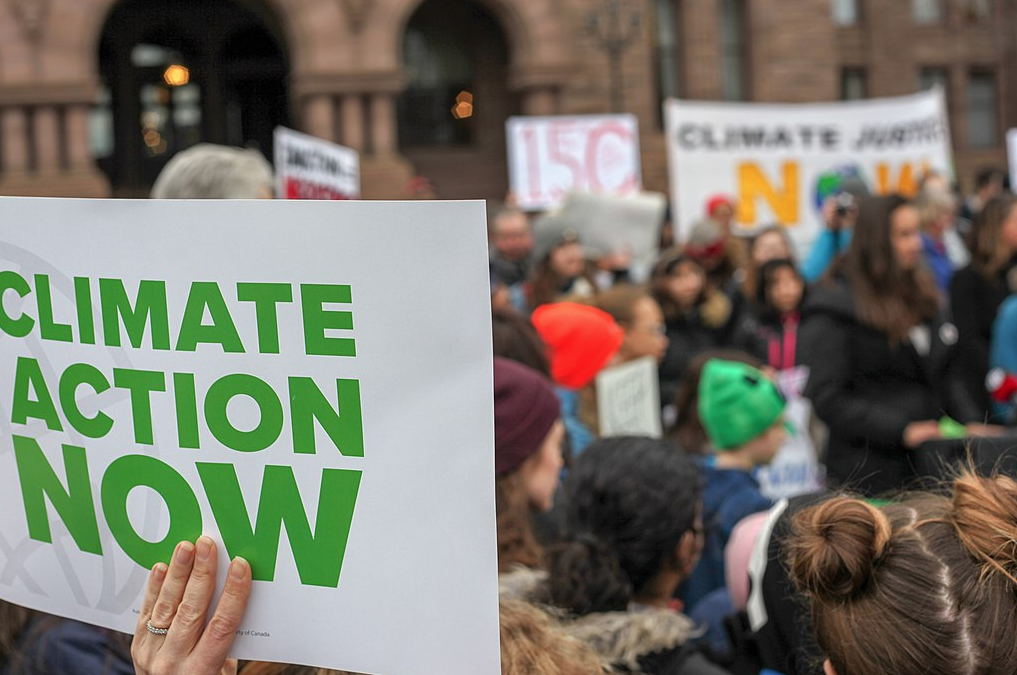
It was hard to focus on anything else these last two weeks as the Climate Conference took place in my home city of Glasgow. Although the deal isn’t perfect, I have three reasons for hope. This week on Fresh Dialogues, I’m sharing those reasons and a recent conversation I had with Vivienne Nunis on the BBC World Service. Her reporting from Brazil also gives me hope and underlines our need for an action mindset on climate.
What’s an action mindset? On a personal level, an action mindset is the belief that your actions can change your future, that your abilities are not fixed, but can be improved by a bias to action. Your action can change your future and the future of the planet. The promises made in Glasgow must now be followed up by action. Dr. Martin Luther King Jr said it best:
“An idea without action is like a bow without an arrow,” Dr. Martin Luther King Jr.
Photo credit above: Jasmin Sessler
Listen to the Fresh Dialogues podcast this week:
.
Here are my three reasons for hope after Glasgow’s COP26:
Renewal of international collaboration: The cooperation in Glasgow was in stark contrast to the nationalistic trends we’ve witnessed around the world in recent years. The unexpected joint statement by the U.S. and China gave me hope, as well as the final agreement which requires countries to come back next year with even more ambitious plans.
Private sector driving change: Mark Carney’s announcement of a $130 Trillion commitment from financial institutions is significant. Enlisting the private sector to finance the transition to net zero is crucial, but it also needs to stop funding for fossil fuels. Regulation could accelerate that change by penalizing institutions for holding dirty fuel assets on their balance sheets.
The deforestation agreement: This historic pact was signed by countries that account for about 85% of the world’s forests, including Brazil. The agreement aims to conserve and speed up restoration of forests and increase investment to promote sustainable forest management and support for indigenous communities. It adds about $19 billion in public and private funds, including large contributions from the Ford Foundation and foundations led by Jeff Bezos and Mike Bloomberg.
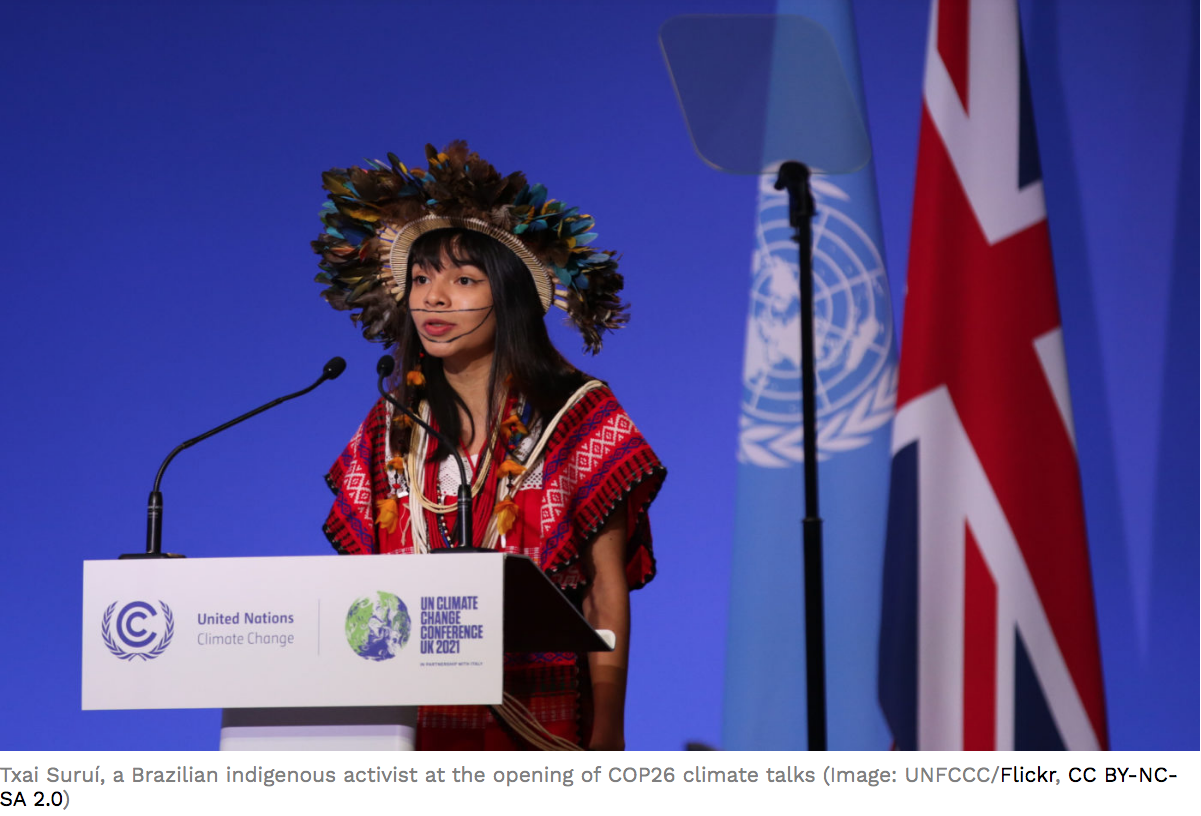
One powerful speech in Glasgow which caught my attention was that of Txai Surui, a 24-year-old indigenous climate activist from Brazil who accused global leaders of “closing their eyes” to climate change.
“The animals are disappearing, the rivers are dying… The Earth is speaking: she tells us we have no more time,” Surui says.
She urged leaders to think of people like her in “the front line of the climate emergency”, and she shared a moving story about a dear friend who has been murdered for protecting the forest. Sadly, her friend is one of thousands.
Making forests worth more alive than dead
The three largest rainforests in the world are located in the Amazon, Congo River basin and Southeast Asia. Together they absorb about a third of carbon dioxide emissions. In 2020, the world lost a staggering 100,000 square miles of forest — a swathe of land bigger than the United Kingdom. Is there a role for the private sector to step in where governments have failed? The key to stopping deforestation is making forests worth more alive than dead.
“We’re going to work to ensure markets recognize the true economic value of natural carbon sinks and motivate governments, landowners and stakeholders to prioritize conservation,” President Biden said in Glasgow.
The BBC’s Vivienne Nunis spoke to Robert Muggah of the Igarapi Institute about the fate of Brazil’s rainforest and the urgency of documenting the destruction and taking action to reverse current trends. Although land clearing, for mining and agriculture has increased under Brazil’s President Bolsonaro, private sector action offers a glimmer of hope.
Nunis’s interview with Nat Keohane of the nonprofit, Emergent was powerful. The organization acts as a middleman between corporations and the forest’s indigenous communities:
Here’s a transcript of the discussion, edited for length and clarity. (Starts @34:43 in the BBC podcast)
Nat Keohane: We need a model that invests in sustainable green growth. This could make Brazil (one of) the world’s first green economic superpowers… We need to decarbonize and protect the forest. One of the most important tools we have to try to shift course and get on a low carbon trajectory across the economy is to align the economic incentives that private companies face or that landowners in Brazil face. You need to make forest worth more alive than dead. And that means changing the incentives and that’s what the leaf model is trying to do. But we also need to change those incentives throughout the economy so that it is more profitable to go after low carbon technologies than to continue to use high carbon ones.”
Vivienne Nunis: Alison, what do you make of this idea of creating a kind of middleman? Somewhere that big corporates can channel their cash to try and cancel out what they’re doing in terms of carbon emissions? Do you think that can work?
Alison van Diggelen: I love the idea of this market led solution. It makes a lot of sense, but I just can’t help feeling it’s a drop in the ocean. The Emergent program needs to be scaled up and fast. I love the idea of making Brazil a green economic superpower, but I think the answer might be more private sector and government programs to help local people work the land sustainably. A change in government next year in Brazil will help that. The sooner we can get Bolsonaro out of power, the better. Someone that’s more sympathetic to the environment and appreciative of the role that the rainforest plays in the global ecology and economy would help. Also, I think public-private and nonprofit partnerships like the one Google and the Igarapi Institute forged to map Brazilian deforestation will help. Maps that document evidence of illegal deforestation will help provide data points and help bolster the demand for action to protect the rainforest.
Continue listening to the BBC podcast (where we discuss why Tesla reached a Trillion dollar valuation and what can be done about the explosion of plastic bottles)
One final note: I was delighted to see my alma mater, Wolfson College in Cambridge organized its own COP26 conference and addressed the need for urgent adaptation and mitigation in their latest Wolfson Review.
.
“People must feel that the natural world is important and valuable and beautiful and wonderful,” David Attenborough
This is a timely story about addiction, suffering, and how one tenacious woman found her purpose in life. Everyone I’ve talked to about this story has been fascinated, full of questions. That got me more and more excited about sharing it.
Sometimes I just pinch myself that I became an accidental journalist. This week more than ever. Interviewing people like Elon Musk, Richard Branson and Meryl Streep is thrilling. Being in the same space as the Dalai Lama, or witnessing the first solar-powered plane take off from a Silicon Valley runway is inspiring, but this month’s assignment for the BBC outshines all of that. Raising awareness about a relatively unknown, and potentially lethal syndrome, and helping to save lives, gives my work a more profound purpose. My research shows the syndrome is growing in prevalence and severity around the world.
Katie Nava, a nurse in California, almost died from this syndrome, but she’s now helping people recover. I’m so thankful to her for sharing her vulnerability and her inspiring story so candidly.
“I gave up weed and went to my Facebook page. I’ve found my calling. It was an unfortunate way to find it. I owe my life to the page. We’re spreading awareness.” Nurse, Katie Nava.
We’re all aware that the impacts of the Covid pandemic on our mental health has been brutal. The data is only now coming to light and experts say it’s just the tip of the iceberg. So, if one of your coping mechanisms has been to start using, or use pot a wee bit more than you did previously, please read on and share this with friends who might be over-indulging their love for cannabis. And tell your friends in the medical field how to identify this syndrome.
Keith Humphreys is a professor at Stanford, an expert in addiction, and one of my favorite academic experts to interview. He sums up the problem like this:
“Everyone in public health needs to be engaged and not fall for the line that cannabis is unlike any other drug in history. Every drug can have a bad effect. That’s the reality of our experience, the reality of chemistry.” Keith Humphreys
Here’s a longer version of the transcript: Alison van Diggelen: When Katie Nava had her first experience of Cannabinoid hyperemesis syndrome, CHS, she felt like she was going to die…
Katie Nava: It’s the most painful thing. You want to commit suicide in the middle of an episode.
The intensity made me nauseous. I’d spend the rest of day on the floor throwing up in this excruciating knotted up, doubled over pain. Like someone took a knife and twisted it in your stomach. You can’t stop it. We’ve coined the term scromiting: screaming while you vomit. My pain was always in the exact same place: It’s right where your stomach and esophagus meet. It’s just on fire. My throat would always be on fire, I had post nasal drip all the time…
Alison van Diggelen: For four years, Katie Nava, a licensed nurse in Southern California, was in and out of the Emergency Room, and had countless appointments with gastro, ENT and other specialist doctors. She had CAT Scans, colonoscopies, and doctors even suggested surgery to remove her gall bladder. Despite a digital trail of medical evidence from her Kaiser doctors, no one could identify what ailed her.
Katie Nava: I started thinking I was crazy. They would say nothing is wrong with me. I was getting labeled as a drug seeker. It hurt so much.
Alison van Diggelen: Finally, a nurse at another hospital recognized the symptoms and asked Katie Nava if she used marijuana. She was diagnosed with Cannabinoid hyperemesis syndrome, also known as CHS.
The first mention of CHS in the medical literature was not that long ago. In 2004 Australian doctors noticed a link between 19 cases of cyclic vomiting in people who used marijuana. Since then cases have been recorded in the UK, France, Australia, the Netherlands, Canada, Spain, New Zealand, as well as here in the US.
The bouts of vomiting, nausea, and severe abdominal pain tend to impact long term, heavy users of marijuana, though some younger people who smoke concentrates only a few times a week have had it too.
Kevin Hill: The precise mechanism is unclear at this point. It’s thought to involve the dysregulation of the body’s naturally occurring endocannabinoid system. There are receptors located throughout the body, primarily in the brain, sometimes in the GI tract.
Extensive use may lead to changes in function of the receptors. Ultimately those receptors in the GI tract, in the gut, appear to be affected in an adverse way, that’s when abdominal pain, nausea and vomiting can result. …
Alison van Diggelen: Nurse Katie Nava describes it more vividly:
Katie Nava: Your endocannabinoid system is like a fuse box and someone ripped it out. It’s like spaghetti wires misfiring everywhere. It’s why our bodies can’t thermo-regulate, it’s why our brains can’t talk to our stomachs properly. It doesn’t help that we’re so dehydrated, and why it’s the number one thing that kills CHS patients: kidney failure.
Alison van Diggelen: As well as the non-stop vomiting, patients also often experience dramatic weight loss, a rapid heart rate and dangerously low potassium levels. One piece of the puzzle that might help doctors to diagnose it is: if patients tell them that hot showers or baths help to alleviate these symptoms.
So does Dr Hill think it might be possible to identify those most at risk?
Kevin Hill: It’s very likely there’s a genetic component to it. Most people who use cannabis don’t have this problem, so it’s something particular to a subset who use it. What we do know is, if you use cannabis, this is a possibility and if they present with symptoms they need to stop using. If not appropriately diagnosed, you can have very serious consequences.
Alison van Diggelen: It’s been reported that two people have died from CHS. And the dehydration caused by vomiting can have long term impacts on the heart and liver. Once relatively rare, CHS is becoming more common around the world, especially where marijuana has been legalized. Dr. Hill estimates about three million people have suffered CHS in the United States and his hospital has treated thousands of patients.
Kevin Hill: I’m at Beth Israel Deaconess Harvard teaching hospital. I routinely work with folks in our emergency department… They’re seeing these cases more and more.
Alison van Diggelen: Some ER doctors in SF are seeing it on every shift. Other nurses in Denver see it about once a week, but it’s on the rise.
Keith Humphreys is a professor of behavioral sciences and a leading addiction scholar at Stanford University.
Keith Humphreys: The majority of Americans have access to recreational cannabis. At least 80-90% have access to medicinal cannabis… There’s always been a wink and a nod as to what medical cannabis is in the United States.
THC is the principal intoxicant in the plant. In the 1980s, 1990s, a typical plant might have 5-7% THC. Studies of the current legal market show they have 20%. Some products have 50-80%: DABS and wax extract. It’s dramatically stronger.
Speaking as a scientist, I don’t really know much what they do: there are fundamentally novel products I wouldn’t want to generalize, any more than I’d say: You can understand what it’s like to drink a pint of vodka, if you’ve had a pint of beer.
Great Increases in the dose of the drug can have effects you can’t infer from the low dose.
There’s been a great increase in the number of people who use cannabis every day… Perhaps tied to potency: More people are addicted. More users look like cigarette smokers; all day long they have cannabis going. That was uncommon in the days of lower potency.
Alison van Diggelen: One study from the Netherlands found that the concentration of THC (tetrahydrocannabinol) – the compound that makes you feel “high” – in cannabis sold in retail outlets had roughly doubled between 2000 and 2015. (from link above)
Humphreys says the number of people using cannabis in the United States is growing about 3-5% a year, but the volume of cannabis sold is going up much faster. Kevin Hill: The purity and potency of any cannabinoid you use, including whole plant cannabis, is critical to know because it does appear the adverse effects of cannabis are often dose dependent….When I talk to patients, about what they’re using, I want to know specifically and ask them to bring in labels.
You have to know what you’re putting in your body, to know the potential outcome can be, either good or bad.
Alison van Diggelen: So – what’s more dangerous? Vaping, smoking or edibles?
.
Kevin Hill: In terms of health effects, smoking is the worst possible thing you can do. Vaping is slightly better than combustible cannabis, but oral cannabis products are better in that way. We want people to be thoughtful…
There are always risks involved. You wanna get products from a reputable source. In general oral consumption is the least harmful, depending on the dose involved. If you get to the point where your use is creeping up… Sometimes intervention is necessary. Talk to a healthcare provider.
Alison van Diggelen: Professor Humphreys believes that alongside people learning more about what they’re using, healthcare professionals need to be aware of CHS – to catch it early.
Keith Humphreys: People who work in hospitals need to be aware of it and generally are not. We need more public health messaging to counter the industry message which is: it cures everything and has no downside!
We don’t tolerate that for other substances like tobacco, alcohol because we know it can harm people. We need it not just for CHS, but for memory problems, concentration problems. People do worse in school if they’re heavy users.
Public health is in a defensive crouch about cannabis, compared to tobacco and alcohol, in part because they have a powerful industry on the other side of the table. It’s also more cultural: no one wants to be a finger-wagging, blue rinse activist saying: bad bad cannabis! Once it’s legal, that argument is over. Now it’s just like any other thing.
This is really in the hands of our political leadership and regulators. Will we learn the lesson of alcohol and tobacco? If we don’t regulate we get a lot of public health damage. Are we going to treat this as a cash cow and let industry sell as much as it wants? Or will we say: wait a minute, if we take all the controls off, you get a lot of suffering. Everyone in public health needs to be engaged and not fall for the line that cannabis is unlike any other drug in history. Every drug can have a bad effect. That’s the reality of our experience, the reality of chemistry.
Alison van Diggelen: Katie Nava has learned the hard way about the risks associated with cannabis use….
Katie Nava: We’ve created a super plant – don’t abuse it! If someone had told me: don’t smoke 20 joints a day, I woulda listened. Now it’s too late. I’ve completely ruined my body, my endocannabinoid system’s wrecked.
Alison van Diggelen: Giving anti-nausea drugs and replacing the minerals lost during vomiting with electrolytes are central to treating CHS. Antipsychotic drugs like Ativan and haloperidol can also help. But the only proven way to cure CHS is to stop cannabis use entirely.
Katie Nava: It’s literally a game of Russian Roulette…it’s a ticking time bomb.
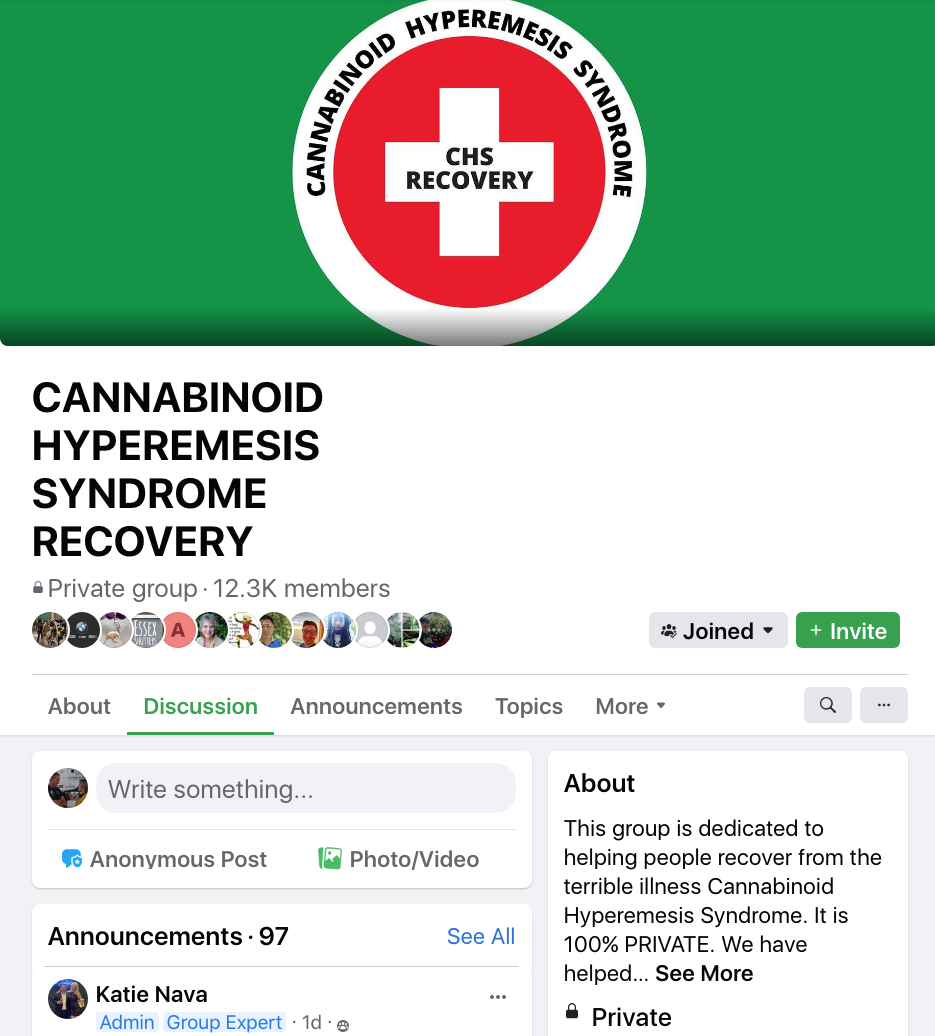
Alison van Diggelen: Nava stopped two years ago, and she even avoids foods like black pepper, truffle oils, and broccoli that contain cannabinoids. Helping run a Cannabinoid Hyperemesis Recovery support group on Facebook keeps her busy. Founded three years ago, the support group now has over 12,000 members from around the world. Membership is growing about 10% a month. (8500 of the members are in the U.S., 1400 in Canada, 400 in UK).
Katie Nava: It was my AA (Alcoholics Anonymous) meeting. It helped me stay sober. It was my exchange. I gave up weed and went to my Facebook page. I’ve found my calling. It was an unfortunate way to find it. I owe my life to the page. We’re spreading awareness.
Alison van Diggelen: What else does Nurse Nava think should be done to raise awareness?
Katie Nava: If dispensaries would just put up signs saying: Hey this is what CHS is! Then, if someone comes down with it, they wouldn’t spend four years in misery like I did.




 We explored why we get stuck and what we can do to get unstuck, and build momentum in our lives and careers. Julian’s story and the one she shares about
  I asked Julian to share the story of one excruciating time she was stuck and found it hard to move forward. After she secured a book deal for her best seller,