Oct 23, 2009 | Celebrities, Green World, Technology, Transcripts
By Alison van Diggelen, host of Fresh Dialogues
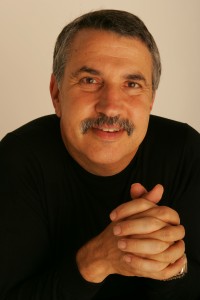
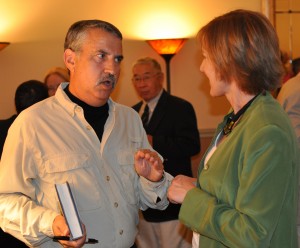
This is a transcript of my interview with Tom Friedman, recorded on September 10, 2009 at the Foothill College Celebrity Forum Series, in Silicon Valley.
Check out exclusive Fresh Dialogues Videos:
Tom Friedman on Copenhagen “This is a problem that will be solved by innovators, not regulators.”
Tom Friedman on his Envy of China’s action on Clean Energy: “You detect the envy of someone who wants his own government to act democratically with the same effectiveness that China can do autocratically.”
Introduction: In this second part of my interview with Pulitzer prize winning columnist, Tom Friedman, we discuss how he uses his platform to drive forward the green agenda. Tom shares his views on the resignation of Obama’s green czar, Van Jones, and how he himself deals with critics.
Alison van Diggelen: Tom, thank you very much for joining me today on Fresh Dialogues. In Davos this year, you asked: ‘Am I a bad guy for wanting to be China for a day?’ In light of the resignation of Van Jones, do you feel you’re a bad guy?
Tom Friedman: (laughter) No. I don’t feel Van Jones is a bad guy either.
Alison: Absolutely, but in that environment of criticism (that Van Jones bowed to), do you feel you are a ‘bad guy’?
Tom Friedman: I don’t really care. I say what I say. I think there’s a big audience for what I say and I don’t really pay attention to the critics.
Alison: Right. So you just turn a deaf ear?
Tom: I keep on marching on. I hear it and it’s fine. And it’s a free country. You can say whatever you want. But I’ve got my own bully pulpit and I use it. I don’t use it to shout back at critics; I use it to get my message out. I’m looking forward. You know, the dogs bark and the caravan moves on. I’m in the caravan.
Alison: But you don’t feel that distraction…that Glenn Beck and his ilk… are getting stronger and are going to be energized by the Van Jones resignation?
Tom: Well here I am giving a talk at De Anza College. We had 2500 people last night, 2500 tonight, 2500 people tomorrow night, actually paying money to come hear this and other lectures – not only my own. You were here last night…I think the audience was really paying attention, really motivated. Did everyone agree with every word I had to say? God, I hope not, that wouldn’t be a very interesting audience. But I think people understand the stakes, they’re living it every day. They know the climate’s changing and the Glenn Becks and the other opponents of these ideas will have their audience and I have mine…and let the best man win. To me that’s what it’s all about.
I don’t spend my time dealing with my critics. I’ve got a great podium and if you’re criticizing me, God bless you. I’m not above criticism. My focus is on my ideas with my audience.
Alison: I’m not intending to criticize you. But I’m just curious…
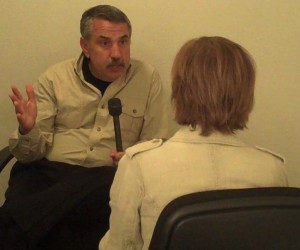 Tom: No, I’m telling you this is just my philosophy…I think you’d have to Google a long long time to find a column…I dare say, you’d have to Google forever to find a column where I’ve actually addressed personally, one of my critics.
Alison: Good for you.
Tom: My feeling is, I’m out there. And therefore, if you can’t take the heat, don’t be out there, number one… But why would I waste a column writing about one of my critics when I can write about these really interesting ideas for my audience who cares. So what I always say to the critics is, ‘you may be writing about me, I really appreciate that, but don’t think for a second that I’d waste a column on you.’
Alison: Good for you. I like that.
Tom: I’ve got this platform in the New York Times, why would I waste it on one of my critics? By the way, they’re entitled to their criticism. I’m out there. Sometimes you even learn from critics, but you move on.
Alison: Talking about journalism, what is your feeling on the future of journalism? What is morale like at the NYT today?
Tom: Well, I think it’s getting better. I think there’s a feeling -hopefully, we keep our fingers crossed- that we’ve hit bottom. Stocks are creeping up. We’ve just announced that we’re going to start a pilot project here in San Francisco Bay Area, whereby every Friday and Sunday, there’ll be two local pages in the NYT of San Francisco news. We’re going to go after some of the papers out here and try to win readers here. We’re pushing forward, ideas are coming out…
Alison: Is that going to change your column at all?
Tom: No…no…em
Alison: It’s more local news?
Tom: They’re going to be writing about Bay Area news…
Alison: Right….I met with your colleague from the NYT, Maureen Dowd this year…
Tom: Uh huh.
Alison: And she told me that you guys get together for a daiquiri from time to time. She said, and I quote ‘when Tom is feeling down about climate change’…
Tom: (laughter)
Alison: So I’m curious to know how the daiquiris are going? Have there been a lot of daiquiris recently? In other words, are you feeling more optimistic or less optimistic since you wrote this book (Hot, Flat, and Crowded), Tom?
Tom: Umm, I am going to hedge that. You know, Maureen is my dear friend and we do, you know, confide in each other about our moods at different times.
Right now I see a lot of things that are very exciting happening – exploding really – on a kind of small scale, but they haven’t achieved yet a critical mass and when you’re talking about changing the climate, you are really talking about critical mass. And that’s really what’s missing. A lot of exciting things happening, a lot of good buzz, peoples’ ideas are changing, they’re in flux, and much more open to all of these arguments but it hasn’t yet been translated into policy at scale.
Alison: And you’re still waiting for that…
Tom: Yes
Alison: And what do you see as your part…you talked about being in your bully pulpit…
Tom: My part is to use my platform as a journalist to drive this agenda – that I see as important – I have the great good fortune of having this platform and I use it to drive this agenda.
Alison: You also hooked up with John Doerr, I think it was in January of this year and you went before Congress. Can you describe what your expectations were for that and if it’s something that you’d want to do again?
Tom: Well, it was a very informal hearing…sponsored by Barbara Boxer, the Democrat Senator from California, on climate change and energy. John and I were the two main expert witnesses…It went great but no one intervention like that is going to be decisive, it takes many many more at many levels…most of all from the President.
Alison: And did you enjoy the experience? Is it something you’d like to do again?
Tom: Oh, it was fine. Um. It wasn’t like ‘wow.’ What struck me was how serious Senator Boxer was in her questioning and her colleagues. They’d done their homework, they were serious. To the extent it got out…YouTube, C-Span, the respective websites of the senators; I think it really contributed something.
Alison: Great, and let’s talk about the future. What’s the next book, the next travel plans, the next story Tom?
Tom: Well my book, Hot, Flat, and Crowded is coming out in paperback in November, right before Thanksgiving and I’ve updated the book significantly and I’m very excited about that. Now that I’ve done that I’m not sure what I’m going to do next. I’m just sitting back thinking. I’m in the market.
Alison: I read your column about Botswana and you wax lyrical about how beautiful it was, the nature there. What is it that drives you forward? I mean you could retire tomorrow probably but what is it that drives you to keep writing these thought provoking and insightful columns?
Tom: Well, I care first of all about the issues, so that’s what drives me. Secondly, I have this platform so what I care about can be heard by a lot of people and third, I’m having fun. I have the best job in the world. Somebody has to have it and I have it and you don’t.
Alison: (laughter)
Tom: I get to be a tourist with an attitude. I get to go wherever I want, write whatever I want…and they pay me for that. And I get to be part of the debate and ideas, people agreeing with you, disagreeing with you, trashing you, praising you. You know, I enjoy it; it’s why I’m here. I wouldn’t give it up for the world. I still enjoy getting up every morning, hitching up my trousers and getting out there…opening up my laptop and taking on the world.
Alison: Great. Well Tom Friedman, thank you very much for joining me on Fresh Dialogues.
Tom: My pleasure
To read the summary post of this interview, part two click here
To read the transcript of Part One on China Envy & Government Policy with Tom Friedman click here
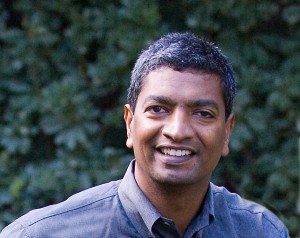
Oct 7, 2009 | Electric Vehicles, Entrepreneurship & Innovation, Fuel Cells, Green World, Sustainability, Transcripts
By Alison van Diggelen, host of Fresh Dialogues
SEE THE VIDEO INTERVIEW HERE – A FRESH DIALOGUES EXCLUSIVE Bloom Energy: Fuel Cell Technology
Bloom Energy: Affordability is Essential Video
Bloom Energy: Mission to Change the World Video
This is a transcript of Part One of my interview with Bloom Energy CEO, KR Sridhar about fuel cell technology, electric vehicles and the Bloom Energy mission. The interview was recorded on September 30, 2009 at the Bloom Energy headquarters in Silicon Valley, California. To listen to the interview and read the original post, click here. To read the transcript of Part Two of the interview – on fuel cell affordability, company timeline and the Bloom team- click here
Alison van Diggelen: KR, thank you for joining me today on Fresh Dialogues. First of all, I want to start with your background. You’ve been described by Fortune Magazine as one of the top five futurists. What is it about you that makes you able to tell – to invent – the future?
KR Sridhar: I’m not sure that I necessarily agree with that description, but… I’m not sure I’m deserving of that. But here is what I think: like any entrepreneur you don’t look at the world and take it for what it is, you always look for what it can be. And when you think that way, you have a different lens, a different perspective. You ask some very fundamental questions. Fundamental things that we take for granted but you say: why should it be that way?
And then you bring analogs from other worlds, other businesses, other practices and try to insert that into a new paradigm where there is really a market need, a disruptive element that you can bring forward. The examples would be in the green space if you’re thinking about… If you could do distributed computing from mainframe computing, and that changes the world; the fact that you could do distributed telephony – which is mobile phones from landline locked telephone – and you could change the world, then why couldn’t you do the same thing for energy?
Alison: So is that what you’re proposing at Bloom Energy?
KR: Yeah, yeah, yeah. That’s what we’re doing. So that’s an example of how you take…you really then invent something new. Distributed is a lot better than centralized because you’re empowering the people. It’s not some central authority that’s going to tell you when and how you can get your energy and at what cost and when can you have it. You give the power to the people; you empower them.
Alison: And talking of empowering the people, I want to talk about your motivations with Bloom Energy – for deciding: ‘OK, I’m going to leave NASA and I’m going to invent the future energy technology.’ What is your key motivator? Is it climate change, is it the world’s poor, is it the future for your children, or is it the huge market opportunity that you’ve talked a lot about?
KR: Well, it’s all of the above. But fundamentally the driver that makes you wake up in the morning and say: ‘This is more than a job, this is a mission. I’m committed to something that I’ll absolutely do.’ Where does that come from? It comes from something very fundamental. As human beings, as parents…any parent knows that anywhere in the world you go talk to any parent, it doesn’t matter what religion, country, economic, social background they have, if there’s one thing they have in common: they want a better life for their children than what they had. And I deeply believe that unless we solve this energy issue and not make it a zero sum game – where more and more of the population as the world’s population grows has to use a fixed amount of energy and so each one uses a lot less – then we cannot promise our future generations a better life than what we had.
But the big misunderstanding in my opinion is: people believe that more energy is more pollution, more unsustainable. There is nothing in science or technology, no physical laws, no chemical laws that say more energy and sustainability have to be at odds with one another.
Alison: So is Bloom Energy’s solution… is it non-polluting? Zero pollution?
KR: Yes and no, and I’ll explain what I mean by that. We have charted a road map. The road map simply says: today you have abundance of fossil energy which, no matter how you use it, will create some greenhouse gases. But then you ask the question: for the same amount of energy that I need to produce useful energy – electricity that I need to produce – how do I cause the least amount of pollution? So how can I take the fossil fuel and squeeze the maximum number of electrons out of it until the renewable fuels – in a sustainable way – become prevalent?
And the same technology that you used as a bridge to the future is also the future because it can use renewable fuels and give you zero net carbon. So it can do both. So that’s the practical way to get into something. As a baby you first learn to crawl, then to walk and then run. We want to just go from sitting down to running and I don’t think there’s that magic potion. So we’re building both the bridge as well as the future destination.
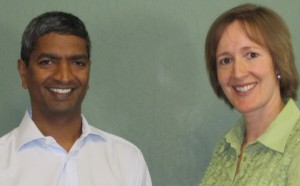 Alison: Right. You’re also good friends with Tom Friedman, and he’s quoted you in a recent column last year “We are thrivers. Thrivers are constantly looking for new opportunities to seize and lead and be number one. That is what America is about.” Can you explain that comment and whether you feel that with Bloom Energy that is part of your motivation: to lead and thrive and be number one?
KR: Absolutely. We want to be number one simply because the mission of the company – and you’ll have seen it as you walked in on posters – we fundamentally want to change the world. This is a mission about changing the world because energy is a passport to a better living. For the rest of the world that does not have access to power, access to electricity, to give them that is empowering them to a better life. So if the solution works and you make it affordable and you can distribute it all over the world then definitely you have changed the world. So the motivation is that, if that’s the motivation and that’s your goal and you achieve that goal, clearly given the size of the energy market, it’s in trillions not in billions and given how many people you can impact with this kind of stuff, this has to be a prominent company. So, I would say being the number one corporation is an offshoot of achieving your larger mission which cannot be just counted in dollars and cents. So that’s what makes me feel really good about what I’m doing, because you can do good and make good and not have a conflict between those two.
Alison: And as far as saving the world from itself, what is your timetable for that? We’re living in fast paced Silicon Valley, people want to see results and I’m aware that you have a lot of pressure: when is it going to be revealed… the magic Bloom Box. What is your big picture timetable?
KR: Well, ask any entrepreneur, ask any missionary who wants to do something big, you’ll find one thing in common in all of them, there’s a sense of urgency. You feel like you need to do it do it faster than humanly possible and you somehow believe that and you push it. By having that sense of urgency you get there faster than anybody thinks is possible.
But this is a big scale issue. The size of this market, the size of what needs to get done. It’s larger than what people normally think about. This is not a microchip. These are huge devices, they need to be build in very large quantities, and if you take automotive, if you take anything else, its penetration and how long it takes to build the factories, the machines for factories. These things don’t happen over night. So it’s going to be faster than conventional energy people think it’s going to happen because they think in decades and centuries. It’s going to be slower than what the bits and bites people in Silicon Valley think because it’s not like software that you’re just going to write and then copy 800 times, or a million times over instantly, and distribute. It’s going to be a happy medium in between: so you’re looking at within a decade as opposed to within a century but you’re not talking about eight quarters. You are talking about longer than that.
Alison: And are you at the stage where you have the test boxes out there in the field?
KR: We have field trials going on. We’re still in a stealth mode so we really don’t get into the details of explaining that. But stay tuned and soon you’ll hear about it.
Alison: Great, and are the trials going on just in Silicon Valley or are you trying them out in India and all over the world?
KR: There have been reports written about our work in Tennessee that’s been going on for a couple of years. But again, the details of that are not something that we like to discuss at this point of time. Other than to say, we’re very optimistic about where it’s going and we feel very good about where it is, and it’ll get there.
Alison: And your funders are quite happy with progress?
KR: Yes
Alison: Good. That’s important.
KR: Yes
Alison: Tell me in simple terms what the Bloom Box does? I’ve read that it’s a chemical reaction in a box…can you explain a little more than that?
KR: The easier way to describe that is very simply: when you take a fuel, it doesn’t matter whether it’s a renewable fuel – like a biofuel, or biomass generated fuel or it is a fossil fuel – coal, oil, natural gas. A fuel is simply a substance that has in it chemical energy. You burn that in air, that’s combustion, and when you burn that you see the flame, that’s creates heat. So you’ve converted chemical energy to heat energy. That raises steam, the steam then goes into a big turbine that spins, so you’ve converted the heat energy to mechanical energy. Now, around that is a copper coil, called an alternator, converts the mechanical energy to electrical energy. So the way you convert this fuel to electrons on the other end, which is what you need, is going from chemical energy to thermal energy to mechanical energy to electrical energy.
When you do multiple forms of energy conversion it’s like starting with your dollar and going from airport to airport and changing your currency everywhere and paying your commissions.
Alison: You’re losing out
KR: At the end you end up with a lot less than a dollar, if you started with a dollar. In science terms, if you start with a dollar in this chemical, you end up with 30 to 40 cents by the time you get the electrons in the conventional way of converting the fuel.
Alison: And a lot of CO2
KR: Yeah, so if you need 40 cents worth of electricity you need to burn a hundred cents worth of fuel and create a hundred cents equal amount of CO2. And because this type of conversion only works well on a large scale – we’re talking 500 megawatts to a gigawatt size plant which can do from half a million to a million homes, that size big power plants. You put them very far away from where you live, and you have transmission distribution lines, that bring it hundreds of miles so you lose another 8 to 10 percent conversion. So what the Bloom Box does is it takes the chemical energy from the fuel and converts that to electrons with no in-between conversion. So you change your currency only once.
Alison: And how does it do that?
KR: It is an electro-chemical reaction. The simplest way for you to conveive of that is, it’s similar to your battery in your car, a lead acid battery. Everybody is familiar with that. The big difference between our box – which is a fuel cell – and that box – which is a battery – is a battery is only a storage device. If it’s a primary battery you use it once and you throw it away; if it’s a rechargable battery you keep doing the charge, recharge cycle.
A fuel cell is not a storage device, it’s a power generator, so you keep supplying the fuel in, as long as you’re supplying the fuel you’ll keep getting the electrons out without having to go through the charge recharge cycle. But a similar electro-chemical reaction, which is simply to say: you take a chemical and convert that to electricity with no in-between steps and most importantly without combustion, without fire. And so not only because of the high efficiency you get from the one step conversion do you have to burn less fuel and therefore less greenhouse emitting gases, but because there is no combustion, you eliminate all the combustion related polluting gases, like noxious gas from getting into the atmosphere.
Alison: And I also understand part of the Bloom box is splitting out the hydrogen?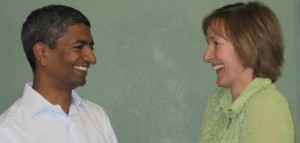
KR: That’s an option. People always ask, it’s electricity is it a fuel cell for the car? The answer is no. This is for stationary uses like buildings and houses. So then the question is, you have a big transportation infrastructure that requires fuel for that. Transportation can potentially go in two directions in the future: one is a hydrogen infrastructure for the car, the other one is an electrical infrastructure. We’re already getting a lot more comfortable with plug-in hybrids… which is right on the horizon.
Alison: Do you drive one?
KR: When the plug-in hybrid is there, I will drive one. I don’t like the hybrid as it is.
Alison: You don’t drive the Tesla?
KR: Unfortunately, I have children and I need a four seater…
Alison: Practical man
KR: …so I’m waiting for the Fisker which is a four seater
Alison: It’s imminent
KR: So, our device can either produce the electricity that will charge the car or provide you hydrogen if the transportation becomes hydrogen based. So we’ve sort of become the gas station for the transportation industry.
Alison: Your vision of the future with this KR…has been described as a refrigerator sized device.
KR: That’s the ultimate vision. How we get there I cannot describe right now.
Alison: So that’s maybe, what 20 years off…who knows?
KR: Silicon Valley time, ultimate is within a decade, right?
Alison: So it’s all within a decade.
KR: Right, right.
Alison: Well KR Sridhar, it’s been a pleasure. Thank you for joining me today on Fresh Dialogues.
KR: Thank you
This Fresh Dialogues interview was recorded at the Bloom Energy headquarters in Silicon Valley, California on September 30, 2009. To listen to the interview, click here


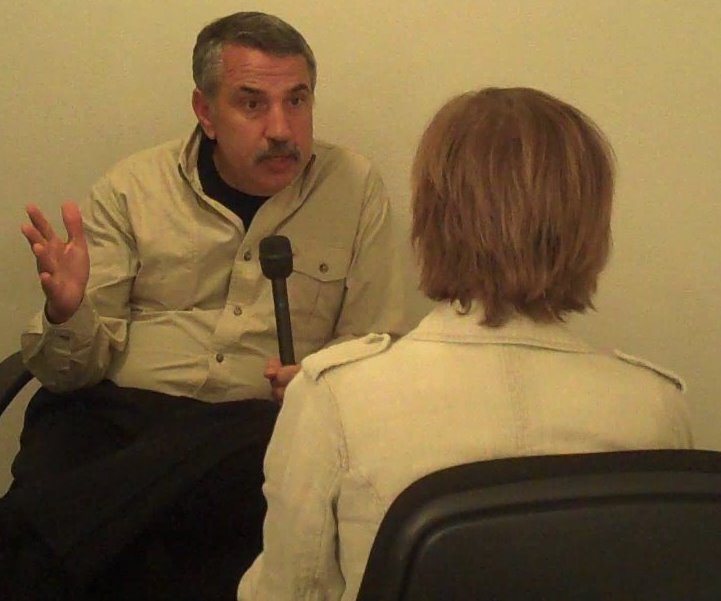 Tom: No, I’m telling you this is just my philosophy…I think you’d have to Google a long long time to find a column…I dare say, you’d have to Google forever to find a column where I’ve actually addressed personally, one of my critics.