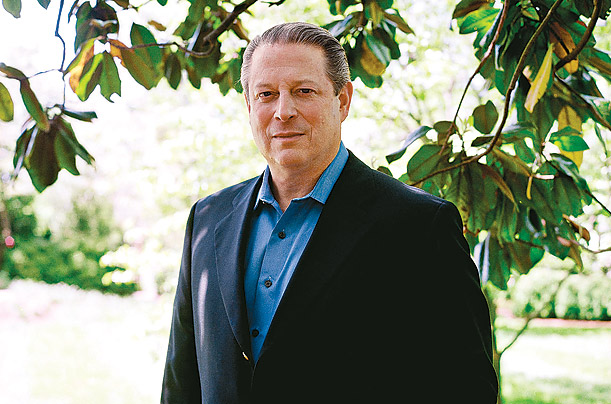
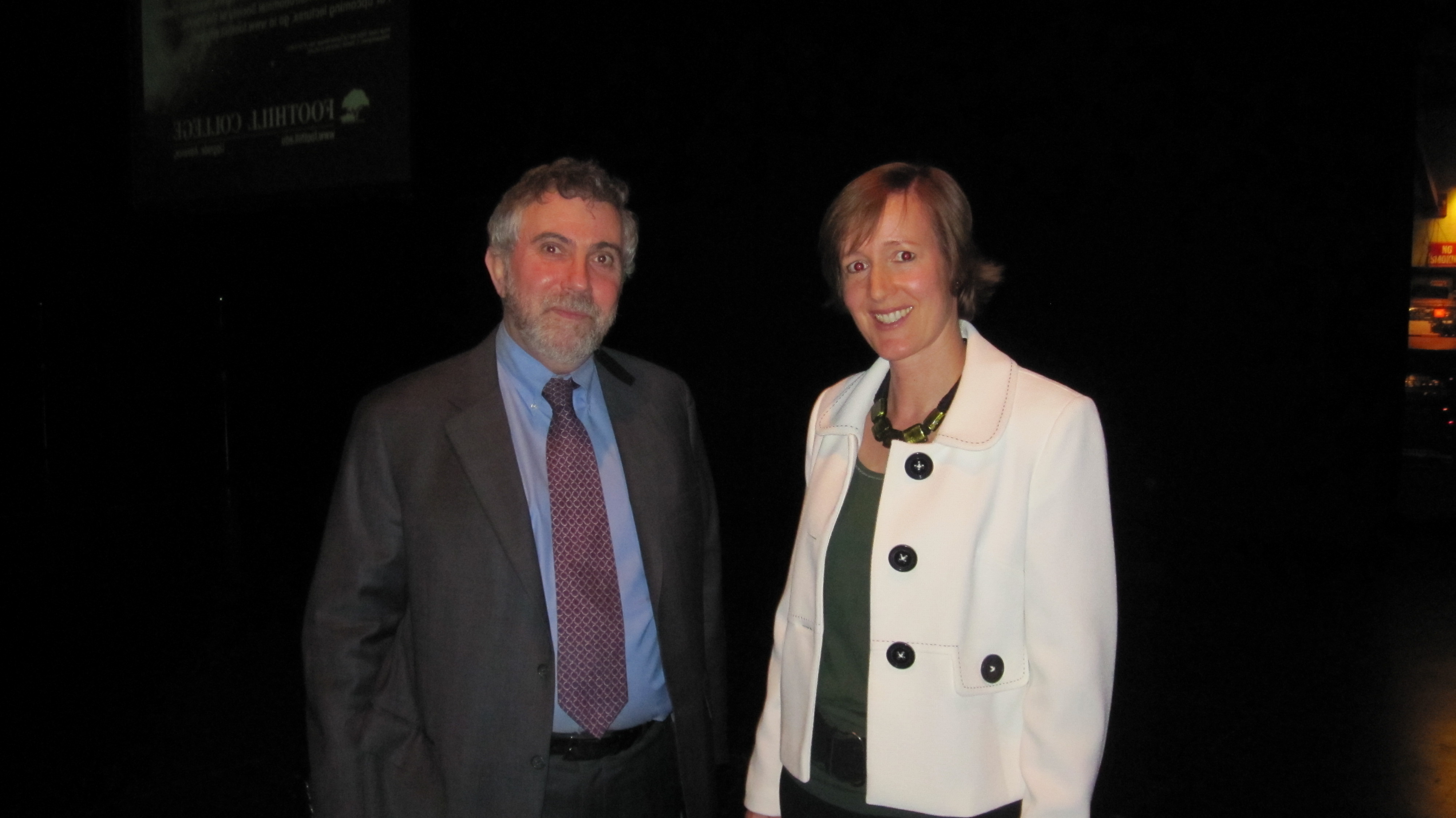
I talked briefly to Vice President Al Gore off mic, before his speech and look forward to interviewing him for Fresh Dialogues in the future. These audio and video links feature highlights from his rousing speech.
Former Vice President, Al Goreshowed his passion in front of a rapturous Silicon Valley crowd at the 2009 Tech Awardson November 19th. He described a “day of reckoning” and suggested future generations may look back one day and ask,
“What were you thinking? Were you watching Dancing with the Stars? Did you care?”
Dancing? A little dig here to Silicon Valley luminary and co-founder of Apple, Steve Wozniak, who took part in the dance contest last Fall (you really ain’t seen nothing yet…)
Gore then echoed the hope in his new book “Our Choice” – that this generation that will develop a sense of shared purpose, and do what needs to be done to combat climate change. Gore described his deep belief that future generations will instead ask,
“How did you find the moral courage to shake off the lethargy… seize the responsibility and act in time to solve the crisis?”
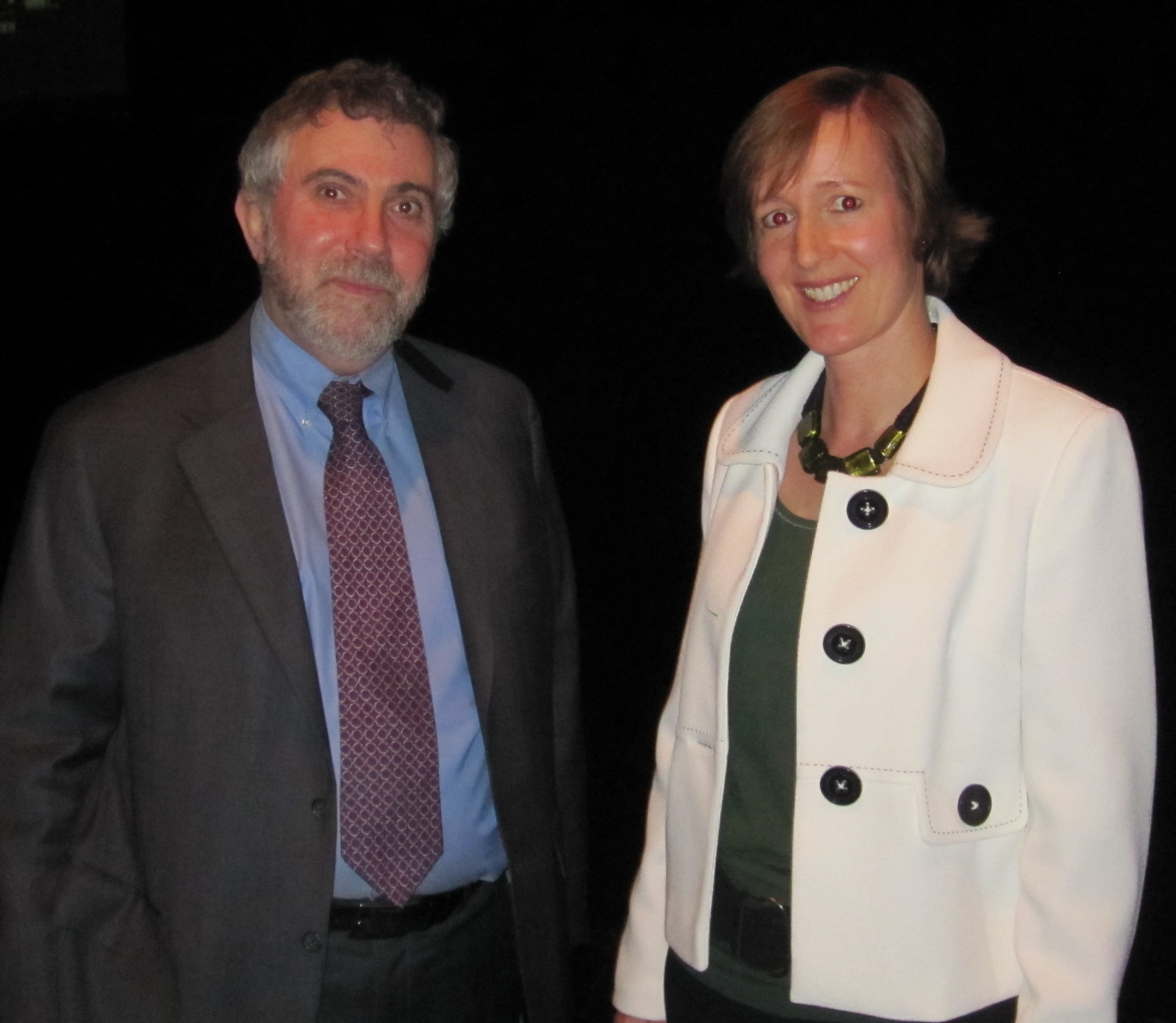
This exclusive interview with Nobel Prize winner, Paul Krugman was recorded on November 12, 2009 in Silicon Valley. Dr. Krugman was in town to deliver a lecture as part of the Foothill College Celebrity Forum Series. Here is the transcript of Part Two: On China and Climate Change. To listen to this interview click hereand or watchvideo (coming soon)
Alison van Diggelen: Paul thank you very much for joining me today on Fresh Dialogues.
Paul Krugman: OK. Good to be doing this.
Alison: Talking about other countries, Spain took the lead… Denmark is taking the lead… China is now way ahead of us in certain clean energy technologies. Do you feel that we’ve lost eight years and we have at least eight years to catch up? Is it feasible we can catch up?
Paul: It’s always feasible. You don’t want to get too hung up on the specific sexy technologies. I guess the Danes are ahead of us in building wind turbines. But a lot of what we’re going to be doing on the environment is going to be… insulation, clever urban design to minimize energy loss. That’s all stuff that’s coming along and look – the history of information technology has said very clearly that nobody gets a monopoly for very long… I don’t get anxiety about it. I’m just more concerned that we won’t do what we need to do to protect the environment.
Alison: How big is the role of government? Ultimately it’s the private sector investment that’s going to make the substantial investment…
Paul: But the government has to provide the incentives…what we have now is the economic concept of an externality…if you have something where you impose costs on other people but you don’t have any incentive to reduce those costs, bad stuff happens. And climate change is the mother of all externalities. It’s a gigantic thing and the private sector by itself is not going to deal with it. Left without any government intervention, we’re just going to basically par-boil the planet, right?
So what you have to do is have a set of rules in place. Now the idea is for it to be market oriented. Yes, there can be some public research, some public investment, some things will have to be done directly by government… but mainly put in a cap and trade system – put a price on greenhouse gas emissions and then let the private sector do its stuff.
Alison: Right. Why is it you favor a cap and trade system over a straight carbon tax?
Paul: Oh, there are a couple of reasons. One is, right now, cap and trade looks like it might pass Congress and a direct tax will not. Partly that’s because cap and trade is relatively well suited to paying off the industry groups, right? We live in the real world. By handing out some of the licenses, at least in the first decade or so, you make it easier to swallow.
International coordination is easier with cap and trade. If we say to the Chinese – well we want you to have a carbon tax – how can we really tell it’s enforced? But if we negotiate with the Chinese that they will have total CO2 emissions of so much, we can monitor pretty well whether that’s actually happening. So that’s a lot easier to envision an international agreement with cap and trade.
So, I would take a carbon tax if…
Alison: If it were politically feasible?
Paul: It’s not clear to me that it’s even superior. But it would be OK, certainly. The fact is, cap and trade could be a bill by this time next year. A carbon tax is like single payer health care. It’s not going to happen this decade and I want something to actually happen now.
Alison: Paul Krugman, thank you very much I really appreciate your taking the time.
Paul: Thank you so much.
Check back soon for more interview segments on the stimulus package, what gave him that “missionary zeal” to write such fervent columns in the New York Times, and whether the green economy can be our salvation.
To check out more exclusive Fresh Dialogues interviews, click here
In advance of Obama’s trip to Chinathis week, Nobel Prize winner, Paul Krugman gave a short, sharp economics lesson on climate change and China during our exclusive interview in Silicon Valley, November 12. What does he think the US and Chinese governments should be doing to combat climate change and stimulate the green sector?
Why is he not concerned about China’s lead in clean energy technology?
Krugman explains why negotiating with China over CO2 emissions would be preferable to trying to enforce a carbon tax. Hear all this and more in this Fresh Dialogues interview.
Here are selected quotes:
“Climate change is the mother of all externalities…left without any government intervention, we’re going to basically par-boil the planet.”
“You don’t want to get hung up on the specific sexy technologies (like wind turbines)…look at the history of information technology…nobody gets a monopoly for very long.”
“If we say to the Chinese, we want you to have a carbon tax – how can we really tell it’s enforced? But if we negotiate with the Chinese that they will have total CO2 emissions of so much, we can monitor that pretty well.”
For Part One of the Paul Krugman interview – on Obama’s Job Summit click here
This exclusive interview with Paul Krugman was recorded on November 12, 2009 in SiliconValley. Dr. Krugman was in town to deliver a lecture as part of the Foothill College Celebrity Forum Series. Here are some transcript highights. To listen to the interview click here and or watchvideo.
Alison van Diggelen: Paul thank you very much for joining me on Fresh Dialogues.
Paul Krugman: OK. Good to be doing this.
Alison: Last night, you talked in your lecture of your concern about the unemployment rate. It’s very high and moving higher. In light of Obama’s announcement today about the job summit in DC in December, do you have any advice specific advice for Obama administration, particularly for green jobs?
Paul: Well OK, green jobs I think is going to be a much harder thing to get going. That’s going to take time. That really waits on climate legislation which we won’t get till next year, if we’re lucky.
What he needs to do is get some actual targeted job measures, we need some policies that are aimed at encouraging job creation directly: probably a job tax credit and maybe some subsidies for firms that hang on to jobs. We can learn a little bit from European countries (like)Germany which have been relatively successful in containing the job losses…We just have to get something going…. If I had my druthers, if there were no limits politically, I’d say actually let’s just have a really massive second stimulus plan to get the economy going, but since that’s not going to happen we need some measures that are cheaper, don’t maybe do as much for GDP but create a lot of jobs…
Alison: You said last night he’s been too cautious, Obama has been doing things in half measures. What advice would you give him at this stage?
Paul:This jobs summit can’t be an empty exercise…he can’t come out with a proposal for $10 or $20 Billion of stuff because people will view that as a joke. There has to be a significant job proposal…
Alison: Do you have a minimum he aught to spend?
Paul: There’s no hard and fast number, but if it isn’t several hundred billion dollars…OK, probably it’s not going to be as big as the first stimulus bill and not going to be as big as I think it should be… But I have in mind something like $300 Billion, you could do quite a lot that’s actually targeted on jobs.
Alison: Paul Krugman, thank you very much I really appreciate your taking the time.
Paul: Thank you so much.
Check back soon for more interview segments in which Paul Krugman discusses China, Climate Change and clean technology, the stimulus package, and why he prefers cap and trade over a straight carbon tax. He also explains what gave him that “missionary zeal” to write such fervent columns in the New York Times. To check out more exclusive Fresh Dialogues interviews, click here
On Thursday November 12, I had an exclusive interview with Nobel Prize winning economist, Paul Krugman. Just hours after President Obama announced the Job Summit, I sought out Krugman’s wisdom and he gave some radical advice to the President. Emphasising that “the Job Summit can’t be an empty exercise,” the renowned economics expert recommends a minimum of $300 Billion be spent by the government to encourage job creation, with a focus on job tax credits and subsidies for companies that retain jobs. For a transcript of the interview, click here or watch video
This is part of a longer interview in which we discussed green jobs, Krugman’s impact on government policy, his future plans and what gives him that “missionary zeal.” Click here for Part Two on China and Climate Change. Check back soon for more interview segments on Fresh Dialogues.
The interview was recorded on November 12, 2009 at the Flint Center, De Anza College, Cupertino. Dr. Krugman was in Silicon Valley to deliver a lecture as part of the Foothill College Celebrity Forum Series.